
Counting Cards When Cards Are Face Down
45sThis clip hooks viewers by addressing a common challenge in blackjack counting, making it relatable and educational for aspiring card counters.
▶ Play Clip"Title accurately describes the content: a tutorial on counting face-down blackjack games."
This video teaches a foolproof system for counting cards in face-down blackjack games, where only the player's own cards and the dealer's upcard are initially visible. The method involves counting only cards that are flipped face-up by the dealer, avoiding double-counting errors that can ruin the running count.
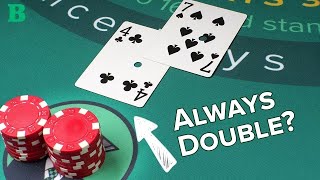
In face-up games, all cards are visible. In face-down games, you only see your own cards and sometimes a neighbor's. This makes accurate counting difficult.
The team trained players on face-up games and told them to 'figure out' face-down. One player, Mike, admitted he 'usually remembers' if he saw other players' cards, which is not reliable.
If you count a neighbor's card when you see it, then count it again when flipped, you double-count. In a double-deck game, this can make the true count off by 2-3, a horrendous mistake.
Count your own hand and dealer's upcard immediately. For all other player hands, count each card only when it is flipped over by the dealer and fully exposed, never to be face down again.
Example: Start with D2 (your hand + dealer). Player hits: D3, tucks: D3. You hit: D4, tuck: D4. Another player hits: D5, tuck: D5. When cards flip, count them: D4, D3, D2. Your own hand is not counted again.
Second round: Start D3. Player stays: D3. You hit and bust: D3. Another player hits and busts: count their hand (cancelling) → D3. Dealer flips: D2, D1. End of hand.
When a player splits or doubles, cards are flipped immediately. Count them at that moment. Example: Split hand: count flipped cards (0,1,2,1,1). Double: add flipped cards (1,2,3). Your hand: 5,6.
For double/single deck, learn to divide by half-deck increments. With half a deck left, true count = running count × 2. With 1.5 decks left, multiply by 2/3. Master this to maximize edge.
The key to accurate card counting in face-down blackjack is to count each card once and only once, by waiting until the dealer flips cards over. This system eliminates double-counting errors and ensures a reliable true count for betting decisions.
What is the main problem with counting cards in a face-down blackjack game?
You only see your own cards and sometimes a neighbor's, making it easy to double-count or miss cards.
00:40
What is the foolproof system for counting face-down games?
Count your own hand and dealer's upcard immediately, then count all other cards only when the dealer flips them over.
02:51
What error can occur if you count a neighbor's card when you first see it and again when flipped?
Double-counting, which can make the running count off by +3 and the true count off by 2-3 in a double-deck game.
01:35
How do you handle splits and doubles in the counting system?
Count the newly flipped cards immediately as they are exposed, since they will not be face down again.
05:07
How do you calculate true count with half a deck remaining?
True count = running count × 2 (since dividing by 0.5 is the same as multiplying by 2).
06:01
What is the true count if running count is 4 and 1.5 decks remain?
True count = 4 / 1.5 = 2.67 (approximately 2.7).
06:38
Double-Counting Disaster
Illustrates how a simple memory lapse can ruin the count by 2-3 true count points, a critical error in high-stakes play.
01:35Foolproof System Introduction
The core technique: count cards only when flipped, ensuring each card is counted exactly once.
02:51Half-Deck Division
Teaches a practical math skill to maximize edge in double/single deck games by dividing by half-deck increments.
06:01[00:01] Apprentichip. And it's one thing to count a game where all the cards are face up the entire time, but how do you keep an accurate count with a faceown blackjack tables? We just finished filming a couple dozen new videos, both
[00:15] improving old videos and adding two new videos for our paid video course. And asked me how to count a faceown game, I thought I would share the video we just recorded on how to count a faceown blackjack game. So, without any further
[00:28] ado, here's our video. [Music]
[00:40] and you're able to see your hand. In a face up game, you would see all the cards on the table. Well, here you only see your own cards and sometimes you're going to see the cards of the person next to you, and sometimes you're not.
[00:53] Let me back up and tell the story of how we dealt with this with the church team. flying around the country with as much as $100,000 playing blackjack. And when we trained players, we trained them at a
[01:06] face up game. And then we were like, "Oh yeah, you know, figure it out with with everything else." And we didn't actually train them. And I remember asking a guy on our team, Mike. I said, "Mike, how do you deal with a faceown game? How do you
[01:19] cards?" He said, "I can usually remember if I saw the other players cards or not, and I'll count them when I see them." And I said, "You can usually remember that is not good enough. Imagine that you count your own hand. You've got D1
[01:35] you count your own hand. You've got D1 and the dealer's card makes it D2. You see this guy's card. So, you go D1. You see their cards 01. And then it You see their cards 01. And then it plays out
[01:56] they flipped these over and you forgot they already counted these and you count they already counted these and you count them the other players cards again. them the other players cards again. In this scenario, you would have double
[02:09] counted these cards, meaning you're off on your running count by a running plus three. In a double deck game, that means that your true count is off by a true left, your true count's off by a true two. If there's a deck left, your true
[02:25] count is off by a true three. That is a horrendous mistake to have the running count or the true count off that much. When I discovered that players on our When I discovered that players on our team are playing with six figures and
[02:38] players cards or not, I thought we need a foolproof system. Just like we have it with the face up game, we need a way to count the cards once and only once all the time. Follow that same procedure every single hand of double deck. And
[02:51] that's when we started one testing out our players at double deck specifically the count perfectly, but secondly showing them, hey, here's the way that whether you use this way or another way, I don't care. You just need a foolproof
[03:05] count. But this is the way I recommend it. What we're going to do is count cards. We're going to count our own hand and the dealer's card. And then every player's hand or a face up card, we're going to count it only when it's flipped
[03:19] over and fully exposed, never to be face down again. So in this situation, we look at our hand, we got D1, and with the dealers's card, we've got D2. And this guy, even if you see these two
[03:35] So we're saying D2, he's going to take a hit. D3, he tucks his cards. We're going to take a hit. D4. Tuck our cards.
[03:49] Even if you see this guy's cards, you're not going to count them. He takes a hit. D5. Tuck. D4. D5. At this point, cards are going to
[04:04] get flipped over, and we'll count them. D4. D3. This was our own hand, so we don't count it again. And D2, count the cards once and only once by waiting till the cards are
[04:18] flipped over by the dealer to count them outside of our own cards and the dealer's hand. So, just for practice, let's do another round. We had D2 at the end of that first round. I'm just going to deal it out.
[04:34] So D3, we've got cancelling a neutral hand. So we're at D3. This guy is going to stay. We're going to take a hit. We bust. Still at D3.
[04:50] This guy takes a hit. Busts. Now we're going to count their hand. And it's a cancelling. So we're still at D3. And then D2. still at D3. And then D2. D1
[05:07] the hand is all done. Let me show you an example. So, we still had that D2. hand cancels. So, we're at D1. This player wants to split. So, it's getting
[05:22] flipped over. So, we're going to count this now. 0 one two one one and then this guy it's going to have
[05:35] flip his over because he wants to double. So we add one, two, three,
[05:47] This was our hand. Still five. And six. That's the way to count when the cards get flipped and are not going to be face down. Again, now we got a six. We got like a true four. Throw those bets out there. Make the
[06:01] going to be playing a lot of double deck or even single deck is to learn how to divide by half deck increments rather than just dividing by full deck amounts. We can already divide by two and one. So that means adding to our game dividing
[06:14] you get good enough deck penetration dividing by half a deck. Well half a deck is actually really easy because with half a deck left your troop count is just going to be double your running
[06:26] if you take a number, divide it by a half, you actually take that number in So if you have a running four, you have a true eight with half a deck left.
[06:38] Running two, you have a true four with half a deck left. So really, when you learn how to divide by a deck and a half. That just takes a little practice a deck and a half. One and a half, three, four and 1/2, six, 7 and 1/2,
[06:52] nine, and so on. Take the time to master divide accurately by half deck amounts so that you can maximize your edge. Make disadvantage by getting off on your rank count and your true count and beating
[07:05] those double deck games. Hopefully that was helpful. As I said, this is part of our paid video course that comes with our membership along with training drills, betting software, a casino database, members forum, a bunch of
[07:17] carding, you can check all that out at blackjackapprenip.com.
⚡ Saved you 0h 07m reading this? Transcribe any YouTube video for free — no signup needed.