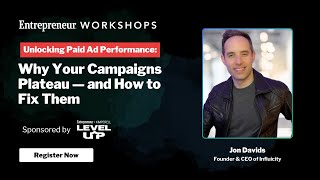

Why Your Ads Are Failing
45sDirectly addresses a common pain point for entrepreneurs, creating instant relatability and curiosity.
▶ Play Clip"Title promises to fix broken ad campaigns, and the video delivers a detailed, actionable framework—no fluff."
In this webinar, Entrepreneur Magazine's editor-in-chief Jason Feifer and paid ads expert John Davids (founder of Influicity) reveal why most paid marketing campaigns fail and how to fix them. They break down three core pillars: identifying the right audience, crafting scroll-stopping creative, and making an irresistible offer. The session is packed with actionable tactics, real-world examples, and classic infomercial wisdom to help entrepreneurs turn ad spend into real revenue.
Many entrepreneurs pour money into digital ads but see poor results because they focus on vanity metrics (clicks, likes) instead of ROAS, CAC, and LTV. The real goal is profitable conversions.
Generic headlines attract everyone but convert no one. Example: 'Get glowing skin' vs. 'Tried five serums and still breaking out? This formula is for adult acne.' The latter speaks to a frustrated buyer and repels casual browsers.
Use lead magnets (e.g., free downloads) with qualifying questions (e.g., 'How many sq ft do you manage?') to tag users in your CRM. Build lookalike audiences from this data for highly targeted ads.
Use movement, contrast, curiosity, humor, or shock to interrupt the scroll. Avoid boring openers like 'Hi, my name is...' or 'Over the last 35 years...'.
Dramatic, Entertaining, Memorable, Optical. Even boring products (e.g., Flex Tape, Ab Flex) can be made compelling by showing extreme use cases (cutting a boat in half, smashing cinder blocks on abs).
People don't buy products; they buy outcomes. Use the 'so that' framework: '24/7 support so you never wait for help.' Focus on the benefit, not the feature.
Show multiple use cases to attract different avatars. Example: A food dehydrator can be for gardeners (herbs), parents (healthy snacks), or cereal lovers (dried strawberries).
Use authentic-looking testimonials (screenshots from WhatsApp/Slack), waitlists (like Rolex), or create the illusion of demand ('Operators are standing by') to show others want your product.
To fix underperforming paid ads, entrepreneurs must get hyper-specific with targeting, create creative that hooks within three seconds, and craft offers that sell outcomes—not features. Mastering these three pillars will turn ad spend into profitable customer acquisition.
What does ROAS stand for?
Return on Advertising Spend
02:00
What does CAC stand for?
Customer Acquisition Cost
02:00
What does LTV stand for?
Lifetime Value
02:00
What is the first tactic for identifying the right audience?
Use creative and copy to attract the right people and repel the wrong ones by being specific about the problem.
05:00
What is the second tactic for audience targeting?
Let customers identify themselves by using lead magnets with qualifying questions, then build lookalike audiences.
10:00
What should you focus on in the first three seconds of a video ad?
Use movement, contrast, curiosity, disbelief, humor, shock value, or surprise to interrupt the scroll.
15:00
What does the DEMO framework stand for?
Dramatic, Entertaining, Memorable, Optical
20:00
What is the key principle when crafting an offer?
People don't buy products; they buy outcomes. Focus on the 'why' not the 'what'.
25:00
What is the 'so that' framework?
State a feature followed by 'so that' and the benefit. Example: '24/7 support so you never wait for help.'
25:00
Why should you list multiple use cases for your product?
To appeal to different customer segments (e.g., gardeners, parents, cereal lovers for a food dehydrator).
30:00
Name three ways to add social proof to an offer.
Testimonials (authentic-looking), waitlists, and creating the illusion of a crowd (e.g., 'Operators are standing by').
35:00
What is the purpose of a waitlist like Rolex's?
It proves that other people want the product, increasing desire and perceived value.
35:00
Specificity in Headlines
Shows how a simple headline rewrite can dramatically improve ad targeting by attracting the right audience and repelling the wrong one.
05:00Let Customers Identify Themselves
Introduces a scalable, data-driven method for audience targeting using lead magnets and lookalike audiences.
10:00First Three Seconds Rule
Emphasizes the critical importance of immediate engagement in a fast-scrolling environment.
15:00DEMO Framework for Boring Products
Provides a memorable framework to make any product interesting using dramatic, entertaining, memorable, and optical demonstrations.
20:00Sell Outcomes, Not Products
Reinforces a core direct-response principle that transforms feature-focused messaging into benefit-driven offers.
25:00[00:00] perfect as well as adding her own dried apples Are your paid marketing campaigns stuck? You're spending lots of money, you're just not seeing the results, and you cannot figure out what is going wrong. And this is incredibly frustrating, of course, because you could spend endless amounts of money just pouring it into digital advertising, and you aren't sure why people aren't watching or looking and why they aren't clicking and buying. And that is what we are going
[00:25] to address today because it is likely that you are missing some very core fundamental things which in the next 30 minutes we are going to help you uncover. My name is Jason Fiverr. I am the editor-in-chief of Entrepreneur Magazine, and I am delighted to be joined here today by the guy who has the answers. His name is John Davids. He is the founder and CEO of InFluicity. And John, why don't you, first of all, welcome. Can
[00:50] you tell us a little bit about yourself and InFluicity and the expertise that you bring to this subject? Yeah, Jason, thanks for having me and wow, great day and I'm so happy to be here. So people might know me, you might have seen me on the Instagram for entrepreneur, I'm the guy with the purple wall behind me on a lot of those reels. And during the day, I'm the founder and CEO of Influicity. We help a
[01:15] lot of companies make a lot more money by selling more things to more people, to put it simply. And one of the big ways we do that is through paid ads, Google, Facebook, TikTok. and the like. And so a lot of the stuff we're gonna talk about today is stuff that me and my team do all the time. It's a daily habit for us and so I'm excited to share some inside secrets from how to do
[01:40] the paid advertising thing. - Perfect, so helpful because John, people are just throwing cash at the internet, aren't they? And they're just not seeing the results that they should. They're throwing cash and the problem is that that cash can run out pretty quick, especially when you're setting budgets on Facebook and on Google. You'll see a lot of metrics like, "Hey, we're getting clicks and we're getting likes," and all these kinds of things. But unless it boils
[02:04] down to a ROAS and a CAC and an LTV that makes sense, it's not worth anything. Some of the stuff we'll get into today is how to know if you're getting a whole bunch of feel-good metrics that don't actually deliver the dollars. Right. And you threw out some acronyms there just for folks who are maybe newer to digital spend. ROAS, return on advertising spend. CAC, which is consumer acquisition cost. Am I right about that? I always
[02:29] stumble on CAC. CAC's a hard one. People think the first C is cost. It's customer acquisition cost. Yeah, right. And what was the third one you used there? LTV, lifetime value. Lifetime value, right. So, okay, John, what you are going to walk us through are three pillars, which are how to identify and target the right audience, how to craft creative that stops the scroll. And then number three, how to make an offer so compelling that people
[02:54] cannot help but click and And boy, by the end of this session, if people have their heads around that, folks watching at home who you have the chance during this talk to ask us questions, let's get you the answers that you need from John. You can always do that in the chat. Then if people really understand their audience and how to craft that right creative and make the right offer so that people actually convert, what a
[03:19] game changer that is. Before we get to that though, John, let's talk about something really exciting, something that is bigger than just this conversation, something that's really almost like stepping into the world of this conversation. And that is that on August 22nd and 23rd in Las Vegas, Entrepreneur is hosting an incredible conference called Level Up. Level Up is designed to do exactly what the name suggests. It is all about helping you grow your business by giving
[03:44] you access to incredible experts who are there in the room with you, driving conversation, driving revelations, driving tactical knowledge. And we've got incredible people on this stage here. We've got some folks who actually I'm privileged to call friends. John Taffer from Bar Rescue, Marcus Limonis from The Profit and now The Fixer on Fox, Cody Sanchez from Contrarian Thinking. It is Kim Perel, nine-time founder with an incredible most recent exit of $235 million, friend of the brand
[04:09] and entrepreneur. and more, you can see everybody at entrepreneurlevelup.com, entrepreneurlevelup.com. And this is happening August 22nd and 23rd. We're really excited to have folks there. Anybody who's watching now, if you want to be not just watching a webinar, but instead be in the room where magic is really happening, that's where to go. John, I'm curious, you know, I'm sure you've gone to a lot of events and maybe as you were building your own business, how valuable
[04:34] did you find it to be going out to something live and connecting with folks in your industry facing similar challenges to you? Priceless. It's kind of funny. I was thinking about this the other day. So many of the big breakthroughs that we had in the early days, whether it was finding clients or co-founders or investors, it always happens at some kind of conference or a run-in that you have at an industry event where someone that you
[04:59] didn't know existed is introduced to you by someone that you just met five minutes earlier. You build rapport really quickly and you're able to just kind of break down the walls that we have. You email someone, they don't respond. You call them, they don't answer. But you're at a conference and everyone is just kind of on the same level. Everyone has their guard down. So for me, it's been incredibly productive over the years and I know
[05:24] you guys throw the best events. So this is going to be a good one. Yeah, this is going to be really great. I'm really excited about this and just the caliber of people that we're going to have on that stage and in that room is just really off the charts. So I'm very excited about it. And what else? I just want to make sure that people know all about it. So if you go there into the
[05:49] chat right now, you'll see a link to entrepreneurlevelup.com. And as an attendee of this webinar, you can book your VIP ticket for $300, which is a pretty amazing deal. So you come, you get to meet folks, just like John, you're saying you come to that event and you know what it really does to me, and this is how I think about it, is that it creates a permission to to connect. You made this really nice point
[06:13] about how everybody's reachable in some way. I can send a DM to literally anybody on LinkedIn. Doesn't mean that they're going to respond. Doesn't mean that they're even going to see it. And oftentimes, I think that when we're all separated by a digital divide, we don't feel like we have the permission to reach out to somebody. Oh, am I allowed to reach out to them? Are they going to respond? And if you get a random message
[06:38] from someone, you might think, ah, who's this person? They don't have the right to reach out to me and ask me for for coffee or something. But when you go to an event together, then that permission is already kind of granted and corrected. And that I think is just an incredibly powerful thing to be part of a shared experience where you have the time and the space to really connect and grow. Yeah, yeah. I mean, I
[07:03] think it's gonna be a good one. You guys have some phenomenal guests, too. I mean, these are people that are really kind of the educators and they're doing a whole lot of work. You know, Marcus Lamone, this is someone I've known for a long time. Cody, of course, is fantastic. So a lot of fresh ideas. And I'm sure there's gonna be a lot of people there that, you know, we can all do business with. Yeah. And
[07:28] by the way, my apologies. I read something off of the chat a little incorrectly. As an attendee of the webinar, you can get $300 off your VIP ticket. So anyway, again, that is entrepreneur.com. I'm sorry. I always say entrepreneur.com because that's where the site is. So this keeps throwing me off. Entrepreneurlevelup.com is where you want to go. Okay, John, let's get into these three main... major points that you want everybody to understand if they want to
[07:53] improve their ad spend and their digital marketing efforts and that is how to identify and target the right audience how to craft creative that stops the scroll and how to make an offer so compelling that people can't help but click I'm really excited to see you dive into these and I know that you've got a lot to share so we'll go through it one by one but why don't we just start right there at the top
[08:18] how do I identify and target the right audience what do we need to know about that and what are entrepreneurs generally missing yeah well there's there's a lot to get into here you're seeing my screen Jason uh yes I am okay fantastic so How to identify and target the right audiences is probably the most important thing to do if you're actually going to spend money advertising, putting your budgets towards whatever it is, Facebook, Google, your platform
[08:43] of choice. You really need to make sure that you're reaching the right people because you can very quickly try to boil the ocean and reach everybody. What you're doing is you're getting a lot of really nice metrics on the top, but you're not actually accomplishing very much. The first point, the first thing I want to get into here, and I want to cut right to the best tactics, the most dangerous tactics that we use. So number
[09:08] one would be to use creative and copy to attract the right people and just as importantly, repel the wrong people. And so here are some things that we look for. We always look to get more specific with exactly what we're talking about. So most people in their creative or their copywriting, they'll focus on the what. It's like, what are we talking about? Usually it's the product. But the better you can get specific, the better you'll do
[09:33] at targeting the right people and repelling the wrong people. So thinking about who this is for, how they're going to use this product, why they need this product. Where they might get this product and so I'll give you some examples of like good headline bad headline when you're thinking about Copywriting for that ad so let's say we're selling a skin serum some not specific headlines or a headline That's not specific that's going to attract a lot
[09:58] of clicks but probably not the right audience might be something like get glowing skin with our all-natural serum and Now, the problem here is that you've got a headline that appeals to everyone, teenagers, casual shoppers, skincare junkies, deal hunters, basically anybody who has skin and might want to take care of it would click on that ad. It'll give you a metric that looks like, "Oh, I'm getting lots of clicks," but you're not getting any conversions. A
[10:22] lot of low quality that won't convert. If you switch it to something like tried five serums and still breaking out, this formula is made for adult acne. Now, look at how many things we're doing there. We're speaking directly to a frustrated buyer who has tried other products because we've said, have you tried five serums? And they're looking for a better product that's actually going to get them results. And we're repelling the casual browser who's just looking
[10:47] for a generic glow up because we're saying this formula is made for adult activity. So if we think back to that checklist before, every word in this headline is doing a job beyond just that high level what. We're getting into the why, the how, the timeline, the where. So there's a lot more here. Does that make sense, Jason? - Yeah, that's really fantastic. I love this example. And something that really jumps out to me, John, is,
[11:12] how the specific cell is oriented around a problem that the consumer is already thinking about. Whereas the not specific cell is really oriented around what you might think of as the solution as the person who created the product might be thinking about it. Like if I made the skin serum, I might think, Well, I want to create something that helps people's skin glow, but I'm not sure that your actual buyer wakes up in the morning thinking,
[11:37] you know what I want is for my skin to glow. What I want instead, when I wake up in the morning is for something to damn work already because I've tried five different serums and none of them work and will somebody please make something that works and you are targeting that specific frustration in the way that they are articulating it to themselves and when people see their own language and their own thoughts reflected back to them
[12:02] they think that's a brand that gets it Right, right. And we're targeting a problem here, which is not just you want nicer skin, but you want to defeat, let's say, adult acne. I'll give you one more example that's actually, it takes it a step further. So let's say this is for a toy delivery service. A headline that you might use is something like, fun educational toys delivered to your door. which isn't bad because we're saying that
[12:27] they're fun they're educational and they're delivered to your door so we're getting a few points there the problem here again is that it's relatively generic because is this toys for newborns is it toys for eight-year-olds for adults for teenagers it competes with every other toy ad and so what's going to happen is you're going to attract bargain hunters toy lovers parents grandparents teachers and And so if we look at this at how we would do it,
[12:52] getting more specific, we might say something like too much screen time. These play kits are designed by child psychologists to boost brain growth, no batteries needed. Now watch how much we did there. So, number one, we've called out a parental guilt, which is screen time. And if you're a parent, you know, I've got two young kids. We all think every time we hand them the iPad, we think, "Oh, God, should I be doing this?" Right? They're
[13:17] going to watch more YouTube Kids. So, we've got that, the guilt covered there. We offer a benefit, we're saying brain development, so we're talking about hands-on play, and we're signaling something premium by referencing child psychologists. So the reason I show these two side by side is not because one is bad and one is good. One is good and one is way, way better. And so when you get more specific, your advertising will get that much more
[13:42] effective. I really love that great example. It reminds me of something that comes out of Donald Miller's book, Building a Story Brand, which is that he says every consumer is looking for one of two things or both, which is to survive or to thrive. And so if you can speak to their desire to survive a challenging situation, to, you know, blossom under difficult circumstances or to thrive, then you've got their emotional attention and you can drive
[14:06] them towards a conversion. And when you think about that and you apply it to fun educational toys delivered to your door, it doesn't exactly tell me how to survive or thrive, But too much screen time, yes, okay, that's a problem. That's a problem for me as a parent. I feel like it's a problem for my child. I have two kids, 10 and six, so I know that problem very intimately. And then these play kits are designed
[14:31] by child psychologists to boost brain growth. Now we're really talking about thriving. So right there is those two emotional triggers that are really gonna drive interest. Yeah, you nailed it. You nailed it. I've got a four and a six-year-old, so I'm right behind you, but I feel the same way. So that's kind of point number one. Point number two I would make on this, how to identify, target the right audiences, is actually don't identify them, let
[14:56] them identify you. And this is a really simple but super effective tactic you can use as your business grows. So this isn't a day one tactic. This is more of a year two, year three, year four tactic. Over time, you want to develop these little lead magnets and it could be anything. I mean, we have so, so many that we use at Influicity, but for your business, you know, these are just different client examples. A commercial
[15:21] real estate brokerage might have something that they're offering and behind the form when you want to download that item, you ask, "Hey, how many square feet do you manage and when are you looking to buy or sell next?" A house cleaning service might ask, "What size is your home? Do you currently have a home cleaning service?" An event planner might ask, "How many events do you hold a year? How many people attend?" An art gallery asks,
[15:46] "Do you currently collect art?" These are all real forms, by the way, that we've built over the years. What this does is it lets you in your CRM, whatever you're using, HubSpot, Salesforce, et cetera, you can then tag these people and attach that to your Facebook pixel or your Google Pixel and now you're targeting people and you're able to build lookalike lists not by guessing. So whereas in the first example, we're sort of putting something out
[16:11] there and trying to bring people in who fit the bill here. We already know you fit the bill. We already know that you are exactly who we want to target and we're basically just getting the data. We're giving you something free in return and then we're going to build lists. We have lists for clients that are literally thousands and thousands of people and through lookalike audiences, now you've got a real scalable program. So I would encourage
[16:36] people to try to do these little efforts to bring in data about who's visiting their site and then use that in your paid ads. Yeah, I am shocked by how many founders don't actually know that much about their consumer. What exactly are they looking for? What exactly are the problems that they solve? And some data about exactly who you're reaching out to. So I really love you prompting here to be gathering those insights that you can
[17:01] then use to more specifically target the consumer that you actually want. It's so simple and the value of this, like I said, after a couple years of doing it, you're going to go, "Holy crap, I've got a database here of all these buyers and it makes a big difference." That's the first section. Can I move on to section two? You do. Yeah. So this is how to craft creative that stops the scroll, hooks attention, and speaks
[17:26] directly to your customer's pain point. So the first thing I want to talk about, which is probably something we've all heard before but I feel like it's worth mentioning again, is you've got to focus on those first three seconds, whether it's a video, a reel, a written piece of content, whatever it is. So how do you get people's attention fast? Through tactics like if you're talking about a video, it's movement, it's contrast, it's curiosity, it's disbelief.
[17:51] It's humor. It's shock value. It's doing these things. Surprise is the last one there. It's doing these things right off the bat that interrupts what they're doing. You know, the scroll, like their thumb wants to keep on moving down the feed, right? Their eyes want to keep on browsing down the page, but you've got to do something that gets their attention fast. So that's what works. What do we see way too often? And, you know, people
[18:15] think that this works and it just never does. Lines like, hi, my name is... Like, I don't care what your name is. Over the last 35 years, our company blah, blah, blah. Let me tell you about our service. Thanks for taking a moment to watch. Here at Acme, we're passionate about-- like, these things work in a world where you're dealing with analog, one thing at a time type activities. These days, people are scrolling and watching and
[18:40] walking and washing the dishes at the same time, and you really need to interrupt them in a way that captures their attention because they don't care about you at all, right? They care about themselves. So that's the first three seconds. And then the next thing I'll say is how do you actually keep them? So this is actually a really simple framework that I came up with a few years ago. It's called the demo framework. So it's
[19:05] dramatic, entertaining, memorable, and optical. Dramatic, entertaining, memorable, and optical. And this is how you take a product, doesn't matter how boring it is, and I'm going to show you in a second some super boring products, and you make them interesting enough that people want to watch. So a lot of my sort of learning around this type of advertising, Jason, came from 90s infomercials. Did you ever watch 90s infomercials? Sure, all the time. All the time. All
[19:30] the time. Well, you know, I was a kid of the 90s, and they were on a lot, and... And there would be these long, long pitches. People don't appreciate this now. I mean, these things could go on for 30 minutes or an hour. They're long, long pitches. And yet, as I look back on it, I find that I was strangely compelled by them. They held me. And part of the reason for that was because I think
[19:55] that they were always hinting that something interesting was coming next. in the way that great marketing language, one line always sets up the next. Every second of those things were really crafted to constantly pull me in and have me wonder what's going to happen next. Yeah, it's so true. So this is this was a classic. This is called the Flex Tape. And this might have been early 2000s. So it's literally just tape that you put on
[20:20] things to seal it like you can't be a more boring product. Now I'm going to show you in four screenshots. I'm not going to play the video. But in four screenshots, I'm going to show you how they demoed how they actually showed this product in the infomercial. So you had a guy who picked up this like saw whatever that, you know, that, that cutting device, whatever you call it. Then in frame two, he literally cut a
[20:45] big steel boat in half and this thing falls to the ground frame three is him applying the tape and he's doing this all fast and there's music and there's talking. And the fourth frame here is he's on that boat on the water and he's riding it like a maniac. And they showed this and this. So this for these four screens, you can you can see the story they're telling. And all they're showing you is, hey, watch
[21:10] how strong this tape is. But imagine how boring this would have been if he had just like taken some drywall, applied some tape and said, look, you know, the rain won't get in now. Who cares? You've got to show it in a way that is, again, dramatic. Yes. Check. And Entertaining? Yeah, for sure entertaining. Memorable? I remember this decades later. And optical? It's a very visual way of showing how this product works and the benefit that
[21:35] it serves. So this is an example of a dramatic explanation of a demo of a boring product. I'll give you one more here. this is a classic this is an all-time classic this is the ab flex which was the best-selling workout fitness device for like a decade basically helped you help to get stronger abs and so with this one in the infomercial they would put these cinder blocks on somebody's abs they would take a sledgehammer and
[21:59] they would have people off to the side you know like they can't even look it looks so terrible and they would smash the guy's abs and again Dramatic, entertaining, memorable, optical. So the reason I share these examples is to show you, A, this has been happening for decades and decades since the beginning of direct response advertising. And you've got to think of interesting ways to show your product that's not an everyday use. You've got to do
[22:24] it in a way that's kind of over the top. Yeah, you know what it reminds me of? I was just recently having a conversation with the head of marketing for Liquid Death, which does digital advertising perhaps better than anybody else, certainly in the CPG space these days. And he said, his name is Dan, Dan said that he... thinks of not just him but the entire organization thinks of liquid death as a entertainment first brand and i
[22:49] think that's really interesting framing his argument is look in a older media environment you had a lot more time with people but now everybody is in control of what they see and so if they don't like what they see they can flip off of it instantly and therefore you have to have to be entertaining because that is the only thing people won't skip. They will skip everything else, but they will not skip entertainment. Now, Liquid Death,
[23:14] their entertainment is comedy, but you don't have to be comedy. You could be informative. There's all sorts of ways that you could do it. You could play to the specific interests of your target audience in the way that Red Bull plays to extreme sports, for example. But whatever it is, if you do not have engaging people at the very top of your activity list, then they are going to skip you before you even get to tell
[23:39] them what you're all about. It's so true. Educate, entertain, or inspire, maybe all three, but at least one of them. And if you can't do that, you're not getting anyone's attention, and you're certainly not going to hold it for any amount of time. Right. So I'll get to the last point, if you'd like, the offer, which, of course, is so important. Yeah. So how to make an offer so compelling people can't help but click, and how
[24:04] to actually deliver on that promise. There's been a lot of talk about offers over the last number of years and truth is, offers, they come from direct response advertising. There's a book that was written about 100 years ago called Scientific Advertising by Claude Hopkins where Claude Hopkins says, "Advertising is salesmanship in print." This was sort of the birth of what is now modern day direct response advertising. And the reason we think about offers in direct response
[24:29] so closely is because an offer is really just a way to compel someone to take action right now. If you are running brand advertising or trying to create awareness or whatever, this wouldn't be as important. But if you're actually trying to drive sales from every dollar spent on advertising, you have to get the offer right. And so the way we think about this, there's lots of frameworks to think about it. I'll talk about one or two
[24:54] things that I think people get wrong quite often. So number one, people don't buy products, they buy outcomes. And a quick tip when you're actually framing this, thinking about your business is focus on the why, not the what. And so how I would think about that is like, if you think about a product and a feature that you offer, you might think, okay, well, at my company, we offer customers 24/7 support. But what that actually means
[25:19] to the customer is so you never need to wait for help when something breaks. So literally just using that framework of this is the thing so that Fill in the blanks. And it's the fill in the blank, it's the second piece that people actually care about. So when you're crafting your offers, again, whether it's video or written or whatever, you've got to think in these terms. I sell a stainless steel water bottle. Nobody cares. What do
[25:44] they care about? So you can keep drinks hot or cold for the whole day. We offer 500 gigabytes of cloud storage when you buy our software. So you can access your files anytime, anywhere. Waterproof jackets. So you can stay dry in the rain and people see this and they think, yeah, but this is obvious. Like I have a waterproof jacket so that I can stay dry in the rain, but it's not obvious to the customer. It's
[26:08] obvious to you. The customer isn't giving you the time of day. So you need to actually make it super obvious to them what the benefit or the outcome is of the thing that you're trying to sell them. So that's kind of the first piece. And the second piece here, which is just to kind of put this on overdrive, is to get into the use cases. And so I'm going to go back to an example, to another
[26:33] infomercial example, because this is one of the classics. Sorry, John, I think we lost the screen share. Did you? Let me bring that back for you. While you're figuring that out, I'll just say that what you just said there is so important about the benefit and outcome. It reminds me of a great framework from the jobs to be done framework. I think framework is the right word for that. Anyway, it was this kind of Mad Libs
[26:58] that you should be able to articulate from the point of view of your consumer, which is when context, I want solutions so that benefit. When something happens, I want something to solve that problem so that I get the thing that I actually want. And so the problem, and you gave some really great examples of that. The one I always like to give is that if we were selling zit cream to teenagers, then it would be, you
[27:23] know, when I have a big zit on my forehead, I want something that can make that go away as fast as possible so that I can go to school more confidently. And the reason to do this is because most people stop at solution. We talk about our solution. We pitch our solution because we built our solution and we're selling our solution, but nobody cares about solution. What they care about is benefit. So if you spend all
[27:48] your time talking about the chemicals in your Zik cream to the teenagers, you've totally lost them. But if you talk about getting to school more confidently and they see that you understand that, and then you've hooked them emotionally then they're interested in your solution and so that's how you focus on this on the solution of the and the benefit in the outcome which is so critical which is what you were talking about instead of harping on
[28:13] the solution which is not actually what anybody cares about I love that Madlibs framework. I'm going to take that. That's so good. So the example I give here is like this is a product. You see my screen okay now, Jason? Yes. Okay. So this is a product. This is a food dehydrator. So you use it, you put fruits, vegetables, whatever you want, and it dehydrates your food so you can get dried fruit in this case. And
[28:38] in this infomercial, which you can go to YouTube and watch, it's one of the classics, what you'll notice is that there's like a four-minute block where the host, the inventor of the product, is actually talking about all the things that you can dehydrate. And so he'll literally say, you can dry strawberries for your yogurt or for your cereal. You can use dried herbs and spices on your pasta. You can make your own healthy banana chips. Notice
[29:03] he's throwing the word healthy in there because he was trying to push people who wanted to eat healthy, which was very big at the time and still big now. Here's another thing he'd say. Apple snacks instead of candy. So right there, he's subliminally talking to parents who don't want their kids eating more candy. So he said apple snacks instead of candy. Dry herbs and spices from your garden. So right there, he's identifying another avatar, a gardener.
[29:28] So in this case, if you just saw on the shelf a food dehydrator machine, you probably wouldn't think, oh, well, what am I going to dehydrate? Well, if I'm a gardener, I have herbs. If I like pasta, I can do that. If I like eating cereal. So getting into the use cases is so important because people are not going to think about all the things that they will use your product for unless you tell it to
[29:53] them and make it really simple. So use cases are a really important thing to do. And then I've got one more point here to wrap it up. And that really is the last point is social proof. Because one of the things we need to have when we're doing an offer is we have to have, we have to show people that they're not the only ones who want this thing. 'Cause we have doubt, we wanna follow other
[30:17] people. So three ways to do it super quick. Number one is obviously testimonials. If you have testimonials, use them and try to make them as authentic looking as you can. So snap the screenshot from the WhatsApp thread, snapshot the email, the Slack, whatever it is. It doesn't have to be pretty looking. It has to be real looking. So these are some real testimonials that we use because we like how they look. We're trying to make them
[30:42] look authentic. Another one, I just did a YouTube video on this. I talked about Rolex and the wait list that they have. And so Rolex has this very famous wait list. If you want to buy a Rolex, you've got to wait. And the wait list accomplishes two things. Yes, it's inventory control, but more importantly, it's proof that other people also want the watch. So a wait list is a great way to do it. And the last
[31:07] one, maybe the most simple, is just to create the illusion of a crowd. So if you remember, if you ever watched a commercial where they're selling something, one of those short commercials or a long infomercial, they'll use the line, operators are standing by. If lines are busy, please call again. The reason they put that in there was not because lines were ever busy. It's because they wanted you to know that other people were calling also. And
[31:32] so by saying if lines are busy, please call again. They're implying, hey, you might not even get through. We have so much demand. And so you can even just put a line in your in your ad. We've done this. That says, like, hey, if you can't order it, put your name here and we'll we'll let you know when the products are back in stock. Even if we have lots of products ready to sell by giving the
[31:57] illusion of demand, you're getting people to want it more. And that's how you make an offer that's compelling that people will actually want to click on. I love that. Just to add to both, just very briefly, so the use cases thing, I thought was really great and reminds me, I should have also given a shout out to my friend, Rochelle DeVoe, who does consumer research and was the one who introduced me to that Mad Libs that
[32:22] you just took there. So anyway, thanks, Rochelle, for that. But what Rochelle does is consumer research, understanding consumers and specifically what they're looking for so that you can then build that into your marketing. And what I was seeing with the use cases that you were giving examples of, John, was understanding of who the product is for and what people tend to do with that product. So before people were selling that dehydrator on TV, what they surely
[32:47] did was a lot of research about exactly how who would buy it and exactly what they would most like to do with it so that you can then identify that target audience and then in a way actually, interestingly create a kind of lookalike audience but on TV as they were doing in the infomercials, which is to say, well, okay, we know that a bunch of our audience is using the apples and they're drying them because they
[33:12] don't like that their kids are having so much candy. So why don't we talk about that and it'll reach other people who have the exact same problem. And the point there is the more that you know about your consumer, the more in which you can target them directly with the exact kinds of things that they're thinking about and concerned about. It's so true. If you don't know who you're selling to, then good luck. You're not going
[33:37] to have a very easy time. Whereas the opposite is if you know exactly who you're selling to, you'll be able to over deliver so much and give them so much value that they'll come back every time. Yeah. That's really great. Well, speaking of delivering so much value, let me just remind folks one more time about this incredible event that we're hosting in Las Vegas on August 22nd and 23rd. And I have a feeling that you're about
[34:01] to see some visual about it. So here it comes. So at Level Up, August 22nd and 23rd, you get the chance to see so many incredible entrepreneurs in action. Here are four of them. We've got Robert. I cannot believe. believe I forgot to talk about Robert from Shark Tank. Oh my God, I didn't mention him at the top of the program, but I'm glad that I got to him here. Robert Herjavec from Shark Tank is going
[34:26] to be there. We're so excited to be hearing from him, as well as Marcus Limonis, John Taffer, Kim Perel, and so many more the number one entrepreneur event to propel your growth and set you apart as it says right there but i'm not just reading it off of the slide i'm telling you because it's true because if you want to grow your business you need to be among people who are doing exactly what you are doing
[34:51] facing the exact challenges that you are facing and hearing from the folks who see it all And that is the thing that I'm really excited about with Robert, Marcus, John, Kim, so many of the other incredible entrepreneurs and leaders who are going to be on stage is how these are really John, they're pattern matchers. Robert has invested in who knows how many businesses and built, he's one of the world's leading cybersecurity experts, which nobody even knows.
[35:16] They just know him as the Shark Tank guy. Marcus has built and scaled so many businesses, Camping World, he's the chairman or executive chairman, I apologize if I forget which one it is of Beyond right now. John Taffer, who built a thriving hospitality consulting business. Perel has built nine of them, nine of them. These are people who are pattern matchers, who see what it takes to actually grow, who understand how to dissect business at a real
[35:41] granular level and then build back up better and stronger. And those are the kinds of people that you don't get a chance to talk to all that often, if ever, but they're all going to be on the same stage in August. I'm really excited. You said that you've had some experience with some of those folks, maybe Marcus, you had mentioned. What comes to mind as you see this group? i mean you guys got a hell of
[36:06] a lineup here so marcus is one of the i mean he's inspired me i've gotten to know him a bit personally as well robert as well uh he's a from from toronto grew up just down the street from from where i grew up so uh yeah i mean these these people are at the top of their game and what i like is also you have an eclectic mix you're mentioning you know robert is a phenomenal uh
[36:31] technical mind, like, you know, came from cybersecurity. Marcus is, if you guys have ever watched, you know, his show, The Profit. I mean, he really, really brings lessons and insights to business that you don't find anywhere else. So these are not people that just, you know, play gurus on YouTube. They've actually done it. They've built things. And so having this kind of lineup is really special. And I think they're going to bring a ton of value
[36:56] to whoever comes to this conference. Yeah, without question. Incredible. I've seen Marcus. I'm really looking forward to meeting Robert of the four. That's the only one I haven't met yet. But I've seen the other three live and in person, in personal conversations, just break down a business problem and understand exactly where something is going wrong in its own. only something you can do if you have done it so many times before and you have have have
[37:21] seen so many failures seen so many sex successes and understand uh what really builds great businesses so if you want to join us i'm going to be there i am really excited to see all of you at level up in august uh all you got to do is well there are many ways to do it you can either click the link that's in the chat right now um you could scan that qr code you could just
[37:46] go to entrepreneurlevelup.com whatever it is you want to do and if you use that code that you see right there ads3 you get a VIP ticket at the general admission price, which is pretty awesome. So, John, let us review one more time what we have learned today, which is that if your ads are not converting, then it's time to look at three important things. How to identify and target the right audience, how to craft creative, it
[38:10] stops the scroll, how to make an offer so compelling that people can't help but click. John, you are the founder and CEO of Influicity. How can people get a hold of you if they want to learn more? Well, head over to JohnDavids.com, get on the newsletter for the most value. Of course, follow across social media, Instagram, YouTube, Facebook, I'm everywhere. And I also do a podcast, Making It With John Davids, which is usually at the top
[38:35] of the charts in marketing and business. So if you want to hear me in your ear once a week, tune into Making It With John Davids. Amazing. Well, John David, this has been so informative. Really appreciate your time, your energy, your enthusiasm, and your insights. And for everyone who has joined us, I hope that you learned a lot. Have a great day and hope to see you in Vegas in August. Thanks, Jason.

⚡ Saved you 0h 38m reading this? Transcribe any YouTube video for free — no signup needed.