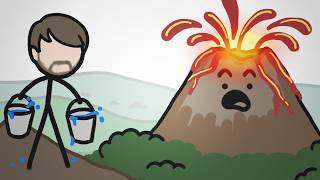
Can we kill a volcano?
44sThe introduction challenges common assumptions about volcanoes and sets up a surprising educational journey.
▶ Play Clip
[00:00] Volcanoes are one of the most powerful
[00:01] forces on Earth. Their lava can destroy
[00:04] cities and their ash clouds can blot out
[00:05] the sun.
[00:06] >> [music]
[00:06] >> And there is basically nothing we can do
[00:08] to make sure a volcano will never erupt
[00:10] again,
[00:11] >> [music]
[00:11] >> except wait for it to die. So, while we
[00:14] wait, what is it exactly that kills a
[00:17] volcano? Hi, I'm Cameron and this is
[00:20] Minute [music] Earth. There are three
[00:21] main ways a volcano can die, and the
[00:23] first is if its supply of magma fizzles
[00:26] out. The pushing together or pulling
[00:28] apart of tectonic plates can cause magma
[00:30] to form. But when those plates fuse
[00:32] [music] together, the magma forming
[00:33] activity stops, snuffing out the
[00:35] volcano. Poland's Kaczawskie Hills and
[00:38] Foothills has a whole national park
[00:40] devoted to volcanoes that suffered this
[00:41] [music] fate. Locals call it the land of
[00:44] extinct volcanoes. The second way a
[00:46] volcano can die is if it gets dragged
[00:48] away from its magma supply. Sometimes
[00:50] weird conditions in specific places can
[00:53] melt the mantle, sending up a plume of
[00:54] melting mantle rock known as a hotspot
[00:57] that pools beneath the crust and can
[00:59] birth a volcano. That hotspot itself
[01:01] doesn't ever move, but the Earth's crust
[01:03] above it does. So, the volcano will
[01:05] eventually leave its magma supply
[01:07] behind. But since the hotspot itself is
[01:09] still there, when one volcano dies in
[01:12] this way, a new one might form next to
[01:14] it, and then a new one forms next to
[01:15] that, and so on. The Hawaiian Islands,
[01:18] for instance, are the newest volcanoes
[01:19] [music] formed by a hotspot that has
[01:21] left a trail of dead volcanoes that
[01:23] stretches all the way to Russia. The
[01:25] third way a volcano can die is if it
[01:26] gets clogged. Like if conditions in the
[01:29] mantle change and the magma flow slows
[01:30] down, the magma that's already in the
[01:32] volcano's vents can cool, hardening into
[01:34] a giant plug.
[01:35] >> [music]
[01:35] >> 50 million years later, that plug might
[01:37] be all that's left of the volcano. Or,
[01:39] if the volcano's vents somehow get
[01:41] damaged, the magma might not be able to
[01:43] escape. In these cases, the remaining
[01:45] magma will often find its way to a
[01:47] different spot nearby where it can
[01:49] escape. [music]
[01:50] That's likely what happened when, in a
[01:51] spectacular eruption, the largest ever
[01:54] actually, a volcano called Toba clogged
[01:56] itself. Evidence suggests that the magma
[01:58] from its chamber got rerouted to nearby
[02:01] Sinabung, which is still active today.
[02:03] Of course, it's really, really hard to
[02:06] tell exactly what's going on underneath
[02:07] a volcano, so we're not always sure what
[02:10] has happened to a volcano. In fact,
[02:12] sometimes it's hard to tell whether a
[02:14] volcano is actually dead. Uturuncu in
[02:17] Bolivia hasn't erupted [music] in
[02:19] 250,000 years, so scientists assumed it
[02:22] was long gone. But recently, it started
[02:24] rumbling again, suggesting the
[02:26] possibility of future volcanic activity.
[02:28] >> [music]
[02:28] >> It turns out that Uturuncu and other
[02:31] quiet volcanoes like it might not be
[02:33] dead after all. Instead, they could be
[02:36] taking magnifcently [music] long naps.
⚡ Saved you time reading this? Transcribe any YouTube video for free — no signup needed.