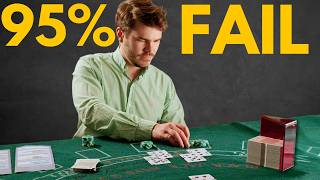

Why Aspiring Card Counters Fail
45sDirectly addresses common mistakes and promises a solution, creating immediate curiosity and relatability for viewers interested in card counting.
▶ Play Clip"Title accurately promises a breakdown of proper practice, and the video delivers exactly that."
Colin from Blackjack Apprenticeship explains the difference between amateur and professional card counters, emphasizing that skipping essential training steps leads to failure. He advocates mastering individual skills one at a time before combining them, and focusing on perfect decisions rather than short-term wins.
Pro-ready Pete trains the right way, mastering skills at home before going to a casino. Amateur Andy rushes to the casino without proper training, leading to losses and back-offs.
Andy watches training videos but then heads to the casino to try counting, which is a distraction and likely a huge loss. He should train at home first.
Pete masters individual skills one at a time: perfect basic strategy, counting a deck under 30 seconds, then combining them with software before betting practice.
Colin admits he was an Andy, winning initially but losing later because he focused on chip stacks instead of perfect play. He had to retrain properly.
Pete focuses on perfect decisions, counting, and betting, knowing that profits follow. Amateurs focus on short-term wins and losses.
A 95% perfect card counter gets all the downsides (heat, variance) but not the profits. Only perfection leads to long-term success.
Pete starts with flat betting to acclimate, then implements a bet spread, ensuring he can perform in the casino as he did at home.
To succeed at card counting, you must train methodically, master each skill perfectly, and focus on process over short-term results. Rushing to the casino without perfection leads to losses and back-offs.
What is the cardinal mistake amateur card counters make?
They go to the casino to try counting without proper training at home.
01:18
What is the first skill a card counter must master before combining skills?
Perfect basic strategy 100% of the time.
02:51
How fast should a card counter be able to count through a deck of cards?
Under 30 seconds every time.
03:05
What should a card counter focus on instead of short-term wins/losses?
Perfect decisions, perfect counting, and perfect betting.
04:42
Why is a 95% perfect card counter not profitable?
They experience all the downsides (heat, variance, back-offs) but not the long-term profits.
05:33
What is the first step Pete takes when entering a casino?
He starts with flat betting to acclimate himself to playing in a casino.
06:14
Cardinal mistake of amateurs
Highlights the most common error that leads to failure: rushing to the casino without training.
01:18Master skills one at a time
Key principle of effective training: isolate and perfect each skill before combining.
02:51Focus on process, not results
Critical mindset shift: short-term results are misleading; focus on perfect execution.
04:4295% is not enough
Powerful warning that near-perfection still leads to losses due to variance and heat.
05:33[00:01] aspiring card counters fail because they skip essential steps in their training? If you want to be among the successful few, you've got your work cut out for between your success and your failure comes down to your skills and your
[00:14] discipline. In this video, I'm going to break down how to practice the right way break down how to practice the right way to gain the edge over the casino. I'm Colin from Blackjack apprentichip. I've been a professional card counter
[00:27] for being casinos for roughly $4 million. And now I provide training, tools, and community for card counters through Blackjack apprenticeship. I've trained hundreds of people at Blackjack, some who've gone on to win five, six,
[00:40] had way too many phone calls with aspiring card counters who are struggling, losing money, and getting backed off way too often. For those who are struggling, when I dig into their training, it becomes abundantly clear
[00:53] they either lack the skills, the discipline, or often both to gain the edge over the house. So, let me introduce you to two types of aspiring card counters. First, we have pro ready Pete. Pete trains the right way. He
[01:05] everything that it's going to take to beat the casino. And then, we've got beat the casino. And then, we've got amateur Andy. Andy represents, well, everyone who won't make it. Let's start by talking about how Pete and Andy
[01:18] train. Both of them watch a bunch of Blackjack apprentichip YouTube videos, smart enough to subscribe so they don't miss any of our training videos. But amateur Andy then makes the cardinal
[01:30] mistake of heading to the casino to try it out. I know the idea of counting just want to go to the casino and see if you can do it, but you have no place in a casino at this point. without putting in the requisite training. Going to the
[01:44] distraction at best and likely a huge other hand, is putting in the training at home. He's flipping through decks of cards. He's memorizing the charts and then he's practicing with card counting
[01:57] training software so that he can master the skills at home before ever going into a casino. Don't play in a casino until you can prove that you can play has learned his lesson and he's not going to go back to the casino until
[02:10] his approach still is going to differ from ProRady Pete in some important at home until he can successfully keep the running count. And then he starts dealing to himself hands of blackjack until he can play perfect basic strategy
[02:24] he even downloads an app so he can practice keeping the running count while playing perfect basic strategy. As the practice hours grow, he's making fewer mistakes, but there's still some, usually only on the soft hands. And if
[02:37] running count accurately most of the time. He's feeling like he's got it down. He doesn't. Meanwhile, Pete approaches his training the way I teach people, mastering the individual skills one at a time before putting them
[02:51] together. Until you can recite and play every hand of basic strategy perfectly 100% of the time, you're not ready to stop your basic strategy training. Until you can count through a deck of cards perfectly under 30 seconds every time,
[03:05] you're not ready to combine counting with basic strategy. If you haven't training like an amateur. Look, you've got no excuses for this. We've got free at Blackjack Apprenticeship. We have an app for five bucks where you can
[03:20] combine them. At this point, it's together and practice until you're perfect at them. Then you need to know exactly how to bet for your bankroll and the game that you're going to be
[03:33] playing. Then you need to practice placing those bets for your bet spread before ever doing it in a casino. Do make sure that you master each skill this point, it sounds like I'm being pretty harsh on Andy. Well, I've got a
[03:47] secret to admit. I was an Andy. I practice at home quite a bit, but not to deck in 30 seconds every time. I played simulated hands of blackjack on free where I could play every single hand
[04:02] tell me if I was making mistakes. And so, of course, I started going to the casino when I was still making mistakes on soft 18s and hands like that, getting off on the running count, I'm sure, making up my own bet spread, and I was
[04:15] doomed for ruin in the long run. But you know what? I was winning. I doubled my $2,000 bankroll in the first few days. So, what did I do? I kept playing, expecting the same result. What mistake was I and every other Andy making? We
[04:29] were looking at the wrong results. Amateur Andes like me are looking at the stacks of chips growing or shrinking, even if it's virtual chips on training software, but that is the wrong thing to focus on. Pro ready Pete, however, knows
[04:42] that it's a marathon and not a sprint. He knows that anything can happen in the short term and to not look at short-term wins or losses. He's looking at different results. Can he play perfectly hand after hand? Is his count perfect
[04:55] every shoe? Does he ever miss a deviation or a bet? Can he do it fluidly so he looks like a gambler and not like an AP in the casino? Pete knows that if he focuses on these results, the profits will come in due time. Don't focus on
[05:08] winning or losing. Focus on perfect decisions, perfect counting, and perfect betting. You might be thinking, Colin, but I thought you said you were winning. I just want to double my bankroll like you did. Ah, Padawan, if only it were
[05:20] that easy. As the days and weeks went on, all those profits disappeared, and I had to humble myself and ask a pro to test me out. I failed the test out miserably and realized I had wasted hundreds of hours in the casino and a
[05:33] few back offs all the time not even playing a winning game. Fortunately, to become a pro ready Pete. And I rededicated myself to the skills until I had perfected my game. You see, what Pete knows is that a 95% card counter is
[05:48] going to have all the downsides of card counting, the heat, the back offs, the variance, but not the profits. Only a perfect carer will get the long-term profits that come with the skill. So Pete doesn't put his bankroll at risk
[06:00] until he knows that he has perfected every skill necessary and been tested out either virtually or by a pro to make sure that he's going to beat the game. Don't cut your training short. 95% is not good enough. Now that Pete is a
[06:14] stepped into the casino with confidence. He starts flat betting just to acclimate himself with playing in a casino until he feels confident in his skills. He money, but it's worth it for some practice. Then he starts implementing a
[06:28] bet spread to make sure he can do everything in the casino that he can do at home. Not only is he prepared to play perfectly, but he's also prepared for in the casino. And I covered that in this video.
⚡ Saved you 0h 06m reading this? Transcribe any YouTube video for free — no signup needed.