

Make $50/day betting sports with math?
44sPresents a controversial, math-based system that challenges typical gambling narratives, sparking curiosity and debate.
▶ Play Clip"Title delivers on the math and strategy, but requires a large bankroll and discipline most don't have."
This video presents a mathematical system for making $50 per day through sports betting, focusing on high-probability player props with odds around -300. The creator emphasizes bankroll management, discipline, and a long-term edge over short-term variance.
The system aims for $50 per day from sports betting, not through parlays but a repeatable math-based approach requiring a specific bankroll and discipline.
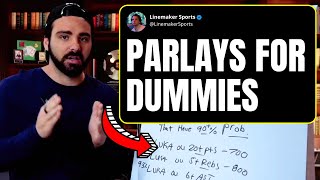
$50/day * 300 days = $15,000/year. Using -300 odds (implied probability 75%), with an 85% win rate, over 100 bets you win 85 ($100 each = $8,500) and lose 15 ($300 each = $4,500), netting $4,000 profit ($40 per bet).
Minimum bankroll $10,000 for $300 unit size. $5,000 bankroll: $150 unit, 3-4 plays/day. $10,000: $300 unit, 1-2 plays/day. $15,000: $450 unit, 1-2 plays/day. $20,000: $600 unit, 1 play/day.
People focus on the 15 losses rather than the 85 wins. The coin analogy: if a coin lands heads 85% of the time and you get $100 for heads, lose $300 for tails, you'd take that deal.
Avoid money lines, totals, spreads. Focus on player props. Good matchup → over props; bad matchup → under props. Applicable across all sports.
NBA: points, rebounds, assists. NHL: points (goals/assists), shots on goal, saves. NFL: QB passing yards/completions/attempts, RB rushing yards, WR yards/receptions. MLB: pitcher strikeouts/outs/hits allowed, runs scored (under), hits by player (under).
Tracker shows 85%+ win rate, 12.4% ROI, consistent profit over time despite occasional losses. Graph demonstrates long-term upward trend.
The system works mathematically with a sufficient bankroll and discipline, focusing on high-probability player props. The key is to ignore short-term losses and trust the long-term edge.
What is the implied probability of -300 odds?
75%
01:25
What bankroll is required for a $300 unit size?
$10,000
02:49
How many plays per day are needed with a $5,000 bankroll?
3-4 plays per day
03:03
What is the recommended unit size as a percentage of bankroll?
3% (e.g., $300 on $10,000)
02:49
What is the coin analogy used to explain the mindset?
A coin that lands heads 85% of the time: win $100 on heads, lose $300 on tails. Over time, you profit.
04:38
What type of bets should be avoided according to the strategy?
Money lines, totals, and spreads.
07:05
What is the rule for betting player props based on matchup?
Good matchup → bet over; bad matchup → bet under.
07:44
Which props are recommended for the NBA?
Points, rebounds, and assists.
08:38
Which props are recommended for the NHL?
Points (goals/assists), shots on goal, and saves.
08:54
Which props are recommended for the NFL?
QB: passing yards, completions, attempts; RB: rushing yards; WR: yards and receptions.
09:24
Which props are recommended for MLB?
Pitcher strikeouts, outs, hits allowed; runs scored by player (under); hits by player (under).
09:50
What was the ROI shown in the tracker example?
12.4%
10:58
Math Foundation
Provides the core mathematical proof that a 10% edge at -300 odds yields consistent profit.
00:41Coin Analogy
A powerful psychological tool to help bettors accept losses and focus on long-term edge.
04:38Matchup Rule
Simple, actionable rule for betting player props: good matchup → over, bad matchup → under.
07:44Proof via Tracker
Demonstrates real-world results with a tracked record, adding credibility to the system.
10:44[00:01] $50 a day betting on sports? Not from some lottery ticket parlay, not from but from a boring, repeatable, math-based system that I've been using off thinking this is too good to be true, let me be clear. This isn't some
[00:15] get-rich-quick strategy. You're not going to start tomorrow with 200 bucks There's a specific bankroll that you need, a specific process that you need to follow, and a specific level of discipline that most people honestly
[00:28] don't have. But if you do have it, the math works. And I'm going to show you exactly how, step-by-step using my actual spreadsheet and real numbers. So, with the math because the entire strategy falls apart if the math isn't
[00:41] correct. So, let's start with $50 per day. Times that by 365 days. What does that get us? That gets us 18,000 $250. going to bet every single day because not every single day you're going to
[00:56] find value. So, what I like to do here is I like to put that into calculation. All right? So, let's actually just say $50 * 300. Okay? We're going to say 300 days cuz that's more realistic and that gets us about $15,000
[01:11] average odds that we're going to do here are going to be minus 300. Yeah, crazy, they see that because they're going to be like, "I would never bet a minus 300." But I'm going to show you exactly why this actually works and how you
[01:25] So, with this line right here, what does that mean? That means if you put down 300 that you end up making $100, correct? The implied probability here for that is 75%. What is the implied probability? Implied
[01:38] probability is the percentage the sports book's telling you that this is going to you need to be able to break even and win long term just to be able to get use for example and I'm going to pop up exactly what my win percentage was over
[01:53] an example. As you can see here. Now, let's just round that off with some let's just round that off with some variance and say 85%. Okay? Let's say 85% was what I was hitting here, and that would be my true probability. This
[02:05] is how I imply probability. So, now I have what? A 10% edge or a 10% spread on and do the math behind that. Let's do over 100 bets, okay? That means I win 85
[02:17] of them, and I lost 15. Now, my profit on each one of these wins was 100 bucks, That means I made 8,500 here. Now, each time I lost here, I lost 300, okay? So, every time I lost was 300. So, we do 300 * 15, which would
[02:33] get us 4,500. That would put me at a profit margin here of $4,000. So, over 100 bets, that's about $40 profit per bet. Now, this formula right here is an example of using a $300 unit size, okay?
[02:49] $300 unit size, now what your bankroll is it has to correlate with this is going to be $10,000, all right? That's at minimum. That's what you need for this formula right here. Well, I'm going to break down exactly each
[03:03] individual bankroll so you could see what's doable and what's not, and how many plays you actually need per day per bankroll to be able to make this work. So, let's start out with a $5,000 bankroll. That'd be 150 per bet, and you
[03:16] bankroll. That'd be 150 per bet, and you would need about three to four plays per day, okay, to be able to make that work. Let's go to $10,000 bankroll, which we just did, which is a $300 unit, and you could last with one to two plays daily
[03:30] with that. Now, let's go to a $15,000 bankroll. Here would be 450 for your unit size. And again, one to two plays is all you would need there. Now, let's go to a $20,000 bankroll. That'd be $600 per unit. And
[03:45] at this level, you'd only need one play per day. All right? So, if you have need at least three to four plays. You to get that down. This is what you would have to do, okay? But, if we go all the way down to $20,000 bankroll, $600 unit
[03:58] per day to be able to make this formula is it to be able to come up with one play that's minus 300 at least on average per day that's going to give you a favorable matchup, that's going to
[04:11] you an actual edge? Doesn't sound that hard, right? But, here's the problem that most people see, all right? They see this number right here, which are the odds, okay? And when you take one loss here, what happens here? They get a
[04:24] terrible. Like, I'm never going to be able to recoup. I'm never going to be able to make it back." So, what they focus on is, like I showed you before, those 15 losses, okay? They don't focus on the 85 times that you're going to
[04:38] to think about it like this, okay? Think about if I had a coin, and I said, "Every time that coin, I'm going to flip it, and it hit heads 85% of the time. Every time it hits heads, I give you 100 bucks. Every time it hits tails, you got
[04:52] that deal? Of course you would, because 85% of the time I'm going to be giving you money. And it's going to outweigh the amount of times that you actually you're going to make money over the long term. You just have to think about that
[05:06] analogy every single time you look at these type of odds. Because as long as you have an edge, the long term, you're actually going to turn a profit. It just need an actual
[05:18] bankroll to make this work, okay? As you guys could see before, I didn't show you $500, I didn't show you a thousand, I didn't show you two thousand. Why? right? If you're going to make an investment into your income to make more
[05:32] money makes money. If you don't have no money, then you go into the lottery system, where people are trying to hit those huge parlays, trying to put 20, 30, 40 dollars on them to try to win thousands of dollars, which they never
[05:45] do. And they just end up donating, and that just racks up over time and those as throughout the year. Next thing you know, they've lost a couple thousand you do have a smaller bankroll like a $500 bankroll, you could use the same
[05:58] with the results because instead of making $50 a day, you'll be making $5 a day. And who's happy making $5 a day? Mostly nobody because they're not going adds up long-term over the course of a whole entire year. So, people with lower
[06:13] bankrolls would rather just lose the money rather than see a little bit of income come in. So, you could do it at any level, but for mentally to be able actually making a good enough money
[06:26] income, then at least like that level of $5,000 would be the minimum to start at. So, the first step there was being able to break that mentality, okay? You got to break that mentality and understand and understand mentally how this game
[06:39] what your mind is going to see and how your emotions are going to feel. As long as you keep in mind that coin analogy that I just literally told you, that's understand that the long-term of this is going to add up. The small wins will add
[06:53] up and they will outweigh any of those losses that you occur. Now, number two is going to be the strategy behind this, okay? The strategy behind this doesn't mean that you could just go out and pick any minus 300 favorite and it's going to
[07:05] work, all right? So, what we're going to cancel out here is going to be teams, to cancel out those three type of bets cuz we're not going to do any of those. We're just going to focus on player props. Now, everybody loves betting
[07:19] money lines, totals, spreads. They love doing that, okay? They love betting that watch. They get entertained watching that. And I understand that, but that's profit is at player props. The reason
[07:31] why is because you're focusing on that one player to either do something or not do something. And whether they even have the best match-up or the worst match-up, player prop that's in that division. So, remember this on a player prop. If the
[07:44] match up against that certain player, remember this, match up, if the match up is good and it favors the player, then you're looking for props that are on the over. You're looking for over props. If the match up is not too good and the
[07:56] defense plays very well against that certain player, okay? That means that the match up is not good, it's bad. Then you're looking at the under props on that match up. This is a base, okay? That's a base of what you need to
[08:10] understand when you're looking at player props. If there's a good match up to there's a bad match up to exploit, you're looking at an under. And this concept could be used across all sports, okay? It could be used for MLB, the NFL,
[08:25] the NBA, the NHL. It could be used for every single major sport for player give you a list for every single one of these sports of the props that you is top secret, so if you guys made it this far in this video, you're really
[08:38] show you right here. Let's go ahead and start with the NBA. So, the NBA, the props that you should be looking at are going to be points, rebounds, and assists. Points individually, rebounds individually, assists individually, and
[08:54] props that you should be looking at when it comes to the NBA. Whether it be for match up. Now, let's look at the NHL. The NHL, what you should be looking at is going to be points, which means if they score a goal or an assist, and
[09:09] looking at shots on goal. And then on the other side of pretty much the match up there within the NHL, you'd be looking at saves, and that's by a the sauce on this, so you might want to actually write this stuff down. Let's
[09:24] to be looking at there is going to be every major position. All right, so QB, you want to look at passing yards, completions, attempts. Running back, you
[09:37] want to look at rushing yards. Wide receivers, you want to look at yards, and you want to look at receptions. Now, let's go ahead and get to MLB. MLB, what you want to look at here is
[09:50] you want to look at pitcher strike outs, pitcher outs, which is how long they're going to pitch in the game, pitcher hits allowed, which I made a video on this. sure you go look in the channel because I give you exactly how to find that prop
[10:03] right there. You also want to look at runs scored by a player, meaning they one you want to focus on the under on, okay? You always want to focus on the what you want to look at is hits by player. Under
[10:18] a game. It's hard enough to get one. When you find a great match up with a pitcher, and you can get under two hits in a game, that's a solid match up. Now, I just literally gave you guys a secret formula of exactly how to make at least
[10:31] $50 a day betting on sports along with all the strategy and the props that you want to look at within each individual sport. Now, how do you know that this proof, right? You need proof to know if this actually works. Well, that's what
[10:44] tracker so that way I can show you exactly what that looks like. So, let's here for example. So, I hit a little bit over that 85% threshold, like I said, used in the in this video, we're going
[10:58] more than that. And the odds that I played were a little bit higher than that minus 300, but it still was able to work out where I still created a 12.4% ROI. And my unit gain, that's because I adjusted my unit size consistently. I
[11:12] was adjusting it according to the probability. So, the unit gain is not exactly correct. It's more or less probably double that. It's about like 16 probably double that. It's about like 16 or 17 units there. But, this is how how
[11:24] is a graph showing you the ups and downs throughout that that entire stretch. Like, yeah, okay. We had a couple downs here and there, right? But look at the about the coin flip, right? Look at the 85% of the time that you win compared to
[11:40] the 15% of the time that you lose, okay? It's not not even comparable. You're going to rack up money consistently over the long term. Now, let's go ahead and take a look at exactly what that looks like bet history wise so you guys could
[11:52] see the actual numbers here. All right, so you guys look, you could see when you lose one bet, yeah, it takes up a decent amount of money, right? But then when you go on streaks, it you get all of it back, okay? You end up raking all this
[12:04] money back whenever you take one loss. And over the long term, this continuously just adds up and adds up. And next thing you know, you're at a profit just like what I just showed you as the total amount of money being made.
[12:17] So, this right here is successful sports betting. Everything else that everybody else shows you, they don't even have a tracker to prove it. So, there's no the stuff that most of the garbage that is preached throughout the sports
[12:29] betting industry. All right? Unless somebody's going to pop up a tracker and show you day by day exactly what it looks like and if it works, then guess that simple. But just like I showed you guys there, that's the easiest way to
[12:43] show you the proof behind what it is that I teach because if you can see that I track every single play that I put in and that's the results, there's no way anybody could tell you otherwise because this is tracked every single day. Now,
[12:59] that I just showed you there where I send them to you every single day, make sure you guys click the link in the description because I also show you not just those plays, but I show you every single strategy that I know, that I use
[13:12] major sport. So, make sure you guys click the link in the description if you guys want that. As always, I'm Frank LaManna Sports. I'll see you guys in the LaManna Sports. I'll see you guys in the next video. Till then, I'm out.



⚡ Saved you 0h 13m reading this? Transcribe any YouTube video for free — no signup needed.