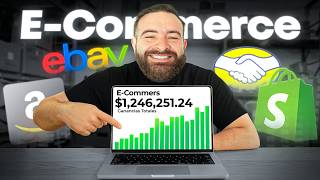

E-commerce is NOT easy money
46sChallenges the get-rich-quick myth and sets realistic expectations, making it controversial and attention-grabbing.
▶ Play Clip"Title promises a money-making guide; video delivers a thorough, actionable framework, though it's more educational than a quick-win scheme."
This video provides a comprehensive, A-to-Z guide to building a successful e-commerce business, emphasizing that it requires hard work, discipline, and patience—not passive income. The instructor, Maurito, leverages his 10 years of experience and tens of millions in revenue to debunk common myths and teach viewers how to choose between stock/no-stock models, marketplaces vs. own stores, and how to master niche, product, supplier, offer, and traffic.
E-commerce is not passive income; it involves sacrifice, structure, systems, discipline, judgment, and patience.
E-commerce is buying cheap and selling dear electronically. The Hispanic market has a huge window of opportunity due to exponential growth in online buyers.
Maurito has 10 years of e-commerce experience, tens of millions in revenue, and has taught thousands. He aims to counter misinformation from inexperienced 'gurus'.
Common excuses like 'no time,' 'no money,' or 'market saturated' are false. Time can be found by reducing social media use; low-cost models like dropshipping require little investment; the market is not saturated because buyers far outnumber sellers.
E-commerce is simply buying and selling products online. The 'e' stands for electronic.
E-commerce grows exponentially each year as more people learn to buy online. Eventually, all age groups will shop digitally.
The market is not saturated because the number of buyers is in the hundreds of millions, far exceeding sellers. Amazon alone generates $1 billion daily in the US, with 65% from third-party sellers.
Successful e-commerce entrepreneurs use the internet as a tool to generate income, not just for distraction. They capitalize on trends and influencer recommendations.
No stock (dropshipping) is safer with lower margins but less control. Stock requires upfront investment but offers higher margins and more control. Start with no stock to validate products.
Marketplaces (Amazon, MercadoLibre) provide built-in traffic and trust but charge commissions and have strict rules. Own stores (Shopify, Tienda Nube) offer more control and lower commissions but require traffic investment.
NPPO stands for Niche, Product, Supplier, Offer. Choose broad niches (e.g., hygiene) over narrow ones. A good product sells even with bad ads. Supplier relationships are crucial for long-term success.
Marketplaces provide organic traffic; own stores require paid ads (Meta, Google, TikTok). Use tools like Pixel to optimize campaigns. New listings need PPC to gain visibility.
The key steps: choose stock/no stock, decide marketplace vs. own store, master NPPO, and acquire traffic. The instructor offers a paid program (NUM) for structured learning.
E-commerce is a viable path to financial freedom, but it demands action, continuous learning, and a willingness to invest time and effort. The instructor's proven framework and experience can help beginners avoid costly mistakes and build a sustainable online business.
What does the 'e' in e-commerce stand for?
Electronic.
06:06
What is the main difference between selling with stock and without stock?
With stock, you buy inventory upfront for higher margins and control; without stock (dropshipping), you only buy after a sale, resulting in lower margins but less risk.
12:31
What is a marketplace? Give two examples.
A marketplace is a platform where customers already shop and trust, e.g., Amazon and MercadoLibre.
17:00
What does NPPO stand for?
Niche, Product, Supplier, Offer.
22:18
Why does the instructor recommend starting with a broad niche?
Broad niches (e.g., hygiene products) have a larger potential customer base and are not limited by geography or lifestyle.
23:42
What is the advantage of having a good relationship with a supplier?
They may offer payment terms like 30, 60, or 90 days, which helps with cash flow.
26:31
What is the function of the Pixel tool in e-commerce?
It feeds customer data to ad platforms (like Meta) so their AI can optimize ads to target similar users.
33:16
How much daily revenue does Amazon generate in the US, and what percentage comes from third-party sellers?
$1 billion daily; 65% from third-party sellers.
10:17
E-commerce Requires Sacrifice
Sets realistic expectations that e-commerce is not passive income but hard work.
00:02Exponential Growth of E-commerce
Provides data-driven evidence of market opportunity.
07:14Market Saturation Myth Debunked
Uses Amazon's daily $1 billion revenue to illustrate massive buyer demand.
09:10Stock vs. No Stock Trade-offs
Clear comparison of risk, margin, and control for beginners.
12:31NPPO Framework Introduction
Core strategic framework for e-commerce success.
22:18[00:02] very likely that someone told you that making money with e-commerce was going to come while you're in your Paraguayan hammock enjoying a delicious tereré. And save you an hour of your time, if you keep thinking about those kinds of things,
[00:18] take advantage and close this video. Go watch something else, some other nonsense. E-commerce is E-commerce is something that involves sacrifice and effort. You have to let go of a lot of things. Like any real business, it requires work,
[00:33] structure, systems, discipline, but above all, judgment and patience. So if that's not what you're looking for, take advantage, I closed one, I don't know, from Mr. Beast, and also say hi to your mom while you're at it . In this video you will learn from
[00:48] A to Z everything you need to know to get into the business of e-commerce. What I'm going to teach you today is, without a doubt, the most valuable e- commerce information you'll see for free, and it will allow you to build a
[01:04] real business. And I'm talking about a business, not a small shop that sells occasionally, a business with structure, margins, systems, and processes.
[01:16] Let's see what e-commerce is and why the Hispanic market has a window of opportunity. Right now we're going to look at the two different modalities we have in e-commerce, which is with stock or without stock, and when to use
[01:28] difference between selling on a marketplace and having your own store. We'll also look at details about specific platforms and marketplaces like Amazon, MercadoLibre, Tienda Nube, and Shopify. The idea
[01:41] is also to find the right niche, which product sells, which one has potential, how we're going to find or look for suppliers, and how we're going to make this business viable, solid, and
[01:53] long-term. We're going to cover a lot of logistics and operations, what I sell a product until it's delivered to the customer, and how all of that works. This class will be based on four blocks. It's a long class, so
[02:07] pay attention if you need to pause, go to the bathroom, poop, take a bath and come back, do it, because I need you to study this very carefully because it's gold dust. And why am I doing this [laughs] for free? Well, I'm doing this class for free
[02:22] I taught e-commerce and I got the bug again. I like it, it's something I rich. But something that's really catching my attention is that I see a lot of people attention is that I see a lot of people
[02:37] people who have online stores, but rather some kid who had a hit with an MVP, a kid who had a successful product and made his first $10,000 and now he's teaching you how to make your first $10,000
[02:49] online. I see many people who really don't have experience like mine, 10 years in e-commerce with the authority and tens of millions of dollars billed in their business to come and teach you from experience,
[03:03] because I did live it, I can tell you about it. And that's why, seeing so many people spreading misinformation, damaging the industry, and harming people who the dinosaurs to return. But the reality is that the number
[03:17] of people who got burned investing in garbage courses and discovered that it's illegal things or sell products with flimsy paperwork, the number of idiots who sell colored water saying it's juice. My friend, you're going to learn from the number
[03:32] one Spanish-speaking e-commerce expert . Get in line, Maurito's here. Now, before we start the class, before we get down to business, a lot so you don't get that crap in your head: that I don't have time,
[03:47] that I don't have money, that the market is saturated. Listen, I'm going to tell you every excuse you can make, one by one. You don't have time. That's a lie, because if you're watching this video it's because you found the time and
[04:00] made space in your routine to study and learn. Second, go to your cell phone now and see how many hours you spent on your cell phone today and social media. I promise you that if you transform that hour into studying
[04:15] e-commerce, you could be generating much more money. If you don't have money, it's a stupid thought I made, because since you don't have money, you can't study e-commerce because that's precisely what will make you have more
[04:27] do something to get more money, like selling products online. And there are also ways you'll learn with me, like no stock, that require very little or almost no investment. So not
[04:41] you don't know anything or understand anything, then shut your mouth and listen to me until the end, and when this class is over you'll understand a lot and that won't be an otherwise it gets boring, you know? It's a class, I have to swear. If you already
[04:55] me. I've been doing this for 10 years, I've been teaching for four, revenue, with 100,000, with 10,000. Listen carefully to me and tell me at the end of the video, and you'll more or less give me the chance to change your life. And if
[05:09] e-commerce business, as I told those who say they don't have money, you can start with very little stock and the loss you would incur with a small product that you are testing to see if it sells or not will be much less than what
[05:21] you lose by not doing something to change your life for 5 years. Do the math, take my word for it emphasize something to you, okay? And it's not because I want to show off, but so you talking to you. I must be the only person in e-commerce who became a
[05:35] multimillionaire before teaching. This training is one that I will give you for free and from the heart. I could easily charge you thousands of money for my training courses. I've filled stadiums, I've sold books. So
[05:49] value it and take it in good faith, study it well, because it really can give you results. E-commerce, guys. What the hell is e-commerce? Commerce comes from commerce, an ancient commercial skill:
[06:06] buying cheap and selling dear. How long have shops existed? How long ago did people trade a plowshare for a ball? How long have people been marketing their things, their products? Thousands and thousands of years ago,
[06:22] products? Thousands and thousands of years ago, fairs, events. What is the e? fairs, events. What is the e? The E only stands for electronic. The E only stands for electronic. Yes, electronic. I'm going to put it on. Because?
[06:34] Why is it electronic? Because you literally do it online. You're opening online. You're opening a shop, right? A person enters the store from their computer or cell phone , buys the product, and you
[06:47] send it to them. Alright? Let's now go into a little more depth, ways, methods, but basically electronic commerce or e-commerce is literally buying and selling products, buying cheap, selling more expensive
[07:01] digitally or virtually. Now, why do I mention that e-commerce is an incredible opportunity today, especially in the Hispanic market? the numbers say it.
[07:14] Which numbers? Okay, if we evaluate, then yes? And you can find that everything I say is backed up by metrics, data, and statistics. E-commerce is an industry that has grown exponentially in
[07:28] recent years. Exponential. It grows more and more each year Exponential. It grows more and more each year . Every year there are more people. Yes, the number of people who shop online or
[07:42] buy products digitally is increasing. And this is because it's this is because it's common sense, right? If you start buying your products digitally at age 20, today you are 20,
[07:56] but in 40 years, when you are 60, you will still be buying products digitally because you already know how to do it. On the other hand, perhaps I am a person who is maybe 60, does not have perfect knowledge or does
[08:11] not know well how it works or has to learn from scratch how to buy a product online. So this means that as time goes on, more and more people are buying their products digitally.
[08:26] I think that by 20 or 30 years old, absolutely absolutely everything, but every age range will buy products. Obviously not a minor, but from 18 to 90 years old, I do
[08:42] products digitally. Because? Because today an elderly person may not Because today an elderly person may not know, but in 20 or 30 years you will see the elderly person. So, it's growing exponentially, not because of
[08:54] the people themselves. but also by the market. Now, I want to add something to this, which is that many people who don't know the reasons behind its exponential growth and give their opinions without knowing, say, "No, but it's completely saturated."
[09:10] No, but someone else already sells that. Of course, you have to understand that obviously as time goes on there will be more sellers, because just as there are people who learn to buy, there are people who learn to sell, like you now who
[09:25] are learning to sell online. So, by inertia, obviously there will be more and more sellers and it will become more and more saturated, but it's nonsense to think that it's becoming saturated when the proportion between people who
[09:37] sell online and those who buy is in the millions. hundreds of millions more. Therefore, there will never be more sellers than buyers. Therefore, the market will never be saturated . Never. It is impossible for
[09:51] a market to become saturated where the number of sellers and consumers is hundreds, billions of people. Do you understand? Common sense. I'm going to give you an example so you can become a little more aware of what I'm saying.
[10:05] Amazon, if it is a marketplace that is the largest in the United States. Amazon, let's say you open a store on Amazon. Do you know how many people shop on Amazon every day? Hundreds of millions. Do you know how much revenue Amazon generates daily
[10:17] in the United States alone? $1 billion. To give you an idea of the $1 billion. To give you an idea of the magnitude of it, I'm going to write it out for you. 1 billion magnitude of it, I'm going to write it out for you. 1 billion
[10:33] dollars. 65% of this number, which would be 650 million, is sold by third-party sellers. The other 35 is sold by Amazon. 650 million. Every day, people who sell on Amazon are taken home, not
[10:49] Now, obviously these people pay commissions, they pay for a lot of things and operations, but every day $650 million goes to Amazon sellers. And let's not even talk about MercadoLibre, about people who have their
[11:04] own store like Shopify, people who set up a store in Tienda Nube and don't sell on a platform like Amazon, but in their own store. Billions and billions and billions are billed online every day. And the best part, if you're a
[11:20] Spanish speaker, is that there's still a huge gap, much larger than the buy. That's why you have many more possibilities and you're at the right time to start. But what's the first thing you need to do to
[11:34] truly enjoy this industry? It's about making a switch in your mind, changing your mindset. Most people go on social media to distract themselves, to like a picture of a busty miniskirt, to see some viral nonsense,
[11:47] to be entertained, or to watch an influencer doing stupid things or to gamble. People who want a better life see the internet as a tool to generate more income. So, instead of looking for ways to distract yourself, if you go
[12:02] online to make the most of your time and capitalize on it, or at least learn, you'll be able to do productive things, like opening a product to go viral and wanting it because your favorite influencer recommended it, you might
[12:18] could have a product recommended by your favorite influencer, turning the tables on the market. Do you understand? You have thousands of ways to generate income through e-commerce, but there are two
[12:31] main ways to sell products online: one with stock and the other without stock. What's the difference? Yes, I'll be brief about this. I'll explain it to you first
[12:43] without stock. Without stock, a very popular way is what is called dropshipping. Yeah? Basically, what you do is you go out in your store. Yes, put that this is your store. What you do is put products inside.
[12:59] We're going to put you here and we're going to put your client here. Yes, the person will see the products you posted and buy them. You do . Because? Because you have suppliers you've found who
[13:13] sell you this product, and since you buy in bulk, you buy them one by one, and they give you bulk, you buy them one by one, and they give you a good price. You pay him, the final consumer, who is the one who bought it from you. Now, this is extremely useful if
[13:27] you know a good supplier who you know will deliver on time. The thing is, since you're selling without stock, you have something very secure, which is that you're not a lot of money or risking a lot of money because you're publishing something that if it doesn't
[13:41] buy it to have it shipped. The problem is that if you go out and sell them, the margin won't be the best , because the person selling them to you, even though you bought 38,000, you bought them one by
[13:54] bought 38,000, you bought them one by one, one by one. So, the price is retail. You bought a lot, but only once. And since you bought it with insurance, knowing that it was bought from you, what's going to happen is that the price won't
[14:08] be the best. Now, another thing about this business model is that while the margin is there, let's put it here, the margin is lower, right? The margin is smaller. The thing is,
[14:20] is lower, right? The margin is smaller. The thing is, because if this person tells you, "No, no, wait, you published that at 10
[14:32] but it increased for me because of the import and I don't know what, I have to charge you seven." Boom, it ruins your margin. Or if he then tells you, "No, look, the truth bought it and are complaining that your
[14:45] shut down your store. So, you have less control, but it's safer in terms of money because you don't go out to spend unless you 've sold something. In other words, there are even
[14:57] use the money they gave you to go out and buy things. Yes, it depends on the platform. Now at Constock, what you do is not that the supplier will send and all that, but if you have already validated a product, for
[15:11] lot of these units, you can already go out and publish them in your store and when the customer comes to buy from your supplier, you have already bought many products from them and they sent you, for example, even a palette. Yes, here's
[15:26] one who sent you a lollipop and you already have it in your possession. So, when you publish it, this person comes, pays you, and you send it. So, since you already you send it. So, since you already bought it, right? For larger quantities, you'll
[15:41] have much more margin, and in addition to having much more margin, you'll have more control over the stock in your possession, and you know you can ship it on time. Now it's more work, right? Because you have to
[15:53] hire a logistics service to do everything for you, but you know that everything is under your hands and under your control and it will be less secure. Why is this less safe? And because you 're basically buying many
[16:07] units in advance to get a better price. So, in the hypothetical case you thought you were going to sell them and the product stopped selling because it went out of all this merchandise, you're going to have to go out and liquidate it, you're going to have to see
[16:20] how you get rid of it. Then it's very problematic. What I very problematic. What I suggest you do now is always start with no stock. Because? Because it's safer, and you're someone who's just
[16:32] you gradually validate certain products and take the reins better, you can risk having a better margin by buying a large quantity of would be the best way. Once we've learned the differences
[16:47] between selling with stock or without stock, I'd like you to learn the differences between what type of platform you're going to sell on. We separated it into what sell on. We separated it into what is a marketplace, right? I'm going to put MKT, and
[17:00] is a marketplace, right? I'm going to put MKT, and the other one is my own store. What's the difference? Okay, to give you some examples, the marketplace could be, for example, Amazon, or it could be, for example, MercadoLibre. It could be, for example,
[17:15] eBay, you have more platforms, even, for example, ETI, many more. What is a marketplace? The marketplace is a space where people have already come to expect that they can enter and buy their products there. So, the reality
[17:30] someone buys on Meli or if someone buys on eBay or on Etie, they don't really care if they are buying from Amazon or if they are buying from Pepito. Trust Amazon because of its name, its brand, how it treats customers, or
[17:44] even because it delivers orders quickly. So, if we publish products here, we'll be able to benefit from the traffic and the number of people who already enter these marketplaces every day because they
[17:58] already trust them. A person who lives in Argentina today, for example, has a lot of confidence in buying from MercadoLibre. He doesn't care if the seller is Pepito or Mondongo, what matters to him is buying from a platform he already trusts
[18:12] will deliver the product, and if it doesn't, he'll get his money back, and if it does arrive, it will arrive quickly, nothing more. Now, if we start selling on a marketplace like this, because we'll have to follow the marketplace's policies and terms.
[18:27] Besides having less control, we're also going to have to pay commissions, and we're going to have to be much more careful because these aren't our rules and because we have to take great care of the store's health. Because? Because
[18:42] these platforms, designed to help you lead or increase sales, generally use algorithms that decide who will win a sale based on price and availability. How quickly can you deliver the product and what is your
[18:56] health of the store, we're going to end up affecting sales. Now, a "your own store" is when you create your own store, for example, maurito.com, and you sell Maurito underwear, or whatever you want to sell, and you don't want to
[19:11] sell it on a platform like Amazon, Mi, eBay, or ETI, for example, but Because you believe it should be your own brand and because you want to have customers come in to buy, you want loyal people and you want to have added value
[19:26] which can also be done there, but let's go here . Platforms to use would be, for example, Shopify, or you can also use Tienda Nube. And the big difference tiendan.com to buy, nobody goes to Shopify.com to buy, you can't even
[19:40] because these are platforms where you're going to build your own you're going to build your own store. You don't go to amazon.com. but to maurito.com, to pepito.com. So, since it's our page, we have much
[19:53] more control. Yes, because it's our page, they're our rules. We have lower commissions, although commissions are paid by the payment processor commissions are paid by the payment processor and so on, but we have our rules
[20:05] and we also have the factor of having our own store, this adds added value to my company, since the store is ours and we are not selling in a marketplace. One negative point you might have selling your
[20:18] own store is that if you're just starting out, people are more skeptical or have less confidence and may look for the product you offer on Amazon or MercadoLibre, which is what we call the famous
[20:30] bounce sales. But that's why it's for people who are more advanced, right? And as they begin to master their own store, I teach them how to also open a store on these marketplaces to be able to link rebound sales. Now, here
[20:44] you pay more commissions and here you pay less, but here you're going to have to go to pepito.com to buy the t-shirts unless you advertise and promote the page and tell those people that you have
[20:59] good quality or cheap t-shirts available or whatever. So, here the money will cost us in traffic and here in paying commissions. Plus commissions. Now, Maurito, you're going to say, "Well, but what's the best option for me? Marketplace or my
[21:13] own store?" Well, here it's not as simple as in stock or out of stock. There are many variables and many possibilities here. So, I can't recommend anything specific in a video like this for so many people, because it
[21:26] depends on your money, your time, your availability, your desire, everything you can, let's say, contribute to this business model or to yourself. So, to know exactly which is the best platform, whether it's your own store or a
[21:40] marketplace, it's ideal to understand your personal situation very well. I can't recommend it in a general way because there are many people watching this with different economic, social, emotional positions and many more
[21:52] So, I left you a link below this video so you can go and fill out a form with all your information and a member of my team, one of my advisors, can contact you and see what the best option or path is
[22:06] for you. And maybe , in addition to being able to assess your situation and help you with the most solid path for you, you might even be able to apply to study with me. I want to enter this block in what we
[22:18] call NPPO. Yes, we have a niche, a product, a Yes, we have a niche, a product, a supplier, and an offer. We are. Niche,
[22:31] niche, product, supplier, offer. That's clear, right? What is a niche? Yes. Here we're going to focus on who we're going to sell to, but it's not about who the type of people are, but rather
[22:45] about the style or type of product itself. For example, if I'm going to sell products for cleaning the house, the niche, well, is home or home cleaning. Now, if I like to sell, for example, I
[23:00] like products or sports items related to ice sports, such as snowboards, it's a niche that limits you much more. Yes, the niche, if you sell, for example, snowboards, the niche of
[23:13] this product will be winter products or winter sports products, right? And what happens is that people in this niche are limited to places where they can do this sport, to places where there is this climate and also to places
[23:27] where there is perhaps a mountain to do it. So what happens? If I'm going to focus and emphasize a niche that is quite specific, you'd better first know a lot about the subject and second make sure that you can be
[23:42] a reference in that niche knowing that it is small. Now, what about I recommend very simple and everyday niches that don't really niche a
[23:54] group of people, but the product itself. For example, if you sell toilet paper, the niche for toilet paper is cleaning, bathroom, hygiene.
[24:06] Yes, hygiene products, but everyone, whether a snowboarder, a police officer, or a skateboarder, wipes their butt. So, you're entering a niche and a product, but that doesn't limit you in terms of a
[24:19] person's style, where they live, what they like, or their tastes. So, to begin with, I always recommend niches that don't ring too much. Do you understand? Product. Yes, going back to the snowball example, and here's something very important.
[24:33] snowball example, and here's something very important. A good product, right? A good product will sell even when the ads aren't bad, sorry, even when the ads are bad, because you can advertise a product that is very, very
[24:45] good. The way you advertise it or the way you promote it is sells anyway. Or because, for example, if the product is very necessary, for example, if you were selling face masks during the pandemic , the product is face masks
[25:01] promote it, it's something that people didn't need in an essential way to ads are rubbish, you're still going to sell . And that's the opposite, because if the product is crap, no matter how good your ads are, the product is
[25:16] n't going to sell. So here I want to make it clear that a product that sells doesn't necessarily do so because the product is good, although if the product is good, it's more likely to sell even if the way you market it is bad.
[25:30] Very important supplier. Because? And here I also differentiate whether I am out of stock or in stock. If I have a supplier without stock, that is, who sells to me without stock, he will sell to me on demand. So I have to entrust this person with
[25:45] logistics, shipping, warehousing, customer service, giving me an incorrect tracking number, and I 'm delegating a ton of things to them. If I buy from stock, yes, here I just have to worry about
[26:00] getting a good price, nothing more. Now, in this way, by buying more from him I will be able to establish a certain relationship with the supplier and not just one that is you want to sell one, let me know and I'll ship it to you, kid, it's not the same. That's why
[26:16] in the long run it's always ideal to understand that a good provider is a life Because if you have a good relationship with a supplier—and I mean it—if you're relationship and giving them a birthday present, whatever, yes, maintaining a good
[26:31] a good relationship with a supplier, it's going to really change your life. the day things get tough and you need a loan, they'll let you pay in 30
[26:43] days, 60, 90, right? This is done with someone you've been buying from for crucial, and it's crucial that we have a good supplier. Now, the
[26:55] truth is that the supplier is very extensive, making it difficult to find products with potential. It stock or without stock. If you also sell in your own store or on a marketplace. For example, if you own your own store, right? And if you sell on Shopify in Tienda Nube,
[27:10] check, for example, the meta ad gallery or even the TikTok one, and you'll be able to see the conversion rate or even who is advertising the most if there's a certain trends. If you sell on
[27:25] platforms like Amazon, for example, you have tools, such as you have tools, such as Kipa or Jungle Scout, read the metrics within the marketplace to see which products
[27:37] have potential. Mercadoolbre, for example, has the same thing. Yes, it does; I think the best known are Real Trends and Nubimetrics. Yes, these are tools where you'll input the metrics and algorithms of the marketplace itself, thanks
[27:51] to API extensions they have, and you'll be able to find a good product. Now, the offer, this practically depends much more on you, but the good thing about the offer is that if you, for example, have your own store, you'll be
[28:05] customers, you'll be able to offer them a birthday discount, you'll be able to offer them a 20% discount on their second purchase or when they come back, and the offer on a marketplace, right? Whether it's Amazon or
[28:19] limited. Because? Because it's a person who went on Amazon, saw your you have the flexibility to offer, for example, what's called a bundle, right? tights, you give a discount, right? Because it's a
[28:35] combo package. Or if you give a discount starting with the third unit, etc., you can do thousands of things with 2s for one, right? For example, Bundle will give you much more flexibility to
[28:47] make offers, since you keep the you see fit, as long as you don't do anything stupid, to be able to stupid, to be able to retarget and offer them many more
[29:00] offers and many types of discounts. Next up, traffic, guys and girls, uh, because there are female entrepreneurs who follow me, traffic too, right? Or, to put it more intellectually, customer acquisition. What is this? No, my friend, it's not that there was
[29:17] a crash on the Pan-American Highway and you're delayed. Traffic is the number of store. Yes, we'll have four people here and
[29:29] you have your shop here. Yes. The great thing about e-commerce is that you don't limit traffic to the number of people who walked through your store, right? In person, but you can get all these people to come to
[29:42] your store from their cell phone or computer to buy. Yeah? Now, we need to differentiate between two things here. If you have your own store or if you are going to sell on platforms like, for
[29:57] going to sell on platforms like, for example, Amazon or, for example, MercadoLibre. Because? Because you already have a huge number of people who come to buy on Amazon every day and a huge number of people who come to
[30:10] buy on MercadoLibre. So, one of the ways that own store and selling on Amazon or MercadoLibre or any marketplace is that these already have traffic , that there are people who already trust
[30:23] these marketplaces because they already have a reputation for having a variety of products, fast delivery and good prices. So, to sell here you're going to benefit from the high traffic that these people, sorry, that
[30:36] these platforms already have, right? People come in literally every walk into Amazon and say, "No, no, I'm just browsing." They come in to buy. So, if we're going to benefit from the traffic these platforms bring us, we'll end up
[30:50] paying more commission, but precisely because they're facilitating this traffic for us. Now, if I'm going to launch a new product that doesn't exist, if my product is completely new or if it's a listing that doesn't exist, because it could be
[31:05] a product that isn't yet sold in this marketplace, a new listing, or if it's my this marketplace, a new listing, or if it's my own brand, then it doesn't matter if you 're selling in a marketplace. These marketplaces are based on a
[31:18] listing positioning ranking. What does that mean? If number one is the top product, if your product is number 3,347, it won't sell a damn thing because it has no exposure. And how do you make it number one? For higher
[31:33] purchase volume you are traffic. So, regardless of whether people are coming to these platforms, if your product is new, if your listing is new, or if the brand is your own and new, you're going to have to spend on what's called PPC,
[31:48] pay-per-click. You're going to pay these platforms. by creating an advertisement and a schedule within where you will pay for each click made on your post. Now, if you sell a product that isn't new, or a listing
[32:02] that isn't new, or a brand that isn't your own, and you do it genuinely and legitimately—you don't sell counterfeits, you don't sell replicas, and you don't do anything stupid— someone authorized to publish it on Amazon, it's very likely that all these
[32:17] people will see you quickly and buy from you quickly. Now, if your store is your own, nobody knows pepito.com.com. Nobody knows
[32:30] Comomar. Nobody. To show them that I have good products at maurito.com.ar or pepito.com , I need to reach out to them and offer them to them. How do I do it? Well, then I have to
[32:46] think about what I'm going to think. What do people use these days? Cell phones. What do you use nowadays? Computers. What do you use nowadays? social networks, what Google was selling, what short videos they sometimes watch on YouTube. Well, I need to
[33:00] advertise in these spaces. How do I do it? Well, for example, you have Metaads, you have Google Ads, you have YouTube ads, you also have TikTok. By paying these platforms we will be able to bring in traffic. And the best part
[33:16] is that there are ways to optimize campaigns, such as with programs like Pixel, right? What Pixel does is allow you to feed, for example, Meta, right? It is one of the engines where we will run
[33:30] Pixel, for example, we will update who paid for all the people who update who paid for all the people who brought us in. So, we're going to fill Meta with information, and thanks to its artificial intelligence
[33:44] called Andromeda, it will analyze the profiles of the people who bought and will automatically learn, optimize, and adjust the ads to people who look similar to those who
[33:59] convert. This way the costs will be cheaper and it benefits Meta if you convert because then you'll end up paying for more advertising. all your money on ads that don't sell, but as people who see things in the long
[34:11] term, they need you to convert a little bit. So if you do things right, it's because you're going to sell, and if you do things wrong, you might spend everything on ads and not sell a damn thing, or your product might be crap, or
[34:23] also be crap. But hey, that's determined through trial and error. We have to start. Okay, let's do a summary of the blocks we saw in this class. First we need to choose a model if we are going to start with stock or without stock.
[34:38] Next, we'll try to see if it's better for us to sell on a marketplace or if we should launch our own store. Then, most importantly, NPPO, 90% of e-commerce, niche, product, supplier, offer.
[34:52] supplier, offer. And then, based on everything we choose here, we're going to have to understand how people are going to come to our store, that is, traffic. Now, you have two paths to immerse yourself in e-commerce and
[35:07] make it your main source of income. You can do it alone, you can keep watching free courses on YouTube, which really doesn't have much information due to cost and time constraints. You can bang your head
[35:21] against the wall multiple times and spend a lot of money in vain and lose a lot of money by doing the wrong model, selling on the wrong platform, not hitting the right niche, not hitting the right product, not hitting the right supplier and not hitting
[35:34] the right offer either, and even doing the traffic wrong and paying a lot of money to test it until you get it right, which in fact I don't judge you for because I did it that way. Or you can have a slightly happier path and take advantage of someone who
[35:49] made mistakes for 10 years, 10 years of making mistakes and learning about products with and without stock, about marketplaces, about your own store, NPPO and traffic. I'm talking to someone who has been in
[36:06] millions of dollars. NUM is a space where you have a platform with all the courses certified by the UTN, where you have a beautiful, active community that has gone through what you are going through or want to go through. There are expert teachers in
[36:21] each niche, in each subject, who will guide you weekly, and also weekly meetings with me. This is someone who has already had more than 60,000 students go through their training programs. And I can tell you with
[36:35] certainty, in fact, with the greatest certainty in all of e-commerce, with the authority I have in it, that the only difference between the person who succeeds in e-commerce and the one who doesn't, is not your country, it's not whether you come from a wealthy background, it's not
[36:49] your ability, it's not whether you speak languages, it's not whether you know how to speak Chinese or whether you went to China, the only thing that makes the difference is the one who takes action and does something every day to improve and excel. If you've made it this far and watched this
[37:03] entire lesson, it's a sign that you take this seriously and that you truly believe it's possible to make e-commerce your main source of income and live off it , have a
[37:17] better life, be able to go on vacation, buy that car you've always wanted vacation, buy your mom a house— all of that is possible. Thousands of people, change their lives thanks to e-commerce. So if you've made it this far, it's
[37:33] because you know you can do it too. If you've made it this far, let me also tell you that it would be a shame to leave everything unfinished. What I've years of experience in e-commerce, isn't even one, not even
[37:48] 0.005% of what I know and what you can learn of what I know and what you can learn with us. That's all for today.
⚡ Saved you 0h 37m reading this? Transcribe any YouTube video for free — no signup needed.