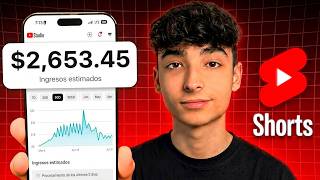

Shorts Pay Hundreds Daily? Real Proof
36sOpens with shocking income proof that challenges common belief that shorts don't pay, sparking curiosity and controversy.
▶ Play Clip"Title promises a method to make money with shorts, and the video delivers a detailed, actionable strategy with real earnings proof."
This video reveals a proven strategy to make money with YouTube Shorts, debunking common myths. The creator shares a transparent case study of a channel earning over $2,155 since December 2025, and explains how to achieve high RPM by targeting audiences in countries like the US, UK, and Australia. Key steps include warming up the channel, analyzing viral shorts, and focusing on retention metrics.
Most people fail with shorts because they don't understand how to make money. A single shorts channel generated hundreds of dollars daily since monetization in December 2025, earning over $2,155.
RPM (revenue per 1000 views) varies by audience location. For India/Philippines, RPM is $0.01-$0.06. Targeting US, Canada, UK, Australia can yield $0.15-$0.20, up to 200% more.
To join YouTube Shorts revenue sharing, you need 1,000 subscribers and 10 million valid views in the last 90 days.
Music deals from production companies pay for using sounds in shorts, increasing RPM and earnings.
Avoid niches with very young audiences (low RPM). Good niches: podcasts, everyday curiosities, religion. Choose something you like for consistency.
New channels face zero views. Warm up by browsing YouTube, interacting with niche content for 2-3 days to signal you're a real user.
Study competitors' viral shorts: what they talk about, how they start, what keeps viewers. Get inspired, don't copy.
Clip-dependent: video first, then script (reactions, curiosities). Script-dependent: script first (curiosities, quizzes). Use AI for script ideas but write yourself for human touch.
Swipe rate: percentage who stay. Aim for 75-80% or higher. Average view duration: ideally 100% or more. High retention signals quality to algorithm.
Start with 1 short/day, then increase to 2-3. More attempts = more chances. Don't spend hours editing; focus on ideas and scripts. Use tools to scale.
Success with YouTube Shorts requires understanding RPM, targeting high-paying audiences, warming up your channel, and focusing on retention metrics. Consistency and volume are key; scale with tools and reinvest earnings.
What is RPM in YouTube Shorts?
Revenue per 1000 views.
01:32
What RPM can you expect if your audience is from India or the Philippines?
$0.01 to $0.06 per 1000 views.
01:47
What RPM can you achieve by targeting US, Canada, UK, or Australia?
$0.15 to $0.20 per 1000 views, up to 200% more.
02:02
What are the two requirements to join YouTube Shorts revenue sharing?
1,000 subscribers and 10 million valid views in the last 90 days.
02:52
What are music deals in YouTube Shorts?
Companies pay you to use their sounds or music, increasing your RPM.
03:36
Why should you warm up a new YouTube channel?
To signal to YouTube that you are a real user, increasing the chances your shorts get shown.
05:08
What is the recommended swipe rate for a viral short?
75-80% or higher.
09:35
What is the ideal average view duration for a short?
100% or more of the video length.
10:16
What is the difference between clip-dependent and script-dependent shorts?
Clip-dependent: video first, then script (reactions). Script-dependent: script first (curiosities, quizzes).
06:53
Real Earnings Proof
Shows a transparent case study of a shorts channel earning over $2,155 since December 2025, debunking the myth that shorts don't pay.
00:02RPM Nuance
Explains that RPM varies drastically by audience location, with potential to earn 200% more by targeting high-paying countries.
01:32Channel Warming Technique
Reveals a simple but effective method to avoid the zero-views trap by interacting with content before publishing.
04:54Swipe Rate Benchmark
Provides a specific target (75-80%) for swipe rate, a key metric for virality.
09:35[00:02] still don't make any money, it's not because shorts don't pay, it's because almost no one understands how to actually make money with them. What you are seeing here is what a single channel of shorts has generated. And so you can also see how it
[00:14] started, since it was monetized in December 2025, from day one, it has been giving hundreds of dollars every day . And yes, all of this you're seeing is with a YouTube Shorts channel, something that people today believe is
[00:27] impossible. Also, so you can see here in the income that it's all with shorts, so you can shorts fit, so you can see what it has already generated, because it's already more than $2155.
[00:39] And no, it's not a rare case, nor is it a channel that opened a long time ago. What's more, the channel is very recent; it opened on November 22, 2025, just a few months ago. And I'm showing it to you so you can see the real metrics
[00:53] transparently, because yes, I've seen many YouTube videos about how to make money with shorts, but the channels they show you have been publishing for a long time or have barely generated any money. And I'm telling you this because I was exactly on the
[01:06] other side. I uploaded short videos, got thousands of views, and didn't see a single euro until I understood how short videos and their monetization really work. step how to make money with YouTube Shorts, how much they actually pay, what
[01:20] you need to do, and what channels that generate thousands a month are doing. To begin, let's talk about how much YouTube pays for shorts. There are many doubts here, but I'm going to make everything clear. First, there is what is
[01:32] called RPM. This is basically revenue per million, that is, how much YouTube pays you for every 1000 views. Most say they have an RPM between 0.01 and 0.06 per 1000 visits. And that is certainly true, but with a very
[01:47] important nuance. If your audience is from countries like India or the Philippines, then yes, that's probably your RPM. But instead we can do something much better , aimed primarily at an audience in countries like the United States,
[02:02] Canada, the United Kingdom, or Australia, can pay up to 200% more, which means we would have an RPM between 0.15 and 0.20. And language is not an
[02:14] obstacle. Remember that there is now something called artificial intelligence and we can create any video in any language or even replicate it. In addition, this is the best opportunity to create shorts. There
[02:26] are more and more advertisers, more investment, and more monetization formats. That's why, to this day, shorts remain a much less saturated market than long forms. But lately YouTube has been betting much more heavily on
[02:39] YouTube shorts, since that generates a lot of dopamine. These videos are very easy to make, and YouTube is literally full of short videos. However, to avoid confusion, YouTube Shorts do have official
[02:52] longer videos. To get in on the revenue sharing for ads in shorts, you need to meet two very clear requirements. One, have at least 1000 subscribers on the channel. And the second, to have more than 10 million
[03:05] valid views in the last 90 days. Once it's monetized, I want you to generate by going for the lowest possible amount. With an RPM between 0.01 and 0.06, you would be generating between $1 and $60 per million visits. And if we target a
[03:21] better audience and achieve an RPM of between 0.15 and 0.20, you would already be generating between 150 and 200 per million visits. But there's something I haven't told you yet that's going to blow your mind. Music deals exist in YouTube shorts
[03:36] . Basically, these are companies and production companies that pay by using sounds or music in your YouTube shorts. And what does this do? Basically, increase your RPM and therefore help you earn more money. I ca
[03:49] n't show this here due to some YouTube restrictions, but I am private community, I'm teaching how to monetize YouTube strategically, not just with short videos, but by building something truly
[04:03] sustainable. I'm only showing it to you because if you're serious about your channel and want me to help you, you have the link to access the community in the description of this video. But let's now go over the first steps you can take on your channel.
[04:15] you choose a niche with a very young audience, you might get a lot of views, but YouTube might pay very little. Even so, if your passion is video games, for example, I recommend that you upload videos of that
[04:29] style, because that way you'll ensure you reach many more people. Instead, you can look for interesting niches like podcasts, everyday curiosities; I 've even seen short videos about religion that work very, very well.
[04:42] But remember to choose something you like because you'll need consistency when uploading videos for this to work for you. In any case, you can search and filter by niche, even the most viewed channels on YouTube, and
[04:54] exploited. The second step is creating the channel, and this is where 99% of people, without exaggeration, make a mistake, and that's where you fall into the zero-views trap. And believe me, it's happened to me and it feels
[05:08] horrible. YouTube trusts channels with a history much more than completely new channels. That's why, when you create a channel from scratch and upload YouTube shorts immediately, the algorithm may hold them back because it does
[05:21] n't yet know who you are and therefore doesn't trust you. But there are two a channel that was created several years ago, even better. If not, you can opt to heat it up. But, Edu, how do you do that? It's very simple,
[05:36] for two or three days go to YouTube from that channel and browse through the complete videos, interact with content from your niche, like what makes sense to you or what you like, and quickly skip what doesn't interest you. This will
[05:49] tell YouTube something very simple. This is a real user, that is, a human person and not a robot. And that greatly increases the chances that your first shorts will start to show much faster. Furthermore,
[06:01] while you're doing all this, you're training the algorithm to you only interact with content related to your topic, YouTube starts to associate you with that niche even before you publish videos. And that sets the
[06:14] stage for the next step: creating shorts with real viral potential. The point, if you've done the previous step correctly , you should have already identified who your competitors are, because while you were warming up the channel, you
[06:27] were also watching shorts from your own niche. And here there's no need to reinvent the wheel, the smart thing to do is to do what already works. To do this, analyze the most viral short films in your theme. Pay attention to what they talk about, how they start, what kind of
[06:40] stay until the end. In other words, what does that video have that the other one doesn't? Then you take that idea, give it your own twist, and adapt it to your channel. But be careful, don't copy or clone, just get
[06:53] inspired and do better. From here there are two very clear ways to create the . In this type, the clip is basically what rules. The idea comes from the video itself; it's when you find a viral clip and build the
[07:06] commentary on top of it. It's the typical reaction short, curiosities about a clip, or narration about something that's already happening on screen. Here, the video comes first, and then the script. And on the other hand we have script-dependent shorts
[07:19] , which in this case is the other way around. First comes the script, and then examples could be channels of curiosities, surprising facts, quizzes, for example, or short stories. And the hook here is in what
[07:34] is said, not so much in the clip itself. And now something that many of you have asked me is, "Edu, how can I implement artificial intelligence short films where the script is king, you can use artificial intelligence to generate
[07:47] ideas or structure the text. But in short films where the clip is king, it's much better if you write the script yourself and then, if you want, use artificial intelligence only to polish it and not to create it from scratch. This way you maintain a
[07:59] human touch and prevent everything from sounding the same as everyone else and from sounding too you can use, for example, Chat GPT, although my recommendation is that tried them and they are very good alternatives. Besides, you'll be able to
[08:13] differentiate yourself from everyone else who makes all the scripts with the same voice and editing, it's very simple. Once you have the script ready, you can then generate the voice-over. And for this you can use tools like elevabs.
[08:26] like Capcut, which is more than enough for short films, although I personally prefer using programs like Adobe Premiere Pro. But I do want to clarify that you do n't need very complex editing; what
[08:39] your short film needs is good pacing, clarity, and a good hook from the very first second. Because when you combine a proven idea, a clear script, and a well- own. Now, when you create shorts, there are two key metrics you absolutely must understand
[08:53] only with viral content can you monetize shorts quickly, and only then can you these metrics I'm talking about are retention and average view duration. Don't worry, I'll explain them to you now. The first is the swipe rate, that is
[09:08] , the percentage of people who stay to watch the short. And this is exactly of your own shorts and your own videos on YouTube. Notice how here I have this section showing how users have interacted, and it tells me
[09:22] and how many people skipped the content. And why is this metric so important? Because the more people stay, the more YouTube understands that the content is good and the more it promotes it, the more it recommends it. Basically, as a
[09:35] reference point, you should be aware that your video should be among the 75-80% of people who stay to watch. In this case, as you can see, I meet it, in fact I exceed it, so that assures me that the short will work
[09:49] better. Even so, I will say that if it can be more, all the better. I've even had shorts with over 90% down, and that somehow ensured that it would go viral. Even so, if I tell you that it will never be 100% certain, that won't guarantee it,
[10:02] but it will help you a lot more to make it happen . And the second metric is how long people watch your average short. And here's a rule that's very simple. If your short lasts, for example, 20 seconds, ideally the average should be 20
[10:16] seconds or more. That means people watch it all the way through or even watch it again. And that's a brutal signal for the algorithm. And for that, simply look at your video's retention graph . If it has a high retention rate, as
[10:30] close to 100% as possible or even exceeding it, that will be a great signal for for us, the audience, to know if that video is more likely to go viral or not. And I want you to see here how, for example,
[10:43] want you to see here how, for example, this video starts with a 154% retention rate, and obviously, like all videos, the retention rate drops, but it remains at a very high percentage, and that obviously makes
[10:56] this video more viral. In fact, notice how this video got over 11 million views. Even so, with everything I've shown you, I'm not saying that if you reach this number you'll definitely go viral because it doesn't
[11:08] work that way. But the higher these two metrics are, the more likely YouTube is to recommend your short. Now, the metrics? For these metrics to go up, your shorts have to deserve them,
[11:22] although as you might guess, not all shorts are going to go viral and that's with shorts, you need some of them to be profitable. And for your channel been showing you in this video, you first need to do the
[11:36] following. Publish more, but do it wisely. In short, more attempts equal more one a day. Once you see that the channel is already moving, upload two a day. And if you really want to climb, three shorts a day. But don't do it all at once, because
[11:51] some new channels that do that get zero views. And as for the time, don't go crazy. Publish when your audience is awake. But there is still one last step that you need to know, and I've saved it for last. If
[12:03] because it's a reality. If you're spending hours editing each short film, you're going to be very slow, and your work should be idea plus scriptwriting plus from the beginning if you have a budget or as soon as you monetize the
[12:18] channel and can reinvest and leverage what you are generating, because Scalar Shorts is not about editing better, it's about publishing more without losing quality. And remember this, in fact, I'd like you to write it down. Short is a game
[12:30] of volume plus consistency because if you publish little and sporadically, you never give the algorithm enough attempts. If you maintain quality and repeat the process, exploding. But the mistake most people make is thinking that shorts are just
[12:45] channel and have been posting for a while, but it's not working, at Founders we work on exactly all of this . And so you can see the community from the see here on the calendar, we held several meetings and private calls
[12:59] where we analyzed what is hindering your growth, applied already validated strategies and, above all, made sure that your shorts or your videos don't depend on the strategies you can apply to your channel to make it work much better. And
[13:12] sharing their results, their channels, their videos, applying all these strategies that we are teaching every day. So, if you link to the community in the description and pinned comment of this
[13:26] consistently, you'll notice the change because YouTube rewards structure, not improvisation, and that's what we teach on this channel. So I sincerely learned something new today and
[13:39] leave you here, right here, another video that you'll find very interesting about shorts, and you can subscribe to the channel here. So with that said, see you in the So with that said, see you in the next video.
⚡ Saved you 0h 13m reading this? Transcribe any YouTube video for free — no signup needed.