

Rich People Own, Not Earn
45sReveals a counterintuitive truth about wealth that challenges common beliefs, sparking curiosity and debate.
▶ Play Clip"Title promises a money management rule used by the 1%, and the video delivers a detailed, actionable framework."
This video presents the 25-15-50-10 rule for managing personal finances like the top 1%. It breaks down how to allocate income into growth, stability, essentials, and joy, with practical steps for investing, building an emergency fund, and controlling spending.
The richest people are 75% entrepreneurs, 15% investors, 7% inheritors, and 3% athletes/entertainers/artists. Entrepreneurs own businesses, investors own assets, and athletes own rare skills.
The rule allocates 25% to growth, 15% to stability, 50% to essentials, and 10% to joy. It's designed to help anyone manage money like the top 1%.
Growth means investing in assets that put money in your pocket, not mindset nonsense. Most people spend on useless things; instead, put money into assets like index funds, real estate, skills, businesses, or stocks.
Billy invested $200/month for 40 years (total $96k) and ended with $1,264,816. Phil invested $300/month for 30 years (total $108k) but only got $678,146. Starting early beats saving more later.
Low risk: index funds (e.g., S&P 500). Medium: real estate/REITs, skills (copywriting, coding). Higher: online businesses, individual stocks. High risk: crypto (Bitcoin, Ethereum, NFTs).
Use accounts like Stocks and Shares ISA (UK), Roth IRA (US), and workplace pensions to save on taxes. Roth IRA grows tax-free; even billionaires use it. Employer match is free money.
Set up a monthly transfer to your investment platform on payday. Use a three-fund portfolio: US stock index, international stock index, and bond fund. Example allocation: 60% US, 30% international, 10% bonds.
Stability fund covers 3-6 months of essential expenses. Store in a high-yield savings account (4-5% interest) that's easy to access and zero risk. Automate contributions and use tactics like paycheck sweep and round-ups.
Cap essentials (rent, groceries, utilities, transport, insurance, clothes) at 50% of income. Cut unnecessary subscriptions and focus on housing and car costs. Use the 7-day rule to avoid impulse buys.
Allocate 10% for joy (travel, hobbies, dining, gifts) to make saving sustainable. Preload a separate 'joy jar' account. Spending on experiences and connections prevents burnout.
The 25-15-50-10 rule provides a balanced framework for building wealth while enjoying life. Start investing early, automate savings, control essential spending, and allocate guilt-free money for joy to achieve financial freedom.
What percentage of the richest people are entrepreneurs?
75%
What are the four categories in the 25-15-50-10 rule?
Growth (25%), Stability (15%), Essentials (50%), Joy (10%).
00:58
In the Billy vs Phil example, who ended with more money and why?
Billy ended with $1,264,816 vs Phil's $678,146 because Billy started investing earlier (40 years vs 30 years) even though he invested less total ($96k vs $108k).
02:53
What is the average annual return of the S&P 500 mentioned?
10%
03:37
Name three low-to-medium risk investment options from the video.
Index funds, real estate/REITs, and skills (copywriting, coding, etc.).
04:34
What is the annual contribution limit for a Roth IRA?
$7,000
08:20
What are the three funds in a three-fund portfolio?
A US stock index fund, an international stock index fund, and a bond fund.
10:05
How many months of essential expenses should a stability fund cover?
3 to 6 months.
16:08
What are two tactics to build a stability fund faster?
Paycheck sweep (automate 15% on payday) and round-up apps (round purchases to nearest dollar).
19:03
What percentage of Americans earning over $100k live paycheck to paycheck?
Over 60%.
20:27
What is the 7-day rule for impulse purchases?
Wait seven days before buying; if you still want it after seven days, consider it.
26:19
What is the purpose of the 10% joy fund?
To spend guilt-free on experiences, hobbies, and gifts, making saving sustainable and preventing burnout.
28:12
Wealth Distribution Insight
Reveals that most wealthy people are entrepreneurs or investors, not employees.
Power of Starting Early
Billy invested less total but ended with nearly double due to starting 10 years earlier.
02:53Tax-Advantaged Accounts
Using accounts like Roth IRA can save thousands in taxes; even billionaires use them.
06:49Stability Fund Importance
Personal story of car breakdown shows how lack of emergency fund can derail finances.
14:24Essentials Spending Trap
Over 60% of high earners live paycheck to paycheck due to lifestyle inflation.
20:27[00:00] that will change your life if you let it sink in. The richest people in the world are 75% entrepreneurs, 15% investors, 7% inheritors of wealth,
[00:12] 3% athletes, entertainers and artists, So if you wanna know how to manage your money like the 1%, So let's think about it.
[00:28] Entrepreneurs own businesses, investors own assets, Finally, athletes, entertainers and artists own rare skills. you are what's owned.
[00:43] So how can you start owning things like the 1%? I designed this rule so that anyone, can manage their money like the top 1%,
[00:58] it's about how you manage what you make. I've actually used this rule for decades, even though I started out
[01:12] So let's get into it. The first 25% of your income should be going towards growth. By growth, I don't mean some kind of mindset nonsense
[01:29] about growing as a person with the power of meditation. You see, when most people get their paycheck, on useless things they don't even remember buying.
[01:43] owning nothing of value. The system wants us rich for a week, so we've got no breathing room
[01:58] This is effectively modern day slavery. Slaves used to work every day with no pay, Today, people work nearly every day and get paid.
[02:14] on food, shelter, and water. Once you understand this, you can start fighting back and putting it straight into assets.
[02:29] and puts money in your pocket. these assets that you own are working for you Eventually, these assets could even make you more money
[02:41] to invest in assets. because the sooner you start, the better. This is Billy.
[02:53] and this is Phil. he invested $300 a month. and they both stopped investing.
[03:08] Now I'm gonna give Phil a walking stick Right, that's better. Billy put in $200 per month for 40 years,
[03:23] so that's a total of $96,000. However, Phil put in $300 per month for 30 years, which is a total of $108,000.
[03:37] because he saved more each month. because they were investing instead of just saving. which is the average return of the S&P 500
[03:52] then the numbers start to look a little bit different. Fuel's investment will be worth $678,146. Whereas Billy's investment would be worth
[04:07] a staggering $1,264,816. Billy invested $12,000 less,
[04:19] all because he started earlier. That's why you should start now, even if it's small, But how can you actually get started?
[04:34] There are loads of ways to grow your money, So I like to think of them as a scale from relatively safe and steady to high risk, high reward.
[04:48] At the lower risk end, we've got index funds. You are not trying to pick winners. like the S&P 500 I mentioned before.
[05:02] You just let it sit there Then there's real estate. or REITs if you haven't.
[05:14] It's kind of like buying a small share in a building In the middle is skills. the fastest return on investment you'll ever see.
[05:28] I'm talking about things like copywriting, editing, sales, coding, anything you can actually use to bring in income. However, it does take more time to learn,
[05:41] Further up, we've got online businesses, These can pay off big, but they take a lot of effort
[05:53] before you find your. I know it's tempting to try and pick the next Tesla, and you really know what you're doing,
[06:06] So if you're gonna do it without learning the specifics, not your main strategy, I'm talking Bitcoin, Ethereum, NFTs,
[06:22] Can you make money with these? Absolutely. Can you lose it overnight? Also, absolutely. but I never risk more than I'm willing to lose.
[06:35] but not where you build long-term wealth. that actually builds a foundation, Then as you grow more confident,
[06:49] Now we've gotta talk about how to invest, you could be handing over thousands That's why step two is to set up tax-advantaged accounts.
[07:06] to legally save as much money as possible. I'm just sharing what I've personally done over the years. One of the best options is the stocks and shares ISA.
[07:24] and anything you earn is tax free. All you have to do is select the stocks and shares ISA Since I was planning to talk about Trading 212 anyway,
[07:39] in sponsoring this portion of the video. a free fractional share worth up to a hundred pound when they create an account.
[07:52] you'll both get a free fractional share. you've probably got access to a workplace pension.
[08:04] and your employer will match with 3%. You don't pay any tax on the money it earns If you're in the US, your setup's a little bit different.
[08:20] The Roth IRA is one of the best accounts you can open. but every penny it earns grows completely tax free, The limit on this account is $7,000 a year
[08:36] Even billionaires use this account. reportedly turned his Roth IRA into over $5 billion. in early stage high growth companies,
[08:52] which then increased value significantly. which is basically the US version of a pension. It also grows over time
[09:07] and if your employer offers a match, definitely take it. so here's a list of all the tax advantage accounts Hopefully you can find an account in this list
[09:22] of the tax savings your country offers you. put their money in every month That brings us onto step three, actually start investing.
[09:38] Whether you're on Trading 212, Vanguard or something else, The best thing you can do is set up a monthly transfer
[09:50] into your investment platform, ideally on payday. sitting in your account and get tempted to spend it. or try to time the market.
[10:05] to build a three fund portfolio. The first fund is normally a US stock index fund, like Apple and Amazon for example.
[10:19] which is similar to the US-based one, and the final fund is something called a bond fund, as they're generally less volatile than stocks
[10:34] Let me show you how to set something like this up then I'll leave a link in the description. you can head over to the promo code section of Trading 212
[10:50] to get a free fractional share worth up to a hundred pound. Then go over to pies and then click the plus icon.
[11:02] For our US stock market fund, This Vanguard one should do nicely. the Vanguard Total Stock Market Index Fund
[11:19] This fund is like owning a tiny piece like Apple, Amazon, and Coca-Cola. or distribution in the brackets.
[11:34] as it reinvests your dividends Then let's go and search for our next one, For this, let's select iShares, MSCI World,
[11:48] UCITS ETF with the ticker IWDA and tap Add to pie. This fund is like having a collection of companies like Europe, Japan, and Canada.
[12:04] let's search for iShares USD treasury bonds, 7 to 10 years, UCITS ETF with the ticker IBTM and tap Add to pie.
[12:17] They promised to pay you back with a little extra, Right, now those are added, On this page, you can adjust the percentage allocation
[12:34] If you go with an aggressive approach, which can grow faster, but can also go up and down a lot. where 90% of your money is in stocks
[12:49] This set up is the potential for big returns, If you prefer a slightly less risk then a slightly less aggressive approach
[13:03] with around 80% in stocks and 20% in bonds. It's all down to your age. the older you are, the more bonds you should have,
[13:16] so let's make the S&P 500 60%, the iShares world fund 30% and the bond fund 10% and click Next and then Auto invests.
[13:29] as it shows you how much money you could make you can get back less than you invested but it's still a great way to get an idea
[13:43] of how much you could make based on data back projections. stop fiddling and go and make more money, who build wealth aren't the ones
[13:56] They're the ones consistently putting in more over time. so you can increase your investments. This is where the skill building I talked about in step one
[14:10] If you haven't yet, learn something valuable. then feed it straight back into your investments. (smooth jazz music)
[14:24] should be going towards stability. A lot of people don't realize Some of it needs to be set aside to protect your progress.
[14:39] 'cause I had to learn it the hard way. so when I turned 18 and needed a car to get to work, so I did what most people do.
[14:53] and bought myself a solid little German whip, a VW Golf. and for about three months Then outta nowhere, the engine blew up.
[15:08] I had no backup, no safety net, and no clue what to do, I'd lose my job. more pressure and more stress.
[15:22] To me, that car didn't just break down, it broke my finances If I just had 15% tucked away for stability, Most people don't have a money problem.
[15:36] One unexpected bill, and it all falls apart. you'd be forced to sell your investments at a bad time, That's why you need a margin for error built into your life.
[15:50] Step one is to calculate your stability fund. These are things like your groceries, and any essential services like your internet connection,
[16:08] All of those things combined should give you a total. Let's say that adds up to $1,500 per month.
[16:22] This will equal the ideal stability fund So in this example, that should be $7,500.
[16:37] 15% of your wages should be going You might be thinking this is quite extreme, However, I know from experience that when life hits,
[16:51] So if you only have a couple of months saved up, Step two is to store it correctly. don't make the mistake of parking it in the wrong place
[17:06] as having it in the first place, and for that reason, Firstly, it must be easy to access. This money should be available within 24 hours max,
[17:21] that penalizes you for withdrawing early in return for a bit more interest. and still not be able to access their stability fund.
[17:33] When things go wrong, you need speed, Secondly, it must be zero risk. This is not money you invest, gamble or chase returns with.
[17:47] do not put your emergency fund into the stock market, because when an emergency hits, the market might be down. or anything else that's meant to grow over years.
[18:04] Although this isn't your growth pot, You want it somewhere that earns a bit while it waits with zero interest, then it will be eaten away by inflation
[18:21] That's where high yield savings accounts come in. you can get savings accounts with 4 to 5% interest rates I'll leave some banks in the description.
[18:35] Ally, and Marcus by Goldman Sachs, and they're FDIC insured so your money's safe. Most people think it takes years
[18:49] but if you play it smart, When I was building up my savings, Using them all together help me really accelerate
[19:03] Tactic one is called the paycheck sweep. This is when you take 15% of your income the second it lands You can automate this with a direct debit
[19:17] just like we did with the 25% that goes towards growth. This is a promise you make to yourself
[19:29] you immediately replace it. and it costs $250 to fix, that's fine. but the next time you get paid,
[19:41] you top that $250 straight back up like it was never gone. This one might sound a little bit crazy, These round every purchase up to the nearest dollar
[19:56] So if you spend $3.60, it rounds up to $4 It sounds small but it adds up fast The other way to do this is with cash back.
[20:11] and paying it off in full every month, Once your stability fund is fully stocked, or you can shift it into the final 10%,
[20:27] (smooth jazz music) towards your essentials. Surprisingly, over 60% of Americans
[20:43] earning over $100,000 a year still live paycheck to paycheck instead of actually becoming rich. and still feel broke every month,
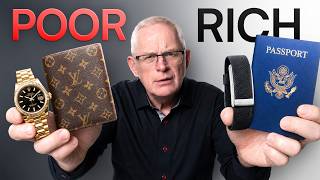
[20:57] it's about how much you waste. This was me age 20, and that's my mate. Designer shirt, an expensive watch,
[21:11] I was the opposite, baggy top, cheap watch, just the basics. I could have at least picked up but I was young, so cut me a bit of slack,
[21:26] He had $43 and 20 cents in his account whereas I had $1,000 plus quietly sitting in investments
[21:40] I'd learned from my experience with my car loan disaster, which meant cutting out any unnecessary spending Although this might not seem like a lot,
[21:55] This $1,000 was a start, Wealth isn't what you see, it's what you don't see. by saying things like, I need a safer car.
[22:10] and I deserve a nice meal out, so how can you keep this under control? Well, step one is to get clear on your essentials.
[22:24] because what many people consider essentials nowadays Essentials are the things That means your rent or mortgage, groceries,
[22:37] utilities, transport, insurance, and clothes. Just what you absolutely need. Takeout isn't essential.
[22:51] The gym you haven't visited since January. you keep meaning the cancel, and the list goes on. but so many people sign up for stuff they never use.
[23:06] to free up money is to go through your bank statements if it's not helping you live, work or stay healthy,
[23:19] so why do I recommend capping it at 50%? 60 to 70% of their income on what they think are essentials,
[23:32] it forces you to actually eliminate what you don't need. from wanting to spend more of what you earn which is always something you should be doing.
[23:47] So many people talk about cutting out the little expenses Honestly, I'm guilty of saying this myself. then you first need to focus on the two key categories.
[24:03] For most people, this is the biggest expense, Always renegotiate your rent when the lease is up.
[24:15] than go through the hassle of listing, Even a small reduction or freeze can save you thousands. If you wanna go further, think about house hacking.
[24:30] splitting a place with mates, If you can manage to limit house then that's a pretty good place to be.
[24:43] Car payments are one of the biggest wealth killers. and end up paying for years on a depreciating liability.
[24:56] buying used, reliable cars at least until your income can support a nicer car.
[25:08] It should be under half of your essentials fund. you could even consider getting rid of the car entirely because it's not just the car payments you save,
[25:24] but also the insurance, maintenance, and parking charges, Once you've got those two areas under control, Use rules, not willpower.
[25:38] your willpower disappears, and that's exactly why the top 1% don't rely on it. that make the right choices automatically.
[25:51] Every time I was tempted to buy something I'd run it through a few key questions. and help me stay focused on the bigger goal.
[26:07] So firstly, ask yourself, is this an impulse purchase? It's likely something and if it fits into the essential categories
[26:19] However, if the answer is yes, The trip behind this is pausing for seven days ask yourself again if you still want it.
[26:37] That's the funny thing about waiting seven days. and it wasn't that important to begin with. it is time for the next question.
[26:52] If the answer is the brand, then don't buy it. If it's an essential, that will do the job just as well, if not better.
[27:08] Wealthy people don't throw money at brands They really think about the value. Well, if you buy a $60 pair of boots
[27:20] and wear them a hundred times, that's 60 cents per wear. But if you buy a $200 pair of designer trainers and going too cheap isn't smart either.
[27:33] in the wash is still a waste of money. So if you answered value, will this improve your life?
[27:46] a conscious intentional purchase, go ahead. it's probably just about impressing someone, It's not worth your money.
[27:59] you'll be able to decide without even consciously thinking about the questions. Remember, it isn't about being tight,
[28:12] (smooth jazz music) This is the 10% that keeps you sane.
[28:24] stability and essentials. and then wonder why saving feels so pointless. I've realized it's the little things that refuel you
[28:38] in the first place. 92% of people say they overspend because saving without joy starts
[28:53] and that's exactly why this 10% exists, not as an excuse. It's a thing and most importantly sustainable.
[29:08] you have to be strategic with how you use it. To make something guilt free, The truth is you can spend your 10% on whatever you like.
[29:23] which should make them more guilt free. such as trips away or just weekend getaways.
[29:35] It's also a great way to de-stress. I completely ignored the importance of vacations,
[29:47] The doctors diagnosed me with stress-induced shingles. and that's when I went on my first ever ski trip. Since then, I've made it a priority
[30:01] Instead of seeing it as a waste of time or money, because it helps me stay sharp and more importantly, Next is hobbies.
[30:14] This could be painting, gaming, photography, This is valuable as it keeps you passionate. so by doing it in your spare time,
[30:27] so you can work harder for longer. Dinner, concerts and experiences. and it was a big mistake
[30:40] Having a strong social network is so important, Finally, we have gifts. but for your loved ones.
[30:53] You can see how most of the stuff I teach in these videos Back when I was focused on chasing my goals, I often forgot birthdays and special occasions.
[31:07] that I overlooked what mattered in the present. about receiving gifts. and we started exchanging anniversary gifts
[31:22] They're about the thought, the connection, Step two is to preload the fund. and call it your joy jar.
[31:37] You can actually have multiple current accounts which makes things very simple. of 10% of whatever you make to be deposited
[31:52] So if you make $2,000, send 200. It doesn't matter how much it is. Just make sure you don't cheat.
[32:07] stability, or essentials when it gets low. When you know this fund money is limited, This is exactly how you protect your goals
[32:24] or you pass something in a shop that you really love. If you don't have a particularly large joy jar
[32:36] above anything else. Bro's gonna die with all his money, and I get it. From the outside, it might look like I'm depriving myself,
[32:50] I don't need a garage full of cars That stuff might look rich, but it doesn't feel rich to me. such as a ski trip with my wife,
[33:05] meeting you guys in New York, So there you have it, the complete 25-15-50-10 rule.
[33:18] then I'm gonna leave that video right up there, Make sure to subscribe if you want to grow your wealth. Okay, I'll see you over there.


⚡ Saved you 0h 33m reading this? Transcribe any YouTube video for free — no signup needed.