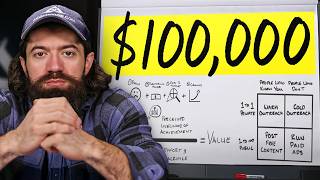

When I Felt Wealthiest: $100K
45sThe speaker contrasts massive financial success with the emotional milestone of $100K, creating a relatable and aspirational hook.
▶ Play Clip"Title accurately promises a six-step roadmap to $100k, and the video delivers exactly that with actionable advice."
The speaker shares his personal journey from sleeping on a gym floor to building a $106 million business, revealing that his wealthiest moment was when he had $100,000 in the bank. He provides a six-step roadmap to help others achieve their first $100,000 in savings, emphasizing the importance of cutting costs, saving time, learning marketable skills, and avoiding lifestyle inflation.
The speaker felt wealthiest when he had $100,000 in his bank account, not during larger exits, because it freed him from worrying about basic expenses.
Eliminate all non-essential spending: no eating out, no new clothes, cheap housing (e.g., splitting a bedroom), and a paid-off clunker car to maximize cash flow for reinvestment.
Use the 5-9 AM and 5-9 PM blocks (before and after a 9-5 job) for productive work. For entrepreneurs, use a 4-4-4 split: 4 hours promotion, 4 hours delivery, 4 hours building.
A maker needs an empty calendar for deep work; a manager thrives on many touchpoints. Protect your first 4-6 hours as maker time to maximize output.
Find skills already in demand. For B2B, look at business functions like content creation or outreach. For B2C, check your own credit card statement. Use the 1-1-1 rule: sell one product to one avatar on one channel until $1M.
Learning means changed behavior. Use 10,000 iterations (not hours) with feedback loops. Analyze top 10% performers, identify key differences, and avoid common mistakes.
Invest in tools (software), implementation help (courses, tutoring), and trial attempts (ads, editing software). These provide leverage on time.
Keep living cheaply even as income grows. The speaker earned $20k/month but still split a $400 room. Bank the surplus to reach $100k savings.
Having $100k in savings provides a 3-year runway, freeing you from survival mode and enabling long-term thinking and bigger dreams.
Achieving $100,000 in savings is a critical milestone that provides financial security and the freedom to think long-term. By cutting costs, saving time, learning in-demand skills, investing wisely, and avoiding lifestyle creep, anyone can reach this checkpoint and unlock their potential.
What was the speaker's wealthiest moment?
When he had $100,000 in his bank account.
What is the 1-1-1 rule?
Sell one product or service to one avatar on one channel until you make $1 million.
09:00
What is the definition of learning according to the speaker?
Same condition, new behavior.
10:30
What is the 4-4-4 split for entrepreneurs?
4 hours promotion, 4 hours delivery, 4 hours building.
04:30
What is the difference between a maker and a manager?
A maker needs an empty calendar for deep work; a manager thrives on many touchpoints and decisions.
06:30
What are the three buckets to spend money on?
Tools, implementation help, and trial attempts.
14:00
Why is 10,000 iterations better than 10,000 hours?
Because iterations assume failure and feedback loops, which are essential for learning.
10:30
Wealthiest Moment
Reveals that financial freedom comes from savings, not high income.
Extreme Cost Cutting
Demonstrates the level of sacrifice needed to accumulate capital.
01:30Maker vs. Manager
Provides a clear framework for structuring productive time.
06:30Learning Through Iterations
Emphasizes feedback loops and analysis of top performers.
10:30Avoid Lifestyle Inflation
Critical advice for actually saving the first $100k.
15:30[00:00] $42 million in distributions, a $46.2 million exit, $106 million in a weekend. Most people hear those numbers and think, "Oh, that's probably when he felt the richest." That's actually not the truth. The moment that I felt the wealthiest in my entire life was when I had $100,000 in my bank account. That was the first big unlock for me as a person. And the reason is before that, I was sleeping on a gym floor and doing math
[00:20] on whether I could afford groceries, right? And once I had $100,000, that was when I stopped having to worry about tomorrow, right? About paying rent, about paying dues, about paying my cell phone bill, or paying my car insurance. You can't think about your long-term vision if you're trying to pay rent, right? That's just real. And so, in this video, I want to give you a six-step roadmap, as clear as humanly possible, to making and banking your
[00:39] first $100,000. If you're a big baller business owner, then you can skip this one. But if you don't have that yet, then this is just a pure give on my part of trying to help you get there. The first step is that we have to cut all costs, so that we can take more risk. When I say all costs, I mean all costs. That means you don't eat out anymore for anything. And if you're hungry, you
[00:59] deal with it. And if it's not from a discount grocery store, you don't buy it. Clothing? Like, what you have right now on your back is everything you need for the next 2 years, period. No exceptions. Just keep reusing it. Trade or go to Goodwill. You go to work, you go home, and home is ideally with your family, or worst case, with another family also trying to make it and save. And it's got to be as
[01:19] cheap as you possibly can. And I say this as somebody who lived through this. When I was beginning my journey, I was splitting a bedroom in a six-bedroom house with one guy, just in that bedroom. As in, like, every night we'd stare at each other, and I'd be like, "Good night, John." And he'd be like, "Good night, Alex." And I'd blow out my candle. >> [laughter] >> Everything about that was true, minus the candle. And pro
[01:39] tip, if you sleep with a fan on your face, it you can't hear anything. So, you know, if you have to deal with it, that's one way to do it. But, I had roommates that I I was paying like three or four hundred dollars a month for a very long time while I was beginning my business and started actually make real money, and I still stayed there. Now, the next thing is going to be your car.
[01:58] So, if you're thinking about expenses, ideally a paid-off clunker is the best way to go. If you can't, you want it to be as cheap as humanly possible, but ideally just pay off your car so you don't have to think about it again. All right, so that covers your food, your car, your shelter. And the reason that this is so important for us to basically stack up this cash flow because you're working and making money, but
[02:18] right now you're probably spending all of it. So, it's like we need to make this we need to decrease it from the downside so we have this cash flow, this fluff that we can start spending and reinvesting in getting more skills, which I'll talk about in a second. All right, real quick, if you're on this path to your first 100K, I want to make it faster and easier for you. So, this uh these books I had
[02:38] 3.6 million of these books that were donated by other entrepreneurs. These books I'm personally donating. And so, if you are on the path, you can get all three of these books for the like nothing, basically. Uh for just covering the shipping. So, I think it's 16 or 17 bucks all in for all three hardback shipped to you, plus a 30-day trial of School so you actually use the stuff and have the tools to apply it in.
[02:58] All right, so it's like it's the best thing we call the business backpack. It's literally everything you need to get started uh online. I'm not promising you're going to be a zillionaire. I'm not promising you're going to make $100,000. I'm just saying it's a great great way to start, and it's the best it's one of the most valuable things I can possibly give you. And again, special thank you to all the entrepreneurs who donated the books
[03:17] cuz we're doing our best to give them out. Now, we have to cut all of our time costs. Step two is save time. And so, if you work a nine-to-five job, this is kind of just the reality of it. Your nine-to-five job is not killing your dreams. All right, so just stop subscribing to that. You're wasting the two four-hour chunks of the day that you do have available to you, which is your five to nine in
[03:37] the morning and your five to nine at night. So, what you want to be doing is instead of just like mindlessly doom scrolling through life, right? Instead, you're like, I have 4 hours before I have to go to work, right? Now, if you work remotely, even better cuz you can be more efficient with it. If you're not remote, then it might be 3 and 1/2 hours, or you just wake up earlier. And I also say this
[03:57] to someone who did this, right? The reason that this whole like I wake up early in the morning became a thing for me was because that was the only time I could get ahead. And so, I I very much believe in Kobe Bryant's perspective on this. So, it's like if everyone else is is, you know, going to practice, he's like, well, if I do two extra practices a day, I'm going to move forward three times faster.
[04:17] And so, one is we got our money back. Two, we got our time back. Now that we have our time back, we need to minimize the distractions in that time period because focus is achieved not through addition, but subtraction. When you remove everything else that doesn't matter, s- focus is what's left. Now, if you happen to be just If you're on your path right now, so like let's say that you have your you're not at job,
[04:36] so you you started a business, but it's not making as much as you want, and you don't have the 100k savings. Let me just give you the simplest formula that I had this happen like the 2.0 version, which is a 4-4-4 split. So, if you're at 9 to 5, then you got 5 to 9 and 5 to 9. If you don't have a a 9 to 5 during the day that you got to go to, then
[04:56] I like to do 4 hours of promotion. First thing I do when I get up is let people know about my stuff because if nobody knows about your stuff, they can't give you money. The second 4-hour chunk is delivery. So, you give the people that give you money what you promised them. The third 4-hour chunk is building. So, this is building the future. Figure out what to do next and how to do it. This is a
[05:16] combination of two things. It's going to be the curation of opportunities. Like, what are all the things that are out there? I have to see them, find them, and then the second is the prioritization of those. Okay, there's 10 things I could do. This one thing is going to get me the highest return. This is what I'm going to prioritize my time and money towards. So, big picture, you promote, you deliver, and you build. That's what
[05:36] you do with your time. Now, regardless of what job or business you have, if you want to save time, you need to understand this concept, which is understanding whether you are a maker or a manager. A maker is when you're in the build mode. This is when you're completely locked in, you're like, "No distractions. I have to go learn stuff. I have to go write copy. I have to go edit videos. I have to go make
[05:55] content. I have to go build this template that I'm going to sell to my customers." Whatever. Manager is when you're interacting with other people. Now, that could be client calls, that could be team calls, that could be vendor calls, any kind of conversations that you have to have, Slack messages, whatever. The thing is is that managers, their perfectly productive day is no blank time, right? It's 5-minute chunks and you're just trying to have as many touchpoints
[06:15] and decisions as possible. A maker, a perfectly productive day is a completely empty calendar. So, I don't know if you're anything like me, when I look at my calendar I truly have nothing on it, I feel one, this immense sense of relief and two, this huge amount of energy of possibility. Like, what big thing can I get done today? And that's when I really move the ball forward. And I'm telling you like the the life hack
[06:35] of all hacks, a single habit that has changed my output, was having my first four to six hours of my day to myself. So, when you're in that maker manager decision mode, I like to block at the micro level my day is maker time, manager time, and then keep them separated because the biggest killer of productivity is task switching, right? So, if you're trying to make and then you're slacking and then you're making and then you're
[06:55] texting, you're you're screwed, right? So, instead, you just have to put the blinders on your maker period and then when you're in the manager period it's like, go for it. Just be distracted and know that that's like the rest of your day is screwed. And I accept that. Like, for me, Mondays are my day that I'm a manager and the rest of the week I try to do my absolute best to be a maker. Now that
[07:14] we have the money saved up and we're still we got some cash, so we drove down our living expenses, we drove down our time expenses so we have free time, and we're organizing it well and we're focused and productive during that time period, what do we do with the time? Three, which is research a skill that people already pay money for. And this is a key part. What you want to do, especially if you're like, "I
[07:34] need to make more than I am right now," go find what people are already paying for, right? So, on a B2C side, it just looks you look at all the things that a business does, right? So, a business gets advertised, so they make content, they do outreach, there's the funnel building process that's associated with that. All of those things, each of those are skills that on their own, you could go build yourself a million dollar plus
[07:54] business off of. Just one of those. And so, that's just on a B2B side as an example. On the B2C side, here's a very easy hack. Just print out your credit card statement or your bank statement and look at what you actually spend money on. So, just think when you're selling to consumers, I'm going to give them time back that they otherwise wouldn't have. And for business owners, you're giving them money that they otherwise wouldn't have.
[08:14] But don't get overwhelmed with the zillion things that you can that you can learn there. Pick one. And so, I have a a a 111 rule, which is you want to sell one product or service to one avatar on one channel until you make $1 million. That's it. So, we saved our money, we saved our time, and then we researched the skill that people are already paying for today. That leads us to number four. Spend time
[08:33] learning. All right, so first of all, it's important that you understand what learning is if we're going to say what it means. So, I say this because a lot of people spend their time trying to learn or sitting in front of a computer or listening to podcast or whatever, but it doesn't actually change behavior, which ding ding ding, that is the definition of learning, which is same condition, new behavior. If you're in the same condition, meaning
[08:53] you're in the same bedroom, you're looking at the same computer, and what you're doing every day is not changing, you are not learning. So, use that as a simple litmus test for understanding whether the content that you were consuming is valuable. If you cannot translate it or the person who's teaching you, whoever it is, me or anyone, into what do I do now? So, there's this big thing Malcolm Gladwell talked about 10,000 hours is this common
[09:13] theme, which is it's not 10,000 hours, but 10,000 iterations. And the reason I like that framing is because it assumes that you will fail, and it assumes that you will get better as you learn, right? It is that 10,000 iterations is a proxy for feedback loops, which means that if you do something and you get no feedback, it's virtually impossible to learn. So, when we were doing stuff in the real world, a lot of times real
[09:33] world will give you feedback loop. You post this content, nothing happens. That is still feedback. It's that it sucked, right? But you can still get better. The fastest way to learn skills is to find somebody who's really good and hire them one-on-one. Fastest way to learn skills. I still did this in my early days, even when I barely could afford it. So, when I say I learn with the first-party data, I give you a handful of
[09:52] examples, but this is a do this instruction list. So, number one, you have to do a lot of volume in order to learn, right? I can't just have one sales call recording. I can't just one comment that I try and learn from. I have to have lots of comments that I have to aggregate. I got to put them together. Number two is that I analyze the top 10%. So, what are the top 10% of sales calls?
[10:12] What are the top 10% of content? What are the the top 10, you know, customer service resolution, uh you know, person? What are What are What are these top 10% outcomes? What do they have in common that the other 90% don't have? And you can apply this to any subject matter that you're trying to learn. So, that is step three. You analyze the difference. Step four is you figure out the most important details like the eyes,
[10:32] like the feet, like the whatever. And this is This is where a lot of people struggle is that they they don't know which part is important. And that's part of learning is that you're like, "There's six differences. I don't know which one was the reason." So, you start trying them one at a time. It just is what it is. And then the final step is avoid the mistakes that the 90% is making uh that are keeping
[10:52] them at the bottom and do more of the stuff the top 10% and you just continue to do another 100 repetitions, look at the top 10, try and make the next 100 look like those 10, and do it over and over again and again until people are like, "Man, you're so good at this. You must be a natural." And that is fundamentally how you learn any skill. We saved our money so we could get aggressive. We
[11:11] saved our time so we'd have time to to actually do the work. We researched which skills to learn. Then, we spent our time actually learning, and we went walked through exactly what those 10,000 iterations look like. So, what do we do now? Step five is you spend the money in the right places. So, I think of this in three bigger buckets. You've got tools, you've got implementation help, and then you've got trial attempts. So, think about
[11:31] that as like, where am I going to spend this time and money? Cuz you actually have to do this in order to get out. Like, if you're if you're just like, "Okay, I'm saving my time, saving money." You're not going to get to 100k, right? Like, you have to do stuff, too. So, for tools, that might mean that you might buy a software tool, right? That might mean like a CRM or a landing page thing or
[11:51] school is nine bucks a month, right? Like, chill. All right. Um to get started, right? Because for you to like the alternative is you could try rebuild the entire thing. Yeah, or you could just like go to grab a tool that's already there. Save yourself some time. So, that's what kind of tools looks like. Implementation, this is where you can buy courses, you can buy uh communities on school if you're looking at to learn anything. You
[12:11] can uh get tutoring, which I'm a huge advocate of, and for some reason this is like falling out of vogue. Um but if you can get someone to just give you one-on-one help, my god, it's so valuable. Um the next is trial attempts. So, that means like, "Okay, I want to start running ads." Okay, great. Well, you got to spend money on ads. Or like, "Hey, um I want to start, you know, making content." You're going
[12:30] to have to spend money on maybe some of the editing software that goes with that. Like, of course, there are free things and be as cheap as possible, but accept that some of these things are kind of minor investments that will give you huge leverage on your time. So, the last step and the whole point of all this is to just increase your active income. People look at the billionaires, they're like, "Oh, they live on passive
[12:50] income." What people miss is that most billionaires who are self-made made their money from making money. Meaning, they had active income. They had monster active income that they could deploy. Like, you get rewarded for the risk you take on. You cannot take any risk on if you have no time and no money. So, you need to go take go find that risk, create something that you can put at risk so that you can get rewarded for
[13:10] it. And we do that through increasing our skill sets and our active income. And so, you're like, "Okay, well, those are the five steps. So, what's the last step?" Number six, do not increase your lifestyle. All right? I I know guys who are making $40,000 a month and made it for years. Great sales guys and spent every single dollar. I've got multiple friends who didn't start saving money until they're 40s. And they were like, "Oh my
[13:30] god, I can't believe I I just like lived that way." Right? You want to be rich, not look rich. Right? This is about 100k in the bank, not 100k in revenue. Everything minus food and shelter is your profit. I say this is once things started working out for my gym, my first gym, I was making about $20,000 a month in income, personal. I was still splitting the room, paying $400 a month in rent. Because I was
[13:49] like, "Well, dude, I need to say like my goal was not to stop at $20,000 a month." I was like, "I want to go big. And I'm going to need all this cash to open a new location, to learn more stuff, to attend more conferences, all of this stuff cuz I wanted to learn." And so, basically the day that you stop spending money on learning is the day you decide that you do not want to make
[14:09] more. And so, zooming all the way out, the six steps to getting your first $100,000, you got to stop spending money so you have money to spend on the right stuff. You got to stop wasting time so that you have time to invest in the right stuff. What stuff do you invest in? Number three is you have to research. You got to pick. You got to look. And the best way to look is not to risk
[14:29] it on something that you don't know, but find stuff people are already spending money on. The fourth is now that we know the thing that we're going to focus on, we're going to eliminate all the other distraction and we're going to spend all our time learning. Number five, the money that you do have, you want to spend on tools, implementation help, and attempts, trying it and failing. And then finally, once things actually start working, you never
[14:48] get to the 100k in a bank account just by increasing your income. You also got to not let your lifestyle take back over so you can finally bank it. And the reason this is so kind of near and dear to my heart is that when I had the first 100k was the first time that I mean I remember looking at Leila and I was like, "We did it." I said, "We could do nothing and off for
[15:08] 3 and 1/2 years." And it was crazy cuz like I think about that now, right? Two people, $100,000 in savings, 3 years. And I wasn't think about it in terms of investments or anything like that. I just knew that I didn't have to worry about rent. I didn't have to worry about food. And that was when I was able to really start thinking long-term. And so I want as many people as possible to get that point
[15:28] because many of you have bigger dreams than that. But you can't get there until you pass this checkpoint. Like it's Maslow's hierarchy of needs. Like until you're you're not thinking about food and shelter, it's amazing to want to change the world, but if you got to pay rent tomorrow, you got to pay rent tomorrow, right? And so this is the plan to help you do that.

⚡ Saved you 0h 15m reading this? Transcribe any YouTube video for free — no signup needed.