

From Zero to €2k/month in 90 Days
45sThe compelling story of Monsen's success and the promise of a step-by-step system immediately hooks viewers seeking financial independence.
▶ Play Clip"Delivers a solid step-by-step system, but the title oversells by implying a complete business setup, while the content is mostly a pitch for a paid program."
The video presents a step-by-step system for starting a one-person business using AI, specifically Claude, by creating automated YouTube channels. It argues that this approach is simpler and more profitable than building apps, and provides a detailed guide on niche selection, content creation, and scaling.
Monsen, a beginner, generated over €2,000 a month within 90 days using an automated YouTube channel, without any technical skills.
In the US, over 30 million people run one-person businesses, with 84% of businesses having no employees, and 70% of these are profitable in the first year. AI is the key enabler.
The difference between profitable (77%) and non-profitable (23%) users is understanding that AI is a tool to leverage, not to delegate everything to.
Building an app is a 'black hole of time and money' for 99% of people. 99% of apps made with AI generate less than $100 a month.
Automated channels require zero technical knowledge, have zero product risk, offer recurring revenue, and don't require showing your face.
The niche determines 90% of the results. A good niche can generate $2,000-$3,000 a month, while a bad one only $200-$300 with the same visits.
A good niche has: 1) reference channels with few subscribers but many views, 2) no competition, 3) low barrier to entry, and 4) high RPM.
Claude helps find channels with specific characteristics, analyze competition, cross-reference budget, and estimate RPM.
The presenter demonstrates analyzing a bedtime stories channel, noting that recent videos with high views are more valuable than old ones.
Use stock clips, copy the reference script from YouTube, and ask Claude to create a new script from scratch, avoiding direct copying to prevent penalties.
The channel relies on scripts (Claude), voiceovers (Eleven Labs), thumbnails (ChatGPT), and video editing (freelancer).
It's easier to have four channels generating $500 each than one generating $2,000. Diversification reduces risk and is easier to achieve.
Scaling to $10,000 a month in 30 days is unrealistic. A realistic goal is generating over $1,000 a month in 90 days.
Days 1-30: find niche and produce content. Days 30-60: reach monetization requirements (4,000 watch hours). Days 60-90: monetize and correct mistakes.
The video concludes that starting an automated YouTube channel with AI is a viable path to a one-person business, but it requires leveraging AI, choosing the right niche, and following a systematic process. Realistic expectations and diversification are key to long-term success.
What is the key difference between leveraging AI and delegating to AI?
Leveraging AI means using it as a tool to support your work, while delegating means relying on it entirely. The former leads to profitability.
03:27
What percentage of one-person businesses in the US are profitable in the first year?
70%
01:25
What are the four characteristics of a good niche?
1) Reference channels with few subscribers but many views, 2) no competition, 3) low barrier to entry, and 4) high RPM.
07:37
Why is it better to have four channels generating $500 each than one generating $2,000?
Diversification reduces risk: if one channel has a down month, your income doesn't drop as much, and scaling to $500 is easier than scaling to $2,000.
24:45
What is the realistic timeline to generate over $1,000 a month with an automated channel?
90 days, according to the presenter.
27:27
What is the monetization requirement for YouTube channels?
4,000 hours of watch time on your videos.
28:09
What is RPM?
Revenue per mile, the amount earned for every 1,000 visits.
05:59
Why should you copy a reference script and ask Claude to write a new one?
To avoid YouTube penalties for repetitive or reused content.
16:08
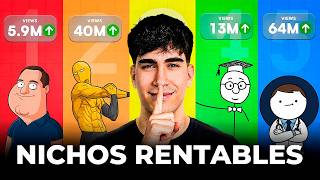
30 Million One-Person Businesses
Provides a compelling statistic that validates the feasibility of the business model.
01:10Leverage, Don't Delegate
A key principle that separates successful users from failures.
03:27Niche is 90% of Results
Emphasizes the critical importance of niche selection over other factors.
07:07Diversification Over Scaling
A counterintuitive strategy that reduces risk and is easier to execute.
24:17Realistic Expectations
Debunks the common '$10k in 30 days' myth, setting realistic goals.
26:47[00:01] Mons was in exactly the same place you probably are, wanting to start a one- person business, watching all the "build your own app" videos, without having any idea where to start and feeling that
[00:14] everything was too technical for her. Today, less than 90 days later, he has managed to generate more than €2,000 a month with his own YouTube channel. And the people who end up getting stuck throughout the whole process was understanding one thing. There's
[00:29] no need to create any app, learn to program, or anything technical like that . All you need to do is leverage Cloue effectively and follow a system that has already been validated. And the best part is that in this video I'm going to teach you
[00:41] exactly that system, the step-by-step process to set up a real one- person business with Claudia. I'm going to teach you the exact same process that I taught Monsen. And really, don't worry if you're not a technician or
[00:55] show you everything step by step, I want you to understand one thing. What Monsen did is neither a miracle nor an exception. It is the direct result of last 3 years and, to be completely transparent with you,
[01:10] 90% of the population has not yet realized this. Look at this number. Right now, in the United States alone, more than 30,000 people are making a living from businesses that don't have a single employee. 84% of the
[01:25] country's businesses are a single person earning a living without equipment, without an office, without living without equipment, without an office, without fixed expenses. And of those 30 million, 70% are profitable in the first year. In Europe the figures are very similar, slightly more
[01:38] conservative in percentage terms, but the trend is identical. Three years ago, this was mathematically impossible for most people, and it has changed for one reason only: artificial intelligence. And when I talk about
[01:52] artificial intelligence, I'm not referring to any abstract concept. I'm referring to specific tools that, today, do it for you. And the reality is that you can use those tools for less than $ a month. There are even
[02:07] free. The job that 3 years ago cost you a lot of money and many dollars a month. Right now, those artificial intelligences do it for you, and not only for much less money, but also much faster. The scripts,
[02:21] the research, the competitive analysis, the ideation, the structure, the revision, everything that previously required a human to do, you artificial intelligence. And among all the artificial intelligences that exist
[02:34] on the market today, Cloue, and to be completely transparent with you, is one of the best on the market. These are the ones that are giving us the best results when it comes to all content creation. Writing scripts, analyzing
[02:47] niches, researching competitors, structuring ideas. That's why this video is I want to clarify one important thing before we continue because I know exactly how my audience thinks. This does not mean that artificial intelligence
[03:01] will give you a profitable business without you literally doing anything. And that's not really the case. Artificial intelligence is a powerful tool, but it needs someone behind it to support that tool. And that's exactly the
[03:14] job Mon did well, and that I'm personally going to show you in the next few minutes. I want to repeat something. You need to understand and know how to leverage AI, not delegate everything to AI. And that's really what
[03:27] separates the fact that 77% of people are profitable and 23% are not. I'm also going to be very transparent with you about something that's happening on the internet right now. If you go on YouTube or Twitter right now and search for how to make
[03:40] most people will tell you exactly the same thing. Set up unacom cloud. And I really understand why they say that. It sounds great, it sounds very sexy, it sounds like Silicon Valley. The problem is that for 99% of people who try it, that path
[03:55] is a black hole of time and money. And I'll explain why with data. If you pick up Cloud Code today and start coding for months or years, you'll spend hours and hours learning to program,
[04:08] connecting APIs, designing how everything works internally, publishing on App Store or wherever. And when you finally have the product created, you don't even know how to sell it, or someone has already come along who has a much bigger budget than you and
[04:21] everything is going to be much better. If you look at real data from apps made with last year, the vast majority don't even generate $100 a month. Literally 99% of those apps end up at zero or almost zero. And be careful with this because I'm not
[04:36] just that it's a much more complicated route. And to be completely honest with you, there's no point in taking the more complicated route when there's an infinitely simpler one. an automated YouTube channel. And why does an
[04:50] automated channel win on all fronts compared to an app? Let me explain it to you with concrete data. First of all, zero technical knowledge. You don't know how to connect APIs, you don't have to connect anything at all. All
[05:03] a channel is structured and how to use the Cloud for that purpose. Second, zero product risk. You don't build something, you don't build a product, and you pray that everything goes well. You create your own YouTube channels, upload your videos, and
[05:17] if the videos are successful, they generate money or not. If it doesn't work, you upload more videos about different things and you don't spend months waiting to create that product. Third, recurring revenue without having to scale a product. Each video you
[05:29] upload continues to generate income for months, and in fact I have some and know of some that have for years. I have videos from some of my channels that are over 2 years old, or videos from a year ago, that are still generating
[05:42] talking about channels, I'm talking about just those videos within the channels—generate between €300 and €500 a month, every single we measure that, and we measure it with RPM, which stands for revenue per mile, which is what
[05:59] we earn for every 1000 visits. That's the metric used to measure how much we're earning from that. And there are channels that generate $ or $2 for every 1000 visits, but there are others that generate 10, 15 or $ for those same
[06:13] 1000 visits. Fourth, and for me personally this is my favorite, you do n't need to show your face. You set up a channel without showing your face, without exposing yourself, without building a personal brand from scratch, and without recording
[06:26] yourself. You can leverage Cloue to create the entire script, other artificial intelligences to create the voiceovers, and several other artificial intelligences to generate the video, and you focus on checking that everything is correct. And that's why I
[06:39] manage more than 15 channels in parallel, because the model allows it, and that's why the skill to generate income within a 90-day period, because the reality is that they are not struggling with APIs or code, but rather they are building a system
[06:54] that is already validated and working. Once you understand that the path is an automated channel, the most important question in this business arises: which niche do I choose? And I want to emphasize this because it's the number one mistake
[07:07] people make when they're starting out. The niche market will account for 90% of the results we will have in this business. I repeat, 90%. It 's not the best script, nor the best voiceover, nor how the video is edited; it 's not the right niche. The difference between
[07:23] choosing a good niche and a bad niche is that with Nuo you might be generating $200, $300 a month, and with another you might be generating $ 2,000 to $3,000 a month with the same number of visits. That's why we dedicate much more time to that than to other parts of the system. Right now
[07:37] give you four characteristics that a niche must have to be truly where you have reference channels, that the channels don't have a huge number of subscribers, and that all the videos have many more views than
[07:51] those subscribers. Because? Because in that way we are validating that the visits that those videos from the reference channels have are because there is a high market demand and not because they are already the visits of the subscribers. If
[08:04] we take inspiration from niche channels that have 5 million subscribers and 200,000 views on their videos, it may be that those views are already from the audience. But we're not interested in that. We are interested in
[08:18] small channels with 20, 30, 50, 100,000 subscribers having videos with millions of views, because, I repeat, that validates for us that there is a large market demand. The second is that there is no competition, that nobody is doing it
[08:31] in your market. Because? Because you go from eating the whole cake to just a small part. And not only that, but if there is a lot of competition, your channel may never even make it into the algorithm. The third is the barrier to entry, that is
[08:43] , what good is it to have a channel that generates 1,000, 2,000, 3,000 a month and then produce that content? That's going to cost you. It's better to select a channel that has less potential in terms of revenue, but has more potential in
[08:55] relating it to ease of creation. And the fourth is that it is a niche with a high RPM. Because? Because, as I mentioned before, that can change from generating $0 a month with a channel to generating $5,000 with the same number of visits.
[09:09] And this is where Claude comes in, in each of these four steps. In step number one, Claude is a beast. Because? Because I input all the characteristics I need to follow so that it can find me or give me
[09:22] channels related to that, and it makes a list of all those channels according to the characteristics I have entered. In this case, we go to Claude and tell it, "I want you to find faceless channels with these
[09:35] faceless channels with these characteristics: less than 100k subscribers, many characteristics: less than 100k subscribers, many more views than subscribers." We press enter, and it will automatically ask us some questions that we need
[09:48] to answer correctly. Notice that it says here that it's already searching. And I want to emphasize something: the more information you give Claude, the better the result will be. is, "Find me channels with these characteristics," but if you tell it to
[10:02] faceless, and that no faces should appear, it will do a much better job. Notice that it's already starting to show us the channels it has searched for, and then, analyze each of these channels.
[10:15] hours doing that process. In the end, it's up to you to ask it questions and see which channel best fits your needs in terms of subscribers and views. I'll give you an "Okay, but I didn't quite understand." We prioritize a channel that has,
[10:30] for example, 30,000 subscribers and videos with 100,000 or 200,000 views over one that has 300,000 or 500,000 views but 2 million subscribers. smaller channels because smaller channels generally mean they
[10:46] started more recently, have reached their peak more recently, and are currently experiencing higher demand. The second step is that once you've found these channels and thoroughly analyzed the subscriber-to-view ratio, you
[10:58] send the information to Claude and ask if anyone is doing the exact same thing in Spanish or in the market where you plan to launch the channel. By market, I mean language. The third step is that Claude cross-references your
[11:12] budget information with you . For example, you might say, "I have a budget of $50 or $100 a month, and I want to create this type of content or these kinds of channels." What kind of niche best suits my
[11:26] current situation? Cloud helps you decide based on your capabilities and the AI tools you can afford. everyone has no excuse because you can create any channel by
[11:40] free AI tools. Cloud is free, it has a paid option, but Cloud itself is free, GPT chat is free, and many AI tools are free or offer a free trial. So you have no excuse
[11:54] YouTube channel. And the fourth feature, regarding RPM, Claude, can help you decide. For example, if you send it all the context of this " religion channel" with videos lasting 30 to 40 minutes, Claude can help you
[12:09] by searching external tools. You have to understand that it obviously won't give you a precise RPM; that is, it won't tell you that you have a 3.4 RPM or that this niche has a 5.6 RPM, but it can give you an estimate. So, the focus
[12:24] is first on finding those niches and then asking Claude what their approximate RPM will be. They're here to explain it to you step by step, so you do n't have those doubts of, "Okay, I have the specifications, but
[12:37] how do I do it?" I'm going to show you how I would do it so you can do it too. from your home. First, I would go to the cloud and analyze channel by channel what you've shown us previously, like this one here, okay? This
[12:51] one. Let's select it, go here, let's go to YouTube and let's search for it to see what kind of channel it is. I'm going to put it here and we'll analyze it. Look, it's a channel of bedtime stories. This is a niche that works
[13:06] very well. If we go to popular videos, we see videos from 3 years ago, okay? This doesn't interest us that much. Videos from 3 years ago with 1,800,000 views and 162,000 subscribers. In terms of ratio it's very
[13:20] good, but that's why I'm showing you the process of how I do it. I wouldn't choose this niche for the simple reason that the popular videos are 3 years old and we're not interested in that. So let's go back to Cloud and, for
[13:33] example, let's select another one like this one here. We're going to copy it and go here. Let's go to filters. We're going to add channels because they haven't appeared for us. Let's go here and put, for example, this one. We're going to
[13:47] copy it, paste it, and watch the channel you recommended. Let's go in subscribers. It doesn't have much, honestly, just an English channel, which replicate it in another market. And if we go to the video, okay?, we see that it's a
[14:03] is completely insane these days. Look, I like popular videos. true that this was 2 years ago, 2 years, but let me explain why I would choose this one, because this, okay? These visits, for example, continue, meaning
[14:19] this channel keeps uploading videos and the visits it has are recent. In other words, it's true that the popular ones were perhaps working a year ago, but the recent ones are also working for him, and that's very interesting.
[14:32] So, the first step you should take, the first feature, is to ask Clou everything, ask it to show you the maximum channels, and gradually decide based on that feature. The second one is the RPM.
[14:44] Seeing that he uploads videos of 16 or 20 minutes, we can guess that he 's a decent RPM. Because? Because the longer the video, the better the RPM will be. So it's about understanding, okay?, what kind of niche am I looking at? Anything with
[15:00] has a better RPM. For example, sports, football, doesn't have good RPM. Because? Because the type of people they attract have less purchasing power. So we have to understand that all those
[15:12] types of niches like celebrities, football, etc., all of that has low RPM, but anything that is longer content and where people can stay longer within the video and where the audience is older, will have better RPM. In terms of
[15:26] example, I'm going to go to the most recent video. And notice that the videos are stock clips or stock images, there's no need to overcomplicate things. Notice that they are images, pictures, some video, it 's nothing complicated. At the script level,
[15:41] what I would do is here in the description you click on more and here where it says show transcript, the whole script appears here, as you are seeing. So, what you would have to do is copy it, okay? You can copy it, deactivate
[15:54] all the watermarks, you can copy the entire script and then what you would have to do is go here to Cloue and ask him to make you a script from scratch with that reference script, but adapting it to the new one. Why am I telling you
[16:08] just transcribe the script, YouTube will penalize you for it and your channels may be taken down for repetitive or reused content. At the thumbnail level it would be very easy because notice that you could create an image from scratch with Chat GPT
[16:22] itself. You go to GPT chat and tell it to generate a similar or identical image, but with small camps. We would change the color of the arrow, the color of the mask a little, and it would be exactly the same. And in terms of
[16:35] content, you could do it perfectly well with any artificial intelligence or with CapCut itself. This is the process and the step-by-step procedure that I follow. Obviously, I a few minutes, but to find a potential niche, a real potential niche, you have to
[16:49] spend hours doing that process and make sure it fits all the earlier. Before we continue, let me tell you something quickly. If you want us to help you put together your entire action plan to start this business, in the
[17:02] first line of this video's description you have a link where you can schedule a consultation call with us. In that call, we will design the entire plan you need to follow so that in 90 days you will learn the skill
[17:15] to generate more than $2,000 or $1,000 a month with this business. If we see that we can work well together, we will support you until you achieve the results you are looking for. Having said that, let's continue. Let's move on to the next section, which is how
[17:28] all this content is executed. As I mentioned at the beginning of the video, I'm going to show you the complete step-by-step process, and even though I've potential niches, how to locate them, and the steps a little bit above and beyond, I'm
[17:41] now going to delve deeper into how to create the content step by step, including scripts, voiceovers, and how to create the overall content. An automated channel lives off four things: scripts, voiceovers, thumbnails,
[17:55] and video editing. And step number one is the scripts, and we're going to do them with Cloud. As I mentioned before, briefly, we would have to go to the reference video or the videos we want to make and go
[18:07] here, okay?, to the entire script and we would have to copy it all. In this case, we would copy everything here, okay? A few seconds. Since it's a long video, that's why it's playing a little slower. We've already
[18:19] copied it. We would go here to Cloue, start a new conversation, and start a new conversation, and say, "I want you to help me write say, "I want you to help me write a script from scratch. I'm going to give you the
[18:32] a script from scratch. I'm going to give you the reference, and I want you to be inspired, but don't copy." Okay, we'll give you the whole script here, okay? And once it's uploaded here, we're going to press enter and 99% of the time Claude
[18:47] make the script in the best way possible. Notice that he is reading what the script, and in a matter of seconds he is going to ask us certain things so that he can write the script in the best way. Notice that he's already asking us
[19:02] things here. He asks us, "What's the theme of the video?" It is important that you give Cloula the best possible information at this step because it depends on how she will one way or another. What format do you want the script in? Video camera, Eric, no.
[19:15] Guide with Let's give something else. Channel. Automated channel. How long does it last? More than 20 minutes. And notice that it's already starting, okay? Notice that with this information we 've given him, he's going to start generating the script. Notice that he's
[19:29] asking us more things. What angle of mystery story do you want to explore? Lost civilizations. Do you already have a specific title idea, or would you like me to suggest three strong options? No, we're going to tell him to propose the three ideas because they
[19:42] the title we'll always do what has already worked, but notice that he's already putting the three titles and once here he's going to start writing the script. has caught our attention the most because it is not the question, it is option one. And notice
[19:58] that from now on, the script really does start. Notice that he's already writing it, and that's how a script is made. If we ask Claude to write us a script directly, he won't do it well. That's
[20:11] important for you to understand. Because? Because if you don't give her a reference, if you don't give her the information that Cloue needs, I repeat, she's not going to do it right. Let's move on to pillar number two, and that is the expressions. To achieve this, we will
[20:23] leverage Eleven Labs. Eleven Labs is an artificial intelligence company. It's a paid artificial intelligence, but it has a free trial if you use it, we're going to click on text to speech here, okay? Let's delete, for
[20:36] example, what we did earlier and go to the script that Cloud generated for us, and what add it paragraph by paragraph. And why do I say this? Because if you give him the whole but imagine if he makes a mistake, we'd be wasting all those credits.
[20:51] So, for example, we would have to copy this first part of the hook, paste it here, and then select the voice we like best or that best suits the niche and the type of videos we
[21:04] are uploading. In other words, that the voice is consistent with what is being said. Here you could control the speed, stability, similarity, and exaggeration of those voices. Finally, you would simply have to click here to
[21:17] simply have to click here to generate speech and it would generate the audio. The computer or wherever you want. And it's important that when you're putting the video together, you gradually assemble all the small audio clips. It's better to go slowly than to
[21:31] include the entire script and have Elevaps generate it all at once, because, I repeat, if Level Labs makes a mistake, you'll be wasting all those credits. Let's move on to miniatures, and I'm going to show you how to do it. You're going to go here to YouTube,
[21:45] download the reference thumbnail from that video, and then we're going to use can create thumbnails with GPT chat. We're going to tell it, "I want you to generate one just like it, but with some changes. Add the
[22:02] but with some changes. Add the yellow arrow and change some things in the mask yellow arrow and change some things in the mask so it's not the same and we don't have any problems." Obviously, when it's working—and I imagine you're watching from home—
[22:16] I repeat, I'm doing something quick because I want to show you what's possible, but the more information you give it, the better the result will be . Look at this incredible thing! It just created the thumbnail in just a
[22:30] as a reference and look at what it gave us from scratch. It's the same, improved, perfected, and with all the changes we made. There's nothing different. I haven't done anything so you can see that it's
[22:43] asked it to do, and look at the result I got. I 'm not hiding anything. I have free GPT chat. In fact, if Notice how I see "Get Plus" here. If I go to Eric Lan Bosk's page, you'll see I have the free plan, as you can
[22:56] see here. And look at the thumbnails he creates—there's thumbnails he creates—there's four, which is editing. And here, in this pillar, honestly, today's
[23:08] AI isn't as advanced as we've seen with scripts, true there are tools to cut certain parts, improve and optimize some things, and automatically add subtitles to the video, but my
[23:22] completely transparent recommendation is to hire a freelancer and pay them between $0.80 and $0.00 per minute. For those of you thinking, that's not too little, is it? Because you don't need to produce
[23:35] high-quality content, and we're giving them all the information and all the stock clips, combine them with the audio we send them, and add 'm not telling you to do things cheaply and quickly, no. I'm telling you it's
[23:51] a simple process to do, and that's why it does n't pay a lot, but just because it's simple doesn't mean it has to be done poorly. I want to emphasize something from the four pillars we just saw. Artificial intelligence doesn't
[24:04] completely replace humans. Artificial intelligence allows you to do what four people used to do, now one person can do in much less time. That's the difference: leveraging it, not delegating and forgetting about it.
[24:17] Now let's move on to one of the most important parts of this video, and it's also one of the most counterintuitive because this is where most people go automated channel generating its first income, let's say $500, $1,000,
[24:31] $1,500 a month, the natural instinct—and I've been through this myself—is, okay, I'm going to scale this channel to $1,000, $10,000 a month, and I'm going to be completely honest with you. I thought that myself when I started, and I spent years... Stagnant. The
[24:45] reality is that through hard knocks and time, I learned that it's much easier to have four channels that each generate $500 a month than one that generates $2,000. Why? Because otherwise, you're always dependent on just one
[24:58] channel, and if that channel has a down month, your income drops. On the other hand, if you have four channels, obviously your income will decrease if one channel has a down month, but the with just one. And not only that, but scaling one channel to $500 or $700 a month
[25:13] is much easier than scaling one to $ 2,000 or $3,000 a month. You can actually reach the first $500 quite quickly, but it's true that scaling to $3,000, $4,000, or $5,000 a month
[25:25] done it— is very difficult. The earlier. The platform's risk . In other words, it's not the same, I repeat, to have four channels that generate, for example, €0 each per month as it is to
[25:39] have one that generates €4,000. If this €4,000 channel drops, all revenue decreases completely. And how does Claudia fit into this? Well, she's the perfect key to learning how to diversify effectively. Before
[25:52] artificial intelligence, managing five channels simultaneously was very complicated, and in some cases, impossible. Why? Because logistically, it was a complete nightmare. Five times more scripts or scriptwriters, five times more people
[26:06] doing everything. Today, with Claude, you can manage all those same time. I personally manage more than 15 channels today, and if Cloud didn't exist, I'm not saying it would be impossible, but I would have to hire a
[26:19] drop significantly. In other words, I leverage Claude heavily to manage those 15 channels. That's why, when we work with our students, the goal of the 90 days to learn the skill and
[26:32] generate $2,000 to $3,000 a month with that skill isn't about learning how to scale a channel to $10,000 a month, but rather how to learn the skill of generating small channels that together generate hundreds of dollars a month. Now
[26:47] let's get to the part everyone wants to know: how long all this takes. And here I'm going to be completely transparent, 100%, without any smoke and mirrors. The promise you hear out there is that you can scale to $10,000 a month
[26:59] in 30 days. Let me tell you, being completely honest with you, that's it. I do n't want to say impossible because I've seen cases of people, students, who have done it, but it's very complicated, very, very complicated. Those figures aren't
[27:13] realistic, and I repeat, even though I 've scaled channels in 30 days, those figures, or the people who have done it, I repeat, are not realistic at all, and I want you to understand that clearly. The promise I make, and that can
[27:27] truly be achieved, because I myself, and if they continue... Students of the step-by-step program can also achieve this: in 90 days, you'll learn the skills to generate over $1,000 a month with this business. I'm going to break down all of this for you on the
[27:42] calendar. From day 1 to 30, the focus is on finding your niche and producing content for your channel. The first week is dedicated entirely to learning how everything works, and then you start working on your niche. The following
[27:55] weeks focus on producing content, and especially on producing more than you plan to upload so you have enough in case something goes wrong. From day 30 to 60, the goal is always to reach the monetization requirements:
[28:09] 4,000 hours of watch time on your videos. If you choose your niche well, follow our steps consistently, and don't miss a single day, you can achieve this. Keep in mind, sometimes it takes a little longer and
[28:23] sometimes a little less, but you should be uploading content for 30 days. Every week, if done correctly, you can monetize that channel. In fact, I myself have monetized channels in less than
[28:35] 5 days, and students have done it in 3 days. The goal from day 60 to 90 is to monetize that channel, not just to meet the requirements, but to truly monetize it, start seeing the first income, and above all, correct the mistakes you've already
[28:50] well you do things, there are always things that can be improved. For example, if RPMs, then make more of those videos to generate more income. The goal is to generate that income during that period and, above all, to learn
[29:04] how to do it. Some people take 180 days instead of 90, but the skill so that it can be replicated. Raúl, for example, as you can see on screen, monetized his channel in 3 days, as I mentioned
[29:18] channel, and as of today... Today, he's generating over $4,000 a month. And you might be wondering how he did it, how long it took him to achieve that. First, you have the video. And second, he did it in a 90-day period. Now that you've seen the
[29:32] video, let me tell you that if you've made it this far, it's because you're genuinely interested in setting up your own automated YouTube channel, generating between € 2,000, €3,000, or even more than €10,000 a month with the help of artificial intelligence,
[29:45] students in our academy. If you'd like us to get in touch to see if we can help you too, we've included a form in the first link of to schedule a call with us and really see if we
[29:58] can assist you. We only want to work with people who are committed and truly want to do this.


⚡ Saved you 0h 30m reading this? Transcribe any YouTube video for free — no signup needed.