
What Is Earned Media?
45sClear, quick definition with a simple three-part breakdown (paid, owned, earned) that hooks viewers confused by PR jargon.
▶ Play Clip"Title accurately promises a budget-friendly PR guide, and the webinar delivers exactly that."
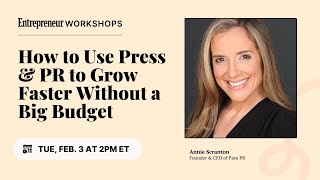
In this webinar, Dan Bova hosts Annie Scranton, founder of Pace PR and NYU instructor, who explains how founders can leverage earned media—free press coverage from journalists—to build credibility and grow their business without a big budget. She covers foundational PR strategies, DIY tips, and the importance of authentic storytelling.
Earned media is coverage from real journalists without payment, based on newsworthiness. It differs from paid media (ads) and owned media (your website/social).
It provides credibility and legitimacy that paid/owned media cannot, as it requires journalists to vet your story. It helps differentiate from competitors.
Earned media is crucial for modern SEO (now GEO) because AI search bots crawl press releases and earned placements to generate answers.
Start after launch, not during ideation. Even early-stage startups can target trade pubs, local media, podcasts, or founder-focused stories.
Agencies charge $5k-$10k/month for startups. Personal branding packages are cheaper. DIY is possible with the right strategy.
1) Clear point of view/elevator pitch. 2) Know your audience. 3) Timely/newsworthy angles. 4) Credibility signals (what sets you apart). 5) Consistency across all platforms.
KPI = key performance indicator (measurable goal). ROI = return on investment (value prop). GEO = generative engine optimization (ranking in AI searches).
Founders overlook compelling personal stories (e.g., failures, resilience) that make great headlines. The subject line of your pitch is critical.
Write industry-focused articles (not self-promotional) for LinkedIn, Substack, or contributed pieces. Position yourself as an expert.
Journalists want fresh perspectives on AI, tariffs, and industry news. Leaning into news angles is key.
1) Update digital footprint. 2) Nail elevator pitch (30-60 sec) with ROI. 3) Write a 100-word LinkedIn post on industry news (authentically, no AI).
Start with local TV or streaming to build comfort. National networks (CNN, Fox, CNBC) require breaking news relevance or specific segments.
Keep pitches short—one sentence. Write your full pitch, then condense it to a text-message length.
Earned media is a powerful, cost-effective growth tool that builds credibility and boosts SEO/GEO. Founders should start with a clear pitch, authentic storytelling, and consistent messaging, even on a tight budget.
What is earned media?
Coverage from real journalists without payment, based on newsworthiness.
How does earned media differ from paid and owned media?
Paid media is ads you pay for; owned media is your website/social; earned media is free press coverage from journalists.
Why is earned media important for SEO/GEO?
AI search bots crawl earned placements and press releases to generate answers, boosting brand ranking in AI searches.
04:00
What is the minimum monthly budget for a startup PR agency?
Between $5,000 and $10,000 per month.
09:00
List the five foundational elements of a successful PR strategy.
1) Clear point of view/elevator pitch. 2) Know your audience. 3) Timely/newsworthy angles. 4) Credibility signals. 5) Consistency across platforms.
12:00
What does KPI stand for and what does it mean in PR?
Key Performance Indicator; a measurable goal the agency aims to achieve, e.g., two national features in six months.
17:00
What does ROI mean in the context of pitching?
Return on Investment; the value proposition for the journalist's audience—why they should care about your story.
17:00
What is GEO?
Generative Engine Optimization; how high your brand ranks in AI search results like ChatGPT.
17:00
What is a common mistake founders make when pitching?
Overlooking compelling personal stories (e.g., failures) that make great headlines.
19:00
What is thought leadership in PR?
Putting your point of view out there as an industry expert via articles, op-eds, or LinkedIn posts that provide value without being self-promotional.
23:00
What is the first step in a one-month PR action plan?
Update your website and all social media profiles to present your brand consistently.
28:00
How should you start if you want to get on national TV?
Start with local TV or streaming to build comfort, then pitch national networks with breaking news relevance.
31:00
What is the recommended length for a pitch email?
One sentence; write a longer version, then condense it to text-message length.
34:00
Definition of Earned Media
Clarifies a core concept that underpins the entire webinar.
Earned Media's Role in GEO
Explains a modern shift from SEO to GEO, making earned media more valuable.
04:00Five Foundational Elements
Provides a clear, actionable framework for PR strategy.
12:00Power of Personal Stories
Highlights an overlooked angle that can create compelling headlines.
19:00One-Month Action Plan
Gives concrete, low-cost steps for immediate implementation.
28:00[00:00] Hey everyone, welcome. I'm Dan Bova, host of Entrepreneur's Podcast, How Success Happens. And welcome to today's webinar, How to Use Press and PR to Grow Faster Without a Big Budget. So publicity is one of the most powerful growth engines founders can tap into. So here to help you unleash that power is Annie Scranton, founder and CEO of Pace PR, and she also teaches public relations at NYU's School of Professional Studies. She's going to walk us through
[00:32] a tactical session on all the ways to get earned media, and I'm going to let her explain what earned media exactly is. So let's all welcome Annie. Hi, Dan. Thanks so much for having me. Great to have you. Looks like we've got a pretty active chat already. So that's fantastic. Great to see you all. And as always, pop your questions right into the chat as they pop into your head and we'll get to as many as
[01:04] we can. So Annie, should we should we get going? Let's do it. All right. So let's start with that whole earned media thing. For those who don't know what the term exactly means, what is earned media and how is it different from paid or owned media? Well, you have to earn it. That's the easiest way to think about it. So paid media, you pay for it. Owned media, you own it, like your social or your blogs,
[01:37] your website. And earned media is where you get real journalists, real news entities to write about you or your company. And there's no money that's exchanged. There's no real favors that are done. It's based on the merits of how newsworthy or how interesting and compelling your story, your brand, your your journey to success is. So you say that earned media, in your opinion, is extremely important. So why is it such a powerful advantage to have earned
[02:09] media versus the other kind that you discussed? Well, I think because with paid or owned media, if you have a budget or if you have a website, anybody, right, can tackle those two. Not everybody can get featured in the New York Times or the Today Show or on CNN or CNBC. And so what those media outlets and earned media bring to the table for founders and startups and brands and businesses, small and big alike, is really
[02:41] that credibility and legitimacy. It really helps to differentiate you and set you apart from other competitors within your industry. And it really, I think, just makes people stop and notice in a way that other forms of media does not. You know, we've become a lot smarter as media, as consumers of media. And so I think it's a lot easier now to spot and decipher if there's a paid editorial or sponsored content. But when you have a
[03:13] real press placement in a media outlet, whether it's traditional or independent, it really just speaks to the fact that a reputable journalist or producer or writer or commentator had to do their due diligence in terms of making sure that you're bringing to the table something that they find interesting, but also that their audience, like their readers or their reviewers will find compelling and hopefully helpful as well. So that's great. Credibility, obviously huge, the authenticity that we
[03:45] talk about so much. And could you talk about how that lends itself to actually helping you with things like SEO and course, sales and partnerships and things like that. Yeah, totally. I mean, you know, when you think about marketing or comms, there's so many different tentacles that you can approach. Digital marketing, paid, advertising, social, this, that, the other. What really, though, it is helpful with is that, you Now earned media is having a big resurgence. In
[04:18] years past, earned media, which is really my core specialty, kind of took a hit because everyone was going the influencer route or the paid route or putting out content on their own socials or their own platforms. Well, since SEO has now really pivoted to GEO, we know that earned placements are more important than ever for helping brands and their lead leaders rank high in those AI search bots. So press releases and earned media placements are what
[04:50] the LLMs actually crawl and take from as they're doing what they do as robots behind the scenes to help come up with the best answers based on your question. It's good and important to have invested in SEO. But now, since more and more people are searching in chat, you know, how can I find a great PR agency as opposed to taking that question in Google? It's important to understand that earned media is a big part of
[05:22] that equation. And I think just to underline what you said about, you know, the influencers thing. I was just talking about this today. I don't know what I clicked, but hardly a minute goes by that there's not an influencer selling me some drink that'll get rid of my dad bod. No, you don't have a dad bod. That's all this was here for. I just wanted that on the record of you saying that. Okay. So let's talk
[05:54] about getting started. You know, there's people... surely have different stages of their business who are watching this right now. But when should a founder realistically start thinking about, hey, a media outlet is going to be interested in my story or my product? Yeah, I mean, I think the simple answer is, is that there's not a one size fits all answer to that question. I think you have to, of course, have an established business and a website
[06:27] and be searchable and have a real company, not just an idea. So if you're still in the beginning phases of planning out your company or your business or your startup, then you are too early. But as soon as you launch or you know you are going to launch, you absolutely can and I think should go after earned media and start the process of promoting yourself in a variety of ways. If you are a startup and you've
[06:59] just launched, it may not be the time to go to the Wall Street Journal, you know, or we know that tech outlets like TechCrunch, you have to have a certain threshold in terms of how much money you've raised to even be considered. But there are a wide variety of trade publications, local media, media, independent media like various substack creators and or podcasts that are industry specific that might be very interested in the fact that there's a
[07:31] new company that's going to be solving for whatever problem it is that you're solving. And the other thing that anybody can do at any stage of their entrepreneurial journey is lean into founder press and the storytelling behind how you as the founder created this entity. Nowadays, consumers, people, we really are interested in the why behind. And a lot of times it's a lot more focused on the founder and or the CEO as opposed to the brand
[08:03] itself. I think just because of social media and people being much more public facing, we're all sort of curious about like the founder and the person who thought up these cool brands or these businesses that we are really into. So I would say those are, yeah, it really can be at almost any stage. That's great. And as someone who I'm an editor at entrepreneur.com and I'll just, I'll just say yes a thousand times to what Annie
[08:35] just said. You know, sometimes people think that the pitching is an ad for whatever their businesses or their product is. But as she said, As someone who gets a lot of pitches, I want to hear the why. Why did you come up with this? What was the spark for the idea? What's the human part of it? That really, I'm just sharing, that really grabs an editor's attention. So, Annie, let's talk about budgets. Let's talk about budgets
[09:08] with regards to money and with regards to time. Annie, you know, all this stuff that we're talking about, it sounds expensive and it sounds like it takes a lot of time. So can you help people who are just getting started on this journey thinking about budgeting? Yeah. I mean, I think that there truly is a PR agency or a freelance publicist at at almost any budget. It really just depends sort of on your goals and your
[09:40] needs. A lot of it you could even do yourself with some simple tips that I can share here. But typically in PR, agencies are charging a monthly retainer and they may be billing back hours against that retainer. What's interesting though is that with the advent of AI, hourly rates are really kind of up for discussion, right now because everything is taking us much, much faster to do than it previously did. I think that most brands are
[10:12] looking at a minimum spend of somewhere between $5,000 and $10,000 a month if you're a startup. And then certainly if you are a bigger brand and have more ambitious KPIs you're looking for, those budgets can go up exponentially. If you are a startup and you're really just kind of know you need to be out there, but you don't really know what you need. A lot of agencies, mine included, offer a personal branding package where we help
[10:44] to kind of set you up and have you understand how to share your message and tell your story in the way that you were just talking about, Dan, that an editor would find interesting and compelling. A lot of times the benefit in hiring an outside agency is that we're able to have a more holistic view of what you've got going on when you're the founder and you're working good day in, day out, around the clock, it's
[11:16] hard to understand sometimes maybe how an outside person or a reporter or an editor might take the information that you're pitching. So I think there's a real value there. My advice would be to anyone listening now is to really think about what is your goal for your company? And if your goal is to, let's say, reach new customers or to build up that overall credibility or brand awareness, to really start thinking about what are the most
[11:49] meaningful media outlets that would help you to achieve that. A lot of times it's a trade outlet. Sometimes it's local media. It could be a podcast that has a smaller audience but a very dedicated niche one that really would sort of eat up your content and your information. And then I would figure out what is realistically a budget. that you have to put ahead it and just be honest and upfront with the publicist or agency that
[12:21] you're talking to. I think many will try to work with you and come up with a KPIs or a statement of work that works and is reflective of that budget. And if they can, you can ask for a referral to someone who can. That's great. So let's get into the sort of DIY of it. And also maybe it's just how to prepare yourself if you are going to be you know going to a pr agency because
[12:53] you've talked about these five fin foundational elements of a successful pr strategy so can you uh walk us through those yeah um so if you're even thinking about pr you have to have a very clear point of view and perspective when i'm doing an intake call with a potential new client i'll often say tell me about your business in one or two sentences. And it's really surprising how many founders or C-suite execs I'm on the phone
[13:25] with really can't say in a very simple, quick elevator pitch what exactly their brand does and more importantly, what that ROI is to the person who's listening on the other side of the conversation. So I would say making sure that you have a very clear understanding point of view is the number one thing that's most important. The second thing is you're going to want to make sure that you understand the audience that you are trying to
[13:58] connect with. The audience who tunes into the Today Show is going to be very different than the audience who reads entrepreneur.com. Know your audience and make sure that what you are sort of pitching or presenting to them makes sense. And the simplest way to do that is to Go on their website, look at past content or articles or videos that they've shared, and get a sense for the kind of coverage that they're putting out there. I
[14:30] would say if there is a way for you to tap into timely or newsworthy angles, that is a very suitable way to present yourself, even if you are just starting out. So I'm If there's Disney earnings today and you have a startup, but you used to work at Apple and maybe you were involved somehow, again, just making this up off the cuff because I know there was some Disney earnings news, that could be a potential path
[15:02] forward for you to connect with a journalist. And that kind of leads into the next point. It's really figuring out what sets you apart from others within the industry. And that's really that credibility. You know, there are a million lawyers in the US. Okay, so if you're a lawyer, are you starting a new PR, a new law firm, what sets you apart from all the rest? And if you can't figure that out, you need to. You
[15:34] need to figure that out because otherwise, what would be the reason for a journalist or an audience to really entertain that conversation with you? Great. We're getting some questions here in the chat, some terminology questions. So I thought maybe we can stop for a second and just define some things. So Bennett asks, what is a KPI? And I was thinking, you know, KPI, ROI, GEO. Can you put these in plain English? I think we could look
[16:06] it up and see what it says, but what do those words, what do they really mean? Okay. So a KPI stands for key performance indicator. So it's a term that's used where you're putting together an SOW, statement of work, and that's going to go into the contract that you're working out with your PR agency. And so Simply put, a KPI is really just a measurement of what the agency or publicist intends to achieve at the end
[16:39] of the engagement. And it can mean wildly different things based on the needs that you have and the goals that you want to hit. It could be, I want to have two national features within six months. I would like to secure three trade podcast interviews. Um, you know, that's up for sort of each individual, um, scenario. Um, but that is what KPI means. Uh, ROI, return on investment. I am a big fan of this. And really
[17:11] what that means is, again, when you are thinking about pitching the media and especially for earned media, you have to say to yourself, what is it about the story and what I'm doing that is truly different and would be beneficial for this editor or journalist and their reader at home to learn so you know and it's another way um you know of just putting into words like what's the value prop that you're that you're putting out
[17:43] there um so that's roi um geo stands for generative engine optimization um it's the sort of next gen of seo which was search engine optimization and geo simply means how high you your brand your company ranks within an ai search so just by way of example um at pace we we would have a lot of inbounds coming to us for prospective clients and they would say um even as as our earlier back as last year oh
[18:15] we found you just google search googling around now when we get leads a lot of times they're saying, oh, I asked Chad GPT for a good PR agency and you popped up. So that is what GEO is. Annie, you passed the test with flying colors. Great job. I'm glad people weren't asking me that. So that's great. So those those foundational elements that you mentioned, is there one or more that you feel like people really overlook or
[18:47] they just plain get wrong? I mean, I think a lot of founders overlook maybe interesting and compelling parts of their journey to founding. And it doesn't have to be just in my past life, I worked at Apple or Google or one of those things. Maybe it's a lesson you learned, but it was a lesson in a really sort of dramatic way. Maybe it's your last startup, you invested, million dollars and it flopped. Well, what did you
[19:20] learn from that? And part of that is it's an interesting takeaway, the ROI, for the reader at home of a potential story about that, about sort of like resiliency and how would you come out of a situation that's so difficult like that. But the other thing is it can be a very, very attention grabbing headline. And that's what I found a lot of reporters and editors are looking for. Media properties are businesses and they need to
[19:52] get clicks, they need to get readers, they need to get subscribers. And so the headline is everything. When I'm teaching at NYU, I tell my students, the subject line of your email pitch is everything. If it's boring, it is likely going to get deleted. So I think just like leaning into whatever it is within your background that's really compelling and interesting and then working to figure out how to tell that story in a way that's to
[20:24] your benefit. Great. And I think – Someone just chimed in and I thought I lost count, but I think I was right. I think we only got to three of your foundational elements. I think we skipped four and five. So thank you for reminding me of that. And I had to have them down here as a little cheat sheet just so I could remember. But the first is the clear point of view. The second is the
[20:56] relevancy to the audience that you're pitching. The third is to utilize timely or newsworthy angles when you're pitching. The fourth is to tap into what I was just talking about, those credibility signals. So what is it that makes you actually uniquely qualified to speak on such a subject? Did you handle an exact situation like the one you're pitching previously? Or were you directly related to a key player in a news story that would make you kind
[21:28] of stand out? And then the fifth one is really just bringing those all together in consistency. I think this is something that a lot of founders can overlook too. You know, you have your own social media, then you have the brand social media, you might have an e-newsletter, and then you might have a deck you're sending out to investors, and then you might use certain language in your LinkedIn posts. You want to make sure that more
[22:01] or less that language is consistent and well thought out because that will just help to hone your message and make sure that everybody that you're talking to is receiving it in the same way. Fantastic. We just got a note from Ava. I don't know if you can see the chat, Annie. I don't think you can. But I think she's sharing her personal story. I was successful. Then I was a homeless single mom with no support. Now
[22:33] Busy Mom Media provides support and edutainment to mom and mom entrepreneurs. We also have a charity to help single moms and moms in homeless shelters in NYC. That's a pretty compelling story. Let's get into sharing that personal journey that you've been through in a way that feels comfortable and authentic and genuine to you, of course. But that's a headline right there. that is absolutely attention grabbing. And again, if you are comfortable sharing that, which feels like
[23:05] you are, I would utilize that as much as you can to your benefit. We got another question from Ben asking, what's a book that you've read that's really influenced you? And he refers to me as Mr. Dan. So thank you for that. You could just call me Dan, but let me ask you, what's a great book that you would advise people to read who are thinking about publicity, about thinking about getting their message out there? Can
[23:37] I say my own book? Of course. The Guide to Earned Media. That's my book that was published a few years ago. All kidding aside, I... I tried to just lay it out as easily and succinctly as possible. I think in terms of some other works that have made an impression on me would be the four hour work week, smart brevity, just to name a few. Fantastic. So, all right, let's see any other, so yeah, the chat,
[24:10] love the questions coming in, so keep them coming. Let's talk a little bit about, because I know a little bit about this with entrepreneur thought leadership. How does that factor into earned media, especially for founders who are trying to get press for their company, but also for themselves, for their personal brands? Yeah. I mean, these days, I think more times than not, those two are really intertwined and kind of feed off of each other. So thought
[24:42] leadership is simply a putting your thought, your point of view out there in assuming a role of leadership within the industry. So one way that you can do that in an earned media capacity is to write an article that would be either accepted potentially as a contributed article or as an op-ed, an opinion piece in a newspaper or a digital website, whatever is sort of accepting those types of pieces. Thought leadership also though can and should
[25:14] be done, I believe, on LinkedIn or if you have a Substack or a Medium page or Beehive. There's a lot of platforms now that are really helping creators to sort of put themselves out there in a more legitimate way. So I would say that if you can start thinking of yourself as an industry expert, thought leadership is not writing an article about why Pace PR is the best PR agency ever. Thought leadership is writing an article
[25:46] about why and how you should be investing in earned media to grow your business. It's taking that like bigger industry approach that will be seen as giving real information to the reader, real takeaway, but also not too self-promotional. A quick question from Abdullah is wondering, do you have an account on X, which leads me to ask, we have your Instagram account up there. What's the best way for people who are watching this who want to get
[26:18] in contact with you? I mean, I have a pretty unique name, Annie Scranton. So you can literally just pop me into Google, find me on LinkedIn, on social. The website is pacepublicrelations.com. Send a message through there. They all go to me. I'll get them that way. So what, you know, in your experience in the last, you know, couple of months or whatever, what are you seeing? What are you seeing editors and media outlets biting on? Like,
[26:51] what are they liking that might be a little bit different if I asked you that question, you know, a year ago? Yeah, I mean, I hate to give the same old answer as, you know, whatever's trending in the news, but it really feels like the news cycle is just one that's very challenging to keep up on, but at the same time is leaving business leaders sort of with a lot of questions, you know, are there tariffs?
[27:23] Do we have to worry about this, that, and the other with regards to supply chain and issues that could affect our bottom line? So I think that is something where it's a news angle, but you don't necessarily have to weigh in in a political sense or in a way that might alienate some of your customer base. So I would say more than ever, leaning into a news angle would be really, really important. And so it doesn't
[27:55] have to be also necessarily something related to just what's happening within the administration or sort of these broader geopolitical issues, but it can be news within your industry as well. I think also there's just a big push now to kind of figure out where is everything going in terms of AI. And we have now these handful of behemoth companies that seem to kind of control more than maybe they should. And so I think I'm getting fresh
[28:27] perspectives there. But again, with that real takeaway about what either consumers or other business leaders at home should be taking into consideration is really top of mind for a lot of journalists right now. Great. So we're getting to the half hour mark. So I want to try to get to a couple more questions. But before we get to some rapid fire, maybe give us all a little bit of a worksheet or a little bit of homework.
[28:59] You know, if someone's listening right now and is all inspired and fired up, like what's let's do a month plan. What's the first step that they should take? And what's like a realistic goal for the end of the month? Okay. Well, I mean, I'm going to start with, do you have your website and all your social medias on updated in the way that you want them to. That is your calling card. It is the first thing
[29:32] anybody is going to do. So make sure that your digital footprint across all platforms is really presenting the way that you want it to present. The second would be to nail down your elevator pitch. That is a 30 to 60 second sort of commercial, so to speak, of how you would describe yourself and your brand. It's You can just Google, what is an elevator pitch? There's some really good five minute videos that you can watch there
[30:04] to help you in that process. You'd be surprised how much time and effort it may take, especially if there are other stakeholders that you're sort of going to consult in terms of like sharing that message. Because a lot of times a business or a brand can mean different things to different people. So maybe consider just doing a small workshop internally so you can really figure that out. And within that elevator pitch, make sure that you answer
[30:36] the question, what is the R ROI for the person listening to me on the other side of this. Why should they care about what I'm telling them? If you always come to it with that in mind, then I think you're going to have more successful conversations. And then I would say last, think about if you were going to write a 100-word LinkedIn post, which is not a lot of words, and you wanted to comment or weigh
[31:08] in on industry news would you say what would you write about what is your opinion on industry news you don't have to publish it but i think it's a good exercise to start thinking of yourself as that subject matter expert as that thought leader even before you begin to engage in the practice itself that's great advice and i'm just going to add one thing to that when you write those 100 words as someone who reads a
[31:41] lot of 100 words don't use don't use ai to write it for you everyone knows it's ai And it's not interesting coming out of a bot. We want to hear your voice. When someone writes something authentic, even if it's not perfect, that is going to move me personally more than some perfectly worded thing that I know no human being wrote. So that's just me proselytizing. I couldn't agree with you more, especially when it's written in that
[32:13] like I narrative. Yes. You have to have your words, right? Not a robot's words there. And I think also, all kidding aside, the personal connection is what is going to be the only thing that really sort of separates us from AI moving forward. And so whoever you're sending an email to on the other receiving end or whoever is going to read that LinkedIn post, is a real person. It's not another robot that it's on a robot
[32:45] that's reading it. So think of it that way. Like, you know what, what would stop you and say, Oh wow, this is really interesting. Like, let me keep reading this. Um, yeah. Yep. Great. We're in agreement humans first. Um, Uh, someone just asked, and I just wonder if there's like a sort of order of operations, but the question is any tips on getting featured on a large network such as like CNN, Fox, CNBC. And my question
[33:17] to you to add to that is, and I think you did say this, but Do you start here with like a local media outlet and work your way up to something like that? Or you just shoot for the moon? What do you think? I think if you have never done live television before, you should not aim to start on a national network first. There are local TV news programs. There are streaming networks that you can pitch
[33:49] yourself to. Honestly, I would even just set a camera up and start recording some content that you can use in terms of video for your website or for your own LinkedIn. Get comfortable just speaking about the industry and about sort of day of news that's related. Because if you want to get on CNN, Fox, or CNBC, it has to be in relation to a major news story or Or you have to really know the audience and
[34:22] the programming. Like on Fox and Friends, for example, they will do a variety of stories from weight loss to animal rescue. You know, it's actually quite a wide-reaching, you know, sort of segments that they do. CNN, Fox, CNBC. CNBC is awesome. markets you know I mean it's earnings its markets it's you know weighing in on the jobs report and you know on CNN and and Fox and MS now it really is related to day of news
[34:54] so if you're not somebody who can weigh in on politics I would say that you would probably be more beneficial for you to look elsewhere as your first sort of foray into into TV That's, that is great advice. And we had a question in here too, that talked about like, you know, where to write for, where should I be posting? And I would echo that and say, you should be posting in places where people are writing
[35:26] stuff that, that you find interesting, that are, are part, that you can contribute to the conversation. I think that's a huge part of, of being part of a community such as ELN, which is Entrepreneur Leadership Network. You know, that's, for entrepreneurs writing about entrepreneurship. So that's probably a pretty good place to begin your thought leadership journey. I wanted to ask one last time how people can get in contact with you. And also, let's talk about that
[35:58] book again. Yeah. Okay. So contact. Well, my email is annie at pacepublicrelations.com. Annie Scranton, I'm easy to find. So you can reach out however you find me on Google. The book is called The Guide to Earned Media. And I really meant to, it is written for mid-level executives really who are trying to up their comms game, who maybe have some understanding, but just haven't put it into tactical practice. Um, so yeah, check it out. You know,
[36:30] one thing I should have asked you, but those initial reach outs, what, what, uh, how much do you give someone in that initial pitch when you're reaching out to somebody? Um, the less words you can write, the better, uh, Nobody has a attention span for anything. If you're writing an email and it's four long paragraphs, no. No. Just what are you trying to say and say that in one sentence. A good tip to sort of practice
[37:03] that is write out your whole pitch. Write out your whole email as long as you want. And then imagine you have that person's cell phone number. How would you text it to them? I'm going to… Not going to set a four-paragraph text message. Right. That is great. I love that. That is great advice. Among many great pieces of advice you've given us today. So, Annie, thank you so much for doing this. And thanks to everyone who
[37:35] sent such great questions in the chat. This has been fantastic. And... Annie, I'm sure we're going to have you on soon because I'm sure there's a lot of questions we didn't get to that people are going to want to know about. So thanks so much for sharing all this. And thanks again for everyone who joined. Thank you.

⚡ Saved you 0h 37m reading this? Transcribe any YouTube video for free — no signup needed.