
UE6: 1000-Player Fortnite?
60sThe promise of massive player counts like 1000 in Fortnite creates huge hype and speculation, perfect for gaming community engagement.
▶ Play Clip"The title 'How UE6 Will Shape the Future For Gaming' is slightly exaggerated—although UE6 is a major topic, the keynote focused heavily on UE5.8 and near-term improvements, with UE6 still years away from impacting games."
At Unreal Fest 2026, IGN reports on the State of Unreal keynote, revealing that Unreal Engine 6 (UE6) early access won't begin until late 2027, with a focus on scalability and asset portability rather than just visual improvements. The presentation also covered significant performance enhancements in UE5.8, including shader compilation reductions and improved PSO pre-caching, along with new AI tools for world generation.
Early access for UE6 starts at the end of 2027, with full production taking about 12 to 14 months. It will not affect games coming out soon.
Epic emphasized that UE6 is about scalability—making games bigger without adding developer workloads, e.g., Fortnite scaling from 100 to potentially 1,000 players.
Assets, tools, and coding will be shareable across all Unreal Engine games. UE6 merges UE5 and UEFN frameworks, enabling cross-pollination between Fortnite and other UE games.
Epic reduced shader count in Fortnite by 68%, and UE5.8 will improve PSO pre-caching and seamless fallback rendering to reduce hitching in games.
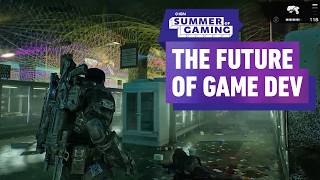
Gears of War E-Day demo showed Lumen ray-tracing from thousands of light sources while maintaining 60 FPS on Xbox Series X|S. Lumen scalability also targets mobile and Switch 2 games.
A new MCP plugin allows communication with LLMs for generating worlds from outlines. Developers retain full edit control, but concerns about AI costs remain.
UEFN now includes assets from collaborations like Star Wars and The Simpsons, allowing users to create content with those IPs. This raises questions about homogenization of experiences.
Unreal Engine's future—through UE6 and UE5.8—promises larger, more scalable games with fewer performance issues and new AI-assisted world-building tools, while the Fortnite ecosystem continues to expand user-generated content with major IPs.
When does early access for Unreal Engine 6 begin?
The end of 2027.
0:13
What is the primary focus of Unreal Engine 6 according to Epic?
Scalability—making games bigger without adding workloads to developers.
0:40
What example was given for UE6's scalability in terms of player count?
Fortnite could potentially scale from 100 players to 1,000 players or more.
0:49
What percentage reduction in shader count did Epic achieve in Fortnite?
68%.
2:15
What feature of UE5.8 aims to reduce hitching in games?
Improved PSO pre-caching and seamless fallback rendering.
2:25
What lighting technology was demonstrated in the Gears of War E-Day demo?
Lumen ray-tracing, pulling from thousands of light sources.
2:51
What frame rate did the Gears E-Day demo maintain on Xbox Series X|S?
60 FPS.
3:05
What new plugin in UE5.8 communicates with LLMs?
The MCP plugin.
4:09
What is the purpose of the new AI tools in UE5.8?
To cut down on busy work and manual labor of building virtual worlds by generating environments from outlines.
4:33
What major IP assets became available in UEFN for user-generated content?
The Simpsons assets (following Star Wars).
5:56
UE6 Prioritizes Scalability Over Graphics
Epic explicitly stated that making games bigger without extra developer workload is more important than visual fidelity, a key shift in engine design philosophy.
0:4068% Shader Count Reduction in Fortnite
Significant performance improvement that will be applied to other UE5 games, addressing a major complaint about shader compilation stutter.
2:15AI World Generation in UE5.8
Integration of LLMs via MCP plugin to generate cities and environments, promising to reduce manual world-building while keeping developer control.
4:03UEFN IP Democratization with The Simpsons
Expansion of user-created content tools with major IPs raises questions about homogenization vs. creative freedom in game ecosystems.
5:14[00:00] Michael with IGN here at Unreal Fest
[00:01] 2026 and we just got out of the state of
[00:03] Unreal keynote. We learned so much about
[00:05] the future of the Unreal Engine and it's
[00:07] going to affect a lot of the games we
[00:08] play, so you're going to want to stick
[00:09] around. At the top of everyone's mind,
[00:11] it's Unreal Engine 6, but that's not
[00:13] coming anytime soon. Early access for
[00:15] UE6 is going to start at the end of 2027
[00:17] and it's going to be [music] about 12 to
[00:19] 14 months until it goes into full
[00:21] production. So, if you think it's going
[00:22] to affect any of the games that are
[00:23] coming out anytime soon, that's not
[00:25] happening. We also didn't get to see it
[00:27] in action at all other than the Rocket
[00:29] League UE6 teaser that we saw before.
[00:31] So, the state of Unreal was more geared
[00:33] towards how it affects game development.
[00:34] [music]
[00:35] So, yes, games built on UE6 are going to
[00:37] look shinier, they are going to look
[00:38] better, but that's not really the
[00:40] priority of UE6. [music] Epic was
[00:41] stressing that UE6 is about scalability,
[00:44] making games bigger without adding
[00:46] workloads to game developers. So, for
[00:48] example [music]
[00:49] Fortnite has 100 players dropping onto
[00:51] an island. Ostensibly, with UE6, you
[00:54] could do that [music] at a larger scale
[00:56] with maybe 1,000 players or even more.
[00:58] So, what this could mean is that you'll
[01:00] get bigger games without adding [music]
[01:01] development time or increasing
[01:03] development costs. Another big part that
[01:05] was stressed about UE6 [music] was
[01:06] portability of assets. So, games built
[01:08] on UE across the board can share assets,
[01:11] >> [music]
[01:11] >> tools, coding, and this is kind of being
[01:14] tested with Fortnite. And part of this
[01:16] is possible because UE6 is merging what
[01:18] you see in UE5 and UEFN. UEFN being the
[01:21] tools that you see to make
[01:22] user-generated content within [music]
[01:24] Fortnite. So, UE6 is merging both of
[01:26] these frameworks and there's going to be
[01:28] a lot of cross-pollination between
[01:30] assets. So, things that are made in
[01:32] Fortnite or UEFN can be ported over to
[01:35] games made [music] in UE6 and vice
[01:37] versa. And there's a lot of information
[01:38] about the coding language Verse, which
[01:40] is going to also be native to UE6 and
[01:42] other versions of UE5 moving forward.
[01:45] Again, that's just top-level stuff
[01:46] because UE6 is a ways out, but if you
[01:49] want to know where UE6 is going, it's
[01:51] probably best to pay attention to what's
[01:52] happening with UE5.8.
[01:56] Now, folks who are worried about
[01:57] performance with Unreal Engine 5, this
[01:59] is where you're going to want to pay
[02:00] attention. I want to talk about
[02:02] compiling shaders. Epic themselves know
[02:05] how much we hate compiling shaders and
[02:07] waiting for that thing to load. So, it's
[02:09] no secret that that is a pain point for
[02:11] a lot of games built on Unreal Engine.
[02:13] And so, one of the points they made is
[02:15] that they've done a 68% reduction in
[02:17] shader count in Fortnite. So, they could
[02:19] do that for Fortnite, you can imagine
[02:21] that that will apply to other games
[02:22] built on UE5. And part of the 5.8 update
[02:25] is also improved PSO pre-caching. It's
[02:27] going to [music] have seamless fallback
[02:29] rendering as well, so there's going to
[02:30] be less hitching. Now, I know you
[02:32] probably don't know what PSO pre-caching
[02:34] means, but if you are having performance
[02:36] problems or if you're having those
[02:37] annoying hitches as you're playing games
[02:39] that are built on UE, this is kind of a
[02:41] solution to solve that problem. Related
[02:44] to this, I think it was interesting that
[02:45] we got a Gears of War E-Day demo that
[02:48] highlighted the lighting model that's
[02:49] being used in that game. So, with the
[02:51] Lumen lighting technology that's built
[02:53] into Unreal Engine, uh
[02:54] >> [music]
[02:54] >> we saw the same scenes that were shown
[02:56] during the Xbox showcase for Gears
[02:58] E-Day, but with a focus on Lumen and the
[03:00] lighting model that's pulling from
[03:01] thousands of light sources. That's all
[03:03] being ray traced while maintaining 60
[03:05] FPS on Xbox Series X and S, and a lot of
[03:07] the destruction model is also reacting
[03:09] to all of that in real time while
[03:11] maintaining performance. And to the
[03:12] point of performance, Lumen is also
[03:14] improving scalability, so you could have
[03:16] a similar lighting model but on a
[03:18] smaller scale for mobile and SWITCH 2
[03:21] GAMES.
[03:25] SO, THOSE ARE THE broader points about
[03:26] performance with Unreal Engine, but
[03:28] there was also a showcasing of how
[03:30] flexible the engine has become. So,
[03:32] Teamfight Tactics from Riot [music]
[03:33] Games is being migrated over to Unreal
[03:35] Engine, and you kind of wouldn't think
[03:37] of it as a game that needs to be built
[03:38] on [music] UE. And all the way on the
[03:40] other side of spectrum, we got to see a
[03:41] lot from No Law, which is a new game
[03:43] from Neon Giant. Previously, they made
[03:45] the game called The Ascent, but No Law
[03:47] is a first-person [music] shooter that
[03:49] is a lot more dense and a lot more
[03:50] detailed at the ground level.
[03:55] The point that they were trying to make
[03:56] is that the tools in Unreal Engine
[03:58] allows a smaller team to make a game
[04:00] [music] with this much detail and with
[04:01] that much density. Now, there's a bigger
[04:03] elephant in the room with UE5.8 and it
[04:05] is the advancement of AI tools in the
[04:07] engine. There's a new MCP plugin that is
[04:10] part of 5.8 and [music] this
[04:12] communicates with any of the LLMs that
[04:14] you may want to use. We saw a live
[04:15] demonstration using cloud coding and
[04:18] [music] how big environments can be
[04:20] generated using these LLMs and the new
[04:23] 5.8 tools. So, for [music] example, we
[04:25] saw a city being built and you can give
[04:27] instructions to the LLM within [music]
[04:30] the tool set that you have with UE5.8.
[04:33] So, the idea is that this is supposed to
[04:35] cut down on the more busy work [music]
[04:36] and the manual labor of building virtual
[04:39] worlds. You can give an outline, you can
[04:41] draw the boundaries, and then it will
[04:43] create a world for you, but all of it is
[04:45] supposed to be editable as the creators
[04:47] themselves. So, you can go to the ground
[04:49] level of the world that was generated
[04:51] and then [music] tool it to whichever
[04:52] way you see fit. So, they're stressing
[04:54] the idea that creative control is still
[04:56] in the hands of the developers and that
[04:58] AI isn't building the worlds on its own.
[05:00] However, there are ongoing questions
[05:02] about the use of AI in a lot of creative
[05:04] spaces, especially [music]
[05:05] the cost that it takes to run these
[05:07] LLMs. So, it's going to be an ongoing
[05:09] conversation and I think the important
[05:11] part is that you need to pay attention
[05:13] to [music] how content is created.
[05:14] >> It's Jurassic Park. Uh, here's Dad
[05:17] having a meeting with my teacher, Mrs.
[05:19] Krabappel.
[05:19] >> So, everybody knows about all the
[05:21] collaborations in Fortnite and all the
[05:22] different IP that have been mashed into
[05:24] the game. Well, UEFN is also an
[05:27] extension of that where a lot of these
[05:28] IP assets are usable for a lot of the
[05:31] creations that you [music] see on the
[05:32] user side. Especially when it comes to
[05:34] Star Wars, there were a lot of games
[05:36] that got a lot of engagement [music] and
[05:37] you can kind of think of it as a
[05:39] platform for user-created content. It's
[05:42] not dissimilar from Roblox, but there is
[05:43] a lot more control that Epic has and
[05:46] there are a lot more sophisticated tools
[05:48] to build out these sorts of experiences.
[05:50] The big conclusion with this is [music]
[05:51] The Simpsons. And if you remember from a
[05:53] couple months back, The Simpsons had a
[05:55] big collaboration in Fortnite. [music]
[05:56] Springfield was the map in Fortnite. But
[05:59] all those assets are now part of UEFN
[06:01] ecosystem. [music]
[06:02] So, people who want to create content
[06:03] with The Simpsons assets can do that
[06:05] now. So, like a lot of the Star Wars
[06:07] content you saw on UEFN, that will also
[06:10] apply to The Simpsons [music] coming
[06:11] soon because the toolkit will be
[06:12] available later this year. There's a
[06:14] broader conversation to be had about the
[06:15] democratization of IP, but also the
[06:18] homogenization of a lot of these assets
[06:20] and a lot of the experiences that you
[06:21] have [music] mashing all these different
[06:23] IP together. But, it is part of the
[06:25] larger Fortnite ecosystem, [music] and
[06:27] it is part of Unreal Engine's ecosystem.
[06:30] So, those are some of the big ideas
[06:31] coming out of Unreal Fest and the State
[06:33] of Unreal keynote speech. [music] This
[06:34] is going to affect a lot of the games we
[06:36] play. Claire Obscure was built on Unreal
[06:37] Engine. The Final Fantasy VII Remake
[06:39] series is built on Unreal Engine as
[06:41] well. So, if you're interested [music]
[06:42] in the future of games, you should be
[06:43] paying attention to this stuff. And for
[06:45] all the coverage of Unreal Engine and so
[06:47] much more in the world of games, stick
[06:48] with IGN.




⚡ Saved you 0h 06m reading this? Transcribe any YouTube video for free — no signup needed.