
How AI Encodes Meaning in Vectors
45sThis segment introduces the fascinating concept of word embeddings in a simple way, making viewers curious about AI's inner workings.
▶ Play Clip"Title is accurate and the content delivers a clear, concise explanation—though it's a short clip from a longer video."
This video explains how word embeddings encode meaning in high-dimensional vector spaces, using analogies like 'man - woman + uncle = aunt' and 'Hitler - German + Italian = Mussolini' to illustrate the concept.
Tools like ChatGPT process text by associating each piece with a large vector—a long list of numbers. These embedding vectors can be imagined as directions in a high-dimensional space (more than three dimensions).
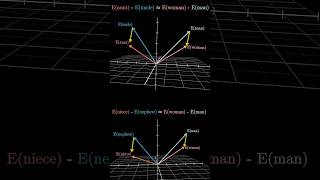
The model encodes meaning into the directions of this high-dimensional space. For example, subtracting the embedding of 'woman' from 'man' and adding it to 'uncle' yields a vector very close to the embedding of 'aunt'.
Similarly, subtracting 'German' from 'Hitler' and adding 'Italian' gives a vector close to 'Mussolini'. This shows the model learned to associate certain directions with concepts like 'Italian-ness' and 'World War II axis leaders'.
Word embeddings capture semantic relationships by encoding meaning as directions in high-dimensional space, enabling arithmetic-like operations that reveal analogies and associations learned from data.
What are word embeddings?
Large vectors (lists of numbers) that represent text, encoding meaning as directions in high-dimensional space.
How does the analogy 'man - woman + uncle = aunt' illustrate embeddings?
Subtracting the embedding of 'woman' from 'man' and adding it to 'uncle' yields a vector close to 'aunt', showing semantic relationships are encoded as vector arithmetic.
00:28
What does the example 'Hitler - German + Italian = Mussolini' demonstrate?
The model learned to associate directions with concepts like 'Italian-ness' and 'World War II axis leaders', enabling analogical reasoning.
00:43
Vector arithmetic reveals analogies
Demonstrates a core property of embeddings: semantic relationships can be captured through simple vector operations.
00:28Learned semantic dimensions
Shows that models implicitly learn abstract concepts (like nationality or historical roles) as directions in embedding space.
00:43[00:00] This came up in a full video that I did dissecting You see, when tools like Chachipt process text, and they associate each piece with a large vector, some long list of numbers.
[00:16] and it's helpful to imagine these embedding vectors as directions in some very more than three dimensions.
[00:28] encode meaning into the directions of this high dimensional space. If you take the difference between the embeddings of man and woman and you add that to the embedding of uncle, you get a vector very close to the embedding of aunt.
[00:43] embedding of Hitler, you get something very close to the embedding of Mussolini. It's as if the model learned to associate some directions in this high dimensional space with Italian-ness, and others with World War II axis leaders.
⚡ Saved you 0h 01m reading this? Transcribe any YouTube video for free — no signup needed.