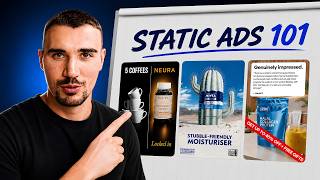

Why 99% of Ads Fail (Even Profitable Brands)
42sReveals a shocking truth that most brands are guessing, creating curiosity and relatability for marketers and business owners.
▶ Play Clip"The title accurately reflects the content: the speaker analyzed over 400 ads and shares actionable insights."
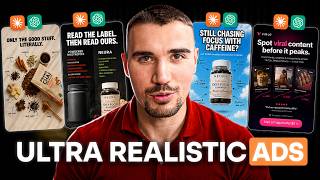
The video analyzes over 400 profitable static ads from various industries to uncover why most fail and how to create winning ones. The speaker identifies three main mistakes brands make and introduces a tool called Mockingbird that automates the ad creation process.
The speaker analyzed over 400 profitable ads from brands in supplements, apparel, SaaS, and consumer goods, concluding that most brands don't understand what makes their ads work.
Three main reasons: designing for aesthetics instead of stopping power, using statics in the wrong funnel stage, and not testing enough volume.
Best-performing ads don't start from scratch; they take winning formats from competitors and apply them with their own copy and product.
Manual method: create a swipe file deck, brief a designer, wait weeks. Automated method: use Mockingbird to generate ads in minutes.
Mockingbird has a curated library of winning statics, allows users to paste a website link, and uses AI to remake winning ads for the user's brand in minutes.
The speaker created 12 ads for a new dropshipping store in 20 minutes. Mockingbird offers first three ads for $5, eliminating agency retainers and long waits.
Patterns: Identity Hook (top of funnel), Problem-Solution Frame (before/after), Objection Killer (middle/bottom funnel), Contrarian Headline (attention-grabbing).
Many brands ignore static ads in favor of video, but statics at scale can generate significant revenue across all funnel stages.
Static ads are far from dead; they are underused and can be highly effective when designed with the right patterns and tested at scale. Using tools like Mockingbird can drastically reduce the time and cost of creating winning ads.
What are the three main reasons static ads fail?
Designing for aesthetics, using statics in the wrong funnel stage, and not testing enough volume.
01:20
What is the 'blink test' for top-of-funnel statics?
If someone blinks and misses the ad, does it still convey the message and stop the scroll?
08:01
What is the key to a successful problem-solution frame ad?
The specificity of the problem; the more specific, the more the ideal customer resonates.
08:42
What is the 'objection killer' pattern and where does it work best?
It addresses the one doubt preventing a warm audience from buying, using review-based testimonials. It works best at middle and bottom of funnel.
09:07
What is a contrarian headline ad?
An ad that opens with a statement against what the audience believes, e.g., 'Stop taking protein shakes.'
10:34
How long did it take the speaker to create 12 ads using Mockingbird?
20 minutes.
05:37
What is the primary goal of a top-of-funnel static ad?
To get the right audience to stop and think 'Ooh, that's for me,' not to convert immediately.
07:08
Most Brands Guess on Ads
Reveals that even successful brands don't understand what makes their ads work.
00:42Winning Ads Use Proven Formats
Key insight that top performers adapt existing winning formats rather than creating from scratch.
02:27Mockingbird Condenses Learning Cycle
Demonstrates a tool that reduces ad creation from months to days.
04:15Four Winning Patterns Identified
Provides actionable patterns (Identity Hook, Problem-Solution, Objection Killer, Contrarian) for different funnel stages.
06:43Static Ads Are Underused
Challenges the trend of focusing solely on video ads, highlighting statics' potential.
11:28[00:02] Ads library of hundreds of brands, pulling ads from some of the biggest And by the end of it, I'd gone through over 400 profitable ads. Supplements, apparel, SaaS, consumer goods, all of
[00:16] it. And I came away with a conclusion that honestly made me feel a little bit uncomfortable. Most brands, including those doing serious revenue, still have absolutely no clue what's making their ads work. They are actually just
[00:29] guessing. And even worse, the ones bleeding money are making the same three mistakes every single time. So, in this video, I'm going to break down the exact statics. And by the end of this video, I'll even show you the workflow I use to
[00:42] create profitable static ads in minutes, rather than paying a designer hundreds of dollars and waiting weeks. Right, before the good stuff, why do most ads fail? Because I see this constantly. Someone puts a lot of time, effort, and
[00:55] money into making what they think is a great ad. Clean layout, nice colors, product front and center with a decent headline. But they upload it to Meta, and yeah, terrible ROAS. Here's the thing nobody tells you. A good-looking
[01:08] ad and a good-performing ad are not always the same thing. And most brands are optimizing for the wrong one. There are an abundance of reasons why statics fail, but after analyzing over 400 of them, these are the three main reasons.
[01:20] Number one, you're designing for aesthetics. If the first question you ask when making an ad is, "Does it look nice?" you are already not optimizing for the right thing. A better question is, "Does this ad stop my target
[01:32] different briefs, and the second one is far more powerful for creating a winning ad. Number two, and this is powerful, you are using statics in the wrong part of your funnel. Static ads are a tool, and just like any tool, using a hammer
[01:46] when you should use a screwdriver doesn't mean a hammer is bad. It just means you don't understand the job and the right creative required. I'll come really powerful, and it was a massive unlock for me and my brands. And number
[01:59] three, you're not testing enough volume. If you run just three statics, they aren't for me." That's not a proper test. That's just hoping to get the dream outcome. In reality, you should be testing hundreds of statics because they
[02:12] marketing angles. And if you find one that works, it can scale so easily. about something with you. After going through 400 plus of these ads, one of the clearest patterns I spotted wasn't about the copy or design structure. It
[02:27] was actually this. The best-performing ads were not starting from scratch. They were taking formats that had already worked well for competitors or adjacent niches, and then taking the winning formats and applying it to their own
[02:40] brand. Now, I know how that sounds. So, are you telling me that brands just copy there's a difference between directly taking someone's copy and creatives, and instead applying the winning formats with your own copy and your own product.
[02:55] The first one is lazy and probably can get you in trouble if you do at scale second one, that's smart. That's stealing like an artist. And every decent creative director does it. Why do you think brands spend so much money on
[03:08] through two ways of doing this, the manual version and the automated manual version is you create a swipe file deck. This means that you search find the winning ads from your competitors and add them to a Google
[03:23] Docs or Word file. Which, by the way, is possible but much harder than it sounds of garbage. Drop a like down below if you've tried to search through the Meta Ad Library for winning ads. I've done it myself, not too fun. You then have to
[03:36] ads, and then you're briefing a designer to create these ads for you based on those winning examples. You'll have to wait a few days to a few weeks for a You're paying them hundreds, if not thousands of dollars, depending on the
[03:49] quality and number of statics. And then eventually, you get to test those ads through Meta and get your results. Which, don't get me wrong, is fine if time to waste. But, the problem is that your learning cycle is far too long.
[04:02] From ideation to having the ad ready and results on Meta, we're talking about weeks, if not realistically months. And that is the way people were creating static ads for years. But, now there is an automatic way of doing things, and it
[04:15] can take the whole learning cycle and condense it from months into just days. So, there's a tool called which condenses this entire flow for you to the first thing is what Mockingbird does is it has a curated ad library of just
[04:29] the winning statics. These are not just scraped from the Meta ad library, these you're not sifting through hundreds of mediocre ads to find that one diamond in the rough. The heavy lifting on finding the winning ads is already done for you.
[04:43] library and choose a category as well if you are in a particular industry, and most. And then, on your my heart section, you can click remake in my paste in a link to your website on Mockingbird. So, what Mockingbird can do
[04:58] with their agents is take the website, pull out your offer, pull out the target And then, the best part is it can use that information to remake the winning perfectly made for your brand. And all
[05:11] couple of minutes. And the output is completely original. The copywriting, the product images, all bespoke for your brand. The only thing that's taken from the winning ads is the style and format, aka the part which made the ad the
[05:25] winner. An ad that's inspired by competitors, but remade as a winner into your brand. And I tried this the other day when launching a brand new dropshipping store from scratch with AI. And I had 12 ads ready to go and test
[05:37] through Meta in just 20 minutes. And you can see a few examples of how the ads created were literally taken as inspiration from winning ads already on think this matters is because it levels the playing field for brand new brands
[05:50] entering the ad space. Like I mentioned, to create ads before, it would take hundreds, if not thousands, of dollars. small agency, you get a batch of ready-to-test creatives in literally
[06:04] hours rather than weeks. And you are starting from ads which brands paid And that is a completely different from scratch like a lot of AI ad generators. Now, I'll leave a link down
[06:16] pinned comment to Mockingbird so you can sign up and give it a go. There is make your first three ads for just $5. So, $5 to test this out three times and like I mentioned before, this is powerful because there's no agency
[06:31] retainer, no waiting weeks for your ads to arrive. It's minutes. They're created, ready to test. You can even get it set up and going by the time this video is done watching. Okay, I've gone through over 400 ads within my
[06:43] Mockingbird library. And I landed on four patterns which kept repeating And they map almost perfectly to where in the funnel you are running them. The first pattern is what I'm calling the identity hook. And this lives at the top
[06:56] of the funnel. This is what most people get wrong about top of funnel statics. So, they are trying to sell right away. They slap a discount, a feature list, a buy now button, and expect everyone to go crazy buying the product. But then
[07:08] audiences aren't converting. The job of a top of funnel static is not to convert. Its primary goal is to get the right audience to stop and think, "Ooh, examples I found were brands that created a clear identity association.
[07:24] One ad that I thought was really cool I found on Mockingbird was a supplement immunity capsule unless you're in your and it made the point perfectly. It was
[07:36] within that target audience stopped and thought, "Oh, that's for me. I'm in my 40s." The target audience felt like they were called out personally, and that's a something that solves a particular problem, whether that be supplements,
[07:49] skin care, a SaaS for example, you've actually got this easier. You can just illustrate the problem directly. Something like "Tired of" and then insert the specific pain point. With the right image and copy, done. You've got a
[08:01] ready-to-go top-of-funnel static. And the test I'd use is the blink test. happening in the static, and importantly, does it stop your scroll? scroll-stopping, and gives a good first impression of the brand, you are onto a
[08:15] winner. Okay, pattern number two is the problem-solution frame. This one is slightly different. And it works particularly well if your product has a clear before-and-after transformation. The structure is exactly what it sounds
[08:29] in the headline, and then show the complicated. In fact, what these type of ads that the simpler the better. What made the best-performing version of these statics was not the design. It was
[08:42] the specificity of the problem. Not bad skin, it's your skin looks gray by 2:00 p.m. Not low energy, you're crashing after your fifth morning coffee. The more specific the problem, the more your ideal customer resonates with the ad
[08:55] customer is literally feeling like you're reading their mind. And when someone feels understood, they stop scrolling, and importantly, they're more likely to buy into your brand and product. Okay, pattern number three is
[09:07] the objection killer. Okay, this one I think brands are flat-out ignoring, and it's costing them a lot of money. Middle and bottom-of-funnel statics, these go directly to the customers that already know you exist. They've seen the ads
[09:19] site. They know of your brand. They may even have added the products to their line. That one niggling doubt in the can't quite buy this." And the best format I found to solve this, looking
[09:32] through the Mockingbird examples, review-based testimonials. So, one brand selling supplements, which is massive in the UK is Suna Supplements. And they've been running a super profitable ad for months now which basically just answers
[09:44] all the potential objections of a customer. The whole ad is just a review from a customer, but in that review, all of the potential objections are answered ads that say, "Hey, if you're not going to take it from us, at least take it
[09:57] from someone that's in your shoes." The ad probably took over an hour to make, traffic which was this close to buying, but didn't quite go over the edge. It's literally the closest thing you can get to free money in your ad account. Oh,
[10:10] ads for my own brand on Mockingbird and minutes. So, the question to ask yourself is which specific objection is stopping my warm audience buy my product. Whatever that answer is, make a
[10:22] static to kill that objection. Okay, pattern number four, the contrarian headline. This one is one of my personal favorites. These are statics which open with a statement against what the audience believes. So, for example, stop
[10:34] taking protein shakes, or stop drinking that morning coffee, or most skin care routines are actually polluting your skin. They work because they create that audience needs. When someone is scrolling on autopilot, their brain is
[10:47] something that contradicts what they actually believe in, they suddenly wake captured their attention and that is all you need because now they are actually reading and taking in the information. The caveat, and this matters, the rest
[11:01] of the ad has to back this up. If you open up with a contrarian headline and then just pitch something generic, it's not really going to work. In fact, it's probably worse because you've burnt their attention and trust going forward.
[11:13] But if the ad earns that headline, explains the counterintuitive position, your product, it's proven to be one of the most highest converting formats in this entire analysis. So, truthfully, static ads are not dead, far from it. In
[11:28] fact, they are severely underused by the majority of DTC e-commerce brands, SaaS companies, and service-based businesses. Most brands are pouring everything into video ads, forgetting the potential of running statics at scale. Literally
[11:42] ignoring the revenue sitting in top, middle, and bottom of funnel statics. to know where each of the four patterns fit within your funnel. And importantly, Because hitting the nail on the head with one static isn't realistic, but
[11:57] running 10, 20, 50 statics, you're bound to find a winner. So, either do the it's all done for you in a matter of launched a brand new drop-shipping store with AI using a lot of the static ad
[12:10] examples I showcased in this video, you've got to check out the video right you've got to check out the video right beside me. I'll see you there.
⚡ Saved you 0h 12m reading this? Transcribe any YouTube video for free — no signup needed.