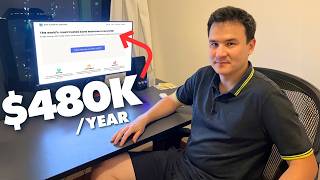

Simple Site Makes $40K/Month
40sThe extreme contrast of a simple website generating massive income sparks curiosity and aspiration.
▶ Play Clip"Title accurately reflects the content: Angus reveals his $40K/month solo business."
Angus Chang, a solopreneur from Hong Kong, built Bank Statement Converter, a simple website that converts PDF bank statements into Excel spreadsheets. The business now generates $40,000 per month in revenue with zero employees and 100% bootstrapping. In this interview, Angus shares how he found the idea, built the MVP, and grew the business through organic growth rather than paid ads.
Angus Chang built Bank Statement Converter, a website that converts PDF bank statements into Excel. He operates it as a solopreneur with no employees, 100% bootstrapped, making $40K/month.
After quitting his job, Angus wanted to track his spending by exporting bank data into Excel. His bank only provided PDF statements, so he wrote code to parse them, realizing others might need the same solution.
Angus built a quick MVP with a friend, launched it, and bought Google ads to get users. People started uploading bank statements, validating the problem.
Angus suggests solving a problem you encounter yourself or hearing complaints from colleagues. Build the smallest possible implementation and test it quickly.
He started with a local console app for his own bank, generalized it, then convinced a friend to build the UI in Next.js. Deployed frontend on Netlify and backend on AWS.
Launch quickly, get real user feedback (not friends/family), and build features based on analytics and user emails. Drop features that aren't used.
2021: launched. 2022: $6K MRR. 2023: $14K MRR. 2024: $27K MRR. Today: $40K MRR. 75,000 total users, 1,000 paying customers, 40,000 monthly traffic.
Initially bought Google ads but lost money ($1K ads for $300 sales). Tried blogging, Twitter, cold emails (1 sale in 3 months). After 6 months, stopped marketing and focused on product. Organic users started coming.
Brex is a modern finance platform for startups with high card limits, automated expenses, and instant money movement. Offers a free guide on modern banking.
Angus does all development, customer support, sales, and marketing himself. No employees.
Shift from writing clean code to focusing on business features. Pros: own schedule, no boss. Cons: loneliness, income instability, social pressure.
As a solopreneur, you can target small markets that VCs ignore, making enough revenue for one person.
Developer since 2010. Worked at an EPS machine company, built indie games and a virtual girlfriend app, worked at an investment bank and a crypto exchange before launching Bank Statement Converter.
Core engine in Kotlin (JVM language), frontend in Next.js, transactional emails via Brevo, backend on AWS EC2, frontend on Netlify, payment processing via Stripe. Profit margin ~97.5% ($39K profit from $40K revenue).
First two years of hard work with little pay, but the payoff comes in years four and beyond. Early customers matter most.
Save enough money to survive 2-3 years without revenue. Ignore social media and building a following; focus on product and real users. Don't create social media pages for the business.
Angus's story demonstrates that a simple, niche SaaS can be highly profitable when built around a real personal need and grown through product improvement rather than paid marketing. His advice: save runway, ignore social media, and focus relentlessly on the product.
What is the monthly revenue of Bank Statement Converter?
$40,000 per month.
00:43
How many employees does Angus have?
Zero employees; he runs the business entirely by himself.
00:14
What problem does Bank Statement Converter solve?
It converts PDF bank statements into Excel spreadsheets so users can track their spending.
01:09
What was Angus's initial marketing strategy and why did he stop?
He bought Google search ads but lost money ($1,000 ads for $300 sales). He also tried blogging, Twitter, and cold emails with little success. After 6 months, he stopped marketing and focused on product improvement.
04:01
What is the profit margin of Bank Statement Converter?
Approximately 97.5% ($39,000 profit from $40,000 revenue).
08:38
What tech stack does Bank Statement Converter use?
Core engine in Kotlin, frontend in Next.js, backend on AWS EC2, frontend on Netlify, transactional emails via Brevo, payment processing via Stripe.
08:25
What advice does Angus give to his past self?
Save enough money to survive 2-3 years without revenue. Ignore social media and building a following; focus on product and real users. Don't create social media pages for the business.
09:18
How did Angus validate the idea for Bank Statement Converter?
He built a quick MVP with a friend, launched it, and bought Google ads. People started uploading bank statements, validating the problem.
01:35
Solo founder making $40K/month
Demonstrates that a single person can build a highly profitable SaaS without employees.
00:43Marketing failure leads to organic growth
Shows that paid ads and social media aren't always necessary; product focus can drive organic growth.
04:01Delayed payoff of hard work
Highlights the long-term nature of SaaS: early hard work pays off years later.
08:52Ignore social media, focus on product
Contrarian advice that challenges common startup marketing wisdom.
09:18Advantage of small markets for solopreneurs
Explains why targeting niche markets can be more profitable for solo founders than VC-backed startups.
07:44[00:02] a month. This is Angus Chang. He lives in Hong Kong and he built the simplest website I've ever seen. >> I built a website that literally does >> And what's even crazier is that he operates this business entirely as a
[00:14] solopreneur. Solo founder, zero employees, 100% bootstrapped. myself. >> I brought Angus onto the channel and he broke down how he found a silly idea that thousands of people also happen to
[00:27] need. why spending money on ads actually hurt his business and why having a big strategy is for losers. All right, let's dive in. I'm Pat Walls and this is dive in. I'm Pat Walls and this is Starter Story.
[00:43] who you are, what you built, and what's your story. business that does just one thing. I launched it in 2021 and today it makes $40,000 a month and I run it entirely by myself. All right, before we get into
[00:56] that you built, I want to hear how did you come up with the idea for Bank >> I had just quit my job and I knew I was going to build some sort of product. I else. But on the side, I was thinking, you know, I've got X amount of money in
[01:09] the bank. I want to know how long I can continue living the way I'm living. And bank data. I wanted it all in a nice Excel spreadsheet so I can kind of spending this much a month. And that was a lot harder than I thought it would be
[01:22] because my bank only provided PDF bank statements. So, I wrote some code to get statements and that was also really hard. So, I figured it must be a real have ideas all the time. How did you know that this could be a business?
[01:35] >> Often I like to just make an MVP as quickly as possible, get it into real users. And that's kind of what I did. So, me and a friend worked on it launched it, and then we bought Google ads to get people to start clicking into
[01:49] started uploading bank statements, which kind of validated the problem. You know, will be looking for how do I find a simple idea? How do I find this kind of it myself and it can become a business. Do you have any sort of framework or
[02:03] >> I think a good way is if you encounter the problem yourself or a painoint yourself. Another way is your colleagues or friends complain about stuff at work. just think of the smallest possible way to implement that idea. You know, get it
[02:17] out there and see if people will use it. You can try to validate before or two weeks to make an MVP, it's not that much of a risk anyway. So, you >> Okay. So, we talked about finding the idea, but I want to hear more about how
[02:30] you actually built this thing. How did you go from idea to real live website? >> When I proved this out, I had a local version that would work for my own bank. a console application. And then I generalized it a bit so that it would
[02:42] obviously I don't know if it works for every bank statement but I tried it out with some of my other banks and some of my friends banks and then I convinced a friend to help me build the UI for this and he did this in Nex.js and then we
[02:54] front end on Netifi. I deployed the back how we did it. >> Cool. You probably build a bunch of process of what works and what doesn't. What's your kind of framework for
[03:06] building? What's the Angus method? >> It's kind of like a lean startup launch it as quickly as possible. Try to get it in front of your target audience, friends and family, you know, they will just lie to you and they're probably not
[03:19] then you build your features based on real user feedback. So maybe somebody emails you or maybe like analytics. So if you notice that people are dropping something there. If people are not using a certain feature, maybe don't continue
[03:33] the numbers of this. Can you give me a timeline of the growth of bank statement converter? So 2021 we launched bank statement converter. 2022 we hit 6,000 statement converter. 2022 we hit 6,000 USD MRR. 2023 14,000. 2024 27,000. And
[03:49] today it's at 40,000 USD MR. >> Total number of users 75,000. Paying customers about a,000 and traffic per month about 40,000. right now is probably wondering, okay, it's cool how you built it, but how did
[04:01] you actually market it? How did you get customers? Was there a specific strategy that made this thing go up? >> At first, I bought Google search ads. users, but I was never able to run an ad campaign profitably. So, I would spend
[04:14] maybe $1,000 on ads and bring in about $300 in sales. I spent a lot of time get them more profitable, but never really worked out. I tried blogging and lot of attention. However, I don't think I get many users from doing that because
[04:29] my users don't seem to be using Twitter or reading my blog. I also tried sending out cold emails and in 3 months of doing that, I got one sale and I also annoyed messages back. People don't really like cold emails. After about 6 months of
[04:42] you know, I'm just not going to do this anymore. I might not even do this app maybe go back to work. And So, I knew everyone who was clicking on the website was an organic user. And I
[04:55] noticed I started getting new users. I'd get like two or three new signups a day. From that point on, I kind of focused on improving the products. When customers complained about things, I would fix them. and I just basically focused on
[05:07] >> All right, real quick before we get into how Angus built this $30,000 per month business, let's talk about something that matters a lot once your business starts making money. Banking. The truth is most banks aren't built for solo
[05:20] founders and SAS builders. They slow you down with low card limits, delayed payments, and systems that feel like they were made in 2004. That's why we're partnering with Brex, the modern finance platform that's built from the ground up
[05:32] for startups. With Brex, you can get up to 20x higher card limits. Earn high yields on your cash, automate expenses, invoices, and vendor payments, and move money instantly when you need it. It's fast, flexible, and made to scale with
[05:46] you, no matter how small or scrappy your SAS is right now. We worked with them to put together a free guide called The Startup's Guide to Modern Banking. It extend runway, and upgrade your finance stack without wasting time. Just click
[06:00] the first link in the description to download it. Thank you to Brex for to the video. All right, so you got this website making a bunch of money. It's a on this. >> No, it's just me. I started this
[06:12] after a few weeks. I do all the development, customer support, sales, >> All right. So, you went from working a 9 toive job to being a soloreneur, running your own business. What was that transition like? working for a company,
[06:25] playing, you know, refactoring code, trying out databases you think are cool. quickly realize these things don't make any money and potentially are a waste of different. You go from being like a developer who cares about writing nice
[06:39] business features and more business aligned, I suppose. solarreneur, what are some of the pros and cons of the solarreneur lifestyle? change. Most of my friends I knew, most of the people I hung out with were
[06:53] for drinks or whatever. And then I went to working for myself, just being at home all day, basically not socializing. It's kind of a big change when you go from making maybe like $10,000 a month to 200 a month and you're basically
[07:05] soloreneur can be pretty depressing. Another thing is people often don't when you're failing to make money. I remember in the first two years people would also, you know, hear the revenue and they would tell me, "Oh, this is
[07:18] after this. And then multiple years later when it's making a lot more money, it's a great business." Some pros, it's good to have your own schedule. Often I to work. It's nice to be like on a different schedule to everyone else. If
[07:31] you have a boss, you have investors, you got a lot of time pressure. As a mean, depending on how much money you have saved up, and you can also go after much smaller markets. A venture capitalist wouldn't want to invest in
[07:44] make enough money. The market's not big enough. But for a single person, you quite happy with that revenue. >> Cool. Now, you have this great business. doing before? Were you a developer? What was your kind of journey to starting
[07:57] >> I've always been a developer. In 2010, I worked for an EPS machine company. 2010 to 2014. I worked for myself developing indie games for the Xbox Live indie game store. I also developed a virtual girlfriend app for Android and iOS. It's
[08:10] worked in an investment bank in Hong Kong. 2020 I worked at a crypto company. We're building a crypto exchange. 2021 I launched bank statement converter. know you're a developer. Can you share with me the entire stack of how you
[08:25] built this app? The core engine is written in Cotlin. It's like a JVM language. Nex.js is what the front end is written in. I use Brevo for transactional emails. I use AWS EC2 instances to host the back end. Netlefi
[08:38] payment processing. And that's about it. a lot of profit. It's like 39 out of $40,000 is profit. Yeah. >> All right. So, you built this awesome a number of years. What have you learned in the process that surprised you?
[08:52] extremely hard on the business and making basically no money. You know, I spent a lot of hours developing the app. I'd reply to customer emails as soon as 3:00 a.m., I would deal with it right away. You know, at that time, every
[09:05] extra customer made a big impact on MR. And what I realized was that those first two years of hard work, you don't get paid much, but you kind of get the money for that hard work in like years four and onwards. The last question that I
[09:18] comes on to Starter Story. If you could stand on Angus' shoulder when you quit was making a few dollars in revenue. What advice would you give him? >> SAS is an excellent business model. Make sure you save enough money to survive
[09:32] have enough money for a few months of runway, you're probably not going to make it, you know? I mean, it took me two or three years before I could pay Ignore social media. That's, you know, a lot of people think they need to build a
[09:44] building a business. I think it's a waste of time. Building a following on you have it, your business might still not be very good. So, just focus on the business. Focus on the product. Get some real users. Improve the product. And it
[09:58] product solves their problem. Don't make a Facebook, Instagram, and Twitter page do this, and I think it's a waste of time as well. That was awesome. Thank business that you built. It's going to keep growing. It's awesome. Thanks for
[10:11] sharing everything with the audience and hope to see you back on soon. Angus is proof that you can build simple apps that actually make money. He found a tiny problem, built a solution for himself, and then turned it into a
[10:23] life-changing business. I think anyone can take this framework and strategy and turn it into their own micro SASS. If you want to learn more about how to Story Build. In about 2 weeks, you'll go from a simple idea to a fully
[10:36] operational app. We'll guide you on how to use AI to build and design your app, and then we'll challenge you on how to launch it into the real world. Just head more and join Starter Story Build. All right, guys. Thanks for watching. I'll
[10:50] right, guys. Thanks for watching. I'll see you in the next one. Peace.
⚡ Saved you 0h 10m reading this? Transcribe any YouTube video for free — no signup needed.