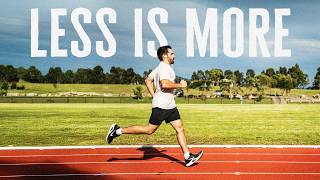

I haven't run a mile in 22 years
45sRelatable vulnerability and a high-stakes personal challenge hook viewers immediately.
▶ Play Clip"The title accurately describes the 30-day running challenge and the journey to break a 7-minute mile."
In this video, Matt d'Avella embarks on a 30-day challenge to run one mile every day, aiming to break a 7-minute mile. He documents his journey from being a non-runner, dealing with injuries, and seeking advice from an elite running coach and an ultra-runner who ran across Australia and back.
Matt, a non-runner, commits to running one mile daily for 30 days to improve his cardio and see how fast he can get.
His first mile was harder than expected; he had to stop and walk three times. His pace decreased over the run.
Matt's goal is to break a 7-minute mile by day 30, something he has never done before.
He develops a blister and uses 'second skin' bandages. He also experiences mild knee and shin pain.
Matt plans to run casual miles at 9-10 min pace most days, and do interval training 2-3 times a week, starting with 200m repeats and building up.
Alex Barbas ran from Sydney to Perth and back (98 days, 2 marathons a day) for charity. He never considered quitting, focusing on small steps like 'just get the shoes on'.
Ben Lady analyzed Matt's form, noting his foot strike should be under his center of gravity and he should stand taller. Building mind-body connection is key.
Knee pain forced Matt to take 3 days off. He learned to listen to his body and prioritize recovery over sticking to the plan.
Matt completes his final mile, fighting mental battles to push through. He feels proud of his progress and the habit formed.
Matt successfully completed the 30-day challenge, improving his running form and mental resilience. He emphasizes starting small, listening to your body, and building consistent habits.
What was Matt's goal time for the mile by day 30?
To break a 7-minute mile.
03:00
What type of training did Matt incorporate to improve speed?
Interval training: running fast for short distances (200m to 400m) with rest in between.
06:00
How many days did Alex Barbas run consecutively across Australia and back?
98 days.
08:00
What key advice did running coach Ben Lady give about foot strike?
The foot should strike almost directly underneath the center of gravity.
14:00
Why did Matt take 3 days off from running?
To recover from knee pain and prevent injury.
19:00
Ultra-Runner Mindset
Alex Barbas shares that he never thought about quitting during his 98-day run, focusing on small steps like 'just get the shoes on'.
08:00Form Correction
Coach Ben Lady identifies that foot strike should be under the center of gravity to improve efficiency and reduce injury risk.
14:00Listening to Your Body
Matt decides to take rest days despite his commitment, showing the importance of recovery over rigid adherence to a plan.
19:00Mental Battle
Matt describes fighting negative thoughts during the final run, highlighting the mental challenge of endurance.
22:00[00:00] I'm a little bit nervous right now. I haven't run a mile all out in over 22 years. So, I feel like I might get hurt. For the next 30 days, I'm going to run 1 mile a day or four laps around an Olympic track. 1,609 m to be exact. Mostly because I've been neglecting cardio my entire adult life and I know it's good for me. But also, I want to see how fast I can get in
[00:25] a month. Let's go. I'm going all in. Buying the gear, hiring an elite running coach, dodging injuries, and getting advice from runners who've accomplished insane feats like running across Australia and back. >> I don't want to be the one who injures you. You're fully liable if I get injured. >> As a non-runner, it's a small commitment, an experiment to see what happens when you give something just enough effort, long enough to make a difference. >> Minutes
[00:49] 2 seconds. >> This video is sponsored by Squarespace. I'll share more about how they help me build all my websites later. All right, so run number one. I did a lot better than I expected. It was also a lot harder than I was expecting it to be. It's been a very long time since I've gone for a run and I've pushed myself this hard. Let me pull up Strava here. So, like you can see by my
[01:14] pace, I just like gas it right from the beginning. And because of that, naturally over time, it starts to decrease and decrease. And I think there were one, two, around three periods where I just had to stop and I had to walk. And so I definitely think there's a lot of room for improvement there. So on day 30, my goal is going to be to break a 7minute mile. Something I've never done in my life. Yeah,
[01:38] got a little bit of work to do. I'm starting small, just one mile a day. It's intentionally slow because I'm a busy dad. Also, because the last time I tried to get into running, I pushed too hard, too fast, and ended up with shin splints. So, this time, I'm pacing myself, something that I can actually commit to and build off of. The ceiling, though, for what's possible in running just keeps getting higher. I remember when the
[02:03] marathon used to be the ultimate test of someone's physical abilities and mental strength. But now people are running ultramarathons 200 kilometers at a time. Races like the Moab 240 where athletes spend days moving through mountains sleepdeprived pushing themselves to the absolute limit. Or those who have defined their own races running across cities, countries, and continents. And while I don't know if I'll ever do something like that, that is part of what makes this whole thing interesting
[02:28] to me. Because even at one mile as a non-runner, learning to just stay in that discomfort is the hardest part. After my first mile, I started to develop a blister and it's gotten worse with each subsequent run. And so, I've gone out and I've grabbed some band-aids. They call these second skin. I don't know exactly what it does. And second skin sounds really gross, but I guess it just covers up the blister and it helps it
[02:52] heal faster. Hopefully, this prevents some of the pain that I'm feeling while running. If it continues to get worse, it might prevent me from running. So, I'm out here doing interval training today. Interval training really means you run really fast for a little bit and then you slow down and you walk for a little bit and then you run really fast again. This is meant to help you start to gradually get used to running at higher
[03:17] speeds. I've pieced together a plan to hopefully help me get faster in just 30 days. Most days I'm going to be running a casual mile at around a 9 to 10 minute pace. These are meant to keep me moving but not push my limits. Then I'm going to do my intervals running around my goal time two to three times a week. I'll gradually build up the volume of these runs starting at 200 m then building up
[03:41] to 400 m. Then finally reducing my rest time every session adding up to just one mile. I'm starting to feel some light pain in my knees and my shins. probably like a two out of 10 pain, especially as I start to push myself in these intervals and I start to pick up my speed and so yeah, hoping that doesn't get any worse. >> How you going, man? >> How's it going? >> To meet you. I'm Matt.
[04:06] >> I'm Alex. >> Alex. Nice to meet you. >> How you guys going? >> Oh, man. Good. I'm excited. >> Yeah. >> I'm just nervous about the running part. When I reached out to you and asked you to come out and like help me out, you were like, I just want to make it very clear. I'm not a runner. >> I'm not. No. >> And yet? >> No. No. >> Well, just over 6 weeks ago, avid
[04:31] runner Alex Barbas kicked off a mammoth attempt to run from Sydney to Perth and back all in the name of charity. While Alex Barbas isn't a professional runner and doesn't compete in races, he's taken on some pretty extreme challenges, including running 50 km a day for 50 days, and most recently becoming the first person to run across Australia and back. It meant running the equivalent of two marathons every day for 98 days straight, raising over $100,000
[04:55] for the Starlight Children's Foundation along the way, which kind of makes me embarrassed that I've been complaining about a blister on my foot. But I was genuinely curious about what it takes to operate at that level and what you learn when you push yourself that far. >> You have, I think, some of the most impressive accomplishments of any runner in Australia. Like how how do you not consider yourself a runner at this point? >> Uh I
[05:20] think honestly because when I grew up a runner was someone who did, you know, a quick 400 or 800 or 100 meter sprint. And when you grow up looking at, you know, Usain Bolts of the world and your Michael Johnson and Kathy Freeman, I'm like, you know, mentally that's a runner. Whereas for me, I'm not built like a runner. I did athletics somewhat growing up, but never to the level of probably some of the people here.
[05:44] >> All right, let's do it. >> To run 98 days straight, over 184 marathons back to back. What was the mindset you had that helped you keep going when like your body was telling you to to stop to throw in the towel? >> To be totally honest, I never ever thought about quitting ever. There was always just moments in the day that were really bad that were I was just like, "This is crap. I hate this.
[06:09] The weather was awful. I'd yell at some exploitives to, you know, try and make myself feel better, but I never once thought, hey, I'm throwing in the towel." But I guess the mindset was always just get the shoes on. If I can just get the shoes on, then I know then I'm going to get to the start line. If I can just get to the start line and just punch out the first 6 km, then then
[06:34] that's my first little break. >> That was good. >> You feel pretty good. >> That was all right. >> You want to go quicker or slower? >> Yeah. You want to go? You want to kick it up? >> We'll kick it up on the last one. >> All right. We'll do like a 6:30. >> Okay. >> Talking with Alex, I learned that he didn't start out with the goal to run across Australia. >> Like you don't
[06:58] roll out of bed and just start, >> you know, running across Australia and backwards. >> It started much smaller. First a 5K, then a half marathon, then a marathon. Most people stop there. He said, "No, mate. I reckon I can go further." I'm sorry. Miles joint accent is It's so bad. I can't do any more talking. >> Is he built different? Honestly, probably. But I also think this is the mindset I have right now. Just start
[07:23] small and see where this goes. As someone who did zero cardio before the start of the year, even running one mile a day would change my life. >> All right. >> Yeah, it's nothing. That was like a 610. Yeah. Nice job. >> By the way, Alex is still taking donations for the Starlight Children's Foundation. Check the link in the description below to help support a really amazing cause. So, as a beginner, running is really hard. But
[07:47] you know what's even harder? Running a business. So, I've been a business owner for the past 18 plus years, and I know how tricky it can get to scale and grow sustainably. One of the platforms that has been there with me through it all has been Squarespace. They're the sponsor of this video. So Squarespace makes getting your website live so easy. From getting your custom domain name to building your website to publishing it. If you're somebody
[08:12] with no experience in design or code, you can simply fill out a few prompts and let Squarespace build your website for you. Or if you're someone like me, you can work with a Squarespace designer who can help to really dial in the details and make your website pixel perfect. And the great thing for me is that it can grow and shrink as I grow and shrink. That sounds dirty. I I I uh This is it. This
[08:37] is the end. It was a good run. It was a good run. Squarespace, thank you so much for supporting me over the years. I understand. We're going to have to go our separate ways now. How am I going to pay the bills now? I don't know. I genuinely don't know. When you're just getting started out, you can throw up a simple landing page, get a newsletter started, bada bing, bada boom, Bob's your uncle. But as you
[09:01] grow your business, you can use it to launch a course, start a paid membership, or launch a full-scale content hub. So, if you want to see why I love Squarespace so much, then go to squarespace.com to start your free trial. And then, when you're ready to launch, go to squarespace.com/mattella to save 10% off your first purchase of a website or domain. Thanks so much for considering. I'm here to see Ben Lady 3 p.m. Amazing. >> Yeah.
[09:26] Thanks. >> We're going to film you on our treadmill. So with you with a challenge where you're trying to run a mile as fast as possible. We'll probably, you know, film you at around about where you're at currently, about that 5 minutes a kilometer. And what we're going to do is we're going to get some footage of you from the side and from behind. Okay? And then we'll come back in here. We've got some software on
[09:50] our iPad that allows us to do a nice analysis so we can draw lines on you, break it down frame by frame. >> Okay, ready to go? >> Yep. >> Beautiful. >> Ben Lady is a level four running coach who helps competitive athletes and elite runners improve their performance by analyzing and dialing in their form. As a total beginner, I'm hoping to find some areas that will help me not only avoid injuries, but improve my mile
[10:15] time in 30 days. >> All right. And you can press that stop button for me, mate. I was secretly hoping you were going to be like terrible and we'll be able to go through. You actually move. Okay. Oh, really? >> Yeah. Which is good. Now, there'll be some things we had to talk about, but someone that doesn't run a lot, it was it was still pretty good. >> Oh, that's good. >> Okay. So, what we'll do
[10:40] now is we'll just um look at it at normal speed. Okay. Um get a feel for what you were doing and then we're going to slow it down, break it down frame by frame, okay? Talk about things you can we can improve upon and the things that are going well. We're going to draw a line down your center of gravity. Okay? We look at where your foot strikes the ground in relation to your center of gravity.
[11:04] And this is, I think, the thing that's going to have the biggest impact on you going forward. Instead of just letting running happening without giving it much thought, I'm going to get you to think about what your foot does as it leaves the ground. During my run assessment, I picked up a few simple ways to improve my form. Things like where my feet land. In an ideal scenario, we want that foot to be striking almost directly
[11:29] underneath our center of gravity. standing a bit taller instead of leaning forward. >> Does that feel better, Matt? >> I mean, it's I have to think about it, >> but it does feel like more secure, more locked in. >> Yeah. >> But the bigger takeaway was to focus more on my form while I was running to build that mind body connection. It sounds simple, especially when you're looking at it in a video like this, but when
[11:53] you're actually running, I've found it surprisingly difficult. >> Okay, good. All right. and jumping off. >> So, the best way that I've found to track these runs is through the app Strava, and it's to select outdoor run, and then I just pause it in between each interval. It's a little bit hard to run with a camera in your hand, but we're going to do the best we can in this first one. third of the way there.
[12:18] So, I was only able to get 200 m on that stretch and then my knees just started acting up. I think the knee pain is just a little bit too much to go all out on right now. I'm going to try to just downgrade my pace. do a nice casual 10 minute per mile jog and see if that hurts as much. So, I was able to run/ jog slashwalk one mile today, but it wasn't pretty and
[12:43] I wasn't able to do the interval training that I had set out to in my planning. And so, I'm at a point now where I feel like I need to start dialing back. I need to listen to my body. My legs are not working or functioning properly. So, I need to just kind of pump the brakes a little bit. The whole point of this experiment was to go like where am I? Over here. Was to go
[13:07] like nice and easy and to not like overdo it. And now here I am trying to do like the bare minimum and I can't even do that which is like a little bit frustrating. I decided to take 3 days off to help my legs recover. It's something I probably never would have done in my early days on this channel when I put so much pressure on myself to be perfect and commit to these challenges no matter
[13:32] what I faced. But being a little bit older now and hopefully a little bit wiser, I'm more interested in making the right choices than sticking with something just because those 3 days of rest were exactly what I needed to get back on track running without pain or discomfort. I hate running inside on the treadmill. Like you do that for convenience, but to get outside like this, especially we're going on holiday now, so getting outside and going
[13:56] for a run, it's just like really peaceful. Take a nice 15-minute break from parenting and just go for a jog. Look at this view. Look at this. Look at this view. This is amazing. Come visit Australia, guys. Definitely worth it. Oh my god. There's a lot of people who just get caught up too much in got to do the ice bath, got to do the sauna. Got to find the perfect shoes, the perfect shorts, the perfect
[14:21] socks. Whether it's running, swimming, learning a language, you just got to get in there and and give it a red hot crack and sort of learn on the fly. >> Even if you're going out there and running one mile a day for 30 days, I know it's extreme for a lot of people. They might be like, Matt, how are you possibly going to accomplish that? But, you know, it starts with those small steps, doesn't it? >>
[14:46] Next year, you're going to do what are you going to do? I think 30 miles a day for 30 days. Yeah, that's a good ring to it. >> You have to be my mindset coach. >> Yeah, I I'll join you for >> Okay. Amazing. >> Parts of this felt so hard. Running really is such a mental sport cuz it's like that last lap killed me. Like I want every single step I was like just quit. Just
[15:10] stop. Just walk. Just pace yourself. You can't do it. You can't do it. And I'm just fighting these thoughts at every turn. I'm like, I can do this. I can do it. I'm so close. And And it was just that final push I was able to make it. Oh my god. I'm like so proud of


⚡ Saved you 0h 15m reading this? Transcribe any YouTube video for free — no signup needed.