
Dropshipping Exposed: 1 Crore Sales, Yet Loss?
43sReveals the shocking truth that even high sales can result in losses due to hidden fees, sparking curiosity and debate.
▶ Play Clip"Delivers on the promise with real numbers and a transparent breakdown, though the '5 days' is slightly padded with setup time."
The video documents a five-day dropshipping challenge in the Indian market, where the creator tests a problem-solving product (nasal strips) using Google Ads instead of Facebook Ads. The creator shares the entire process—from product research and supplier negotiation to store setup and ad campaign management—and reveals the final profit and loss statement, emphasizing the importance of avoiding dropshipping courses and doing the groundwork yourself.
The creator introduces the Indian dropshipping challenge, noting that despite making Rs 1 crore in sales through Facebook ads, they incurred losses due to platform fees, RTOs, inflated product prices, and taxes. They aim to show a mature, grounded approach to dropshipping in India.
The creator explains methods to find products: creating a new Instagram account to engage with ads, watching US creators on YouTube, or using platforms like Ropozo, Zen Drop, and Auto DS. They chose the Instagram method and selected nasal strips as a problem-solving product that was selling well in the US.
Before testing, they checked three things: product cost and suppliers, advertising feasibility, and competitors. They compared prices on Ropozo (₹448-₹58) vs IndiaMART (₹15 per piece) and negotiated with an IndiaMART supplier to get a total cost of ₹210 including shipping.
The creator warns about fake RTOs on platforms like Ropozo, citing reviews on Trust Pilot, Reddit, and YouTube. They advise doing groundwork to find suppliers on IndiaMART or locally, and caution against relying on one-click dropshipping setups.
They chose Google Ads over Facebook Ads because it's easier for beginners. Using SEMrush, they found a CPC of ₹2-₹3 for keywords like 'nasal strips', and calculated that with 1000 clicks at ₹4-5k ad spend, a 2% conversion rate on a ₹999 product would yield ₹20,000 in gross sales.
Checking competition, they found a competitor selling at ₹749, so they adjusted their price to ₹729 to stay competitive, compromising margins but still expecting profitability at a 2% conversion rate.
Using GPT, they found a brand name 'S Brew Well' and domain 'breedw.in'. They bought the domain from GoDaddy and took a 3-month Shopify trial. They set up a basic product page and applied for a payment gateway (PhonePe PG Edge), which took 2-3 days.
They used the GemPages app for product page templates, designed logos and images with ChatGPT, and spent 8-10 hours optimizing the store for mobile, including adding WhatsApp support and a smooth checkout flow.
They set up Google Merchant Center to upload product data, linking it to Shopify via the Google and YouTube app. Product approval took 2-3 hours. They also set up a Google Ads conversion tag to track purchases.
They deliberately did not offer Cash on Delivery (COD) to avoid returns and RTO issues. They plan to explain COD management in a future video.
They created a Google Shopping ad campaign with a ₹1000 daily budget. By end of day 3, they had 3.55k impressions, 77 clicks, average CPC ₹7.89, total cost ₹607, and 141 sessions on Shopify. They received 2 orders with gross revenue of ₹2187.
On day 4, they had 4.33k impressions, 103 clicks, CPC ₹7.80, total cost ₹833, and received 3 orders with the same gross revenue of ₹2187. They added negative keywords to waste less money and excluded states with no sales.
On day 5, ads stopped delivering around midday. They contacted Google Ads support and were told it would take 7 business days to resolve. They noticed the issue but couldn't fix it immediately.
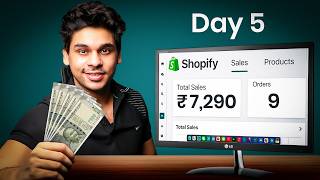
Over the campaign (less than 3 days), they had 8.98k impressions, 825 clicks, average CPC ₹7.88, total ad cost ₹1694.09. Shopify showed 343 sessions, 9 purchases, gross revenue ₹7290, conversion rate 2.62%, and average order value ₹810. Net profit was ₹3759.91, a 50.84% net profit margin.
They recommend buying inventory yourself to handle COD confidently, and suggest keeping customers engaged via email/WhatsApp between order and delivery to reduce RTO. They emphasize that dropshipping can be profitable in India if done properly, and advise against buying courses.
The challenge proved that with proper product research, supplier negotiation, and Google Ads optimization, dropshipping can yield a 51% net profit in India, even without COD. The creator stresses the importance of doing the groundwork yourself and avoiding dropshipping courses that often mislead.
What are the three things to check before testing a dropshipping product?
Product cost and suppliers, advertising feasibility, and competitors.
01:55
Why did the creator choose Google Ads over Facebook Ads?
Because Google Ads is easier and more practical for beginners to set up and optimize.
03:35
What is the difference between interruption marketing and search marketing?
Interruption marketing (like Facebook Ads) takes the product to people, while search marketing (like Google Ads) targets people already searching for the product.
03:49
What is the role of Google Merchant Center?
It is a platform to upload product data (images, price, availability) so Google can display shopping ads and product listings.
08:35
What was the final net profit percentage in the challenge?
50.84% net profit (rounded to 51%).
15:41
Why did the creator avoid COD?
To avoid dealing with returns and RTO issues.
10:09
What is the key to reducing RTO when offering COD?
Keep the customer engaged via email or WhatsApp between order placement and delivery so they remain excited about the product.
16:22
What tool did the creator use to check CPC for keywords?
SEMrush.
04:15
What was the average conversion rate during the campaign?
2.62%.
14:39
Price Discrepancy Between Platforms
Highlights the huge markup on dropshipping platforms like Ropozo compared to local suppliers like IndiaMART.
02:39Fake RTO Warning
Warns about a common scam in dropshipping platforms that can eat into profits.
03:07CPC Calculation Method
Shows a practical way to estimate ad costs and profitability using SEMrush data.
04:4251% Net Profit Result
Demonstrates that dropshipping can be highly profitable in India with the right approach.
15:41RTO Reduction Strategy
Provides a concrete method to reduce RTO by keeping customers engaged.
16:22[00:02] is our Indian dropshipping product and through this we have made sales worth Rs 1 crore by running Facebook ads. But still we have incurred loss due to Ropozo platform fees, charges, RTOs, inflated product prices, ads cost and taxes. Hey, if you did
[00:16] n't want to tell me this then let's do one thing now. A course should be launched and this loss should be recovered. Not all creators but whatever you see on YouTube Drop Spring Gurus, it is the opening his dhoti. So to show you guys everything in a mature and
[00:30] grounded manner and to actually teach you, I also tried dropshipping for the last five days and that too in the Indian market. Because I generally target the US market. So we researched a product, built
[00:42] a store, setup tracking, ran ads and finally saw how much money we made no red green spreadsheets will deliver so many products that do products that do n't happen. Ready for this? Let's do it.
[01:01] and there are many ways to find a product. If you want, you can create a new Instagram account and engage only with ads and product-based reels and then Instagram will fill your feed with products only. Or you can go to YouTube and watch videos from US creators
[01:15] Like you can search for best dropshipping products to sell right now or you can check their marketplace by creating an account on Ropozo Zen Drop and Auto DS. I did not use Ropozo in this challenge just for research. I'll
[01:30] tell you why later in the video. So I used the Instagram method for this particular challenge. choose a problem solving product. Because problem-solving products almost always become winners. So after four to five hours of research, I
[01:43] chose a product which was selling well in the US also. Nasal strips. I had seen this product multiple times before on Instagram. And I thought it would be a great problem to solve. Why? Because I myself have sinus issue. So I
[01:55] related well. Now we had chosen the product. But we also had to verify whether or not we should test this product. And for that we had to check three things. First, product cost and suppliers, second, advertising feasibility
[02:07] and third, competitors. So as most Indian dropshippers do. I first went to Ropozo and searched for nasal strips. Look at the price guys, it's ₹448 to ₹58 per product. How am I supposed to make money with this product? If I am
[02:22] getting the products for ₹58 instead of ₹448 in the first place. To give you guys some perspective, I come to Indiaar and see what price nasal strips are. As you can see it's ₹15 per piece. Now compare ₹448 Rozo and ₹15 Indamar.
[02:39] Absolutely bonkers. Right? Now I contacted the sellers on Indamar to see if they can ship the order for me ? And as expected his answer was no. Then I convinced them that I would bring 20 to 30 orders a day. After
[02:52] long conversations the supplier finally said ok. So now even with shipping and logistics our overall cost was ₹210. They are Better Than Ropzo Isn't It? I know, going forward, when there are too many orders, it can get a little messy. But then I would
[03:07] prefer buying inventory up front. Also, you will see another issue with platforms like Ropos and that is fake RTOs. You can go and see reviews on Trust Pilot, Reddit, YouTube. You will see that dropshippers get fake RTOS even though the
[03:20] products get delivered. So always make sure that you do the ground work and find suppliers on sites like Indiaar or locally. I know it will take some effort but not get one click done for your setup for dropshipping. That's just the brutal reality. And you should also stop reading this
[03:35] in the name of useless dropshipping courses. Moving forward, our Next we had to check advertising feasibility. Now, people keep doing Facebook Ads, but the hard reality is that it is very difficult for beginners to
[03:49] set up and optimize Facebook Ads. So for this challenge we picked Google Ads which is quite easy and practical for beginners. falls under interruption marketing. Which means you take your product to people.
[04:03] On the other hand, people themselves are searching for products on Google. Simple is that. So now we need to check if we can validate the profitability of a product with nasal steps ? And for that I used a tool called SCM Rush
[04:15] or SEM Rush. Now SCM Rush is a search engine optimization or search engine marketing tool where you can find out how much advertisers are paying per click on a particular keyword. So in SCM Rush also typed in keywords like
[04:28] nasal strips, no strips, no strips for snoring etc. And as you can see SM Rush was showing us two to ₹3 CPC. Now this is not 100% accurate. I generally take double the CPC that SCM rush shows. So after checking the CPC
[04:42] I did a rough math that if we get ₹1000 clicks then our ad spend would be ₹ 4 to ₹5,000. If we sell our product for Rs.999 expecting a 2% conversion rate that is roughly ₹20,000 in gross sales. So according to me, the
[04:58] check box of advertising feasibility was also ticked. And now the third step I had to check competition. And as I checked the competition, my confidence went up and down a little. The upside was because I got validation that someone else was also making money selling this product.
[05:11] And it went down because he was selling the product much cheaper than me. because he was selling the product much cheaper than me. About ₹749 instead of ₹99. So to keep things competitive, I also had to increase my product price to ₹729. My
[05:24] margins were getting compromised a lot. But according to the math I did, I would still be profitable at a 2% conversion rate. So, the summary of the first day is product research or selection is done, convincing the supplier is done, checking advertising feasibility is done and
[05:39] checking advertising feasibility is done and finally checking the competition is also done. next day I had to think of a brand name. I had to check domain availability,
[05:54] buy the domain, design the website and also setup the payment gateway. Again so much work to be done. So to finalize the brand name and domain name, I took the help of GPT. In about 20 to 30 minutes I found a good brand name
[06:07] whose domain was also available. And we decided that we will name our brand S brew well. We also got the domain by doing breedw.in. Which was great. I bought the domain from gaddi and then took a 3 month trial lead from Shopify to setup our
[06:20] store. First we mapped our domain. Coming to the domains section, it is a simple process, you just have to link Shopify and God add. Now next, first of all we set up a basic product and designed a simple website. Absolutely
[06:33] simple. Why? Because we had to apply for payment gateway also. Generally this process takes two to three days. So make sure you start it early on. GST is also required in many areas. So you will have to figure that out as well. Anyways I
[06:46] selected PhonePe PG Edge as my payment gateway. It is quite trustworthy and the support is also top notch. The rest of the Razer Pen Cash Free is also okay but quite clunky and the support is also very bad. I also faced some problems in setting up the payment gateway but I took
[06:59] help from my cousin to get it all sorted out. Once I had done all the payment gateway work from my side. Such as setting up privacy policy , contact info, refunds and returns etc. Now I had to design a killer store.
[07:11] And I knew it was going to be very boring and hard. But whatever it is, I had to do it. So I installed an app called Gem Pages in Shopify and got it started working on the product page. This particular app
[07:24] gives us plenty of product page templates to make the process easier. I had the logos and product image designs done by Chat JPT as I work with a lot of DC brands. So I know what kind of images work best. Other than that
[07:36] I found a lot of GI apps, tweaked them a bit, looked at some reviews and read a few reviews, optimized the checkout flow and so on. And it took me 8 to 10 hours to do all this. Almost nonstop. So this is how the site
[07:49] turned out on desktop. As You Can See Not Bad At All. Alldo my primary focus was mobile. And this is how the site looked on mobile. Let me swipe and scroll a little bit. As you can see, it is very sleek, quite trustworthy and the checkout flow is also
[08:03] very smooth. We also added an alternative number and a WhatsApp support button so that customers can ask questions. So by the end of the day we were ready with the website but we were still waiting for the API key for the payment gateway.
[08:22] we also had the API key. In other words, our payment was also setup on Gate. Now only the setup of AIDS was left. Well as you remember we had selected Google Ads as our marketing option so we had to setup Google Merchant Center as well. For
[08:35] what is Google Merchant Center? Google Merchant Center is a platform where you can upload data about your products. Such as images, price, availability etc. so that Google knows what you are selling. The same data is then used to display Google
[08:49] Shopping ads, product listings, and search results. In short, it's the bridge between your online store and Google that ensures your products are appearing correctly in ads. If I give you a better example,
[09:02] whenever you search any product on Google like beer trimmer. So all these listings of Google Shopping Ads have to be set up first in the Merchant Center. There is nothing very complicated. All you have to do is come to Shoppy and install an app
[09:16] named Google and YouTube. Then you have to link your Merchant Center to Shopify by following a simple process. The you have to link your Merchant Center to Shopify by following a simple process. The So after doing this setup, I had to
[09:29] wait for the approval of my product from Google, which was done in two-three hours. Sometimes you may have to wait for 24 hours. Which is totally fine. Once everything was all set, I linked my Google Merchant Center to my Google Ads account.
[09:42] And one last thing, we also had to set up a Google Ads conversion tag to track purchases. This also has a very simple process. You have to come to Shopify, go to Google and YouTube app and then manage settings. If you
[09:56] want, you can also watch tutorials on YouTube. Anyway, once we were all set, we just had to set up our ad campaigns and publish them. But before I go ahead I want to tell you that I did not keep COD in my store. Yap No Cash on
[10:09] Deliveries. I deliberately did not keep COD because I did not want to deal with returns and stuff. However, I will also tell you how to manage RTO in the next video. So moving forward we created a Google Shopping at campaign and
[10:21] set our budget to ₹1000 per day. In a matter of hours our campaign was live and we started getting clicks already. So by the end of day three we had a Google Ads impression of 3.55 and 77 clicks. Our average CPC was ₹7.89
[10:37] which is normal to be high when we launch a campaign. And the total cost was ₹67. When we came to Shahifi, it was showing us ₹141 sessions. Now so many sessions because I, my cousin, was showing the
[10:50] store to my friends and family plus the phone pay team were all opening and viewing the site again and again. Coming to Orders We received two orders on the third day with gross revenue of ₹2187. One customer ordered two products
[11:04] and one ordered only one product. Here's the orders section and here's the customer will also show you proof of Google tracking conversions further to be transparent. So by day three end of day things were starting to look good.
[11:24] checked Google Ads, we were seeing 4.33 impressions and 103 clicks. Our average CPC at 7.80 is still pretty high but better than yesterday and the total cost was ₹83. Coming
[11:37] yesterday and the total cost was ₹83. Coming to Shopify on Day Four, we received ₹17, three orders, and again ₹2187 in gross revenue. So on Day Four also we got the same revenue but the ad cost was a little higher. Again a pretty normal thing to
[11:50] happen, you don't want a panic with Google ads. Well the good news was we were still maintaining a steady conversion rate of over 2%. Now more money was spent but sales were still low. So we did not have to sit idle. And Hope for
[12:02] Things to Get Better. So I came to Google Ads and first of all I added as negative keywords all the useless keywords in the campaign on which money was being wasted. collectively we had an extra ad spend of ₹100 on all these keywords. Now
[12:17] ₹100 itself is not a big number but it was around 10% of our overall ad spend. Now Think About 10% Off ₹1 Lakh, ₹1 Lakh and Even ₹1 Crore. Now that we already had some sales, I noticed a pattern in the location of the customers. So I
[12:32] excluded all the states from which clicks were coming but sales were not coming. So basically I excluded all the second tier and third tier states. Now with that being said we were all set for day five and we had also doubled the budget to ₹2000 per day.
[12:52] checked the Google Ads dashboard, we had ₹94 impressions. Only 35 clicks and an overall ad spend of ₹284 which was quite unusual to see. But looking closely we noticed that
[13:06] our ads stopped being delivered around mid day. I also searched my product on Google many times it was not showing whereas it was showing earlier. Anyways first I opened Shopify and as you can see we had 49 sessions that day for failing orders and ₹296
[13:22] in gross revenue. Why were our ads stopped on Amazing Numbers? Was Quite Concerning. I checked everything in the campaign. Everything was looking good. Even the optimization score was over 97%. I also checked the merchant center. There was no
[13:35] issue show happening there either. This issue has happened to me many times before. So I just waited. But the next day also the same story. So I contacted Google Ads support to know what the issue was and after 6-7 hours they gave a quick email
[13:47] response. Then I checked the next morning and the ads were still not working. Again I contacted Google Ad Support and this is what they told me. Sorry, how long is it going to take? Ah seven business days.
[13:59] Seven Business Days. All right. That's a long time. Seven Breaks in Days. No worries, let us check the profit loss so far. So, we ran the campaign for three days. Technically less than three days. So
[14:13] in Google Ads we got a total impression of 8.98. ₹25 clicks our average CPC was ₹7.88 and total cost was ₹1690. Actually ₹1694.09
[14:27] to be exact. Looking at the data of SHI, we got 343 total sessions and nine total purchases worth ₹7290 and the average conversion rate was 2.62% which was
[14:39] excellent and the average order value was ₹80. We only had five conversions or purchases tracked on Google, which is normal. If you go to YouTube or Reddit, you will see that advertisers often talk about this. And now to show you the proof
[14:54] that all the orders were prepaid. I come to PhonePe PG. I select my day trend. And as you can see, the total number of sales and orders are identical. I refresh the page once again and go to settlement and
[15:07] show the proof that we were paid. And talking about the final PNL, we got a total gross revenue of ₹7290. Our ad cost was ₹1694.09 products plus shipping cost would be 210 * 9 which is ₹1890
[15:24] so ₹7290 in gross sales - ₹1694.09 in ad cost - ₹1890 in products plus shipping is equals to ₹37591. If we do a little bit of math that comes out
[15:41] to 50.836% net profit. Now this is huge. If rounded up, it's about 51% net profit. That's the power of a problem-solving product plus an amazing store plus great marketing efforts. And if it was COD,
[15:53] I'm pretty sure orders could have been 14 to 15 as well. But you can do COD only when you buy the inventory yourself. And for those who want to do this business in India, I would recommend that you buy the inventory yourself so that you can control the packaging yourself
[16:07] and also handle COD confidently. Basically like a full-fledged e-commerce business. Well now how to manage COD? It is a simple method. Within the time frame between the order being placed and the product being delivered to the customer, you need to
[16:22] arriving. Not as a marketer, but you have to Either through email or through WhatsApp so that the customer remains excited about your product that my product is arriving. What happens generally? Customers order
[16:36] products and then either forget about them or lose interest. So it's your job to keep them engaged. And that's the key to reducing RTO. So this was The Challenge Guys. If you know what you're doing, you can be very profitable
[16:49] with dropshipping even in India. Now you cannot scale your store through Google Ads because you do not have control over how many people are searching. doing ₹1 lakh in revenue. Isn't it life changing? That's the way you have to look at it.
[17:03] Now my goal was to show you sales of at least ₹40 to ₹50,000. But this issue came up. No problem. Will Do An Even Better Part Two in the upcoming months. Well I hope you have understood a lot of things. I also showed the entire process and
[17:16] proved it with a challenge that my process works. And please stop getting into the mess of coursers. In the end they will show you a spreadsheet and then they will fool you and you will get fooled. So please don't follow for it. Other than that, start
[17:28] learning, start testing, start earning and I'll see you do the talk.



⚡ Saved you 0h 17m reading this? Transcribe any YouTube video for free — no signup needed.