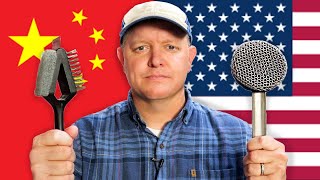

Can You Make a Product in America?
44sImmediately poses a provocative question about the viability of American manufacturing, tapping into economic anxiety and national pride.
▶ Play Clip"The title accurately reflects the video's content: a detailed experiment in American manufacturing."
Destin from Smarter Every Day documents a 4-year experiment to manufacture a grill scrubber entirely in America, facing challenges like supply chain issues, lack of domestic tooling, and counterfeit products. The video explores the decline of U.S. manufacturing, the importance of local production for self-reliance, and the difficulties of sourcing American-made components.
The goal was to manufacture a product in America despite market forces pushing manufacturing overseas.
The video is divided into: why he wanted to do it, how it happened (component stories), and a pitch to buy the product.
Destin's parents were union auto workers; he witnessed the decline of manufacturing in his community.
During COVID, lack of domestic N95 masks and face shields highlighted America's anemic manufacturing capacity.
John's grill products were knocked off by overseas manufacturers who used his tooling to produce counterfeits and sell on Amazon.
Destin designed the scrubber with CAD, iterated prototypes, and used injection molding for production.
Chainmail needed for the scrubber was initially only available from China; they found a US supplier but at low volume and high cost.
American-made bolts cost 38 cents each vs. 9 cents foreign; they found a supplier in Massachusetts.
Many US mold makers send CAD files to China for mold production; Destin insisted on domestic mold making.
America has lost the 'smart work' of tool and die making; now machines are made abroad and operated in the US.
Tim Cook said China's advantage is deep tooling skills, not low labor cost; in the US you couldn't fill a room with tooling engineers.
The problem is not just lost manufacturing but lost ability to make the tools and dies for manufacturing.
Destin learned CNC machining to make the production molds, with help from friends and local machinists.
The squishy part had to be changed from Santoprene to silicone for higher heat resistance, requiring a new mold from a Virginia company.
Roger, a tool and die expert who taught Destin, passed away, taking his knowledge with him.
Logan, an apprentice at T&C Stamping, made the first tool for the handle, representing a new generation of tool and die workers.
The knob, thought to be American, turned out to be made in Costa Rica; Destin plans to make it in the US with Mantle's 3D printing technology.
Chainmail ordered from India was actually Chinese, showing the difficulty of verifying supply chains.
Wire bristles from grill brushes can come off and cause serious injury; Ted shares his personal experience.
Buying a more expensive, durable product saves money over time compared to repeatedly buying cheap ones.
Manufacturing in America is challenging due to lost skills, supply chain issues, and cost pressures, but it's possible with determination and community support. The Smarter Scrubber is a step toward reviving local manufacturing and providing a safer, durable product.
What is the main reason Tim Cook gave for companies manufacturing in China?
The deep skill and precision in tooling, not low labor cost.
20:04
What is the 'boots theory of socioeconomic unfairness'?
Buying a cheaper product leads to repeated replacements, costing more over time than buying a higher-quality item.
43:38
What problem did Destin discover with the chainmail ordered from India?
It was actually made in China and just shipped from India.
36:56
What is the danger of wire bristle grill brushes?
Bristles can come off on the grill, get into food, and be ingested, causing serious injury.
40:16
How much does an American-made stainless steel bolt cost compared to a foreign one?
American: ~38 cents each; foreign: ~9 cents each.
16:39
What is the name of the apprentice who made the first tool for the Smarter Scrubber handle?
Logan.
29:55
What material was initially used for the squishy part of the scrubber, and why was it changed?
Santoprene; it was changed to silicone because Santoprene is only heat resistant up to a few hundred degrees Fahrenheit.
26:41
What is the name of the company that uses 3D printing to make metal injection molds?
Mantle.
32:11
What did Destin's friend Jeremy Fielding say about Chinese manufacturing quality?
It is at least equivalent to what can be made in America, and in some cases, things that used to be available in America are only available in China.
21:40
What is the website to buy the Smarter Scrubber?
smarterscrubber.com
45:12
Chinese Chainmail Discovery
The moment Destin realizes the chainmail from India is actually Chinese, highlighting the difficulty of verifying supply chains.
36:56Logan's First Tool
Logan, an apprentice, makes his first tool, symbolizing the birth of a new tool and die worker in America.
29:55Ted's Grill Brush Injury
Ted shares his personal experience of a bristle getting stuck in his throat, making the danger of wire brushes visceral.
40:55[00:02] America and be competitive in the marketplace? This video documents an experiment that lasted over 4 years. The goal was simple, to manufacture a product here in America. The challenge is that almost every single market force
[00:17] pushes manufacturing to make things overseas. What happens if you ignore those pressures and you just make something here anyways? This channel is supported by the patrons of Smarter Every Day. Their financial contributions
[00:29] experiment, and I think it's very important. The global economic forces War II are changing, and I believe people in your community who understand how to manufacture things are going to be even more critical in the coming
[00:44] years. My home is here in America, but this video's lessons doesn't just apply to America. It's wherever you live. If you can manufacture things locally, then that ensures your self-reliance, your stability, and ultimately your freedom.
[01:00] Let's explore this topic and go get smarter every day. making everything you see here in America. All of these components go
[01:15] together to make one thing, and that thing is a grill scrubber. This is called the Smarter Scrubber, and we'll talk more about that later, but for now, I want to tell you how we're going to lay this video out. There's three parts
[01:28] to this video. The first part is why I wanted to do it. Like, why did I want to perform this experiment? Secondly, how it happened. Every component there has a story. I want to tell you the story of each of those components. And finally, I
[01:41] want to pitch you on buying that product. I want you to buy it, not video, but is it actually competitive in the market? Is this a thing that can exist on its own in the marketplace? I'm going to give you that pitch, and we'll
[01:54] see. Part one, why? Both my mom and my dad were union auto workers. United Auto Workers 2195 here locally in North Alabama. They made steering components for vehicles. My mom worked on the assembly line. My dad was in tool and
[02:08] gauge. When they would come home, they would smell like cutting fluid. And that smelled like work to me. It smelled like productivity. They made things. And everybody that I knew, their parents made things. Middle class America. The
[02:21] American dream was alive and well. And then things changed. With NAFTA and CAFTA, it wasn't one political party. It was It was everybody. Globally, things were changing so that it made more sense economically to move manufacturing
[02:35] facilities out of the United States. And that's exactly what happened. This is more than Destin is upset because NAFTA took Mommy and Daddy's job. It I don't even know that NAFTA did take Mommy and Daddy's job. I think things were
[02:47] changing before that. So, the global economy is so complicated. I I could make a whole channel on it. But what I want to do is just take 60 seconds to demonstrate that I understand this is a complex topic. And I just want to throw
[03:00] about it. And then we're going to move on with this video. But it's just a really interesting thing to think about. Okay, so a long time ago, uh things were better, right? That's called golden age thinking. Every civilization has done
[03:13] return to the way that things were, things would be better. That's a powerful nostalgic thing, but it's not really accurate. Because if you think about it, we went from this type of shipping to this type of shipping in 150
[03:26] years. And that is analogous to the complexities of global trade. Because wars were fought when we were using wooden boats. Imagine how complex the economics are when you go to boats like this with containerized shipping. At in
[03:40] World War II, the Bretton Woods Accords in New New Hampshire, um America decided shipping lanes would be open so global trade and global prosperity could happen. We started doing that. Everybody started doing good things. And then,
[03:52] people started exploiting cheap labor in developing nations, and then profit became king. And so, now we have billionaires, and we have a wage gap, and it's very complicated. And so, people are pushing factories overseas,
[04:06] overseas, but it sometimes it's not. Okay, so that unions, collective bargaining agreements, all that stuff. It's a very complicated issue, and I'm not like America is dominant and must be No,
[04:20] that's not what I care about. I care about people. I love people, and I think these issues are more than something that can be distilled down to like a one-line zinger that you can use to dunk on people who differ with you your views
[04:33] politically. This is complicated, and we as people have to solve it, because we're not agrarian anymore. We have industrialization that can make food, so we must produce things as people, not just in America, everywhere. I just
[04:47] don't want people to be exploited in the process. My answer to all of this is as you would have them do unto you, but we have to figure this out. Let's move on with the video. I remember this period of time not understanding how
[05:00] important these global shifts, literally, were changing the town around draft and draw parts that hopefully America. But then when I got out of school, there were not many plants to go
[05:13] work at. Fast forward a lot of stuff, and then you'll get to the 2020 global of people mad for a lot of reasons. It made me mad. I don't get mad very often, but it did make me mad because of manufacturing capacity in America. So,
[05:28] when everything went down, everybody wanted N95 masks and face shields, and they couldn't get it. When the president starts talking about airplane shipments place we could get these N95 masks, I realized this is a big deal. We can't
[05:42] talking about the mask debate. Like, imagine, if we're talking about individual airplanes coming from China, do you think Alabama is on the priority distributed? No, we weren't. And so as a local community, we decided we're going
[05:57] to 3D print masks for our medical workers, the N95 masks, the face shields had developed this system to do this safely, so we did. We came together. It was a really good community moment. We 3D printed these things, but we realized
[06:10] difficult. We need to be able to manufacture things. And so I started trying to find where I could manufacture these things. And this revealed to me how anemic our manufacturing capacity in America has become, because I was
[06:23] waiting on some billionaire to come save us, and it didn't happen. You know what happened? I went and found a guy here locally in Alabama. His name is Chris Robson. He knew how to make an injection mold, and he did. We worked together,
[06:37] and we created an injection mold here in Alabama. This is the model number Huntsville 02 made in Alabama face shield. This is what was distributed here in Alabama to our medical workers. You put a little piece of plastic over
[06:50] there, and we used this in hospitals all over the state and even in adjacent over the state and even in adjacent states. So, this whole pandemic made me realize that our like manufacturing capacity in America has been gutted. If
[07:03] Chris had decided to retire before I needed that mold made, we would not have been able to make an injection mold in my area. And this made me mad. I realized the knowledge chain almost broke. So, I made this tweet asking
[07:17] manufacturers in order to make things in America. That's what I realized had to All right, I'm going to pause here and introduce you to the last, probably most need to know about before we get going, John Youngblood. John owns a small
[07:32] business named JJ George that sells grill products. There's a ton of problems with grill brushes on the market. We'll get into those later, but John had a very clever idea to solve these problems with chain mail. Now, I
[07:45] to get involved as an engineer and just help him in general. So, we decided to work together. I tagged along as John presented his idea at a round table The problem is that every product out there that's a grill scraper is mediocre
[08:00] at best. Like, I know I'm buying a disposable product. Maybe one a season. grill tables right here in the USA, but he also worked with people overseas to make other grill accessories. John was experiencing pain because of that. Like,
[08:15] I don't know if you realize this, but as a small business, if you have an idea and you get it made overseas, that's cool, but they have all the tooling to make the thing that you wanted made. So, at night, they can literally just crank
[08:28] up the machine, make more of them with less high-quality products, and they can just counter-sell against you on Amazon, and you have no recourse. There's nothing you can do. This is one of John's best-selling products on Amazon.
[08:40] all of these knock-offs. They're everywhere. The interesting thing about this is John has a patent, and he's tried to get these other things taken down off of Amazon, but he's found it almost impossible to get Amazon to
[08:53] playing whack-a-mole. Look at all these That's a lot of money. The interesting thing is Amazon almost tells these manufacturers overseas what to knock off. If you go to the product page, you
[09:07] month, and all they have to do is say, "Oh, look, that one sells 3,000 units a month. That's clearly what I want to pirate." So, these product pirates go, like his grill torch, and they'll just knock it off. And parts of it are
[09:21] a little different because they want to make it cheaper. Like, for example, on John's unit, there is a removable screw that allows you to take the tube off in there or something. Not on the other unit. There's nothing like that. It's
[09:34] throw it away. It's weird, because they're selling this for half the price, but at the same time, they're taking all the business and they're making lower mean counterfeit goods for buyers, look at what sellers are saying in Amazon's
[09:48] own seller forum. Amazon's inability to police this, or at worse, unwillingness small businesses and manufacturers in intellectual property to protect them from fraud. So, this is one of the main
[10:02] I wanted to work with him, cuz I wanted to make something and he knows the business side, but he wanted to work with me so we could use the YouTube channel to tell people about the product and not have to sell it on Amazon. So
[10:14] again, Amazon, do unto others as you would have them do unto you. Let's get to part two of the video. How did we build this thing? To understand why we the problem we're trying to solve. We have grill grates and we're trying to
[10:26] scrub it with chainmail, right? So, in order to do that, we need the chainmail to kind of be compliant around those bars. So, we want to apply downward pressure. To do that, we need something squishy behind the chainmail that when
[10:40] we push it down, it wraps those chainmail links around those grates. So, I figured out that in order to attach the chainmail and the rubbery part to a handle, we're going to have a problem, because the squishy part would break.
[10:54] So, what we need is some type of adapter that could go between the squishy and the rigid handle, and then that way, you can move the whole thing and it would all work as one. So, that's how we did all this and I learned from the pandemic
[11:07] that the key to making things fast is injection molding. I covered injection molding in the MVP disc golf disc video. You have two parts of a metal mold and you clamp them together so that they have a cavity in the center the shape of
[11:19] the part you want. You then inject molten plastic into that void and let it solidify, and then you open the mold and you kick out the part. That's injection molding. So, I started the design process and with for an engineer, you
[11:32] just start in CAD and you start drawing stuff. So, I started making things and started figuring out how to get a rubbery backing and I ended up with a really nice history of all the designs right here. So, it's kind of fun to look
[11:46] at. I knew that I had to design it so that it could be molded and made and then ultimately assembled. I I'm a little embarrassed showing you all this stuff and some of the earlier designs I had like these little posts cuz I had to
[11:59] hold the chain mail around the rubber. My thought was to hold the chain mail breaking off. So, I was making more problems than I was solving in the early that I was going to need multiple components. I needed something on bottom
[12:14] that I would adapt a squishy to. I also needed a top cover and I needed to be able to assemble those. Now, mechanical engineers know from reading books by Toyota folks that it's better to click things together than bolt them
[12:31] together if you can. It makes the manufacturing process fast. So, this is to figure that out. I said, "Well, maybe if I have these two parts and I have a slot and I could put them together like this and I could push them and they just
[12:45] click together, then that would be my assembly process." And so, these posts ultimately were foolish and so I ended up with something that looked like this. So, I had a rubbery component that I molded with a 3D
[13:00] enjoyed that process, but ultimately it's too complicated for making the finalize the rigid components. I had the cover, I had the adapter and they After I finished kind of the design, I
[13:15] decided I wanted to be able to take this this scrubber head off and hold it with my hand. And so, I measured my fingers and I put these little grooves on there so I could hold it and really get in and and and scrub really hard. At this
[13:29] point, I got serious about the squishy part. I knew that overmolding took too long. So, I moved away from that geometry, so things could like pour through there, and I went to a pad design. So, if this was my adapter, I
[13:41] said, you know, what if I had a little pad that goes underneath that was just compliant, and the chainmail itself would keep it in place. So, I started designing these little rigid pads, and then my 3D printer, which is a Formlabs
[13:55] Form 3, I had different materials. One was called elastic. So, I started printing squishy geometries in an attempt to try to figure out what would work best on the grill. So, I even tried some linear designs, I tried some hex
[14:08] patterns, and I ended up with something roughly like this. I had all the hardware store and put it together with a wire, and this was our very first prototype. And at this point, we could
[14:20] only get chainmail out of China, so John started testing the different types, and information. When you go against the grain, it'll catch. It puts a lot of tension on the individual rings, and they're coming
[14:35] apart, and we're losing some. So, that But, that's a good thing. This is a good thing because um we haven't ordered thousands of these chain pieces of chainmail yet, and we
[14:47] can get a welded version. It's going to cost us a little more money, but we can get a welded version that is going to be stronger, and it's going to make our product better. The supply chain for chain is a big deal to me right now. So,
[15:01] John's test revealed that we could not use the most common thing that's on the market, which is this type of chainmail with a radio pattern with a central ring doesn't adapt well to the great. So, we want this rectangular pattern, and John
[15:15] did a lot of testing, and he arrived at not a square like this, but if we got an octagonal pattern of the rectangular grid, this will do what we need. It's really fun to play with, by the way. So, this is what we need and we can only
[15:27] find it in China. That goes against the thesis statement for what we're trying to do. So, we worked and worked and we eventually found a supplier in the US that can make it. However, they can't make the quantities that we need for a
[15:41] price that makes sense. So, what we did is we created a contract where we could buy all that we could afford at the rate they have and and we're getting about 2,000 units a month of this stuff right here.
[15:56] And it's incredibly expensive. It is so expensive that it's by far the most expensive part of the whole thing. But, we realized these quantities that we're able to get aren't enough. And so, we have supplemented that with an Indian
[16:11] to do this in China." But, we contacted our Indian supplier and we said, "We need a stash of chainmail that is the quantities we need in the event that we sell any kind of numbers of the scrubbers. So, we ended up buying some
[16:25] Indian chainmail that would augment the the quantities that we could get from they could produce. And that's where we're at. So, yeah, that's where we're at on chainmail. 1-in long stainless steel quarter 20 bolt. This was so
[16:39] difficult. I know it sounds like an industrial commodity, seems like a this made in the USA and you stipulate that, that changes everything. Foreign bolt like this, 9 cents a piece. In the US, average 38 cents a piece. Like,
[16:54] here's a quote right here. If I buy 10,000 of these, 42 cents a piece. That's pretty standard. Most machine shops I talked to directly, they said, for the price of the finished bolts that you're getting from a foreign supplier."
[17:07] very difficult. I emailed a lot of people. I sent out this tweet, it helped. And it's a very fascinating thing. Eventually, after literally forth, John picked a supplier that got him for 35 and a half cents a piece,
[17:21] which we then verified were made in Massachusetts. So, instead of a dime to get our bolts from a foreign supplier, we're doing roughly this cuz we think it's important to have manufacturing capacity for stainless steel bolts in
[17:34] Massachusetts, which is weird because my uncle used to work down the road at a bolt factory that closed. But, now I'm going to Massachusetts to get this bolt, which is interesting, right? Very interesting. Uh after we bought our
[17:47] piece. Other salesmen told me, "There's no way that's American." I couldn't have no idea what to do with that. I thought it would be simpler. Like, the USA, buy them, they're this price.
[18:00] story is very interesting. I had my parts and it was time to injection mold. And I went to a facility that does injection molding. And I said, "Can you we can make the parts." And I said, "That's great. I would also like to make
[18:14] the molds here cuz I want to learn more about molds." And they said, "Oh, no, we don't make molds here." And I said, "Why not?" They said, "We don't do that. We we ship the part the CAD files to China and they make the mold and they send it
[18:26] said, "No, no, that's not what I want to do. I don't want my intellectual property in China. I want to make it here." And they said, "Good luck." And this is the moment where this whole experiment came into focus for me. I
[18:40] experiment came into focus for me. I realized at that moment we're screwed. I think we're screwed as a nation if we can't do the intelligent work of tool and die, making the tools that make the things.
[18:53] It used to be that America did the smart thing and then we would send the machine that we made to another country and the country would operate the machine in the developing world. We have flipped it.
[19:06] We are now to the point where the smart stuff is done somewhere else and they send us the machines, and we push the buttons to operate the machines. I need you to understand this because I realize we have lost something very, very
[19:21] important. And we did it by lulling ourselves to sleep by pushing money around and doing the intellectual property work, but not doing the manufacturing work. I think it was best put simply by the CEO of Apple, Tim
[19:35] Cook, while sitting in China when he was asked a question about tooling. There's asked a question about tooling. There's a confusion about China that uh let me at least give you my opinion. The the popular conception
[19:49] is that companies come to China because of low labor cost. I'm not sure uh what part of China they go to, but the truth is China stopped being the low labor cost country many years ago.
[20:04] And that is not the reason to come to China from a supply point of view. The reason is because of the skill and the type of skill it is. Like um the products we do require really advanced tooling.
[20:20] And the the precision that you have to have in tooling and working with the state-of-the-art. And the tooling skill is very deep here.
[20:32] You know, in in the US you could have a meeting of tooling engineers, and I'm not sure we could fill the room. In China you could fill multiple football fields. So, Tim Cook said that in 2017 at the Fortune Global Forum.
[20:46] this. One way is, well, Tim Cook is of course going to say that. He's incentivized because his business is tied up in China. He's not going to cross the Communist Party because he needs his stuff to be made there. The
[20:58] that's right. Maybe the tooling and advancement is, you know, somewhere way beyond what Americans can do. So, here's what I want to do. I know a man that is specifically like unique in the world that can answer this question. He's a
[21:13] friend of mine named Jeremy Fielding. He has a YouTube channel. He's an engineer. He speaks Chinese. He spent a significant amount of time exploring these topics in China, and he's right there beside you. Let's just ask him.
[21:25] What do you think about what Tim Cook said about labor and about the tooling industry in China? Well, it'd be hard for me to comment on tooling specifically, but I do think that we do have a common misconception,
[21:40] including myself before I went, that in China that their product is inferior. I mean, the the quality of manufacturing is surprisingly good. And when I come the places I've visited, cuz I've been to many shops here and over there, if it
[21:56] speaking a different language, I would feel like I was in the same place. I was really impressed. And I think I would say it's at least equivalent to what we can make here. And in some cases, things that used to be available in America
[22:10] aren't available anymore. It's like you have to go to China to get it, cuz we that's scary. I Okay, this is a tangent we could talk about for hours just on this topic. I just want to encourage you to go watch
[22:23] do engineering videos, and there's also content there about your time in China, Yeah, absolutely. How do I say thank you in Chinese? How do I say thank you? Uh xie xie. Xie xie. So, that gives you a peek into the world of Chinese
[22:37] manufacturing, but on the American side, it's very different. We talked about this when I was a guest on a podcast called Search Engine. Truth and PJ invited me on to talk about what it was like to try to find a mold maker to make
[22:49] this thing. This was a lightbulb moment for me in the conversation. The problem is not just that we've forgotten a lot about how to make things in America, is that we're also forgetting how to make the things that make the things. We go
[23:01] deep into the topic of the tool and die trades in America. It's fascinating. the guy that made the mold during the pandemic and I asked for help. And not only did he agree to help me, he decided to mentor me. The first thing I did is
[23:15] send him my CAD files of the drawings and he told me everything that was wrong because there were things I didn't example, you don't want some areas to be too thick, you want draft angles, all
[23:28] the process and taught me the proper way to design an object for injection molding. There were three parts to my prototype, so Chris designed three molds and we wanted to try a new technique. So, this isn't a thing that you can do
[23:41] for thousands of parts, but for a few dozen parts, you can 3D print the mold cavities with Formlabs 3rd rigid 10K solution. So, that's what we did and these are those parts right here. These are 3D printed inserts that we could run
[23:56] in Chris's injection molding machines to verify that the geometry is correct. It working parts and this let us see how the plastic would flow in the mold and we made mold design changes. So, it's Chris's vast knowledge of tool making
[24:11] create molds that would work. It's now time to make the production tool out of done in a machine shop. They're not going to have the knowledge of the tool metal part if you send them a CAD file. I wanted to learn how to CNC machine.
[24:26] I've always wanted to learn how to do that. So, me and the younger engineer named Trent, we started learning how to machine. I was able to pick up two used CNC machines. Thank you again, patrons. It started out pretty rough.
[24:45] BUT THEN WE FIGURED IT OUT. THIS process was incredibly enjoyable. I I thought it would be intimidating, but I called friends like Shane from Stuff Made Here and local machinist and Chris himself. They taught me what speeds and feeds I
[24:57] awesome. One night I was machining in the garage and my friend Daylan came over to hang out and we started talking about the importance of making things in America and how it affects local communities. And all the
[25:10] have education and so on and so forth. And so I'm filming you talking about manufacturing in America. Yeah, so so when those jobs went away in those communities, all those economic
[25:24] prospects and all ultimately educational prospects and quality of life prospects went away. So manufacturing coming back to America is really important to me for communities in terms of opportunities for kids, right? So
[25:38] something I spend a lot of time thinking the guy that works with him named Jeremy and they assembled the molds and they things that weren't quite right. They then took the time to fix it and then
[25:52] they put them all together and this is what was interesting to me. I realized that a machinist is not enough to be an injection mold designer and maker. one set of skills that feeds into the other but ultimately that tool and die
[26:06] creation is its own thing. But here we are, we have these beautiful molds and we're ready to make parts. It felt so good to watch parts pop out of these injection molding machines knowing how much work went into the molds. It was
[26:20] molded parts, it was the squishy part that I was most concerned about. Now this is made out of a thermoplastic polyurethane called Santoprene and it's only heat resistant up to a few hundred degrees Fahrenheit. John did a test.
[26:41] So obviously we were going to have to change that material and silicone is the best option. Now the problem is we can't inject silicone with the same molds that we made. It's a whole different process. Unfortunately, I couldn't find anybody
[26:55] in my area. They just weren't here, so I had to reach out to a guy in Virginia called Commonwealth Manufacturing. Kevin hooked us up. He made a nine-cavity mold so the silicone process could work. So, by switching from the Santoprene to the
[27:09] another couple hundred degrees Fahrenheit. However, it's not meant to be used on a fiery furnace blazing hot grill. It's meant to be used on a cold story, and there was a ton that went into this. The first thing I did is I
[27:23] found a metal tool that I liked, and I just went over to an anvil, and I just beat a little flat edge on the end of the thing, and then I cut out the end on a band saw and drilled a hole in it, and we put that on the prototype and gave it
[27:36] we put that on the prototype and gave it to John's mom to test. test, it was time to design it for manufacturability. So, I went back to bending up sheet metal, I might as well put a flat scraper on the front so that
[27:51] you could get into the corners and stuff like that. I put a little bitty curve on could get around the grill grates, and that was our design. I made a video on stamping, and the reason is because I was doing research into how to
[28:05] manufacture this handle. Sheet metal stamping is a process that involves using tooling to cut and bend metal into the shape you want.
[28:20] I spoke to a tool and die expert named Roger who taught me some critical pretty clear to me that Roger had forgotten more about tool and die than between filming that video about metal stamping and filming this video, Roger
[28:34] passed on. He's no longer with us, and that's a big deal. I obviously his going to miss him. Roger seemed like a great guy. Probably takes years just to right? that? It takes years to learn to speak
[28:48] But there's another loss here for the community that's not as obvious, but it's very important. And that's all of the experience and tool and die wisdom that Roger has acquired over the years. He can no longer pass that along. We
[29:01] only have what he gave us while he was here. Furthermore, all the experience of the person that taught Roger, all that is stopped now. All we have is what he is stopped now. All we have is what he passed on before he left. So, that makes
[29:14] what you are about to see very, very important. You're about to witness the birth of a tool and die worker in America. When I first visited T&C Stamping, Weston explained that they had a tool and die shop and they invest
[29:28] apprenticeship program, which is becoming increasingly rare among the progressive stamping dies that they made, but John and I couldn't afford one price to make what's called station
[29:41] tooling. A tooling engineer named Joey worked with a young man named Logan. he's entered into the apprenticeship program for tool and die. The tool that made our handle is the first tool that Logan ever made. Is this the first one
[29:55] Yes, sir. And how long did it take you? About 6 weeks. I've helped him. He needed a lot of help. So, do you feel one now? As long as I got prints to go by, I can
[30:09] think you would have this skill? I never knew anything like this really everything. I didn't know what I was going to do. I started out up here as just a press operator, actually running these presses and got the opportunity to
[30:23] move over as an apprentice, and I've enjoyed it ever since. All the hands-on stuff, learning stuff every day. I've really enjoyed it ever since I've been the tool Logan made in action. Flat blanks that have been cut out with a
[30:37] laser are loaded onto the tool where, as the press comes down, it gets bent into a specific shape along the way. It's called station tooling because the part is then moved from one station to the other and progressively the different
[30:49] bends and shapes are put into the part. I think this side action that bends the handle around into a tube is my favorite. After that we put them in a box and we take them back to Chris's place where he lays a logo on the
[31:01] currently the bottleneck in the process. It's a little slow. We're trying to automate this, but my favorite part we get to put made in the USA on the handle. How cool. All of these parts down here go together to make the
[31:13] put together with a piece of stainless steel wire, which we have confirmed is made in Pennsylvania. Now the rope however is harder to confirm the able to verify it's made in the USA, which brings us to the knob. This is an
[31:29] when we ordered it we were told it was made in America. We have a problem. Right? That's right. So we we thought they were made in But when they got here, they're not. They're made in Costa Rica.
[31:44] um we've got to fix that. So Yeah. That's what we get. So so the first 20,000 lucky customers are going to have their scrubbers with Costa Rican knobs. Yeah. It's probably
[31:57] how to make a mold for this. Chris and I are already working on this new company that's got this new technology we think could be disruptive meet you Ted. How are you doing, man? Good. How are you doing? So you own
[32:11] Mantle. That's correct. So I found your company because the injection molder wanting to like work with your machines for years. My understanding is that you for years. My understanding is that you are a 3D printing company that can print
[32:24] That's correct. That's all we do. We uh invented a new process to print metal um and we specifically use it to make injection molds and other type of hard tooling like that. What I've seen with some of the powder bed fusion laser
[32:38] sintering type uh methods is that it's very difficult to get a good surface finish. So, how are you doing metal with a surface finish that's acceptable for Yeah, most of the other processes that do metal printing melt metal powders
[32:52] and they end up with a surface finish that's like 80 grit sandpaper and it's just not near smooth enough for injection mold tools. Our process is actually a hybrid process which means it uses additive plus subtractive. So, we
[33:04] actually put down this metal paste. We dry it so it firms up, but then we after actually cut it with a CNC. So, we get a CNC like finish out of this material and then as a secondary step we put them in a furnace and densify the metal into a
[33:19] solid metal part. But we can do things you could never do traditionally like in looks pretty simple, but these deep grooves you see here have to be done electric discharge machining. You can't CNC cut those cuz no one makes an end
[33:34] enough that won't break when cutting steel. Our technology allows us to to sort of shape or fine or cut that material as we build up the part those really unique geometries you need for tools. So, your technology is aimed
[33:50] What are your thoughts on tool and die makers in general in the US? I think we incentives to go into tool and die have gone downhill. So, I saw a New York Times article that showed a graph that in the 80s 90s tool and die makers were
[34:05] above the average by about 20% in terms of income in the United States. That's dropped today to 15% below the standard income level and so it's tough to justify going into tool and die. I think that's changing. I've noticed
[34:19] that people really like making things in America. I'm excited about it and other people I talk to are excited about it and your technologies like yours are very interesting. Like I I think it's coming back. There's no question that a
[34:31] to companies every day that are like, "I've got tool and die makers that but they're about to retire. They have open jobs today. There are tons of positions available." So, I think that the you know, it's looking up for tool and die,
[34:44] technology. I think the time to get into a thing is It's before the wave happens. So, if I was a young person, I would be looking Uh let's just say that AI is taking software coding jobs left and right, but
[34:57] it's not taking tool and die jobs. Interesting. Yeah. Mechanical physical things are where it's at, isn't it? We're not there yet, you know, the Optimus robot can barely serve a drink, you know, at a party for Elon Musk, you
[35:10] die anytime soon. It's a great point, Ted. I hadn't wanted to reach out to you is I'm trying to make this product in America, and everything in America. And my understanding is that we were told that
[35:24] this right here was made in America, but when we got it, the box said made in Costa Rica. And so, obviously I have to make it in America. And so, I've learned way, but I've learned the the right way or the traditional way to make a mold
[35:37] insert. And I was wondering if you'd be willing to work with me to make another knob. That'd be great. We print stuff like that all the time. We can do all types of geometry. That would be a a shoe-in
[35:49] lot faster than you would normally as well. Will you please help me? I will do my best. I'll do my best. Uh grill brush bristles from ending up in people's throats is definitely something
[36:02] That's right. I saw your email on your reply to this. So, so maybe we can talk of this video. For sure. I've experienced the problem first hand. It's funny you said in your email like, "Yeah, people know someone
[36:15] problem." Like, "No, that's me. I've had this problem. I'm I'm the guy." later. So, that's the story of how we made the Smarter Scrubber, but there's one more thing you need to know about. You remember I told you that we had this
[36:28] American chain mail and we wanted to get some more chain mail and we had to go to India to get the quantities we need in the event that we sell out of everything Well, I'm in the middle of making this video and a couple of days ago I thought
[36:41] it would be good to go show you a pallet of the American chain mail and a pallet that they're two separate things. While I was filming that, something crazy happened and the camera happened to be rolling. Okay, so this is chain mail
[36:56] yet. This is from India. Dude, look at that. That's Chinese. Is that Is that Chinese? I I didn't even
[37:08] Name, he's he's Indian. I bet they're just shipping it from China to India. I bet that's what they're doing. Is that Chinese? Uh looks like Chinese. Get Google Translate out. We got this
[37:22] drop shipped from India, but I think I think he just boomeranged it. I do, too. I think he I think a person in India told us it was China, is what I'm thinking. That's got Chinese writing on it.
[37:39] Man, that looks Chinese. What is that? It says Hai Pai refers to East meets West culture from Shanghai in the 20th and 21st centuries. It's part of the culture of Shanghai. That's what it is. That's
[37:55] But it's definitely not English. Okay. This is so hard. This is so hard. It's the supply chains. It always goes back to China. Yeah. And everybody wants to make a
[38:10] dime, so that it's worth it to I'm shocked. It's pretty weird to set out to try to make a thing completely in America and to find out towards the end of the process that you made something
[38:24] swallow. So, this is a big big problem to say because I've learned so much in this process
[38:37] and I did a lot of things wrong, obviously. We did a lot of things wrong. But, I'll limit myself to saying this one thing. If you are ever ever in a position to make a decision about where your thing is manufactured,
[38:51] take a second and consider making a little less profit maybe community because these are people you know and love and they need to be able to feed their families and you need a person in your
[39:07] hometown that can injection mold. You need to be able to do that locally. So, things right now. I'm not going to say all of them. It's time for the pitch and before I give you the pitch, I want to say this. I don't think it's right that
[39:22] I had to have a YouTube channel in order to take this risk. I hope that we will invest in manufacturing in America and other places in the west so that it will make sense for people who have a really good idea that will help people, uh
[39:34] types of things in their hometown and and take them to market. I don't like the fact that having a YouTube channel was a big part of the calculus in order for me to do this. So, I just want to say that. So, here we go. I'm going to
[39:47] give you a pitch on the Smarter Scrubber and we will see if you want to buy one. All right. My name's Destin and I would like to tell you about a product called the Smarter Scrubber. I genuinely believe this is the smartest way to
[40:00] right now and you look at the shelves, you're going to see a ton of options for steel bristle wire grill scrubbers and they're interesting. I mean, there's a that this is a very difficult problem because of all the different solutions
[40:16] people are throwing out there for trying to solve it. And these wire bristles are a problem. I don't know if you know this, but those bristles can come off on your grill, and then when you're grilling, they can get in your food, and
[40:28] you can ingest that. And that's very, very bad. Uh if you have ever talked to somebody that this has happened to, it's kind of a big deal, and chances are you know somebody that knows somebody that this has happened to, because this
[40:41] happens way more than you think. So, this is Ted. Ted, my understanding is you had something happen to you with a grill brush. What happened? Um I was uh barbecuing, and um I went to eat my salmon that night, and a
[40:55] bristle brush that had gotten on my grill got into my salmon, and impaled itself at the back of my throat. Um and with some skilled work by my wife and a out, or she was able to get out of my throat.
[41:09] it? What did it feel like? All the way at the back. Uh I could barely see it halfway impaled, uh and I thought it was a uh fish bone, but it pretty clearly wasn't once we started to look at it. Uh and it was it was painful. Like it's
[41:24] were able to get it out without having to go to the emergency room. My brother is near, nose, and throat doctor, and he says every summer he's got someone be easy in the case of what mine was. He's like, "Oh, just see if you can pull
[41:37] it out." And I'm like, "Okay." Or it can go all the way down your throat, and now you're talking about a a semi-surgical procedure to get that thing out. Um so, matter of time if you keep using those bristle brushes.
[41:50] Ted's situation ended up okay, but there is a worse situation that can happen. doctor, and when we gave him a smarter scrubber, he told us a story about his partner. He had to do an exploratory surgery to find a grill brush bristle in
[42:03] the bowel of one of his patients. Apparently, this is way more common than that he hasn't owned a the brush with bristles since residency. I've debated on whether or not to show you pictures of that, and I've decided to do it this
[42:16] way. I'm going to show you a picture for 1 second on the screen, and you have the option of closing your eyes. But, this is from a medical paper of a person that had to go under uh exploratory surgery, and they found the
[42:28] the body. So, I'm going to show you that picture. Close your eyes if you want to in 3 2 1. There it is. Yeah, that's bad. It's bad. You don't want to do that. Um that's That was the thrust behind wanting to build the smarter scrubber.
[42:43] But, the more I get to thinking about why this needs to exist, reasons why we should make a product like this. This is made in America. All in America, but we're moving that way. We're trying very hard to do that. I
[42:58] have noticed that a lot of the products on the market right now are cheap. Like, you would be tempted to buy the cheaper product because it feels like you're at a graph, and let me show you why even if the smarter scrubber is four times
[43:12] the cost of this, it's in your best interest. Check this out. If we look at this graph, when you first purchase, it feels like this. It feels like the cheap spent that much money. It feels like you've wasted money, right? This
[43:25] literally says on a sticker to buy a new one every year. If we play this out over time, look at what happens. You are buying a new one of the cheap ones every year instead of just buying one good one that lasts. So, you are saving money by
[43:38] buying the more expensive scrubber over time. It's very important. This is actually got a name. This is called the boots theory of socioeconomic unfairness. The theory is if you buy a cheaper product, you're going to spend
[43:50] keep replacing it. So, it makes more sense to get a higher quality item. So, the smarter scrubber is we wanted to make something that was strong that you would have for a long time. And so, one thing I don't apologize for, I've
[44:04] actually heard this feedback, I do not apologize for this feeling like a medieval weapon. We actually talked to a person that uh handles grill products the name if I told you. And when we put it in his hand, the first thing he said
[44:17] American-made product." And I was like, "What does that mean?" And he said, apologize for that. That's what I was going for. Another thing I want to tell you about is the fact that I designed it so that you can pull the head off the
[44:32] top, and you can clean things by hand. So, even if you don't use it on your grill, you can use just the head at your sink, and you can clean your cast iron pots and pans with that. It works really, really well. Another thing is,
[44:44] the dishwasher. We've made it out of materials that can handle the clean this thing and get the gunk off of it really easily. The Smarter Scrubber is a problem that I wanted to solve. I've been wanting to design something
[44:58] and build it in America for a really, really long time, and this is my first go at it. And I would encourage you to try it because I genuinely think you reviews on the website. We're selling this at smarterscrubber.com.
[45:12] to pay a little more for it, and that's because we made it well. We didn't make it to just throw away. If you go into the store, and you buy any one of these, I want you to think about the person that made it for you. They don't care
[45:25] they put a sticker on here, it says something like, "Stop using this if bristles are found on the grill. Replace after 1 year of use recommended." That grill scrubber. I'm not. I'm trying to make your life better, and
[45:39] I'm trying to make it in America because I want people here locally to have jobs. health. And uh I want you to try out the Smarter that would work for you and your family. Ultimately, it's about playing the long
[45:54] game. You can buy nice, or you can buy twice. I think if you buy this, it'll you buy those other things, I'm worried that you might get hurt. I would really like for you to try the Smarter Scrubber at smarterscrubber.com. If you don't buy
[46:07] the Smarter Scrubber, do me a favor, don't use any of these wire bristle grill brushes anymore. I don't think it's safe for you or your family. All it worked. We'll uh we'll see. I guess we'll find out. So, I I hope the after
[46:21] recognize what I was going for. I was trying to get the right mixture of intellectual humility cuz I had no idea what I was doing, but also just sheer that's the balance I was trying to strike, and I would love to know your
[46:34] comments on the experiment as a as a whole. It took a lot lot of time, but have done better. I'd love some feedback. With that, I got some things that I want to say that's important to tell you. So, enjoy the footage while I
[46:47] been working with the team to stockpile these scrubbers. We've got thousands of don't know how many orders we're going to get as a result of the video. So, if pre-order, that means the grill scrubber you're buying hasn't been made yet. So,
[47:02] we'll get it to you as soon as it's built. We're hoping to get a surge of happens, please be patient with us. John's a little scared, which is kind of fun. Our plan is to use the profits we get from these initial sales and put it
[47:15] right back into the process and tooling. For example, right now our bottleneck is to try to build a conveyor belt system to do that automatically. That's going to be a tremendous investment, but one of the lessons I learned from this
[47:27] series is that it's really smart to invest in your process and tooling. of these components may or may not be made in a different country depending on when you buy it. I'm working on making everything 100% in America. However, if
[47:42] somewhere else, we're going to make sure that the quality is top notch. So, we're patience. A huge thank you to patrons and people who tested early prototypes. we made changes, and and made the product better. Thank you. Currently, we
[47:57] figured all that out. We have some partners in Europe. We're trying to get there and we'll expand to worldwide as we can. When you get this thing, if for to us and we'll make it right. That being said, don't put this on a crazy
[48:12] not thoughtful. So, be smart about it. being a wholesaler for the Smarter Scrubber, as we get more efficient and we get more tooling that's more efficient, then we would love to have
[48:26] the Smarter Scrubber in your store. So, if you're interested in selling this thing, I've got a link down in the video description. If you'll reach out, we'll something out as we get more efficient at building this thing.
[48:39] this. Thank you so much for watching this video. I'm grateful. I'm Destin. You're getting smarter every day. Have a good one. Bye.

⚡ Saved you 0h 48m reading this? Transcribe any YouTube video for free — no signup needed.