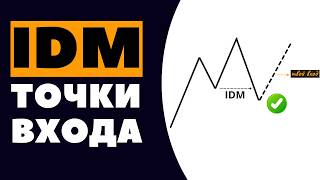
IDM Entry Point: The Secret Most Miss
60sReveals a specific smart money concept (IDM) that beginners find mysterious and advanced traders debate, creating high engagement potential.
▶ Play ClipThis video is a live stream tutorial on the IDM (Initial Drive Move) setup within the Smart Money trading framework. The host, along with co-hosts Andrey and Asia, analyzes charts to demonstrate how to identify entry points using IDM, particularly when standard setups fail. The session emphasizes the importance of understanding market structure, higher timeframes, and trading against the crowd.
IDM stands for the first correct pullback after a candle moves in the opposite direction from the previous one. It is a key concept for identifying entry points.
IDM zones often do not work for other traders' stops, but they serve as areas of interest. If a zone fails on a higher timeframe, it may work on a lower timeframe.
Understanding the core structure (higher timeframe) and internal structure (lower timeframe) is crucial. A zone that fails on a higher timeframe may still provide an entry on a lower timeframe.
When price reaches IDM and breaks through it, it can also be seen as a 'choke' setup. Traders may look for long positions here, but the host advises caution and suggests waiting for confirmation.
The host identifies a complex correction and discusses conservative entry points using SNR or other methods. The goal is to enter short after a long movement.
The same patterns appear across different trading days. The setup is called 'connection-crossing' and is a recurring theme.
On a higher timeframe, price may not touch IDM, indicating an order flow continuation. Traders can look for long entries at the end of each correction.
Sometimes multiple setups (e.g., three choke setups) are needed before a valid long entry appears. Patience is required.
Fibonacci retracement levels and order blocks on lower timeframes (e.g., 5-minute) can help identify entry points when standard setups fail.
Markets move in two formats: acceleration without giving positions to others, or knocking out obvious positions. Understanding this helps in anticipating moves.
When IDM is broken, the next setup to consider is 'setup through connection' (continuation). The host demonstrates how to wait for this setup after a breakout.
The session is essentially a backtest. By analyzing how setups fail, traders can formulate their own personal trading strategy.
If standard Smart Money techniques don't work, traders should look at what others are doing (e.g., on Twitter) and trade against them.
When price touches a visible order block on a lower timeframe, traders can go long aggressively. This is a key phrase: 'find, run through the timeframes and find this very order block.'
The host clarifies that what may look like a flat is actually an impulse with order flow. Traders should focus on impulses and create positions based on order flow.
Understanding basic patterns (e.g., head and shoulders, SNR) is crucial. Without this base, advanced concepts like IDM cannot be effectively applied.
IDM is the first potential reversal point. If it fails, subsequent zones of interest may not work, and traders should switch to setup through connection logic.
The video concludes that IDM is a valuable concept for identifying entry points, but it must be combined with other tools like higher timeframe analysis, order blocks, and understanding market psychology. Traders should backtest and develop their own strategies based on how setups fail and succeed.
"The title promises IDM setup training for beginners, and the video delivers a detailed live analysis, though it assumes some prior knowledge."
What does IDM stand for in Smart Money trading?
IDM stands for Initial Drive Move, the first correct pullback after a candle moves in the opposite direction from the previous one.
01:44
What should a trader do if an IDM zone fails on a higher timeframe?
The zone may still work on a lower timeframe, so the trader should switch to a lower timeframe to find an entry.
03:13
What is a 'choke' setup in relation to IDM?
When price reaches IDM and breaks through it, it can be seen as a 'choke' setup, where traders may look for long positions.
05:36
What is the 'setup through connection'?
It is a continuation setup used after an IDM breakout, where traders wait for a pullback to enter in the direction of the trend.
31:07
What are the two market behavior formats mentioned?
Acceleration without giving positions to others, and knocking out obvious positions (stop hunting).
27:36
How can Fibonacci be used in IDM trading?
Fibonacci retracement levels can help identify entry points when standard setups fail, especially below 50% retracement.
22:05
What is the key phrase for aggressive entry in a trend?
'Find, run through the timeframes and find this very order block.'
45:08
Why is base knowledge of patterns important for IDM trading?
Without understanding basic patterns like SNR or head and shoulders, advanced concepts like IDM cannot be effectively applied.
55:06
What is the first potential reversal point in a trend?
IDM is the first potential reversal point.
56:22
What should a trader do if IDM fails as a reversal point?
Switch to setup through connection logic and look for continuation patterns.
56:22
Timeframe Switching
Highlights the fractal nature of markets and the importance of adjusting timeframes when setups fail.
03:13Market Behavior Types
Provides a clear framework for understanding why markets move the way they do, aiding in anticipation.
27:36Trading Against the Crowd
Emphasizes contrarian thinking and using social media sentiment as a contrary indicator.
41:33Importance of Base Knowledge
Stresses that advanced strategies rely on solid understanding of basic patterns, a key educational point.
55:06IDM as First Reversal Point
Defines a clear rule for when to use IDM versus continuation setups, aiding decision-making.
56:22[00:16] we will conduct will look at what is happening on the chart. Previously, you and I tried to analyze a graph and refute some theory there. Now, knowing one element of this chart, knowing the setup there,
[00:31] for example, the same through the cheek or through the slip, we will try to determine how we can work and what patterns need to be taken into account in order to trade through ADM, what entry point we can come up with . And it’s clear that in this
[00:45] case, when we’re talking about the entry point, through IDM, just the entry point, too many factors need to be added. And just in the near future, a video about a trading strategy will be released that will explain why, more
[00:57] precisely, and show what else you need to consider in addition to the entry point in your strategy. Therefore, during the stream, we will discuss what additions are necessary, for example, about a higher time frame, about market phases, and
[01:10] about the direction of movement. This stream is essentially a follow-up to the previous one, which was last Wednesday, about entry points through Flip or CH. Here. And today with me is Andrey from the last stream and Asia. Here. And all this will
[01:27] help me a little bit. And the first thing we'll start with is we'll go back schedule. And, most likely, on this previous chart we will talk about the current movement, right? So what is IDM? The first thing that IDM is is the
[01:44] first correct pullback, to see, a, the candle that went there in the opposite direction from the previous one. That is, if I see that I have this green candle, and the previous one removed it, it removed the previous one only from above, then I
[01:59] need to find the candle that previously removed it from below. We see that there was a downward movement here. We, uh, filmed everything from below, below, below, then went from above. rollback will be here. There is a detailed video on the channel, be sure to watch it and get the answer.
[02:16] be sure to watch it and get the answer. So, I have a question for the guys. And in So, I have a question for the guys. And in this case, yeah, in this area, draw me in this area and in this area the ID,
[02:33] that is, from the top point here and from the top point here. Yes. In this case, we have the first one right here. Okay, show off.
[02:45] Okay, my computer, yes, it's going to heat up now. He doesn't want to. Next time in the summer we'll have to move to a room with air conditioning. So what do we get? We see ID in this area. If we recall the previous
[02:59] stream, it turns out that the zones of interest themselves often do not work for other people's stops . Dem, in essence, is one of those areas of interest that you is one of those areas of interest that you and I will be observing for ourselves. However,
[03:13] when our zones of interest do not work on one time frame, they one time frame, they will most likely work on a smaller time frame. This is a very important understanding. Why is this important? Because you have a core
[03:28] structure and you have an internal structure. We will now move on to this fifteen-minute time frame Well, we'll come now and see. That is, look, in this case, you
[03:44] and I have a structure. And in relation to this structure, we know that, most likely , in this area we will not have an entry point, right? That is, last time Andrey and I discussed that in this zone, if the price reaches a
[04:01] higher time frame, a higher time frame zone, people will look for a setup here. Question for the guys: what will the cross-section setup look like here? What is there schematically or physically? Draw what
[04:15] physically? Draw what other participants in this area will want.
[04:33] they will see for themselves some kind of zone of interest here and zone of interest here and try to enter a position from it.
[04:53] Where is the male? Here is a green male. No. No, this can’t be a choke, because people will decide to go up while moving down. So, they will find a setup of chereshёk here. Oh
[05:08] , yeah. That is, there was an upward movement, the price comes into a certain zone of interest, and here you need to find a choke. That is, in this area I didn’t understand in which zone. Yes. had a choke, for example. Yes.
[05:24] maybe someone would perceive for themselves some kind of order or something like that zone, and then return to this zone and from there go long. Great. So what do we see? And we see that we call this candle a
[05:36] choke. Ah, but according to the internal structure, what will this point be structure, what will this point be called? IDM. Based on its internal structure, we will call this point IDM. It is clear that in this
[05:50] case, shorting is also a bit of a so-so story for now, because we are only at the top, yes. Accordingly, in this context, if we are in an upward movement there, well, it’s a bit early to short. Here I would like to see
[06:04] some further movement in order to make some kind of trading decision. For now, let's just note that the price comes to ID and breaks through ID, also known as Choke, as a setup through a choke, yes, from the point of view of the current movement. And people here will
[06:21] try to consider long positions. That is, according to the smartmoney theory, this will be the entry point for a long position when moving downwards. And Andrey agrees with you. Here we have a block. And from here,
[06:35] let's say, we're just working through it now, right? So, as researchers, we have to research so that we can get here with you, what entry point we could come up with here
[06:56] according to our trading strategy, right? Yes. Yes. well, we, in principle, had a big long movement. They will come further, with such a decline I am not sure, I have not seen it yet.
[07:10] People are going long here, and we are going in the opposite direction, setting a stop-loss here and looking for an entry point here for ourselves, but short. Okay, great. That is, our task is to
[07:23] enter into a position somewhere from the point of view of a complex correction, where we could enter into a position,
[07:40] Well, a conservative entry point, there, I don’t know how much here, probably, that is, we are somewhere here in this area, yes, either through the SNR, or we would come up with an entry point here. That is, look, in this case our
[07:52] task is to fix, for now we have taken a relatively random place, the place from which last time we began analyzing the graph, right? And in this case, we need to see how it worked, so that we can then
[08:06] try to apply this scheme further. That is, in general, there is a video on the channel called setup through connection. I came up with some kind of list of words. And, accordingly, we will technically analyze it here.
[08:20] we will technically analyze it here. And how can I tell this to others? Yegor writes to others: “There is no complex correction, Yegor. Three people will tell you that there is a complex correction here.” She is here. I am officially telling you this, because I
[08:33] formulated it. Honestly, believe me, there is a complex correction here, and we always use it in this case. Well, I don’t difficult correction, or if I’ll come up with something.
[08:45] Well, that is why this is a complex correction, because here there were these simple rollbacks, and here some more different, completely different movement occurred. And if we come here shortly, it means that we are expecting something more different and
[09:00] then we are trying to dream about it. This is a difficult correction relative to this impulse. And within the framework of this impulse there were some simple corrections. We are saying that in relation to this impulse and the corrections that are within
[09:13] this impulse, in this case it is a complex correction. That's how it is, yes, honestly, this is a difficult correction. Okay, but now we'll go further so that that we can then apply through IDM, right? So, what do we know? You
[09:30] and I know that our setup through the stem looks like this, right? That is, people will want to do it this way. But we see that in this case this setup does not work. And when we see, well, I’ll just finish drawing this little
[09:44] thing, when we see it like this, yes, then it turns out that a form is being formed, an entry point. So that's what we got, right? And in this case, we
[09:56] got, right? And in this case, we have some kind of scheme, yes, with a potential entry point right here. So what do we get? And so I will only erase this. What do we get? We open any
[10:11] trading plan for any trading day. And we get the same pattern, right? That is, you and I open some tool, and we see that, in essence, we are planning approximately the same thing. This is called a connection-crossing setup.
[10:26] And so this is the first scheme. And how can I just... Damn , no, we're not going to do it like that. I'll do it like this. Now I'll redraw it with this thing. Ah, why are we drawing this? So that you can now see, perhaps, according to
[10:42] my theory, according to my logic, that nothing new can be invented on the chart. It can only be called by completely new words. Although technically, I even saw this in one book, that it is there, let's say, with, well, how is it, as in essence, it is
[10:58] also called a setup through in continuation. I saw this somewhere in one of the guys' books. Maybe they, of course, stole this interesting word somewhere recently on one channel,
[11:12] so to speak, which you are watching now, but somehow that’s why we get the entry point here, I forgot to draw it. So, now our task is to see what other entry points there might be through IDM . Yes, we are moving
[11:27] to a higher time frame, and we, well, have to look at, uh, a slightly different story. We talked about the next position on the higher timeframe where people will be looking for entry points, right? That is, we said
[11:40] that the price went lower, but technically here again other market participants, traders, will try to find a long position. And we are also discussing that there is no entry point for long here, right? That is, people see a certain area of
[11:55] interest for themselves. It’s just so good that in fact we have [snorts] a-a this a everything remained drawn. There is no need to say all this over again. And this is what we see? We can see that
[12:09] in this area the price does not reach the point of movement. And now I have a question: what about this candle's internal structure, where do we have IDM? Right
[12:33] where it is transferred before it is taken away. And I will answer the question. Evgeniy wrote on another channel that he saw the use of SNR. Evgeny, you most likely saw not SNR, but SNR. Have you seen this thing? Oh, have you seen this thing? This is support and
[12:47] resistance. And I'm explaining Russian to you . process of deception through the psychology of you and me, deception through the psychology of you and me, so these are slightly different things. So what's
[13:00] going on with us? Look, when we talk about we will most likely find a similar movement format on the higher time frame . And in this case, yes, the price never touched the SNR at all, that
[13:15] is, it simply does, in essence, orderfu, yes, and about not SNR, so, excuse me, who is IDM. The price never took away IDM. She
[13:27] essentially drew an Orderflow, and continued her upward movement. If you and I, seeing this picture on a higher timeframe, yes, this is a 15-minute higher timeframe, we are very strongly inclined to go long,
[13:42] we are very strongly inclined to go long, what can we try here, assuming correction, because, well, for example, I’m fantasizing, this was some kind of final accelerated manipulation. How can we try to find a long entry point in this place
[13:57] try to find a long entry point in this place we have it like this . And talk about it again. I didn't
[14:13] hear it completely. Every time after removal. No, well, that's just a minute, that would be a bit far away.
[14:28] couple of snors there just in long, right? That is, the price is actually finishing this correction and showing us a continuation of the upward movement. So , what we see technically, if we are biased towards longs, we
[14:45] have the right to enter the entry point into a long at the end of each correction, enter the entry point into a long at the end of each correction, right? And the question is, knowing the setup via flip
[14:57] right? And the question is, knowing the setup via flip or ch, here we have our first IDM, right? Here we have our IDM 15 minutes. That is, this IDM loop is 15 minutes, this IDM loop is 15 minutes, this one and so on. How can we get into a position here?
[15:20] Ugu. That is, we see a potential setup through the slip or through the cheek. area. Ah, and essentially, through a beautiful, wonderful Ah, and essentially, through a beautiful, wonderful setup through the cheek, enter long with the entry
[15:34] here, stop here. What's here? Conservative entry point. Here we have the , on a higher timeframe. I should have drawn them, of course. Although let's do it that way. I'll draw them. I just want you to see now
[15:48] the pattern that is present on the chart, but for some reason we don’t want to, well, we do n’t want to see these higher time frames, lower time frames, and we naturally, the market also ignores us, because why give us entry points
[16:05] if we don’t need them. Someone will say: “There are no such movements on the chart .” It happens, why not? At four o'clock we also have movements of this format . And in exactly the same way, you and I get the same entry point
[16:20] into long, right? Only this entry point within the trading day occurs on killzones and that is why they torment us. Here we have with you the SNR, yes, IDM, excuse me, please, here in this place we have this IDM for 15 minutes. Here comes the price
[16:35] . How can we come up with an entry point here? could enter with a stop here. Yes. So, further in each subsequent movement. Same
[16:50] here. Yes. When the correction is already visible to completion. Yes. that is, technically we see, well, kind of incomplete, I can’t say that there
[17:05] are super-complete entry points into long everywhere, because, look, here, IDM was right here, but we have n’t reached it very far. Here we have IDM located here on the higher timeframe. This is the entry point,
[17:20] say, there is no super-beautiful entrance here. Yes, here you and I can come up with a flip, or something like that, by the way, we’ve broken through, but there’s no rollback. Accordingly, the trader will look from below. If we
[17:35] just use SNR over this high, then we can get a position together, right? Yes.
[17:51] Okay, now, excuse me, please. Yes.
[18:03] case, yes, we need to come up with something else. We cannot trade a pure setup through the cheek. And what does IDM look like here , right, this movement? How can we enter here?
[18:28] And do you mean exited? Yes. possibility that if I enter without doing well, then I can get a position. Yes.
[18:51] setup - it's over." And look, the pure setup of the cross-section doesn’t work. We get a pereswhip and fly away with an unclean movement. Yes. E is an evil spirit. What do movement. Yes. E is an evil spirit. What do we have here? Here's our IDM, right?
[19:06] In order for us to get a position here, we have a setup drawn here . In this area it is a stop. We have drawn, well, almost drawn, the next setup - the cleaver. Stop. And only the third setup-cross gives a
[19:22] long position. Can you see this or does it need to be shown more clearly? Why do I see three cheek setups here ? Well, we have a choke here. Yes.
[19:36] [sighs][sighs heavily] After which we make a return. And here, most likely, people could enter, well, from some of this zone, so here, in Well, it's exactly the same story in other places . Yes.
[19:49] . Yes. That is, well, it’s as if this position, well, can’t be opened just like that, right? That is, the first impression is: that’s it, I’m definitely going long this way, but it turns out that something is missing. Or
[20:05] maybe you can tell me what is missing here?
[20:18] how to say it correctly, well, some kind of upward movement, so that the market shows us that we have come out of this kind of correction of some kind. Let's sort this out with Eden, well, somewhere for a minute, right?
[20:32] Eden, well, somewhere for a minute, right? Look, in this case, we are Look, in this case, we are essentially not moving away from the past, but from this lesson. We haven't moved anywhere from the last lesson. We are now essentially still
[20:45] continuing, one might say, a lesson, uh, setup through SNR. Why doesn't it work? Well, more precisely, not why, I don’t care why it doesn’t work. I need We confirmed that it doesn't work, right? So what do I do with this now? We
[21:00] see IDM, right? Here the ID didn't work, the price broke through it, and we went work, the price broke through it, and we went down. In this area, what setup will we use to enter a position?
[21:18] well, it was an overly diagram that I drew there in black. This is a YouTube video setup using a counter in continuation, accordingly, but here
[21:34] continuation, accordingly, but here we don’t have this setup, but at the same time, the market itself does not provide a clean entry through the counter . Ah, well, for example, the first pattern that just struck me, and I can,
[21:48] for example, mm, I’m fantasizing, well, probably draw some kind of order block in 5 minutes . And yes, and if the price as orderflow comes into this block and shows movement, then I can consider a long position.
[22:05] That is, look, we have a five-minute candle, and I need to come up with something, and here it’s clear where the Fibonacci numbers in Smartman came from, right? Well, a lot of people got stops here, so let me open up the
[22:21] Fibonacci. And essentially, when I draw a VPIN grid here, it turns out that if I enter below 50%, then there is a high probability that I will get, for example, a position there, right? And, accordingly, if I highlight, I’m
[22:37] looking at what’s on the chart, and I see this position. But here the price comes to our block at 5 minutes and gives us an entry point. From here we can make a
[22:51] preliminary conclusion, for example, yes, based on these two things. If the price m based on these two things. If the price m goes to ours, comes into the block,
[23:04] uh, we can try to open a long position once. Once, right? In essence, long position once. Once, right? In essence, what kind of setup should we have here, how can I
[23:19] put it? Let 's take a minute and see what, oh, what setup are we going to consider here consider here for entering a long position from these areas?
[23:45] It doesn't matter what the area of interest is, the income to and from the area of interest is, the income to and from the area of interest, and, well, I agree, any imbalances, right? Movement. Yes.
[24:00] [clears throat] So we need to see some acceleration. Agree. And at the same time , if we break through, for example, IDM, yes, the previous one, that is, it’s a zhechok, [snorts] we have the right with you there with a market or a stop order, a
[24:14] stop order will be an even better way to enter a position. Great. That is, for example, we now have a second entry point. Do you have any questions yet? If not, let's move on for now .
[24:34] highlighting all the moments visible on the page, highlighting all the moments visible on the page, on, well, on the graph and presumably at 5 minutes, at 15 minutes, determining the zone of interest, right? And
[24:48] So, at 15 minutes. Well, essentially, we take some higher timeframe. In this case it is 15 minutes. We can choose 4 hours. We define IDM on it. After all, we remember from the ID lesson that, well, he was found here, then he moved,
[25:04] by the way, he didn't move here. Where did I draw the line here? And then he moved. Moved. And in the process of this movement, we know from the previous lesson that the obvious zone of interest does not provide an entry point. That is, there will most likely be
[25:18] manipulation there. Therefore, if the market shows us a certain order flow, we can locally join this order flow and, for example, switch there to a half-time
[25:34] frame, see some order block near the ID and enter a position from there. But how to enter a position, for example, we can use some, well, aggressive action. That is, for example, the price breaks through the choke above the candle that
[25:49] broke through the choke on the lower timeframe, we place a stop order, and we place a stop behind the local low and try to enter a position. Well, we see that in this case, winray is quite interesting, by the way, it works out here. That is, at the same time
[26:03] we see this and here in this area, yes, here it is possible that through the stop all this will be happiness. It's impossible exactly, yes, but we see it. And if the price, this is still an assumption, yes, if the price breaks through our IDM, does not
[26:18] reach the lower timeframe there, this entry point, and we have the right to consider the setup with you through the counter upon connection. connection. Now look. Uh, so we were
[26:31] talking about the following, that when the price comes to that same Eden, well, now I’ll add it here, that is, we’re talking about working in a trend, in a
[26:44] visible trend, when there is an upward or downward movement. Yes. Yes. Yes. Well, the thing is that we always end up with a trend. Look, when I take, well, we're going back to 4 o'clock now. Ah, and look
[26:57] what an interesting thing is here. The thing is that we, in the last lesson, discussed with you that in this context we have a certain upward quite difficult to get an entry point in this upward movement and few people can get one here. That
[27:10] is, she is not here. And if there is no entry point for other participants here, our task is to somehow invent one here . And so technically, when we don’t have this position, we can come up with an entry point in this
[27:24] rather aggressive way, right? That is, in essence, this is a breakout of the trend and an attempt to join in on some imbalances. some imbalances. But when the price reaches a certain
[27:36] But when the price reaches a certain point and starts to roll back to the next zones of interest, very often the price does not give these positions, right? That is, the price enters the zone of interest, and here other participants will look for their
[27:50] setups through the counter. However, practice shows that they did not receive these positions . So, our market is going in two formats, it turns out. The first format is acceleration without positions for
[28:05] others for other participants. And the second is knocking out obvious positions, right? That is, here we have a price that has come, given an obvious entry point there, but,
[28:17] for example, has not given a take profit. I don’t remember, somewhere in the upper part we saw somewhere in the upper part we saw that there was the position itself. This means that if it didn’t give a take profit, my task is to consider, in essence, a continuation of the downward movement. Here,
[28:32] I remember, here we talked about how there was no entry point into a long for smartman traders who want to go short. Oh, excuse me, please, I'm going to take too long. And then, when this position appeared,
[28:47] what did they receive? Feet, feet, feet. Is Is it clear or is nothing clear? So, well , now in practice, yes, it is possible, so
[29:03] let's do it for now. Now we just this case, if we need to avoid deleting such things next time , we discussed this setup here, but collectively
[29:17] we came to the conclusion that a very small number of people in this area would want to open a position, right? And then you and I collectively decided, area people would draw themselves the first picture of some kind and try
[29:34] to find a long position from there. And what do we see here again? On the lower time frame, we have ideas again being drawn. You see, these idems can't be removed in any way, except for this one. Question. Traders who want to search for
[29:50] setup positions through the counter, what do they want to find here during this breakout? deep rollback to the zone of interest. Absolutely right. Titi.
[30:06] So they will wait. Good, beautiful, big rollback down. Yes, just like always be remembered now. Accordingly, when the market starts to do this, and when the market starts
[30:21] to go deep down, what do we understand for ourselves? What if someone else's feet are given an entry point, then they will move in the opposite direction? Absolutely right. most likely go down
[30:35] Absolutely right. most likely go down , right? Ah, but if we, so that they don’t get their take. Yes. Great. Accordingly, in this case, if the market makes these upward movements, we see that,
[30:51] except for this place, the ID was not taken, but here it was taken, an entry point was given, and we will not take further until the market reverses.
[31:07] when we see a place where we broke through the IDM, yes, we really broke through, we’ll come back to this place now, we’ll immediately look at a nice piece, and then we’ll come back to where we need to figure it out. Well, although this is not a democracy,
[31:20] walking here. Or here. We will also come back again. And here we checked the ID, right? We just discussed last time that if we break through IDM, what setup could we potentially
[31:36] what setup could we potentially consider? Setup through counters continued. So what does
[31:49] proboydima tell us? It doesn't matter how . The sweep, the re-sweep, the breakdown, the breakdown of this impulse tells us that we, most likely, will not just we, most likely, will not just leave here. It's the same story here.
[32:03] We got through it. Now my task is to wait for the setup through connections. Most but most likely we won't have it here , yes, this entry point itself won't be there , yes, this entry point itself won't be there . It's the same here. We are also looking at
[32:17] places that we need to analyze.
[32:30] dying. It's probably 26-27 degrees in the room, and it's really hard for him. Oh, it's hot there. Well, I just have a room right in the sun. In the sun, so
[32:43] yes. Well, I'm just too lazy to go to another room all the time and that's all. So what do we see? We see IDM at 15 see? We see IDM at 15 minutes, right? And we see a question.
[32:56] This entry point into long is super aggressive. Can we open it now super aggressive. Can we open it now or not? Long long said that initially, if the price reaches the block there in 5 minutes,
[33:11] for example, here, can we open a long here, for example, we have open a long here, for example, we have broken through the choke.
[33:24] understand it. Probably not, I guess. Uh, we said that we have a block, and if the price flies in super aggressively from this block, breaks through our choke, then we have the right to join long. Well, most likely
[33:38] super-aggressive here. Here are the same candles as the previous ones. We see that this is some kind of continuation, but here I don’t see it, so I also have no idea. Great. We see that the price breaks through ours. And you and I must find here
[33:53] ours. And you and I must find here either a flip or a uh-uh choke entrance. The question is, where will he be here for other participants, how will they see themselves?
[34:10] get that Ч would be right here, right? Yes. But we didn't take him, as far as I can see. Flip - it turns out that, well, for example, here we have some kind of
[34:24] order block and in which and in which we then arrive at the we then arrive at the top?
[34:39] That is, the very first one, which, yes, gives us some kind of reaction and the price does the first thing complex in the local range . Whoever agrees, agrees. He can consider what position, long or short. With ours, we are
[34:58] Yeah, that's absolutely right. Unlike them, you and I will be considering a short position. That is the first point. And then, then the price makes, excuse me, a downward movement. Is there anywhere else we can go short here?
[35:25] he agrees to this movement, he can enter here. But absolutely true. Next, our position will either be here or here. Essentially, Kakanov is a setup join further, seeing that the
[35:39] process of stops of other participants is underway. We see blocks, blocks, blocks, blocks. And the price happily continues its downward movement. [snorts] And that's great. What does it look like in this area?
[35:52] area? And in this case we had mm IDM IDM IDM IDM right here. And in this area there was IDM. Where do we have a setup here through the counter? Oops. I'll delete this. Now let me
[36:06] draw it on the senior dagraframe right away, just in case. Oh. Tu-tu-tu. Yes, everything was correct there. So, that is, look, I was just too lazy to draw this piece. I just took our
[36:22] too lazy to draw this piece. I just took our previous, uh, stream and analyzed it. Maybe someone doesn't agree, but we continue with the logic. Ah, well, I don’t agree that we’re analyzing it incorrectly now , but we’re continuing the logic of the
[36:35] previous stream, right? That is, if I know exactly how it doesn’t work, then let me just analyze it and draw my own conclusion about how it works. And when I come to the conclusion: "How does this work?" I'll ask myself: "What should
[36:50] I do to make money here?" Essentially, you and I can now, well, each of you can, uh, formulate your own personal trading strategy, right? That's it, nothing more is needed, just carry out the working process, work it out, do
[37:07] how it works on history. So, essentially, we're now doing a backtest of this chart, looking at how it all actually works on the chart . So, we have an IDM. And
[37:19] the trader wants to enter a position, right? And even here we come to this block, let's say we've outsweeped it, we have acceleration , there's a choke, we put a stop order above this candle, the price doesn't take us and flies down. If the price
[37:32] open a setup here through the attachment cheek? mistaken. Uh-huh. And so, great. That is. In this
[37:45] case, we can open here. If you and I still want to short further, where else on this chart can we join in?
[38:00] place. Well, here it turns out we could have Yeah. Excellent. That is, look, even in the place where we went up further , we could locally do what I'm now showing on the minute chart, I'm just too
[38:15] four-hour chart now. You can paint it on a higher timeframe. The daily 4-hour chart and the entry point on the 15-minute chart. Then your movements will be longer. Yes, please take that into account. The chart is fractal. It works exactly the same on the
[38:29] minute chart and on the 15-minute chart. And here, in this case, we have And here, in this case, we have IDM, where we have this choke here. Yeah. Where will people look
[38:45] choke here. Yeah. Where will people look for a long position here? And we have a choke here, right? right? Yeah.
[39:02] . Great, good. And if... Well, let's start from here. Other participants are trying to find a long entry point here. And you
[39:15] and I will also enter with a stop order above this movement. Well, this is probably still an impulsive, impulse movement, right? Here we get a stop in this context. We haven't received such stops before. In
[39:28] We haven't received such stops before. In this case, we got one. Good. And we got a stop. Firstly, this stop is already a signal that we shouldn't enter like this anymore is already a signal that we shouldn't enter like this anymore , right? If we get a
[39:43] stop, the stop will be at this level. Can we find further, like you correctly said, here is a setup, further lower.
[40:02] we probably definitely can't aggressively join here , because we already entered like this here go long anymore. That's it, we wait. Now our task is to look for a short.
[40:23] , there was some news, so we can't go into details here, but we're just fantasizing about what we could have. Yeah. And here, where I noted, we right? That would be our entry point. That is, here's a setup across the cheeks, here we have an
[40:38] upward movement, here are other participants trying to enter, here's a complex correction, well, and here's the entry, yes, essentially. A setup through attachments. What is a setup through attachments? A conservative entry point,
[40:52] right? That's it. That is, a movement that had a complex correction. And essentially, essentially, what I saw today for myself technically, it was confirmed, yes, or rather, well, I didn't
[41:06] do any backtesting. I've been generally lazy lately in terms of these actions, because I understand that in reality, these streams, when you don't fully understand, you don't know what will happen , they are simply
[41:18] beautiful for the very reason that you see them live For real. You don't need to find a section of the chart where this guy works. Why? Because you and I are coming to the same conclusion. If the standard smartman technique
[41:33] doesn't work, then you need to look at something else. You need to open Twitter and trade specifically against Twitter. You need
[41:46] to understand what people want most in this area . Taking a random section of the chart will, of course, be difficult in the future, because you'll have 10,000 thoughts. Yes, in history, of course, it's easy
[41:58] to analyze all this, but in life, you'll have 10,000 thoughts and a bias in one direction or the other. Some factors will be forgotten. However, our task is, having seen these repeating actions, uh, to look at the stories
[42:13] ourselves, independently of other participants, right? Ah, well, is it really repeating itself or was it just shown on a stream like that? If you see that it's really repeating itself, and you can
[42:28] build a strategy from it, yes, that is, well, just please, Not the setup itself, otherwise it turns out you're looking everywhere. You see, we've got so many that we've reached the point of getting an entry point on the minute. You need to combine the previous stream and the current one
[42:40] to get an entry point on the minute in this area. this area. Okay, what about questions?
[42:53] Yeah. Okay, but you need to look at everything. I'm doing this now and I need to look at everything. I'm doing this now and I understand that the grain probably hasn't completely unseen this yet understand that the grain probably hasn't completely unseen this yet .
[43:07] Okay, ask away. I don't yet understand what I can help you with or suggest. I want to combine the IDM breakout and the I want to combine the IDM breakout and the choke entry. That's still a bit of a work in progress.
[43:21] What's the logic behind it? You and I know that the IDM and, well, the block before it are the area of interest for other participants who will be looking for long positions. Well, for example, they
[43:33] see Orderflow for themselves, right? I mean , look, has it ever happened that you're looking on Twitter, right, and for some reason everyone
[43:45] starts using Orderflow in their posts. Someone asked this yesterday. I answered this question. Yes. Yes. It's as if at some point everyone actually sees Orderflow. When you see this, everything seems to be
[43:59] trading against them. What does this mean? When other participants see Orderflow, When other participants see Orderflow, they see this repetitive trending movement, which tells them that we're going to continue long now, right?
[44:13] This means that the bottom of this trending movement will almost always be IDM. And if you and I, ah, when they see
[44:25] that this is already FLT, oh, excuse me, orderf, most likely it will be like this. But that's not yet the case. You and I understand that, well, for example, right now on the pound, yes, we have this anomalous movement on the pound, a
[44:39] anomalous. We've actually been through the whole morning, I've confused you. Ah, although not everyone understands why we were discussing longs, right? But
[44:51] how do you trade here? That's it. They don't see order flow yet. See? talking about? This isn't Orderflow, this is some kind of [ __ ]. How do I enter here? There's no answer in Smartman: how do I enter this position? We're
[45:08] trying to explain this through IDM, well , at least the current assumption. Everyone needs to do a backtest. We just saw a couple of snippets on the chart . We're saying that if the price
[45:22] . We're saying that if the price comes here and doesn't give a nice setup through, but touches some visible order block there , we need to run through the timeframes, like 5 minutes, 3 minutes, then we can
[45:38] go long super-aggressively. Essentially, what is this? just said, is the key phrase: find, run through the timeframes and find this very order block. No, well, look at it
[45:50] theory that we've been developing. We know about Discord. Let's rephrase what this entry point in a trend is called. How will you enter? Formulate it for me. Just
[46:03] a second, a second, excuse me, I'll find the piece now. find the piece now. And how will you enter, mm, right here, right now, this downward movement? Are you sure that this is a short?
[46:16] How will you make a decision and enter this short? will join in further. Absolutely right. And that means, in this
[46:29] case, I need to define what a visible correction is. And having received confirmation that this correction has ended, for example, someone will say a liquidity breakout on the left side, someone will say an imbalance, someone
[46:43] side, someone will say an imbalance, someone will say two imbalances, someone will say a SNR. Come up with confirmation for yourself, someone will say in a minute a conservative entry point and fly long
[46:57] in this movement. Correct. now we have a second situation, right? Look, I'm okay, I'm just in
[47:10] case. I understand that I'm now saying the words IDM, setup via the connection counter, but I'm not saying anything new at all. We're just essentially repeating the theory with you [laughter], only through an explanation, and why this
[47:24] happens. And, uh, well, we're bringing in here potentially, not exactly, but potentially, this is what traders who trade smartmania should do. It's clear that someone will break the rules, but we're taking pure theory and stretching it onto a chart.
[47:39] Yeah. Uh, that's how it is. I understand that many people say: "Well, this doesn't work." now looking at how it doesn't work, to understand how to work with it . But at some point, this order flow, naturally, ends and the price
[47:54] naturally, ends and the price starts moving down. starts moving down. And if you and I m, this is a question for And if you and I m, this is a question for you. And here I want to go short, right?
[48:07] I want to look for a short at this point. What should I find? What is our should I find? What is our position called?
[48:19] we look for SNS in In this direction, a breakout of the trend line. trend line. See the downward movement. And what is a setup through joining ? And what is that, I
[48:32] ask you? What is it? this process, right? That is, in this movement we see this wonderful process. But in addition, yes, of course, in
[48:49] trading, well, in theory, we don't use DMAs as liquidity points. I'm generally against liquidity points. Because, for example, by the way, in one example, we saw the entry point for a short earlier. It would have worked if we had
[49:02] come here, right, but here, right, there got it, right? And the person who is waiting for liquidity, it turns out that he would, well, have entered here, perhaps with the news, and closed it at take profit, but
[49:18] you and I allow ourselves an even higher position, right? That is, here, if we are important, because if the answer is no, then this position cannot exist. And so, well,
[49:32] here are the questions, probably, I must... Well, I don't know, I explained. An important point is an important point in this. An important point in this is understanding your own bias, where you are looking,
[49:48] that is, what is happening now, right? That is, what is the question for us, let's talk about the trend then, right? And now, by the way, we will need to make a separate stream about the trend. And through other people's stops. So, I want to do streams through
[50:01] stops. So, I want to do streams through other people's stops. And what for us? And, for example, for example, Andrey and I talked last time. The question is for you, yes, we really want shorts. But
[50:15] shorts. But in which of these 1 23 of these three in which of these 1 23 of these three places do we have the right to open a short? We told us at four o'clock that this manipulation, yes, this
[50:27] point, we are looking for shorts. Here it is clear, but in these places, where I I can open a short, according to theory, according to strategy, where am I even allowed to
[50:39] strategy, where am I even allowed to do this, and when we have - and here we had the opportunity,
[50:54] what we see is that even if the market didn't go down , there was still a stake entry point right? Yeah, great. Another position. Where is
[51:08] No, it's not today. This is history. It was actually here on May 14th. And here, we would have entered with you sometime, especially you definitely
[51:20] enter exactly these types of positions with gold. This is not even up for discussion, that will be. Yes. Look, we just analyzed other people's stops, but essentially, through this logic of other people's stops, we got a
[51:36] through this logic of other people's stops, we got a reason to go short here. . And snip-snip and untied.
[51:49] This is a trading strategy, because we, well, all this, everything I'm telling you, it's built on logic, That this doesn't work. That this doesn't work. The setup doesn't work. I understand what
[52:01] people will be looking for here. And I understand that the market is trending. After all, look, someone will say: "Artem, well, this is flat, this is garbage." And remember, I always... Well, not always, of course, I myself say that this is flat. To understand
[52:15] that, well, what is a flat? This is lesson 52. Trade short, don't fool your head. No breaks, none of this from block to block, right? Ah, but what kind of flat is this? This is an
[52:28] impulse, to which an impulse is moving. To which an impulse is moving. Here, too, an impulse through a gap, yes, but this is also an impulse, to which an impulse is also moving. And impulse, to which an impulse is also moving. And if I remove the garbage, then this is some kind of
[52:42] if I remove the garbage, then this is some kind of flat. What are you talking about? This is what we're recalling here, so what lesson? 33, yes, in which I ask you to highlight 33, yes, in which I ask you to highlight impulses. And what is in these impulses?
[52:57] Orderflow, right? And it turns out that I should, in essence, right? And it turns out that I should, in essence, if I'm important here To clarify, I'm biased towards short trading, so I have to create my own positions based on this order flow.
[53:12] What do I see? A great conservative entry point. I'm making money. Of course, it's correction here. It's clear that we won't enter here. However,
[53:24] enter here. However, do we do this every day? Yes, most likely, yes. Yes, this is our daily trading. That is, this is the point of what we do. And so, questions,
[53:38] do. And so, questions, that is, Uh-huh, please. . No. Well, then, let's summarize. That is, technically, and technically, if it's
[53:50] very difficult to think about what this Artyom is talking about these SNRs, but can all these actions be explained in terms of well-known patterns? It's clear that in any case, some kind of marketing is used , uh, they use words
[54:04] that are more convenient for us, well, for me personally, yes, especially this SNR, it's simply become especially this SNR, it's simply become commonplace. Ah, but you can explain these same actions to yourself. Through patterns, through some
[54:19] words that you know. And when, well, they ask me a question there, Artyom, why the hell should I learn this structure? [clears throat] Oh, why should I look for these order blocks? For what? So that when you conduct some kind of
[54:36] backtest or try to explain something to yourself, you have a base. If you don’t have this green base, then what are we talking about? You just, well, want to learn this base initially. And any strategy that you
[54:51] discover, you will learn this base under different sauces. Somewhere it will be called SNR, somewhere it will be a rejection block, somewhere a mitigation block, somewhere a breaker block, somewhere a quasimodo, somewhere, somewhere. And in the end, it all comes down to the same thing
[55:06] . You trade head and shoulders. It’s also a setup through. What else is it ? A setup through. Okay, I haven’t figured it out yet. Well, Quasimodo, yes. So,
[55:20] it's all the same story. If you know how to do this, well, it should be, if you can instantly find it on the graph, that is, for this I
[55:32] demand that everyone know how to do this, because it turns out that if you don't know how to do this, we have to spend three days explaining this to you. And in the end, you'll still , because you can't see it. But when for you it's
[55:48] That is, when I ask you: "Come on a bike with me quickly, and I'll have to bike," then, well, that's some kind of stupidity. How? Why would I need you then? I quickly got on and rode. Right? And when you jumped up,
[56:04] took this bike and even rode faster than me, yes, because you know how, then there is a point in continuing to talk about these things. And how does the graph work? Well, that's what's important. I want to think about it, so that it's not just for fun These smart-manias exist. If
[56:22] we know for sure what doesn't work, let's learn how it does. We've looked at IDM; it's most likely just a hypothesis, and the market will work the same in other zones . However, there's a problem. IDM is the
[56:36] first potential reversal point. first potential reversal point. And if it doesn't cope with the market, yes, that is, yes, it can make a sweep and go higher, but if a
[56:49] subsequent downward movement follows it, the following zones of interest won't help us here at all. The next zone of interest for us will be the zones in which the market will simply, well, the market [clears throat] sees them, and there will be
[57:04] rebounds from there. It will bounce off them. This means that in them, uh, we can't use the logic that we discussed today about ID. For now, we need to use the setup logic through the connection counter. That's it
[57:18] . This is an important idea. Therefore, Orderflow only works in the initial movement. If you see that everyone is shouting Proderf, forget it, because that's it, it's already forget it, because that's it, it's already worked, it's already visible Everyone. Well, that's
[57:32] probably it. I'll just look at the questions now. Maybe you guys have any questions for me now about what I've applied here. Okay, well, there are no questions, yes, that's all for now. The guys were just commenting.
[57:45] What to do with an anomalous candle? It's okay, you won't do anything with it here. . Most likely, an anomalous candle is just a news movement. Right here, right here, it was a news movement. So in
[57:58] this case, you most likely wouldn't even have entered. You would have simply gotten nothing because you would have been waiting for the news. Uh, well, just like today. You couldn't trade there before the news, yes, so the day just went by. Mm, so, so, so, so
[58:12] , so, so. Well, everything's great. Then, if there are no questions, here's a nice, pretty, quick stream. There probably won't be a stream on Saturday . We'll do it again next week. Entry points setup, flip after flip,
[58:26] yes. To practice these skills again. Any advice? Practice where it works? How it works? Learn to be a robot at drawing flip setups, by structures, by blocks, so that for you it's
[58:41] structures, by blocks, so that for you it's just a click and that's it. And stop messing around with it. That's all from me . Thank you all, have a good day. . Thank you all, have a good day. See you tomorrow. And bye-bye.
[58:54] As usual, I want to immediately close this, what's it called? Zoom. yes. Right.
⚡ Saved you 0h 59m reading this? Transcribe any YouTube video for free — no signup needed.