
The Psychology Secret Behind Viral Content
44sReveals the core psychological driver that makes people watch educational content, offering a powerful 'aha' moment that viewers will want to share.
▶ Play Clip"Delivers on the promise of psychology-based content strategies, though some tactics are common knowledge."
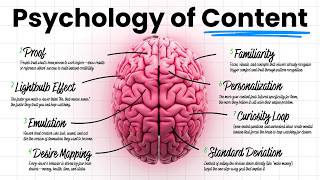
The video explains how understanding human psychology is the key to creating successful content on social media and YouTube. The creator, Callaway, outlines eight psychology principles that can be used to build trust with viewers quickly, thereby increasing watch time and engagement. He emphasizes that viewers invest their time in content they believe will help them achieve their core desires, and creators can leverage this by framing their content to trigger these desires.
Every human has base desires: money, time, health, and status. Human behavior is driven by actions that unlock these desires, primarily spending time or money. Viewers watch content because they believe it will help them achieve one of these desires.
The more someone understands what you're saying, the faster they trust you. When viewers feel smart, they think you're smart. To increase comprehension, talk at a fifth-grade reading level, use comparisons, remove fluff, and use visuals.
People trust you faster when you look, dress, sound, and act like the person they want to become. Your visual presentation signals who you are and can influence trust. It's recommended to emulate the end state of your ideal viewer, but stay authentic.
The more you make content specific to the viewer, the more they trust it will solve their problem. Generic solutions are less trusted. Use 'you' to create a sense of direct address, and consider targeting specific buyer personas even if it reduces total views.
People trust you faster if you have proof that your advice has worked for others like them. Signal proof early, either directly (e.g., 'I have a million followers') or indirectly (e.g., referencing a credible source).
People trust content more if it shows faces or visuals they recognize. The brain releases dopamine when it sees something familiar, leading to implicit trust. Use familiar faces in thumbnails or intros to build trust.
To avoid triggering the viewer's BS detector, package content one step away from the direct desire. For example, instead of promising money, talk about growing on social media, which is a proxy for money. This allows viewers to make the leap themselves.
Understanding and applying these eight psychology tactics can significantly increase viewer trust and engagement. By aligning content with viewers' desires and using proven psychological triggers, creators can build a loyal audience and grow their platform.
What are the four horsemen of desires?
Money, time, health, and status.
00:40
What is the light bulb effect?
The more someone understands what you're saying, the faster they trust you.
03:08
What is the mirroring effect?
People trust you faster when you look, dress, sound, and act like the person they want to become.
05:51
How can you use personalization to increase trust?
Make content specific to the viewer, use 'you' to address them directly, and target specific buyer personas.
08:50
What are two ways to communicate proof?
Direct proof (e.g., 'I have a million followers') and indirect proof (e.g., referencing a credible source).
11:53
Why does familiarity increase trust?
The brain releases dopamine when it sees something familiar, leading to implicit trust.
13:55
What is the one standard deviation tactic?
Package content one step away from the direct desire to avoid triggering the BS detector, letting viewers make the leap themselves.
14:34
Four Horsemen of Desires
Provides a simple framework for understanding viewer motivation.
00:40Light Bulb Effect
Emphasizes clarity as a key to trust, with actionable tips.
03:08Emulation
Highlights the importance of visual presentation in building trust.
05:51Proof and Hit Rate
Stresses the need for social proof to establish credibility.
11:15One Standard Deviation
Offers a nuanced approach to avoid triggering skepticism.
14:34[00:01] better, all you have to understand is human psychology. This is the number one thing that separates the great creators from everyone else. And if you can learn this one thing, there is absolutely zero chance you will fail in the content
[00:13] walk through exactly how to use psychology to hack a viewer's brain into eight main psychology principles when it comes to content. I'm going to break down each one, how it works, why it works, and the exact tactics for how you
[00:27] can use it for yourself. By the way, if you don't know me, I'm Callaway. I have of views. And if there's one thing that helped me grow super fast on both social media and YouTube, it's understanding psychology. All right. Now, the first
[00:40] mapping. And this really is the psychology works. All right. Here it is. Every human has base desires. Typically, these desires map back to money, time,
[00:53] health, and status. I call these the four horsemen of desires. Typically, this is the root of what everyone wants. Now, human behavior is wired to make you take actions that unlock those desires. For example, if I want more money, I'm
[01:05] going to figure out what actions I need to take so I can make more money. This is how base human behavior works. Now, the main actions a human can take to unlock those desires are to spend time or to spend money. Those are the two
[01:17] main inputs. So, really, most human behavior boils down to this. spending time or money to try to get more time, more money, more health, or more status. And now, that sounds pretty obvious, but that fundamental equation is critical to
[01:31] really works. Okay, so what does all this have to do with getting people to watches something, they're paying with their time. This video is free, so it paying with your time and attention. So, the question really is, why do you ever
[01:46] spend any time watching any educational content? And the answer is you do it because you believe that time investment will help you unlock one of those four desires. The truth is you're watching this video right now because you believe
[01:59] it will help you learn how to get more views on your content. And if you do you grow a following, you'll eventually unlock influence and make more money. That is why you're watching, whether you realize it consciously or not. And this
[02:12] really is the psychology secret for why anyone watches any educational content ever. They believe that time in will eventually equal skills and desires out. brain works, I've engineered the title, the thumbnail, the intro, and the
[02:27] storytelling to specifically trigger that desire loop. In other words, I've manipulated you into watching because I already know what you want. And that is what you desire and then frame my content in the optimal way so that it
[02:41] makes you opt in to thinking it will help you get it. And that's the big especially with anything that's educational. All you have to do is get someone to trust that if they keep watching, they will get closer to their
[02:54] breaks. As soon as they feel like spending more time watching will not get immediately. It's not that they get bored, it's that they lose trust that to help them. So, in that spirit, for the rest of this video, I'm going to
[03:08] walk through seven more psychology tactics that will get viewers to trust desires. Because if you can get them to trust that, they will be watching psychology tactic is called the light bulb effect. And here it is. The more
[03:22] someone understands what you're saying, the faster they will trust you. And this things, they feel smart. And when they feel smart, they also think you're smart because you're the one that made them feel that way. It turns out people hate
[03:35] people that they can't understand. And so for you in your content, if you're trying to maximize speed to trust, you need to increase the viewer's absorption Literally, what percentage of the words you say does the viewer actually
[03:50] this rate, the smarter they'll feel and here's why I call this the light bulb effect. The faster you can get a viewer to think, "Ah, I get it now. That makes so much sense." the sooner they will
[04:02] they'll want to feel more of those light bulb moments. And as soon as you can get video, you've got them hooked, line, and sinker forever. Now, tactically, here your content to make those light bulb moments happen sooner. First, talk at a
[04:18] fifth grade reading level. No big words, short, simple sentences, simple phrasing. Don't over complicate it unnecessarily. And I say this all the clarity and comprehension because this really is the most important thing. If
[04:31] they can't understand the meaning and so they won't extract what you're trying to teach. All right. Second, talk in comparisons. You want to relate the new thing you're talking about to an existing thing they already understand.
[04:44] comprehend what you're saying because of relative understanding. Have you ever wondered why those A versus B bodybuilding ads with the pre and post everybody already understands what A feels like. That's what they're living
[04:57] today. So when you show A versus B, they don't need to dream up what A feels like. They know. And so B is the future that they want. I'm telling you, relative understanding is a cheat code for explaining anything. Third, remove
[05:09] all the fluff in the intro and beginning so you can reduce the time to aha. You with the most details. So cut everything that does not matter. And fourth, use visuals to support the words you're saying. All these graphics we make, we
[05:23] can help improve your understanding of the words as I say them. Words by themselves are very hard to comprehend in a long piece of content. The brain can only absorb so many words at once. But words plus visuals are way easier to
[05:37] digest for much longer. Just remember this, it's not sexy, but clarity is the means the viewer actually understands the words you're saying enough to be psychology hack number three is called emulation. I also call this one the
[05:51] mirroring effect. And here it is. People trust you faster when you look, dress, sound, and act like the person that they want to become. In other words, they want to emulate your exact action path so that they can become a version of
[06:04] psychological trigger, but it's really effective at getting someone to trust admit, it seems kind of silly to think your visual representation matters more But you would be shocked at how influential this can be. And here's why.
[06:19] When someone sees you, they take in everything they can see and instantly form a snap judgment of who you are and if they want to be like you. Now, if really like your vibe, they'll put a much more rigorous filter on the
[06:32] information you share, almost looking for a reason to churn or stop watching. But if they do want to be like you, they will give you a much longer leash of to turn off your content is much, much lower. And this is because your visual
[06:45] presentation or visual vibe signals who you really are. and it often gives off a teachings have been effective. For example, if you have a super crisp signals that you care enough about this to invest the money in upgrading the
[07:01] quality and that you're serious on it. If you're wearing a $50,000 Rolex in the successful in some way, shape, or form. It's visual proof in a way. So tactically, it can be extremely helpful to look, dress, sound, and act like the
[07:14] end state of what your ideal viewer or ideal customer wants to be. And it's aspiring designers, then you want to look like what an aspiring designer future. In this example, I think of my friend Orin, who is targeting designers,
[07:29] and I think of what he wears and how his set looks on his videos, and it maps perfectly to this visual aesthetic or visual vibe. Now, if you make content and talk the way someone that was in deep crypto would look. So, don't
[07:42] contact with the camera. I'm just right. Now, I will say one thing. When it comes to building this visual recommend that instead of playing a character that is not representative of
[07:56] who you actually are, lean into your true self really all the way into the things that actually represent you. Because if you play a character that you will come back to bite you when you can't keep up the charade. The point is,
[08:09] it can be an extremely helpful exercise to map out what the visual representation of the end state for your ideal audience wants to be. And then try to emulate those characteristics in your content. things like what you wear, how
[08:22] you act, how you talk, the brands you reference, the slang you use, it all helps influence subconscious liability, and will send trust signals to people before I go on, if you want to learn more about psychology and how to use it
[08:35] social media and YouTube, you should definitely join Wavy World. It's a specifically for business owners and entrepreneurs trying to improve their lessons in there on psychology as well as all the other pieces of the content
[08:50] stack, [music] ideas, strategy, tools, everything. There's 36,000 other completely free. I've got a link in the description if you want to join. All really holds attention is called personalization. The more you make it
[09:03] to the viewer, the more they're going to trust that it will solve their specific problem. Now, why is this the case? People trust generic solutions less because they realize they're going to have to both learn the information and
[09:16] translate it for their specific use case. But personalized solutions for They're already skinned for the use case you have. For example, let's say I ran a marketing agency and I was making content about social media growth. If my
[09:29] surface level, then a clothing brand founder would have to both learn the tactics and try to figure out what exactly applies for him. This is much video saying, "Here's how to grow on social media if you're a clothing
[09:43] brand." Now, obviously, this advice to go more personal and more specific optimizing for max views. Because the more specific you get with your content, and the less views you'll get. But if you're running a business, it isn't
[09:57] really about pure views. It's about ontarget views from your target buyers. So, my suggestion here would be to experiment with much more personalized and targeted content and be willing to trade off pure views in exchange for
[10:11] precision targeting. To do this, you can start packaging or introing your videos specifically by calling out the group that you're making it for. For example, here are three social media growth strategies you should study. Or, these
[10:24] growing on social media right now. Because I hear time and time again from views on their content, but it's not converting into actual customers. And this is because when you make broad content optimized for max views, most of
[10:37] the viewers are not in your buyer avatar. Now, another way to infuse personalization into your content that is a lot less limiting is to use the possibly can. When someone hears the word you in the content, it feels like
[10:50] you're talking directly to them. And this has a subconscious psychological effect that the content is more personalized for them. So the guidance really is this. Think about who your ideal buyer is and personalize your
[11:02] content so it speaks directly to them. And this will drive total views down but it will bring ontarget views up which will increase overall trust with the next psychology hack is pretty obvious but it matters so much it's worth going
[11:15] over and that is proof and hit rate. People will trust you way faster if you actually have proof that what you're talking about has worked for someone like them. And they'll trust you even faster if you have a high hit rate with
[11:27] proof across multiple different types of customers over and over. Now, why is this? Outside proof is the ultimate signal that your knowledge works regardless of who implements it. Because the truth is, most viewers will stop
[11:39] watching once they get the feeling that the information is too custom for them But if you have proof that this has already worked for somebody else, like them, well, they're going to stay because they expect you to be able to
[11:53] explain it in a way they can use. I cannot overstate how critical it is to signal this proof as early as possible in the video. Now, you have two ways to communicate proof, direct and indirect. If you actually have proof yourself, you
[12:05] should say it ASAP. This is direct. So, for example, when I make videos, I I'm Callaway. I have a million followers. I've done billions of views. say that every single time and sometimes I even add I've helped hundreds of
[12:18] problems or some version of that. This is me signaling that I have tons of proof myself and that my lessons have worked for literally hundreds of others just like the people watching. But what do you do if you don't have direct proof
[12:31] haven't yet established direct proof. The indirect proof way would be to direct proof. So, instead of saying, "These are the six best viral hooks," can trust you or not, you could say something like, "I've studied Callaway.
[12:46] views, and these are the six best hooks that he says work amazingly." And then your own perspective. What you've done here is offloaded some of the proof requirement onto my personal brand so that you don't have to carry the full
[13:00] going to be less effective than direct proof because some of the credit's going to go to me in the viewer's eyes, but this is a great way to get some proof you can do to get people to trust you faster, it's proof. This is why every
[13:15] public metrics, and testimonials all over their site. Proof is the easiest the next psychology hack to use in your content is familiarity. And this builds proof. People will trust your content more if you show faces or visuals that
[13:31] they already recognize. This is why you see smaller channels on YouTube use famous creators or entrepreneurs faces in their thumbnails. This is why you see unknown creators using famous names in their titles. This is why you see
[13:43] visuals of well-known people in the intro of most videos. We even use famous intros. And we do it because giving viewers something they're already familiar with and recognize is a cheat code in getting them to trust you
[13:55] faster. And here's why this works from a psychology perspective. The brain is a pattern matching machine. It releases dopamine when it sees something it something they've already seen before, they get that familiarity recognition
[14:08] and they implicitly trust it more. And this goes back to both the clarity point clarity when you show them visuals of something they already recognize. So making more. And they're going to trust you faster because they're going to
[14:20] associate some portion of that point to the expert that they already know. When you're small and relatively unknown, the most important thing is to find points ground of trust with the viewer. And over time, as you get more credible,
[14:34] visuals of yourself. All right, psychology tip number seven really is my figured out that really moves the needle when it comes to speed to trust. And I call it one standard deviation. The key with content is getting a viewer to opt
[14:48] in that they actually have some pain point or blocker without their BS detector going off. Because if you come right out in the intro or the title or the thumbnail and you say, "If you want to make more money, do this." It often
[15:00] dismiss you immediately. And this happens because viewers hear that, "If "It really can't be that easy, so there must be some snake oil thing going on." And they dismiss it. And this is all happening subconsciously in their mind
[15:14] trained to see so many of these internet scams that the warning bells go off when something seems too good to be true. Now, once that BS detector is tripped, it's over. They don't trust you. They're going to bounce and they're never going
[15:27] to come back. So, this is where the one standard deviation tactic comes in when writing the intro, or kind of getting into the story. Now, I call it one standard deviation because sometimes it can be easier to package your content
[15:40] one standard deviation away from the desire the person actually wants and let them make the leap themselves. So, for example, let's take a piece of content about growing on social media. Most people want to grow on social media
[15:52] money. They don't actually want to spend 40 hours per week making videos. They they're targeting. But the beauty is most people already believe that if they grow on social media, they will make money. They think of it as the same
[16:05] thing. It's a proxy. So, if I target with my content that they're not growing that there are faster ways, they will associate this with the money desire that they want. And when they hear not growing faster on social media, they
[16:19] make the leap and opt in. It doesn't trigger the BS detector. And to prove this is so effective, if you look at my videos, anytime I reference money, the think this is what's happening subconsciously. But anytime I reference
[16:32] a specific, very clear content painoint that is a proxy for growing on social videos always crush. And this isn't an accident. It's just psychology. people are tripping the red wire when you talk about the desire directly. But if you go
[16:46] one standard deviation away, they won't. So the specific tactic is this. Figure out which of the four horsemen desires you're targeting and then go one standard deviation away to package your content and make topics about things
[16:58] that are proxies for those desires in the viewer's mind. All right, guys. recap, we covered eight psychology tactics to help you build trust with viewers faster so that they watch your content for longer. And when they trust
[17:11] them unlock their desires, they're going to keep watching for a long time. As a you're trying to get better at content and you like the way I explain things, completely free and we have over 36,000 other entrepreneurs that are all working
[17:26] to do that, there's a link in the description where you can join. All right, we will see you guys on the next one. Peace.
⚡ Saved you 0h 17m reading this? Transcribe any YouTube video for free — no signup needed.