I Wasted Years Chasing The Wrong Look
40sRelatable regret about blindly copying magazine routines creates instant empathy and curiosity.
▶ Play Clip
[00:00] If I could go back 30 years and show this kid the video I'm about to show you here today, I would. The point is I made some muscle building mistakes along the way, both in the kitchen, in the gym. And what I wanna do here is share with you my 16 biggest
[00:13] to prevent you from making them as well. And so we kicked this off with maybe one of the more embarrassing admissions, but that's what this video's about. I actually opened up my magazine as a kid and I thought that I'd look like this, like Sean Ray, just by simply doing what he was doing.
[00:26] And I kinda waste the whole hell of a lot of time in the process. And if I only knew that it wasn't just the routine of 36 to 40 sets of chests that was creating this physique, I probably could have been doing something a lot more productive with my time,
[00:39] like a lot less junk volume that would have led to a lot better results. And not just that, a lot less of the body breakdown that would come along with trying to copy these routines and that led to some of the other mistakes
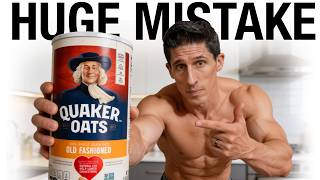
[00:51] gonna reveal to you next. Mistake number two was not realizing soon enough that not all oats were created equally. You see, because as a kid, it ate a lot of these. Thinking I was doing something healthy, except the problem with that is along with my two servings
[01:04] because one was never enough, came 28 grams of sugar. And if I look at the sugar in this, there's zero. And we know that when we're trying to build muscle, what we eat is going to dictate the results that we get.
[01:17] And loading your body up with sugar again, even at an early age is a big mistake. Know the difference. This here is about 10 grams shy of a can of soda. Not likely what you're looking for when you're trying to build muscle. So next we've got to mind was actually one
[01:29] that became fully apparent to me once I became a physical therapist. And that is undervaluing correctives in terms of their ability to help us build muscle. Because they seem like the little exercises, you know, the ones that you don't really wanna do.
[01:41] But the real power of corrective exercises, especially when you do them consistently, is that they plug those leaks, right? They fill in the gaps that allow the bigger muscles, the ones that get more of the attention
[01:53] to actually do their job better. So you can improve your strength if you do correctives. You can improve your aesthetics if you do correctives. Even just doing external rotation can actually improve the appearance of the chest by putting your shoulders back in a better posture.
[02:07] There's so many benefits that come from corrective exercises that elevates them to equal importance in your workouts. And again, I wish I paid more attention to it a lot earlier age, because I don't think I would have been broken down at the age I was either.
[02:19] These things will work and they'll work really well. Regret number four has to do with not knowing the value of the untrug when it comes to building a bigger chest. Now let's face it, I never had the greatest chest to still don't do this day,
[02:31] but I think a lot of it goes back to the fact that every single chest exercise I performed was dominated by a shrug during it. And what I'm telling you is, it's very easy to consciously get rid of that by simply untrugging your shoulders
[02:44] and being aware of that on every chest exercise. On a bench press, if you take your shoulders and you forcefully bring them down before you initiate the exercise, it does something very important. It puts the shoulders back
[02:56] and it puts the chest at the first line of defense. In other words, the chest will be the muscle that gets preferably recruited at the bottom of every single bench press, making it more productive for its gains. I could do this on a crossover
[03:08] and I could do this on a dip, literally on every single chest exercise, and the gains that you see because of the better recruitment that you get is noticeable and it's definitely something you wanna make so that you're not doing as well because if you are, it could be the very reason
[03:21] why you don't see the chest gains that you're after. By the way, when it comes to building big biceps, I think I've learned a few things along the way. As a matter of fact, I put together all of my greatest bicep training tips into something I call my biceps training blackbook.
[03:33] And I want you to have it. Head over to ATHLEANX.com slash blackbook. You can grab your copy completely for free. Again, my thank you to you. Now, let's get back to this video. The state number five was actually being much too rigid with how I ate and I paid the price for it.
[03:47] And it wasn't until actually even as late as my New York meds days, I became more flexible or slightly thereafter. We used to board the plane for, let's say, a 12-game road trip out west and be handed an envelope just like this
[04:00] with nothing but $100 bills and cash in it, which is part of our daily stipend as our meal money. Well, a lot of the guys actually just keep that money and add it to their salary at the end of the year. I would have pretty much nothing left over because I was spending mine
[04:13] on making sure I could eat a very particular way. So I'd go out to LA and I actually sit down in the restaurant. They would sell eggs for about 18 bucks or so for two eggs. And so can I just get some egg whites
[04:25] and they wanna know, well, how many do you like? I'm like, I usually eat six egg whites. They'd come back and build me $36 or even more $48 for the six egg whites and I would actually pay it because I was so obsessed with the idea
[04:38] that maybe not eating my egg whites in the morning would cost me either in terms of a percentage or two of body fat or not being able to look a certain way. So I became a lot less rigid and more flexible after when I actually started living at home
[04:51] and my wife opened up my horizons to other foods. And what happened, I actually got more muscle mass. I actually stayed just as lean and I think I'm much better off for it. So this next one's another one that's a little bit embarrassing because it reveals maybe how much I dislike
[05:05] the gym early on in my training, right? And it's certainly how I dislike the discomfort of training because I shied away from the discomfort of contraction when I probably should have been reveling in its ability to actually create muscle growth.
[05:18] So let me explain a little bit. When I talk about all the time moving away through space, I talk about not just lifting it up and down but actually contracting it through space. And with that is going to come likely a lot of discomfort,
[05:31] maybe even a feeling of cramping. And I discuss this on the Andrew Huberman podcast a few months back. That's actually a great thing. You should be seeking out a contraction discomfort, almost a cramping type feel
[05:43] because it helps to build my muscle connection. You can almost tell whether or not you've got a good ability to grow a muscle if you have that discomfort capability when you contract it. You have to be able to get that muscle
[05:56] to a point of discomfort and not shy away from it but revel in it even if it limits the number of repetitions that you can perform. The contraction is key in realizing this more quickly than I did is going to serve you well. I've shared some pretty big regrets so far
[06:09] but this might be one of my biggest of all time. And that is not realizing that the most important supplement that I could actually put in my body is right here, just regular water. And for so many years, I literally just used thirst
[06:22] as the determinant factor of whether or not I should be taking a drink. So what I do now and I've learned my lesson big time is I start my day every single day. I've covered this tip with you before with two bottles of water sitting right next to my sink in the morning.
[06:35] I have to chug them down first thing when I wake up. And the good news is it kind of kick starts a lot of good things happening but most importantly, it's at least providing my body with a jump star on the water that I'm gonna have to sustain for the rest of the day.
[06:47] And by doing it first thing, I do remember a lot more now and I don't just use thirst as my guide for whether or not I should be drinking. The idea here guys is that muscles are 70% water. If you think that you can walk around chronically dehydrated
[07:00] and get the most out of your muscular development, you're making a big mistake, don't make the same one I was. Mistake number eight was actually not honoring my natural sweet tooth because I grew up literally eating everything that you see on this table
[07:13] for breakfast. I was a total cereal guy. However, when I first started to get serious about what I was eating and I tried to support my efforts in the gym, I got rid of everything I possibly could that I thought might be a problem for me nutritionally.
[07:26] However, it wasn't really honoring that whole idea that I never really got rid of my sweet tooth even to this day. So what do I do? I make sure that even in my healthier approach to eating, I have ways to placate that sweet tooth that's still there.
[07:39] So I have my yogurt in the afternoon which don't judge is actually still give me a little bit of a treat, especially if I add some whipped cream on top. I have my frozen yogurt that I talk about every single night
[07:51] as somewhat of a treat for my sanity to kind of keep me on track. I even have my own protein shake every single day that tastes literally like a chocolate fudge brownie. The idea is without having some of these outlets
[08:03] to still keep me satisfied knowing that the sweet tooth will always be there, I wouldn't have been able to stay consistent with what I eat. And for me, that's the key being consistent has kept me the way I look and is allowing me to build muscle
[08:15] as I got older. Mistake number nine was actually a crucial oversight when it came to building muscle and that was forgetting about the eccentric's on pulling exercises specifically. And there's a big difference between push exercises
[08:27] and pulling exercises. We know that when we're doing a pushing exercise like a bench press, we don't forget the eccentric because we do it to protect ourselves. That weight could come crashing down on you. However, when it comes to pulling exercises
[08:39] the weight is almost always falling safely away from you. On a curl, it's just gonna drop away from my body. If I did a row, the weight's gonna drop away from my body. If I did a pull down, the weight's gonna just rise back up
[08:52] safely to the stack. So there is no threat of the weight and therefore there is no reminder for you to actually slow it down. And one of the main drivers of hypertrophy, one of the big three is eccentric overload.
[09:04] And by forgetting to slow down the eccentric and create that internal muscular damage that is a stimulus for new growth and repair it's a big mistake to make and one that you wanna make sure that you're not doing certainly something you can learn from me.
[09:16] Speaking of overload, when it comes to building muscle you're gonna wanna make sure that you're progressively adding load and it doesn't limit itself to just the weighted exercises. And I think one of the big mistakes I made a long time ago was not applying that
[09:29] to bodyweight exercises as well. You see what I would do is perform more repetitions of the same exercise. Really try to drive up the number of reps I could do rather than try to drive up the difficulty of the exercise variation I was using.
[09:42] Rather than continuing to just bang away at let's say a hundred pushups a day how about doing maybe 40 or 50 of a more difficult more overloading, challenging variation of the pushup? And that's where I think people
[09:54] just spend more of their time. And the same thing when it comes to pull ups. Instead of just trying to continue to increase rep after rep be satisfied with fewer reps if now you're handling more low with the addition of some weight.
[10:06] Remember calisthenic exercises are still exercises they're just utilizing a different form of resistance for getting to apply additional levels of resistance is going to hold you back. Mistake number 11 is one that I've been talking about
[10:18] for a long time and that is if you don't prepare you prepare to fail. And when it comes to having your meals ready and what you're gonna eat your nutrition has to be on point and it has to be consistent. So here's a couple of things I recommend that you do. Number one, have something available in bulk.
[10:33] So in terms of protein a big bag of frozen chicken here sweet potatoes, tons of them up here already in prepared containers. That was gotten from Stu Leonard's catering menu. I told you guys to utilize the catering menus
[10:45] of these places so we can buy them in bulk and not have to spend as much. But I take it kind of to the next step and that is if you can prepare the actual plate that you're gonna eat ahead of time for the week.
[10:58] Now there's nothing to be the same food but what I'm talking about is that the slightest slip up the slightest inconvenience where you don't feel like putting together even the stuff that's already in your freezer and put it on a plate and you reach for something else
[11:10] you could fall off of your plan and when you do there goes a consistency and all of a sudden now you're back on track to a bunch of bad meals. And so my next big regret was not realizing sooner that I actually was not the athlete that I thought I was.
[11:22] You see not all athletes are created equal and that means you probably shouldn't hydrate the same way. See I thought I was Michael Jordan and I grabbed Gatorade all too often as my sole source of replacing my lost electrolytes.
[11:34] The big problem is I wasn't running up and down the court sweating my balls off for two hours like Jordan was. I was performing maybe 30 sets of a chest workout with about three minutes of rest in between. It's not the same. So you didn't have to be replacing electrolytes at all.
[11:48] As a matter of fact, I should have just been drinking water. This was just a bunch of sugar and a big mistake. So number 13 turned out to actually be my lucky number because it's where I realized the value of the face pull.
[12:00] You see the face pull is something that again, might fall into that corrective exercise category that I've already told you about is not something you should be overlooking. But beyond that, it's not just a corrective exercise. It's a muscle building exercise.
[12:13] And one that's incredibly important for building up the muscles of the upper back and mid scap area that we just don't often train enough. And you can never get enough strength and development in these upper back muscles to counteract
[12:26] the postural demands and overuse that we get from a lot of our pushing exercises that we do. So believe it or not, when I was 13 years old, I actually accidentally ran into the value of the face pull because I had that five pound Marci dumbbell in mind
[12:39] that I just kind of moved around in all kinds of motions to try to feel like I was doing something at least respectable in the gym. It was the time that I actually leaned over and tried to pull it straight back that I realized how difficult but beneficial it was
[12:52] for my upper back. I guess that's where you could say the benefit of the face pull started for me. Of course, then I forgot all about it and never did it again for 20 years. Until I realized now how important it is as far as its role in training
[13:04] and it should be part of everybody's training routine, hopefully you won't forget about it after today. This next one's kind of a double regret because I mentioned already how I follow those body build routines to the point of actually breaking down my body.
[13:16] See, I've talked about before, the fact that I wasn't really blessed with the greatest of feet. No matter fact, these flippers here have set me up with some pretty chronic knee issues that I deal with even today. But doing those marathon workouts in that given state,
[13:29] realizing that every single set produced more pains than gains, well, I probably should have done something along the way to intervene, but I didn't because I felt that I should just keep doing what I was supposed to be doing. All those squats, all those leg extensions,
[13:42] I just kind of did what I was told to do. But back then, I didn't know any better and I don't know whether or not I should blame myself more for not respecting my own body's limitations or for continuing to do what I shouldn't have done in the first place.
[13:55] So this next one's one that I actually wished I learned a hell of a lot sooner and it wasn't until I gained my education as a physical therapist that I did. And it's trying to train through an injury rather than around an injury. And there's a big difference.
[14:08] And it was the appreciation that I got from understanding just how interrelated all these little muscles and bones are to each other and how we have options if we just know what to do. You see, for years, I mentioned earlier, that I had troubles with my knees
[14:20] and rather than bang away at the exercises that were just exacerbating the situation and making it worse, I could have redirected my attention to something that would have allowed me to let the body and tissues heal and still train and gain strength.
[14:33] I talk a lot about my torn labor room and how I actually learned in later years to be able to train around that. In other words, not stopping training all together but not continuing to do exercises that inflame the tendons that are already problematic.
[14:47] So when I did my chest training, exercises that would light me up every single time like a bench press were replaced with a simple crossover. And no, it wasn't an ideal situation, but it was one that allowed me to continue to train
[14:59] where there was lots of pain before. And continue, most importantly, to stimulate the muscle and make gains until it was able to actually properly heal. And then I could get back into doing the bench press. Having a smarter approach and being willing to zig and zag
[15:13] but still train is a really important weapon to have in your arsenal and the sooner you realize that you wanna work with your body rather than against it, the more uninterrupted your gains can be. And on number 16, we have to talk about
[15:25] the most important training variable of them all. Or at least the one that we almost always forget. And that's the manipulation of time because time can be literally the great equalizer. If you forget to manipulate time in favor of things like reps, sets, and exercises,
[15:39] well, you can be making a giant mistake because time can dramatically increase the intensity of your effort. I have a no greater example of this than one time when my sister told me, hey, listen, we're going to church and we're leaving in 15 minutes.
[15:51] And I knew I couldn't afford to miss yet another workout. So I did exactly what I would normally do in 45 minutes to an hour in 14 minutes. And the amount of work that I was forced to do in that condensed period of time served to increase the intensity to a level I'd never experienced
[16:05] before but it planted a seed that would later on become a very important part of my training. And even the amount of time that you rest in between sets. If you decrease that rest to the perfect amount of time, you can get more out of your workouts
[16:17] because you keep that intensity high from set to set. It's actually part of our effective reps strategy that I've shared with you here before. If you want to actually try something that will show you firsthand what this feels like, make sure you check out the 100 chest workout guys.
[16:29] I promise you, it's a different experience and I want you to give it a try. If you haven't already, make sure you click subscribe, turn on notifications so you never miss a video. And also if you're looking for full programs guys, we have them at ATHLEANX.COM. I hope you found the video helpful. Tell me what other things that you are dealing with
[16:42] that maybe I didn't cover here. I'd love to hear them down below. See you soon.
⚡ Saved you 0h 16m reading this? Transcribe any YouTube video for free — no signup needed.