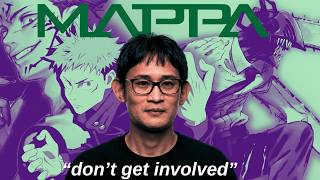
MAPPA’s 72-Hour Shifts & NDA Silence
38sReveals shocking working conditions like 72-hour shifts and forced NDAs that spark outrage.
▶ Play ClipThe video examines the systemic labor crisis at MAPPA, a studio that produces globally celebrated anime like Jujutsu Kaisen and Attack on Titan while subjecting its animators to extreme overwork, low pay, and NDAs. It traces the studio's transformation from a boutique creator to a high-volume juggernaut, revealing how business models—including self-funding and a Netflix deal—fail to address the root causes of exploitation.
MAPPA has produced three of the biggest anime of the last decade, yet one of its own directors worked 72 hours straight without going home, and animators were paid a quarter of fair value per cut. When complaints went public, the studio responded by making staff sign NDAs.
Founded in 2011 by Masao Maruyama (co-founder of Madhouse), MAPPA initially focused on quality over volume with films like Terror in Resonance. After Maruyama stepped down in 2016, CEO Manabu Otsuka shifted the studio toward scale, stacking multiple massive projects simultaneously.
Animator Hisashi Aguchi publicly called out low pay. Animator Mushi Yo described overnight sessions and pointed out MAPPA was producing four concurrent series. Animator Ipe Ichi revealed MAPPA offered ¥3,800 per cut on Netflix's Yasuke (fair value ¥15,000). MAPPA's response was to deny the claims and push back on the whistleblower.
Episode director Teruyuki Omine tweeted he hadn't been home for three days (72 consecutive hours). Sakuga blogger Kevin Sidogea attributed problems to MAPPA's recklessness—growth exceeding infrastructure.
Over a dozen animators reported understaffing, chronic overtime, impossible deadlines, episodes finished hours before airing, and MAPPA allegedly making animators sign NDAs. Animator Hone Hone revealed the JJK Zero film was completed in just four months. Episode 17 (celebrated as a masterpiece) was only 30% of the intended vision.
Under Otsuka, MAPPA funded 100% of Chainsaw Man production to own all rights, aiming for more control and reinvestment. But the result was tighter deadlines, higher stakes, and no improvement in per-cut rates for animators.
In March 2024, MAPPA announced Zenshu (meaning 'redo everything'), an anime about an overworked animator transported into a fantasy world, coinciding with public exposés of working conditions. The backlash was intense, with fans calling it 'exploit your employees: the anime'.
In January 2026, MAPPA and Netflix announced a strategic partnership for co-production, global streaming, and joint merchandising. Otsuka framed it as independence with Netflix's infrastructure. MAPPA also hired an outside director and acknowledged production challenges, but the question remains whether structural change will reach animators.
MAPPA's journey shows that business models (flat fees, self-funding, platform deals) change the shape of the studio but keep incentives the same. The people at the bottom keep drawing until sunrise. The question is whether anyone will be left willing to draw.
MAPPA exemplifies a systemic crisis in anime: studios can create masterpieces while grinding their workforce into exhaustion, and every 'solution'—self-funding, platform deals—so far has failed to rewrite the incentives that exploit animators. Real change requires enforceable minimum rates and structural oversight, not just better PR or funding models.
"The title accurately promises an exposé on MAPPA's labor issues and delivers detailed, evidence-heavy content—but slightly over-promises by implying a completely 'ugly truth' that might surprise already-informed fans; still, the substance is well matched."
Masao Maruyama
person
Manabu Otsuka
person
Hisashi Aguchi
person
Mushi Yo
person
Ipe Ichi
person
Teruyuki Omine
person
Kevin Sidogea
person
Itzuki Tsuchigami
person
Hone Hone
person
Vincent Chansard
person
Haku Yugo
person
Enrico Nobili
person
Jujutsu Gawara
person
Makoro Kimura
person
Shunzuke Okubo
person
Yui-Chi Fukushima
person
Hiroya Hasegawa
person
Netflix
service
What was the pay per cut offered by MAPPA on the Netflix show Yasuke?
¥3,800 per cut, while the perceived fair value was ¥15,000 per cut.
03:17
How many consecutive hours did episode director Teruyuki Omine work at MAPPA?
72 hours (three days straight).
04:07
What percentage of the intended vision was episode 17 of Jujutsu Kaisen Season 2, according to animator Enrico Nobili?
Only 30%.
05:46
Who founded MAPPA in 2011 and what was his background?
Masao Maruyama, co-founder of Madhouse, at the age of 70.
01:33
What was MAPPA's response to public complaints about low pay and working conditions?
It made staff sign NDAs and denied offering unreasonable compensation, pushing back on the whistleblower rather than addressing labor issues.
00:50
What was the title of MAPPA's 2024 anime that critics saw as tone-deaf, and what does the title mean?
Zen shu, literally translating to 'redo everything'—the phrase a director would shout at an exhausted animator.
08:08
Name the producer who helped secure Chainsaw Man's funding and left MAPPA in early 2024.
Makoro Kimura.
07:43
What structural change did MAPPA make in April 2025 to address internal governance?
It hired Yui-Chi Fukushima from Cloverworks as an outside director, a role designed to audit internal problems without executive pressure.
10:53
Masterpieces and meltdowns
Establishes the core paradox of MAPPA: producing industry-defining anime while grinding workers into exhaustion.
From boutique to juggernaut
Documents the pivotal leadership change that turned a quality-focused studio into a volume-driven machine.
01:33Episode 17: only 30% of vision
Reveals that even the most celebrated episodes are compromised, showing the creative cost of the system.
05:46Zenshu: exploit your employees, the anime
Highlights a PR disaster that crystallized public perception of MAPPA's tone-deafness.
08:08Netflix deal: guaranteed money enters, but will it reach animators?
Poses the critical question: whether funding models can actually change labor conditions or just provide better cover.
10:02[00:00] Never again. Okay, so you can tell us why? I don't want to support my support as a worker, as a worker, as a society that doesn't have as much
[00:12] ideologically, I'm not talking about people, I'm just talking about the ideology of the voice, and we don't have as much as the workers' conditions. Mapa animated due to Kaisen, Chainsaw Man, and the final season of Attack on Titan,
[00:26] three of the biggest anime of the last decade, and in the middle of that run, one of its own directors worked 72 hours straight without going home. Animators were paid a quarter of fair value per cut.
[00:38] When the complaints went public, Mapa's response wasn't to fix conditions, it was to make its staff sign NDAs. This is a studio that produces masterpieces and meltdowns at the same rate.
[00:50] We watched the finished product and call it peak. The people who drew it call it a nightmare. And the truth about how that's possible, how a studio can sit at the top of the industry and still grind its people into dust,
[01:03] is something most fans have never actually been told, because the problem isn't just one studio. It's a system, and Mapa is a studio that proved it. Mapa started as the opposite of what it is now,
[01:33] founded in 2011 by Masao Maruyama, co-founder of Madhouse at the age of 70, the studio existed to make one film, early work like Terror in Resonance and Yuri on Ice built a reputation for quality over volume.
[01:47] Small team, real creative identity. Then in 2016, Maruyama stepped down and handed the studio to CEO Manabu Otsuka. That's when the studio's DNA changed. Under Otsuka, Mapa stopped being boutique
[02:01] and started chasing scale, stacking attack on Titan, Jujutsu Kaizen, and chainsaw man on top of each other. Production schedules overlapping, each one bigger than the last, and scale without infrastructure doesn't create growth.
[02:15] It creates pressure, pressure that compounds every season, every deadline, every overnight session. The cracks got impossible to hide, and eventually, the people absorbing that pressure stopped keeping quiet.
[02:41] The first cracks surfaced quietly. Veteran animator Hisashi Aguchi publicly called out Mapa's low pay. Mushi Yo, an animator who actually worked at the studio, described the culture of overnight sessions,
[02:53] drawing until sunrise to fix work that should never have been assigned without proper training in the first place. Mushi Yo also pointed out that Mapa was producing four series concurrently, spreading its staff and possibly thin.
[03:05] They eventually quit, but at the time, almost nobody outside the industry noticed. That was about to change. Then it got louder. In 2021, animator Ipe Ichi revealed that Mapa had offered
[03:17] just 3,800 yen per cut on a Netflix show called Yasuke. The minimum, according to Ichi, should be 15,000 yen. That's roughly a quarter of fair value. And according to Ichi, Mapa hadn't just underpaid,
[03:30] the studio had deliberately undersold its services to Netflix to land high on the market. This is to Netflix to land high profile projects, accepting smaller budgets that meant even smaller pay
[03:42] for the people doing the actual work. When this went public, Mapa's response was to deny offering unreasonable compensation and push back on the whistleblower. Not the claims, the person who made them.
[03:54] The studio treated the problem like a PR issue, not a labor one. A year later, Teruyuki Omine, episode director on attack on Titan, the final season part two, tweeted that he hadn't been able to go home for three days,
[04:07] 72 consecutive hours at the studio. Sakuga blogs Kevin Sidogea, attributed the growing problems to what he called Mapa's recklessness. A studio growing faster than its infrastructure could support.
[04:19] Taking on prestige projects, it didn't have the pipeline to deliver without crushing its staff. Stay with me here, because this is where it all broke open. In late 2023, Jujutsu Kaisen Season 2 triggered a full-scale meltdown.
[04:32] Over a dozen animators took to social media to describe what was happening behind the scenes, under staffing, chronic over time, and possible deadlines, episodes being finished hours before they aired.
[04:44] Then came the part that turned criticism into outrage. Mapa had allegedly made its animators sign NDAs about the working conditions. Itzuki Tsuchigami, who'd worked on chainsaw man and mob cycle 100,
[04:56] confirmed the NDA and warned artists to stay away entirely. Anonymous animators fired back. One wrote, instead of making people write a pledge to avoid complaining, could you please create an environment
[05:08] where they won't want to complain? Another, I have nothing to lose, so if you're going to sue me for complaining, I'll take it. Animator Hone Hone revealed that the Jujutsu Kaisen Zero film was completed in just four months.
[05:21] Vincent Chansard, a key animator on JJK Season 2's episode 17, later set on stream that he doesn't want to support a company that ideologically doesn't care about working conditions.
[05:33] Haku Yugo, the director who convinced Chansard to come back for that episode, doesn't want to work for Mapa anymore either. And here's what makes that hit different. Animator Enrico Nobili revealed that episode 17,
[05:46] the one fans called a masterpiece, was only 30% of what the team originally intended. The episode we celebrated was a skeleton of the vision Mapa scheduled destroyed. And Jujutsu Gawara, founder of Animator Supporters,
[05:59] put it more bluntly than anyone. Regarding Mapa, he said, there's a rule that you're not supposed to talk about it. So Mapa had a choice, keep playing the old game, or try owning the whole thing.
[06:26] In the traditional anime model, studios get a flat fee
[06:38] while outside companies keep the real money, streaming, merch, licensing. Otsuka wanted out. For a chainsaw man, Mapa funded 100% of production, no outside investors, no committee,
[06:52] full ownership of everything. Otsuka said the decision was based less on confidence and more on the team's determination. He called chainsaw man the embodiment of why he chose to work in animation,
[07:04] more control, more upside, and theoretically more money to reinvest in the people making it. The bet half worked. Chainsaw man became a global streaming hit. The Res Arc movie crossed $160 million worldwide.
[07:19] The manga surpassed 35 million copies in circulation, but season one underperformed in Blu-ray sales, and Otsuka admitted publicly, it didn't match Jujutsu Kaisen's impact.
[07:31] Mapa wanted full control, but it wasn't built to carry everything that came with it. An ownership didn't change who absorbed the pressure, more risk just meant tighter deadlines, higher stakes,
[07:43] and the same per cut rates for the animators at the bottom. Makoro Kimura, the producer who helped secure chainsaw man's funding and manage its right strategy, left an early 2024 to found his own company.
[07:56] His departure was amicable, but Mapa lost one of the few people who'd actually navigated the business side of going solo. That's when this stopped being a success story and started looking like a warning sign.
[08:08] And then in the middle of all this scrutiny, Mapa announced a project that made the entire internet think the studio was trolling. Natsuko-chan was looking at horror-be-yukumono-gata-ri
[08:22] and looked like something had changed. I'll be a professor. In March 2024, Mapa revealed Zenshu, an anime original about an overworked animator
[08:34] who collapses from exhaustion and gets transported into a fantasy world. The title literally translates to redo everything, the exact phrase a director would shout at an exhausted animator pulling an all-nighter.
[08:46] Given everything that had just gone public about Mapa's working conditions, the timing couldn't have been worse. The backlash was merciless. Fans called it exploit your employees, the anime.
[08:58] One post went viral. Mapa making an anime about working on anime so that when you look up Mapa working conditions, this show comes up instead. Another, Mapa said to animators, you can't speak about your struggle on social media.
[09:11] You can speak through our new anime. Now go animate the damn thing. The criticism wasn't just from fans. Shunzuke Okubo, a JJK season two episode director who'd been vocal about conditions at the studio,
[09:24] blocked Zenshu's promotional account. Not a random viewer, a director who lived through the worst of it and wanted nothing to do with the show's premise. Zenshu aired in January 2025, got buried under solo leveling
[09:38] and Sakamoto days and was largely ignored. But the reputational damage was already done. Mapa had become the punchline for the exact conditions it kept promising to address. A studio so tone-deaf
[09:50] that it turned its own animator's suffering into content. Which brings us to the real question. If self-funding didn't fix the problem, does a giant platform deal actually change anything?
[10:02] In January 2026, Mapa and Netflix announced a strategic partnership. Co-production from the development stage,
[10:14] exclusive global streaming across over 190 countries, joint merchandising. Sources confirmed to the Hollywood reporter that the deal operates entirely outside the traditional production system.
[10:26] For Mapa, this is guaranteed money up front. No gambling on Blu-ray sales, no absorbing all the risk alone. Otsuka framed it as the realization of Mapa's core belief, independence on both creative and business fronts,
[10:40] now backed by Netflix's global infrastructure. The studio has also made internal moves that suggest the pressure is finally being taken seriously at the top. In April 2025, Mapa hired Yui-Chi Fukushima
[10:53] from Cloverworks as an outside director, a governance role, specifically designed to audit internal problems without executive pressure. Vice-president Hiroya Hasegawa publicly acknowledged
[11:05] the studio's production challenges for the first time, saying it's important that companies don't leave it up to individuals to maintain work-life balance. Those are new words from a studio that spent years denying there was a problem at all.
[11:18] Whether they lead to real change or just better messaging is what the next few years will answer. But Netflix guarantees budgets to Mapa the company, not to the freelancers drawing at three in the morning. More money enters the studio.
[11:31] The question is whether it reaches the people whose hands actually make the work. Without enforceable minimum rates and real structural oversight, new money follows old patterns. So either this deal is the beginning
[11:44] of real change at Mapa or it's just better cover for the same problem. Never again.
[11:57] Mapa isn't the only studio trapped in this cycle, but it may be the clearest proof that the cycle exists. Flaffies, self-funding, platform deals, three different models,
[12:22] and in every version, the business changes shape while the incentives stay exactly the same. The people at the top find new ways to stabilize the studio, the people at the bottom keep drawing until sunrise. The question was never whether Mapa
[12:35] could make incredible anime. It always could. The question is whether anyone will be left willing to draw it. We're covering the system behind all of this next. The production committee model that controls how every anime gets funded,
[12:49] who actually profits and where the money disappears before it ever reaches the people drawing. Subscribe so you don't miss it and drop in the comments. Should studios own their anime or does going independent just create a different trap?
[13:03] Because from what we've seen with Mapa, there might not be a clean answer.
⚡ Saved you 0h 13m reading this? Transcribe any YouTube video for free — no signup needed.