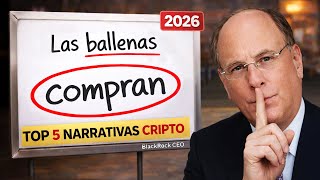

BlackRock's 2026 Crypto Bet
45sReveals which crypto assets the world's largest asset managers are backing for 2026, sparking curiosity and FOMO.
▶ Play Clip"Title promises an institutional tier list for 2026, and the video delivers exactly that with specific rankings and backing evidence."
This video presents a tier list of crypto narratives for 2026, based on institutional backing from BlackRock, JP Morgan, Bitwise, and others. It ranks narratives from 'broken models' like play-to-earn and meme coins to 'S-tier' narratives like real-world asset tokenization and stablecoins, emphasizing where big money is flowing.
BlackRock, JP Morgan, Morgan Stanley, and Bitwise have already decided where they want to be in 2026, building infrastructure and regulations for crypto adoption.
Stablecoins are seen as the structural financial foundation for the global economy, enabling instant 24/7 transfers and displacing slow traditional banking.
Clear legal standards like MiCA, GENIUS, and Clarity remove legal fear for large custodians and banks, allowing them to operate openly.
Play-to-earn economic models collapsed because games prioritized earning over fun. Good games exist but are pivoting to Web 2 to attract users.
Meme coins lack utility and are facing market fatigue as retail shifts to assets with real value. Pump.fun diluted capital into many tokens.
Staking narrative exhausted due to complexity and diminishing returns. Slashing risk remains a critical concern for large amounts.
Too many blockchains with few users; value shifting from infrastructure to successful applications. Liquidity fragmentation is a key risk.
Tokenized physical infrastructure faces regulatory and logistical barriers, hindering growth compared to pure software.
SocialFi platforms fail to retain users once easy money disappears; no successful SocialFi network has emerged yet.
NFTs need to evolve beyond JPGs to real utility like loyalty programs. Adoption is slow but technology remains valuable.
Modular blockchains are fascinating for developers but irrelevant to users who prefer established networks with high activity.
Decentralized finance with simple interfaces like banking apps will bring the next wave of users via account abstraction.
Oracles, nodes, and bridges like Chainlink are becoming industry standards. Low margins but essential for blockchain function.
Digital passports to prove humanity are critical in an AI-filled world. BlackRock emphasizes identity for mainstream adoption.
Using Bitcoin as collateral or to generate returns unlocks trillions in dormant BTC. Backed by BlackRock, Bitwise, and Vanguard.
ZK proofs enable banks to operate on-chain without exposing private data. Essential for institutional entry.
Autonomous AI agents using blockchain for machine-to-machine payments. Crypto becomes the financial system for AI.
Web 2 giants like Amazon could launch tokens for loyalty programs, driving mass adoption. Antitrust risks exist.
Digital twins of bonds, stocks, real estate on blockchain. BlackRock CEO says we are at the beginning of tokenizing every asset.
Stablecoins are the default rails for global trade and remittances, surpassing traditional transfers in efficiency.
Platforms like Polymarket generate precise probabilities for events. BlackRock recognizes them as social barometers.
Decentralized perpetual futures trading volume is catching up to centralized exchanges. Most reliable revenue engine in crypto.
High-speed blockchains like Solana settle instant business payments at near-zero cost. Invisible institutional adoption.
50% of narratives are backed by at least two major institutions. Institutional capital concentrates on stable liquidity infrastructure.
Institutional capital for 2026 is massively concentrated in stablecoins, tokenization, BTCFi, infrastructure, and prediction markets. Retail seeks the next percent, while institutions seek the next global standard.
What are stablecoins and why are they important for 2026?
Stablecoins are digital currencies pegged to the dollar or euro, eliminating volatility while maintaining speed. They are becoming the default rails for global trade, remittances, and neobanks.
23:56
Which tier includes play-to-earn and meme coins?
Tier D: Broken or fatigued models.
03:13
What is the critical risk of staking and restaking?
Slashing: the network can confiscate locked capital if the validator fails or acts maliciously.
07:01
Why are L1/L2 chains considered saturated?
Too many blockchains with few users; value is shifting from infrastructure to successful applications. Liquidity fragmentation is a key risk.
07:39
What is the main barrier for Physical DePIN?
Local regulations and logistics hinder growth compared to pure software; physical entry is a limiting barrier.
09:08
What is the key to SocialFi success according to the video?
Retaining users based on social value of the product, not just easy money.
10:03
What is BTCFi?
Systems that allow using Bitcoin to generate returns, interest, or as collateral in DeFi instead of just holding it.
16:42
Why is privacy and compliance important for institutional entry?
Banks cannot operate on-chain if transactions are public because it would expose customer data and strategies. ZK proofs enable verifiable privacy.
18:04
What is the 'machine-to-machine economy'?
Autonomous AI agents using blockchain to pay each other for resources without human intervention. Crypto becomes the financial system of AI.
19:12
Name three S-tier narratives for 2026 according to the video.
Tokenization of real-world assets, stablecoins, prediction markets, perpetuals (perps), and PayFi payments.
22:21
What is the critical risk of tokenization of real-world assets?
Real liquidity and legal issues; not all tokenized assets will have sufficient liquidity.
23:31
What is the main risk of prediction markets?
Regulation against gambling and potential inside trading or manipulation.
25:19
What is PayFi?
Use of high-speed blockchains like Solana to settle instant business payments at near-zero cost.
26:55
Stablecoins as Structural Foundation
Bitwise and BlackRock both consider stablecoins the financial foundation for the global economy, signaling massive institutional belief.
01:02Tokenization of Everything
BlackRock CEO Larry Fink claims we are at the beginning of tokenizing every asset, a transformative statement from the world's largest asset manager.
22:35BTCFi Unlocks Trillions
Converting dormant BTC into productive capital is described as the greatest opportunity to unlock liquidity today.
16:28AI Agents as Financial System
Crypto becoming the native money for machine-to-machine payments is a paradigm shift for autonomous economies.
18:58Institutional Consensus
50% of narratives are backed by at least two major institutions, showing clear capital concentration.
27:37[00:01] Bitcoin right now, BlackRock, GP Morgan, Morgan Stanley, and Bidwise—people who manage trillions of dollars—have already decided where they want to be in 2026. And let me tell you straight, it's not what you think. Today I'm showing you the definitive institutional tier list
[00:18] . Five narratives that will benefit the most when big money starts coming in because institutions are already building the infrastructure and regulations to make this happen. Let's get to the video.
[00:33] ramble on because I don't want to waste anyone's time, but in addition to this tier list we're also going to see an executive report with super relevant data that you ca conclusion from this video. So, before we begin, why should we really
[00:48] before we begin, why should we really information, we have the stablecoin rail, meaning that we no longer understand stablecoins as a small part of the
[01:02] economy, but rather that in the long term we are going to have a very high adoption rate. So in this case, BlackRock, as you can see, Larry Fish, the CEO, tells us that he sees a future where it wo n't be necessary to leave the wallet to
[01:14] allocate between assets. On the one hand, Bitwise, one of the world's most recognized financial entities, also says that they consider stablecoins to be the structural financial foundation for the global economy. For those of you
[01:27] who don't know what stablecoins are, they are basically stable currencies like more regulated), and many more that I wo n't mention right now. They are as if they were instant 24/7 transfers. And why 2026?
[01:43] because they are becoming the basic infrastructure for payments, remittances, trading and treasuries, displacing slow traditional banking . But there is a critical risk, and in this case a concentration of issuers
[01:56] and dependence on specific legal frameworks , but we will see this as we go looks quite good. So, let's move on to the next important point about cryptocurrency adoption in 2026: crypto regulation. What does this tell us?
[02:09] In this case, BlackRock comments that regulatory compliance and digital identity are key to enabling institutions. So, what is crypto regulation? What are we
[02:21] focusing on? Well, the next thing is that legal standards such as Mica, Genius and Clarity clearly define what digital assets are and how they can be used. And why 2026? Because with clear rules,
[02:34] the legal fear of large custodians and global banks is unlocked, thus allowing them to operate openly. But there is also a critical risk; everything has risks. And in this case, suffocating regulation that hinders
[02:46] decentralization or expels innovation. But personally, regulated market that allows more money in despite losing some innovation. It's just a formality that we have to accept. So let's get on with the tier list. I
[02:59] have categorized it in ST tier, which would be real adoption and massive flow. We would have tier A, which would be high potential and convergence. We would have tier B, which would be infrastructure and niches. Then tier C, which would be stagnant or
[03:13] complicated. And finally tier D, which is where we're going to start, which would be broken or fatigued models. Let's start with the tier, since it's important to know which ones won't work in 2026 and which ones will.
[03:26] integrated with blockchain, where assets like swords, kins, and coins can be earned and sold for real money. Why was making money prioritized over having fun in 2026? The play-to-ware concept that many of you are familiar with. The
[03:41] economic model collapsed, and above all, the most important thing is that games must be fun first and foremost, especially to attract the attention of people who are on Web 2 and get them to move to Web 3. That's what I have seen, okay? In this
[03:54] is a broken economy, but there are good games, there are good games that have been that right now is not the time to invest in the token, but I have seen big movements of web 3 games that have mutated to web 2 in the Apple Store and Play
[04:09] Store and in this way they are opening up to a new audience. Yes, they have been they are opening up to a large audience and this can attract new investors, more players and ultimately more revenue. This will surely be a goldmine for making money when
[04:23] Gamef's adoption reaches a player base and a Web 3 model is already established, but there is still quite a way to go and that is why we have placed it in broken models. Then
[04:35] we also have meme coins, which in this case I've labeled as fatigue. are basically cryptocurrencies based on jokes, memes, and internet culture, without any technological utility or serious fundamental backing. Why is market fatigue setting in for 2026? Why are
[04:49] serious fundamental backing. Why is market fatigue setting in for 2026? Why are to scams and seeking assets with real value? Critical risk, loss of retail interest. And that's the reality. We've seen how Panam Fan has truly been a
[05:02] crypto ecosystem, but I think it has taken more than it has given, since in the end people have used Panam Fan simply to gamble, create token after token after token, and all the money has really been
[05:16] diluted into a huge number of tokens. We haven't seen any companies with success stories; everything has really become quite blurry because of Memecoins. I think it's something regulated market will actually slow down the massive creation of BM
[05:30] continue because in the end it is inevitable that they can exist and coexist with a regulated market, but it is also true that we have to stop this position myself outside of MB Coins, and have been for quite a few
[05:43] months now. So, let's start with tier C. Here we have staking and restaking. I've labeled it "overhype" because there's always been a lot of talk about staking and the fantastic rewards it offers
[05:56] , but you really have to take everything with a grain of salt because there's always fine print. So, in this case, regarding staking, it is true that Bitwise is supporting this narrative. It is the only entity that
[06:08] is backing it and says it is committed to products with institutional staking such as really goes in that direction. So, staking is basically locking up crypto assets to secure a
[06:20] network in exchange for passive interest returns, sometimes reusing the same capital, which in this case would be restaking. And why in 2026? Because the narrative became exhausted due to excessive complexity and
[06:33] recurring returns. It remains vital, but it is no longer the focus of explosive growth. In other words, there are many people who are no longer like before, when you could really Many people have already gone through this process, and at most, they're staking
[06:46] new assets, since that's when all the marketing is happening and where there's really stablecoins, because before having it in a bank, it's better to have it in a where they can give you a better return than just 0% annual interest.
[07:01] But we have a critical risk, and that is slashing. Slashing is the risk that the network will confiscate or remove part of your locked capital if the validator suffers technical failures or acts maliciously in the proof of stake consensus. We
[07:14] 've already seen many protocols that have been hacked or have had some kind of security problem, and in the end, slashing is when you can't do anything because it's a decentralized protocol; you've lost your money, and
[07:26] in this case, you can't risk large amounts on fi protocols that are often anonymous; you have to be very careful with them. So let's move on to the next one, which is L1 L2 chains, K1 or K2 blockchains. And in
[07:39] this case, I see that everything is already very, very saturated. We see many blockchains, all of them really offering unique, true that in the end, even if you have a
[07:52] spectacular restaurant, if you don't have customers, it's useless. Better a McDonald's because it makes much more money, and in this case it could be a similarity to what we because in this case it is true that it is a narrative that is backed by
[08:04] Bitwise and Vangward. Blockchains, as you know, are like the highways on which data and money travel. It includes L1 layers and also L2 speed layers, such as Ethereum, which would be the main one. But
[08:18] then we would have in this case Matic Arbitrum, which offers faster transaction speed and lower costs . And why isn't it a big bet in 2026? Because there are too many roads and too few cars. Value is
[08:30] shifting from infrastructure to successful applications that people use. The critical risk is that there is a fragmentation of liquidity; that is, there are large blockchains, the ones that everyone uses, but then among
[08:43] the small ones they practically have no volume. So, if there is no exist, which is not at the very top, is divided among the small ones and in the I believe there is a lot of diversification in blockchains, and many of them are
[08:56] stagnant and are simply ways for large investors to put money in with big promises, multiply their capital, and then abandon the blockchain because there is no community. Physical depin, struggle. What does this mean? Well,
[09:08] networks that use tokenized incentives to build real physical infrastructure . Examples include car cameras, dashcams, solar panels, cloud storage, shared storage, and Wi-Fi antennas. Why in 2026? Because deploying
[09:23] local regulations and logistics hinder its growth compared to pure software, which faces critical physical barriers to entry. It's great that you share the energy with other people , that you can receive tokens, it's all
[09:38] very cool. But it is true that, I repeat, the physical entrance is ultimately a rather limiting barrier to access , since it's not a simple process, but rather there is a bureaucratic process until you finally end up obtaining
[09:50] these tokenized incentives. Let's continue with Social F, in this case the low retention label. Social Fi is a decentralized system where every interaction, whether a like, a post, or a follow, has
[10:03] an economic value or tokenized cost. Why in 2026? Because people leave when easy money disappears. They have not yet solved the problem of retaining users solely based on the social value of the product. And it's a reality. It's
[10:17] great that you have in mind a social network like Twitter, like X currently, that simply distributes money among all the people who participate in the network, and the money from advertisers is
[10:29] distributed equitably. It's very good, but it's something that hasn't haven't seen any Social F social network that has succeeded, at least not yet . Therefore, the critical risk would be the lack of user retention. In
[10:42] fact, we already had Freentech here at one point, which seemed like it was going to be crazy to have keys to access private chats like OnlyFans, but in the end it didn't succeed. NFTs, Crisis, still backed by BlackRock and
[10:54] Bitwise. In fact, BlackRock is talking about tokenizing alternative collectibles, not JPGs. Like Bitwise, it also discusses Web 3 infrastructure. Basically, it's an investment alternative, though it has
[11:08] n't quite taken off yet. However, if it's given a practical gym or football club memberships , offering certain privileges based on spending, it effectively gamifies the community.
[11:22] already implemented this model, where spending more points earned points for discounts, gifts, unique experiences, or raffles. So, the technology has remained, but the speculative aspect has faded, leaving us with
[11:35] the reality of NFTs. It's a very good technology, but adoption is slow because there's no real need yet. But over time, we'll likely see it integrated into Web 2 applications without
[11:47] people even realizing they're buying or receiving an NFT. NFTs are unique digital property certificates registered on the blockchain, used for art, tickets, and game items. or identity. And why did
[12:00] the expensive JPG bubble burst in 2026 ? They need to evolve towards real utilities such as revenue, loyalty to be reborn and critical risk because it would be the bubble of the past that can leave that stain on the record. And
[12:14] we conclude the TRC with modularity. Modularity, what would that be? Well, build blockchains in specialized pieces, one layer for data, another for execution instead of a single monolithic piece. Because in 2026 it's fascinating for
[12:28] developers, but it's relevant for users and investors who are looking for useful applications and not internal architecture. Basically, the risk for those who don't know what
[12:40] know quite a bit about crypto, but there are many terms that still escape me, and I many times, but if you want to understand it, here I have basically given an example that I think is perfectly clear . The issue is that right now the
[12:54] technological aspect of modular blockchain projects is very good, but it is true that we end up with the same input, which is that it's no use technology if ultimately nobody is using it. People would prefer to pay a
[13:08] little more for gas, they would prefer the transaction to be slower, for everything to be less scalable, but if everyone is at that party, I prefer to go to that even if I pay more, than to go to a party where I can be alone, with better
[13:22] music, with better prices. Let's go for tier B, infrastructure and niches. Let's start with DeFi Consumer, backed by BlackRock and also by Bitwise. And what would that be? Decentralized finance with interfaces as simple as a
[13:35] banking app like Robing Hood Revolute, hiding the technical complexity because in 2026 the private keys. Account abstraction will bring the next massive wave of
[13:47] users and the critical risk of a lack of centralized support. apps within the Apple Store, thanks likely to upcoming regulations and crypto adoption, where people won't understand that they're
[14:00] NFTs, using staking, restaking, or any other through very discreet user interfaces that anyone can use. Let's continue with infrastructure that is backed by
[14:15] BlackRock, Bitwise and JP Morgan and refers to the technical foundations, oracles, nodes, bridges that allow blockchain applications to function, obtain data and communicate. And why in 2026? Although it
[14:28] is a saturated market, winners like Chainlink are establishing themselves as irreplaceable industry standards. In this case, the critical risk is that there are low margins. It's a reality. I don't think Chelling is getting
[14:41] rich either, but the point is that a lot of infrastructure is going to be built in the future and it doesn't necessarily have to be from startups that Some yes, some no, but nowadays there is a lot of innovation;
[14:55] the startup model has become somewhat democratized. Anyone can develop an infrastructure and eventually attract large investors once you've discovered it. It's like the case of Polyarket, which when it was launched
[15:08] everyone wants to invest in Polyarket and they don't have a token. Therefore, following developing an interesting, intelligent, and innovative infrastructure returns on the tokens that these projects may
[15:24] launch. And we finished the TRB with identity dit antisívil. And this point is really interesting, since BlackRock is supporting it quite a bit. In fact, he emphasizes in various articles that resolving identity is imperative
[15:36] for the mainstream. What does this mean? Well, digital passports that prove you're a unique human and not an artificial intelligence bot without needing to give all your data access to a corporation. And why 2026? Because
[15:49] in a world flooded with AI-generated content, verifying humanity will be the scarcest and most valuable resource on the internet. But the critical risk is that there could be excessive surveillance, both for the
[16:01] companies that develop these types of applications and for the narrative in general. Perhaps people don't want to give certain data, such as personal or biometric information, to large companies to log in to different platforms.
[16:14] artificial intelligence is integrated into our daily lives, it may indeed be necessary for these types of applications and platforms to coexist on our side and not against us. Let's continue because we're already going to tier A, high potential for
[16:28] enjoying the video, please leave a like, it helps a lot. BTCF macro is backed by BlackRock, Bitwise, and Vanguard. BlackRock is very up to date on Bitcoin. In many articles he has commented on the phrase "protection
[16:42] against the US deficit" and Bitwise's main institutional reserve asset . What does BTCFI mean? Systems that allow you to use Bitcoin to generate returns, interest, or as collateral in DeFi, instead of just
[16:57] keeping it stored. We are already seeing many people who are not willing to sell their Bitcoin, but are willing to lend it out in exchange for a true that it is something that we are not seeing completely because there is a lack of regulation and above
[17:11] all people do not trust DeFi protocols. It's not smart to leave Bitcoin lying around unless you have a huge amount in a place you don't really know or leave a very large sum. So if this continues to progress little by little, and
[17:24] this whole sector becomes more professional, we'll really see great advances, and this narrative could even position itself as one of the clear candidates for 2026 this year. And why 2026? Well, because there are trillions of
[17:37] dollars in BTC sitting dormant, and it doesn't mean that these are BTCs that have been lost and that people can't recover, but rather that people have them in their sledges and do n't want to touch them for anything in the world. Converting BTCs into productive capital is
[17:50] the greatest opportunity to unlock liquidity today, and in this way, moving more BTCs would actually generate more interest for other people who may not be interested in acquiring BTCs because much more can be earned from
[18:04] simply holding the asset. Privacy and Compliance, backed by BlackRock and also GP Morgan. And what is it? It is ZK Proofs technology that allows you to verify data such as solvency or identity without publicly revealing the
[18:19] underlying private information because this is important. In this case, we now understand why in 2026 banks cannot operate on-chain if their transactions are public, not because they want to hide something from you (which, in a way, they might),
[18:32] but because it would expose customer data, investment strategies, and compliance. Verifiable privacy becomes an essential condition for institutions to enter en masse.
[18:46] Critical risk, extreme technical complexity . We'll see how it all gets resolved, but this is another task for centralized entities like banks, and they have a team that's qualified enough to
[18:58] handle it. And what else do we have? Artificial intelligence, agents backed by BlackRock. autonomous software agents that use blockchain to pay each other for resources, data, computing, without human intervention.
[19:12] And why does the machine-to- machine economy need native internet money in 2026? Crypto is becoming the financial system of artificial intelligence. The critical risk is a security vulnerability, because if
[19:25] we ultimately enable AI agents to connect with other AI agents using artificial intelligence, and if they are already capable of using wallets, can pay for services, pay people, pay for things to develop
[19:41] products, what we are really achieving is that you can have a company that can not only produce, but also finance decisions that can be audited by a
[19:54] higher-level AI or whatever, and in this case, as I said, set up 100% autonomous companies, where the financial aspect is also developed artificial intelligence, so the agents of this will continue to evolve significantly,
[20:09] and in the coming months we will be able to see which projects we can start to identify that will follow this specific trajectory. But we're discussing in this video are narratives that we're going to see
[20:23] tokens, startups that are going to come out, and the idea is to try to identify them as soon as this one in particular I didn't add, but it was mentioned by Juan Diego, a great collaborator of the
[20:35] that in the future we could see companies like Google, Microsoft, Apple something that makes a lot of sense. With regulations already in
[20:47] place, why aren't these companies launching their own tokens? For example, if you want to have Amazon Prime, in this case you have to have x tokens locked, but every purchase you make, you will receive some tokens that in
[21:00] turn will give you some NFTs, that is, a gamification that has never existed, but in the end Amazon lives, like many other large technology companies, they live from A/B testing, trying to squeeze the
[21:13] customer's attention to the maximum and to the last penny, but that ends up repeating. It's no and then having them not want to spend; you have to do it little by little without them noticing. So if you have them hooked with rewards, with NFTs,
[21:27] sense. So, in this case, company tokens would basically mean that Web 2 tech giants are launching their own tokenized digital assets or loyalty points within their
[21:41] closed ecosystems. Why is it that by 2026, users—which is sometimes what's missing—have a community in crypto projects, numbering in the millions, and tokenizing their loyalty programs is the fastest and most direct path to mass
[21:55] regulatory adoption? And the critical risk would be antitrust regulation and who would have more tokens? Well, in the end it would be, in this case Amazon, it would be Google, it would really be the team, just like what happened with OpenAI, with the
[22:08] Wallcoin token, which was practically a pretty clear scam, we could say, but many people do n't want to see it. But anyway, that's it for Tier 1 and now let's move on to Tier S. I think these are the
[22:21] narratives that are going to win, in this case there are five, so pay close would like you to comment on whether you really find it coherent or if you would have changed or added any narratives. Let's begin. Tokenization of real-world
[22:35] assets. asset toquinization. There really are trillions and trillions of TVL a narrative that's backed by BlackRock, Bitwise, and GP Morgan. Ray Fink, the CEO of BlackRock, claims we are at the
[22:50] beginning of the tokenization of every asset, and Bitwise says it's a key structural trend for 2026. But what is it? It consists of creating digital twins of real physical assets, bonds, stocks and furniture on the
[23:04] blockchain, making them liquid and globally accessible. Tokenized shares will allow any investor to buy a share on a Saturday or Sunday or when the stock exchange is closed. And why in 2026? Because
[23:17] Black Rock and the big funds no longer just explore, they execute. It is the inevitable technical fusion between Wall Street and DeFi for instant liquidations. The critical risk, real liquidity, and legal issues—this will
[23:31] surely be resolved because I understand that the main tokenization of the most important things will be done well, but I also understand that there will be tokenization of real estate, not all done so well, which will surely
[23:43] liquidity issues when creating the digital twins. Let's talk about stablecoins. Backed by BlackRock, Bitwise, GP Morgan, the ultimate bridge between traditional finance and the
[23:56] crypto-native and Bitwise, a central element in all its macro predictions. What are stablecoins? Digital currencies, whose value is pegged to the dollar or euro, eliminating the volatility of cryptocurrencies, but maintaining their speed.
[24:10] And why in 2026? They are becoming the default rails for global trade, remittances, and neobanks, surpassing transfer model, in efficiency, but the critical risk would be centralized issuer risks.
[24:25] But I repeat, I believe that with regulation, all the laws that need to be activated and approved will minimize these risks, at least from an with the prediction markets. We're at peak volume right now
[24:39] , especially with Polymarket and Calshi. Calsihi, it's n't know what Poly Market will do, whether they'll have to go through KYC, but both are at ATH. We're going to talk about prediction markets because it's
[24:52] backed by BlackRock and Bitwise. In this case, BlackRock recognizes Bolly Market volume as a social barometer, and Bitwise says it is a structural narrative for scenario analysis. But what are
[25:06] prediction markets? These are platforms where people bet real money on the outcome of future events, elections, the economy, generating very precise probabilities. And why have they gone viral in 2026 as the
[25:19] source of alternative truth to the news, integrating into financial apps and mass media? critical risks, because regulation against gambling is needed so that there is really no inside trading,
[25:33] can manipulate certain results that will always be manipulated. All of this will see how it develops in the coming months. Come on, we have an predictions market, and by the way, if you want to know everything about Polymarket, there's a
[25:48] card here that you can't miss: a complete guide to Polymarket. And now we only have two left to finish this list. In this case, we would have the Perbs of perpetuals, many millions and millions and millions of dollars that are being
[26:01] traded on these types of platforms, but Perbs are not backed by any entity, since they are really decentralized platforms. They are KYC-free; the vast majority of them in this case are futures trading contracts
[26:13] bet on up or down with leverage without owning the asset. And why in 2026? Because decentralized trading volume is catching up to that of centralized exchanges. It is the most reliable and massive revenue engine in the
[26:27] crypto ecosystem. We've seen how Aster Hyperliquid is true that being decentralized, the critical risk can be cascading liquidations. And many times we have seen that, oh,
[26:40] a liquidation at this point. What a coincidence, because all the stop-loss orders were placed there, and that was precisely the way to liquidate the market, right? And now we finally have the Payfy payments, and it's backed by
[26:55] BlackRock and GP Morgan. Pify is basically the use of high-speed blockchains like Solana to settle instant business payments at Mastercard. Come on, when you go to make a payment at Manolo's Bar, they shouldn't be
[27:10] make a payment at Manolo's Bar, they shouldn't be charging you 1.5% or 2%, but practically just one or two cents of a dollar. That would be the success with Payfi. And why in 2026? Because there is an invisible institutional adoption.
[27:23] Companies will use blockchain on the backend to move money without even knowing it's cryptocurrency. And the critical risk will be dependence on bank processors. So, guys, this would really be the tier list for 2026. I'm pretty
[27:37] this direction, but before we finish, let's go to the executive summary, because in this case we're seeing some very relevant data, and I promise you, to wrap things up, we and I promise you, to wrap things up, we have 50% of the narratives I
[27:50] 've mentioned. There is a consensus of at least two global banks or two financial giants, call it what you will. Come on, 50% of these narratives are backed by at least two very recognizable entities. We've seen
[28:02] that there's a speculative risk of around 30%, since there's no validation; these are narratives without any kind of institutional backing. So, institutional backing. So,
[28:15] talking about asset tokenization, stablecoins, BTCfy, infrastructure, and prediction markets—the markets that institutions are backing the most. Therefore, we have to be very attentive to which projects emerge from
[28:29] these narratives, because there will be much more money, many more eyes, and above all, much more regulation. So the committee's conclusion is that institutional capital for 2026 has been massively concentrated in the
[28:41] stable liquidity infrastructure of retail is looking for the next percent and institutions are looking for the next global standard. So guys and girls, this
[28:56] video comes to an end. I hope you enjoyed it and that you now have a general overview spent quite a few hours preparing this video, so I would appreciate it if you shared it with your friends so they are at least a little informed about what's
[29:09] see you in the next video. Ciao. Ciao.
⚡ Saved you 0h 29m reading this? Transcribe any YouTube video for free — no signup needed.