
Swing Trading vs Day Trading: Key Differences
45sClearly explains a confusing trading concept in an accessible way, appealing to beginners and sparking interest.
▶ Play Clip"Title accurately reflects the educational content on swing trading strategies and indicators."
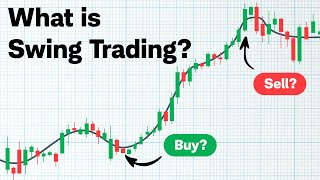
Swing trading is a short-term investing strategy that aims to profit from price fluctuations over days to weeks. This video explains the core concepts, including technical analysis, entry and exit signals like bounces and breakouts, and risk management techniques such as stop orders and position sizing.
Swing trading is a short-term tactic that profits from price fluctuations, lasting from a couple of days to weeks, unlike day trading which is within the same session.
Swing traders use technical analysis (price charts) rather than fundamental analysis (financial statements) to determine entry and exit points.
Before placing a trade, determine: when to enter, when to exit, and how much to trade.
Support and resistance act like floors and ceilings where price tends to change direction. Common entry signals are bounce and breakout.
Honeywell bounced near $170 (previous low) and rose to $200, offering a potential $30 gain per share.
Schlumberger broke above resistance at $44, with a range of $6, projecting a target of $50.
Swing traders often set a stop order to limit losses, but note that stop orders may not fill at the trigger price due to market orders.
With a $50,000 portfolio and 1% risk ($500), if trade risk is $2, you can buy 250 shares ($500 / $2).
Compare trade risk to potential reward. Example: risking $2 to make $5 is favorable, but risking $2 to make $1 is not.
Risks include price shooting past target or not reaching it. Traders may move up stop orders to lock in gains, but this can limit upside.
Swing trading requires a solid plan for entries, exits, and risk management. Practice with paper trading before using real money, and adapt techniques to your style and risk tolerance.
What is swing trading?
A short-term investing tactic that profits from price fluctuations over days to weeks.
What type of analysis do swing traders primarily use?
Technical analysis (price charts).
00:34
What are the three components to determine before a swing trade?
When to enter, when to exit, and how much to trade.
01:35
What is a bounce in swing trading?
When price moves to a support or resistance level and then heads back in the other direction.
02:21
What is a breakout in swing trading?
When price moves past a support or resistance line.
02:59
How do you calculate position size using portfolio risk and trade risk?
Divide portfolio risk by trade risk. Example: $500 / $2 = 250 shares.
04:53
What is the risk-reward ratio example given?
Risking $2 to potentially make $5 is favorable; risking $2 to make $1 is not.
05:34
What is a potential issue with stop orders?
Stop orders may not fill at the trigger price because they become market orders.
04:07
What is one way traders try to lock in gains?
By moving up their stop orders as the stock price increases.
06:27
Definition of Swing Trading
Provides a clear, concise definition distinguishing swing trading from day trading.
Three Components of a Trade
Emphasizes the importance of planning entry, exit, and position size before trading.
01:35Position Sizing Formula
Offers a practical, quantitative method to manage risk based on portfolio size.
04:35Risk-Reward Ratio
Highlights a key decision-making tool for evaluating trade viability.
05:17[00:00] Swing trading is a short-term investing tactic that tries to profit from fluctuations in the price of an investment. Unlike a day trade, where you enter and exit an asset in the same trading session, a swing trade can last anywhere from a couple of days to a couple of weeks. Those who
[00:17] try to swing trade hope to compound returns and increase their portfolio’s overall performance. Let’s take a look at how some swing traders approach stocks and some ways they manage risk. Swing traders tend to use technical analysis to determine when to enter and exit a trade, studying
[00:34] price charts rather than relying on fundamental analysis, or studying financial statements, which is often used in other investing strategies. When analyzing a price chart, you’ll notice the price rarely shoots straight up or drops straight down. Instead, it’ll tend to move gradually toward
[00:51] peaks and troughs. Swing traders want to buy at a trough, ride the upswing, and sell at the peak. Alternatively, they’ll sell (or short) at the peak,
[01:03] ride the downswing, and then close at the trough. Strictly speaking, swing trading refers to trading the short-term trends between the peaks and troughs, but the definition has broadened over time to include most short-term trading. Despite focusing on the short-term swings,
[01:19] swing traders usually trade with the broader trend, which means taking the upswing during uptrends and downswings during downtrends. During a sideways trend, they can try to trade both the up and the down movements. There are three components to a swing trade that
[01:35] should be determined before placing a trade: when to enter, when to exit, and how much to trade. Let’s start with entries and exits. There are hundreds of ways for swing traders to pick entries and exits. Many traders use basic charting techniques, like support and resistance,
[01:52] or price patterns, like flags and triangles. Others use charting indicators like moving averages and oscillators, which can help provide more objective signals. Because many swing traders start with support and resistance levels, let’s use those for an example.
[02:07] It may help to think of support and resistance like floors and ceilings where the price of a security tends to change direction within the larger trend. There are two common entry signals when trading on support and resistance:
[02:21] a bounce and a breakout. A bounce occurs when the price moves to a support or resistance level and then heads back in the other direction. Someone looking to trade off it would set a target exit at the previous level of support or resistance.
[02:35] For example, when Honeywell dropped near $170, which was its previous low, it turned higher again, creating a bounce. A swing trader could use that bounce to enter a bullish trade
[02:47] and set a target price at the previous high of around $200. If the trade worked in their favor, they could capture as much as $30 per share, not accounting for any commissions or fees.
[02:59] Another signal is a breakout, which occurs when the price moves past a support or resistance line. A trader would set a target by measuring the previous distance between the support and resistance lines, then adding that range to resistance for bullish trades or subtracting
[03:15] it from support for bearish ones. Let’s look at another example. Schlumberger was trading between $38 and $44 when the stock broke above resistance—a breakout
[03:27] signaling a potential entry. The range between support and resistance was about $6, which, if added to resistance, would show a target at $50. However, a trader determines entries and exits,
[03:40] it’s important to have a plan in case the unexpected happens. In fact, it’s common to have two exits planned: for if things go right or if things go wrong. Many swing traders use a proverbial line in the sand known as a stop,
[03:55] which helps them determine when to abandon a trade that’s going the wrong way. For example, a trader might decide to close this example trade if the stock dropped to $43. Some traders use an
[04:07] actual stop order, while others monitor the price closely or by setting an alert and then placing the order themselves. It’s important to know that stop orders often don’t fill at the stop order trigger price. When a stop order triggers it creates
[04:22] a market order. When the stock next trades it could be much different from the desired price. Before actually placing a trade, traders should determine how many shares to buy. A few factors
[04:35] can help calculate how much to invest in a trade, including the stop price and the portfolio risk. Let’s say we have $50,000 in a trading portfolio and we’re willing to risk no more than 1% of the portfolio on a trade, or $500. This is the portfolio risk.
[04:53] Next, we’ll divide the portfolio risk by the trade risk, which is the difference between entry price and stop price. For our example, let’s say the trade risk was $2.
[05:05] If we divide the portfolio risk of $500 by the trade risk of $2, we could buy 250 shares. Of course, this is only one way swing traders calculate their position size. You’ll want
[05:17] to find a method most appropriate for you and adjust it to fit your risk tolerance. Comparing the trade risk to the potential reward can also help determine if a trade is worthwhile. Let’s say a trader bought a stock at $55 per share with a target price of $60. They decide
[05:34] to close the trade for a loss if the stock falls $2. That means they’re risking $2 to potentially make $5 (not accounting for any fees or slippage). But if the target was $56, with the
[05:47] potential to make $1 while risking $2, it could mean that the reward may not be worth the risk. There are other risks to swing trading, such as the stock shooting past its target or failing to
[05:59] make it to the target. In our first example, it continued to climb past its target price and, if the trader sold, they’d have missed out on those gains. That’s a risk a swing trader must accept.
[06:12] Then, in our second example, the stock came really close to the target but didn’t quite make it, before starting to fall. If the trader was waiting to close at the target, they would have missed out on the gain. One way traders try to address this risk is by moving up
[06:27] their stop orders as the stock increases to attempt to lock in gains. Just remember that relying completely on stop orders could result in missing some potential gains and carries the risk of orders not filling as expected. There are many ways to approach swing trading,
[06:44] so get started by determining which techniques and indicators best fit your trading style. Then explore money management strategies that work for your risk tolerance. Finally, practice by paper trading your strategy before putting your hard-earned dollars at risk.
⚡ Saved you 0h 07m reading this? Transcribe any YouTube video for free — no signup needed.