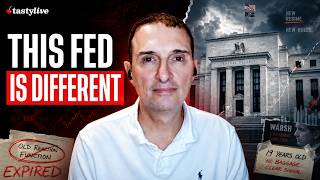

Fed's New Boss: No More Hand-Holding for Markets
60sThe clash between the Fed's new 'no forward guidance' policy and market expectations sparks debate and curiosity.
▶ Play Clip"The title is provocative but accurately reflects the core argument—a rare case where a counterintuitive claim is backed by solid reasoning."
Jim Bianco of Bianco Research joins Trading Trends to dissect the market's reaction to the Fed's latest meeting under Kevin Warsh. He argues that the Fed's shift away from forward guidance is causing confusion, and that the bond market is now sending a clear signal about inflation. Bianco presents a counterintuitive thesis: the fastest way to lower mortgage rates and long-term yields is for the Fed to hike rates, not cut them.
Kevin Warsh is moving away from forward guidance, which he believes creates a false sense of security and leads to excessive leverage. The market must now interpret Fed actions without explicit guidance.
The 30-year yield has risen 125 basis points since the Fed started cutting rates in September 2024, the largest such rise in 40 years. This indicates the market is worried about inflation.
Inflation has been above 2% for 64 consecutive months, with core PCE at 3.3%. The market is sending a signal that the Fed's policy is too loose.
Bianco argues that hiking rates would signal the Fed is serious about inflation, potentially calming the market and lowering long-term yields. Cutting rates would exacerbate inflation fears and push yields higher.
The post-COVID cycle is characterized by deglobalization, remote work, more war, and higher inflation. Pre-2020 economic models are obsolete.
AI-related stocks now make up 45-50% of the S&P 500's market cap. While Bianco believes AI is transformative, he warns that owning the S&P 500 is not a diversified bet—it's a concentrated bet on AI.
The fund was up 429% by June 30th but blew up shortly after due to excessive leverage. Bianco draws parallels to Long-Term Capital Management and FTX, noting that such blow-ups often mark market bottoms.
3.5% of South Korea's population received margin calls, despite the stock market being up 42% year-to-date. This highlights the dangers of leverage in a concentrated market.
What is forward guidance?
The Fed's practice of signaling future interest rate moves to the market.
01:36
Who is the current Fed chair, and what is his stance on forward guidance?
Kevin Warsh, who believes forward guidance creates a false sense of security and leads to excessive leverage.
01:21
How much did the 30-year yield rise while the Fed was cutting rates from September 2024?
125 basis points (1.25%).
03:39
For how many consecutive months has inflation been above 2%?
64 consecutive months.
04:06
What is the current core PCE inflation rate?
3.3%.
04:06
What is notable about the 125 basis point rise in the 30-year yield during the current rate cut cycle?
It is the largest rise in a rate cut cycle in 40 years.
08:32
What does a 'Fed credibility problem' mean in the context of rising long-term yields?
The market disagrees with the Fed about the inflation outlook and is demanding higher yields to compensate.
06:20
How much was the Situational Awareness fund up by June 30th?
429%.
16:11
What percentage of South Korea's population received a margin call recently?
3.5% of the population received margin calls.
16:51
Why does the market often bottom after a major blow-up like Situational Awareness?
Because the market knew there was an overleveraged position and was 'gunning for it.' Once the fund blew up, the pressure was removed.
19:31
The 125 Basis Point Anomaly
Demonstrates a clear disconnect between Fed policy and market reality, challenging conventional wisdom.
03:39The Rate Hike Paradox
A counterintuitive but logical argument that hiking rates could lower long-term yields by calming inflation fears.
08:3264 Months of Above-2% Inflation
Highlights the persistence of inflation, contradicting the narrative that it is transitory.
04:06The 'Carried Out' Bottom Signal
Provides a historical pattern for identifying market bottoms after leveraged blow-ups.
19:31Post-COVID Reset
Captures the idea that pre-2020 economic models are obsolete, a key theme of the discussion.
09:55[00:02] different things at once right now. The Fed just gave us perhaps a confusing meeting. Long end yields are certainly going up. Oil prices are still volatile. Mega cap tech earnings are going different ways and situational awareness
[00:15] just blew up which was riding the AI bubble as hard as anyone could have. about not just the market reaction but really the market structure right now as all of these forces collide. It's Jim Bianco of Bianco Research. He's been
[00:27] with us here on Trading Trends before. Jim, welcome back to tastytrade. minute, we're only down to five or six things the market's trying to process. What happened to the other 14? >> I'm trying to keep it simple. See it?
[00:40] want to relax a little bit right now. >> Exactly. >> So, I mean, the market wanted a cleaner Fed story this week, right? Inflation's coming in so maybe we're not going to have to hike as much. Growth is holding.
[00:53] The cuts are going to come eventually but we got this kind of light monetarist Milton Friedman-esque statement and press conference from Kevin Warsh and long end yields kind of got away from here. Is the Fed just too convinced that
[01:07] inflation's going to get back to 2% without its own hikes that the market's going to do the heavy lifting for it? >> Yeah, I think it's a little bit more nuanced than that. You know, let's Kevin Warsh has been He Remember, he was a Fed
[01:21] 2008. And he's been writing for a number of years that a lot of these programs that we put in place to deal with the financial crisis from almost 20 years ago are now problematic. And the biggest
[01:36] one that he has been really against is what's called forward guidance which is a fancy term for the Fed kind of tells you what they're going to do next. And his fear has been that whenever the Fed says, "You know, we're kind of on pace
[01:50] to cut rates or hike rates or hold steady," the The takes that as a guarantee or a promise. It doesn't take that as a high likelihood and there's a chance it might not happen. And because it takes it as a promise, a
[02:05] lot of traders then say, "Great. The short end of the yield curve, my financing costs are set, maximum leverage." And then when the Fed changes course, things blow up because people didn't get
[02:18] slipped up because they thought that, you know, Silicon Valley Bank, we've we're all long 30-year bonds, right? And we're going to stay long 30-year bonds. and they promised us that they're not going to raise rates. And then they
[02:31] start raising rates in '22 into '23 and we get all slipped up, we have a ton of losses, and then the bank goes out of business. And it's that kind of thing that the Fed is trying to get away from. Now, what's interesting about this is
[02:44] everybody says, "I agree, this forward guidance thing kind of fixes one problem and causes two other problems. It might not be a bad thing to get rid of." And then in the next sentence they go, "But Wurst didn't tell us anything at the
[02:58] meeting." Well, that's the point of forward guidance. You figure it out. You figure it out. I'm not going to tell you what I'm going to do. And then I'll look at what you figured out and figure and then I'll put that into my process. So,
[03:12] it's hard for the marketplace to try and get its head around it. Now, to the other side of the equation, I would I'll give you I'll start off by >> Sure. >> In September of 2024,
[03:25] that was when the Fed cut 50 basis points. That was the first cut and they've cut since September 24th through December of last year 1 and 1/2% or 6 25 basis point cuts, three in '24 and three in '25.
[03:39] The 30-year yield in September of '24 was at 4.02. It is at 5.27 right now. It was going up 125 basis
[03:51] points while the Fed was cutting and holding, it went straight up. Now, why did it go straight up? I've argued the market has been sending a signal all you got the wrong policy. We're worried about inflation. It's not
[04:06] 2%. It's been 64 straight months that it's been above 2%. In fact, it's above three on the Fed's favorite measure, which is core PCE, it's at 3.3. Um you need to address this issue about inflation. But for years, it was
[04:22] suppressed. The Fed Chairman Powell would say, "No, we're not going to worried about inflation, but here's your talking points. Go out there and and read them like you mean it." And those talking points don't have anything to
[04:35] say about inflation. Well, now that Warsh is in charge, he's more taking the attitude of the family fight. That's the phrase he used. And what he means by that is, "You're all independent voters. Go ahead and form your own opinion. And
[04:50] let's kind of come to a consensus of where we need to go." Three of them said immediately. Couple of others have said they're very Couple of others have said they're very close to agreeing with them. So, now
[05:03] Warsh, tell us what we're going to do next. Well, even if he did, he's only say is, the Fed watcher you should listen to is
[05:15] 19 years old because everybody else has watched the Fed for more than 4 minutes has an impression of how they work and it's getting in the way. You have to it's getting in the way. You have to reset and you have to reset and say,
[05:27] "This is a different Fed. This is a different guy. Don't keep lecturing me." And speaking to Bill Dudley, former New York Fed president, "about how Powell worked, how Yellen worked, how Bernanke worked, and why Warsh isn't doing that.
[05:40] quit trying to tell us that he needs to go back that way. Whether it's right or direction. >> That That's one of the things that I've been reiterating all week long. If you are using the same reaction function
[05:53] Yellen >> Call. your skis right now because Warsh has very clearly demonstrated he is not structure or an umbrella right here, which which does raise a question here,
[06:07] Jim, right? If Warsh wants the market to send the Fed a message, we saw that financial conditions did tighten after the Fed meeting on Wednesday. Long and yields shot up. Is that a sign that the market's worried about inflation, or is
[06:20] problem? And I only bring that up because the two-year yields actually went down. So, it's not like we saw this parallel shift higher in the yield curve. >> Well, I guess a Fed credibility problem,
[06:32] you know, that's a that's a way to say the market disagrees with where the Fed boils down to. I'll go back to Wednesday and Tuesday, and I will
[06:46] say that during Tuesday and Wednesday before the meeting, I was active on Axe. I'm just kind of giving you the picture. And I was saying, "Look, the market's pricing a 38 40% chance the Fed's going to hike rates." Uh I It's less than 50,
[07:01] to hike rates." Uh I It's less than 50, but it's close. It's a really close meeting. And a lot of people have said to me, "Oh, you're out of your mind. They're not going to raise rates. It's less than 1% that they're going to raise
[07:13] rates." I was like, "No, it's really close." And that's the way the market saw it. The vote came in at 9-3. And the market, I think, said, "You know what? It's not as close as it should be. They should be a lot closer to raising
[07:27] rates than they actually were." And that's why I think the the long end went down because I'm short Excuse me, the short end went down. The two-year yield fell because the two-year yield is kind
[07:39] Okay, I think they should be raising rates, but they're not going to, so maybe I ought to take some of these rate hikes out. The September Fed fund futures went from a 100% chance that the Fed is going to
[07:52] raise rates to 70. It was actually as low as 55 yesterday. So, it took it took that out, too. So, that's why it went down. The long end went up and said,
[08:04] we have an inflation problem, and there's two ways we're going to fix this. Either you the Fed is going to deal with it by raising rates, or we're going to do it." And the bond market is doing it right now by raising rates. So,
[08:17] credibility problem is another way of saying the market disagrees with the Fed as to what they should be doing. Now that you're allowing the market to express itself, uh it's saying, "We're worried about inflation." I'll go back
[08:32] to what I said before. The 30-year yield is up 125 basis points while the Fed was cutting rates. And that is, by the way, the biggest rise that we've seen in a rate cut cycle in 40 years. Every other Everybody
[08:47] thinks the Fed needs to cut rates so that all rates go down so that the the the cost of financing the deficit goes down. That only works when the market's in agreement that there's no inflation. The fastest way to get higher rates
[09:02] right now is not cut in is not hike interest rates, and that's what you're seeing right now. If you want yields down, if you want cheaper mortgages, demand the Fed hikes interest rates. The market will calm down about this
[09:15] inflation problem, and then long-term yields will fall. I don't know why that's a controversial opinion. I've heard other people push back against that, as well. Inflation and growth premiums are embedded at the
[09:27] short-term rates looser for longer, you're giving inflation and growth more market go for higher yields than if the Fed is going to stay relatively looser >> So let me throw else out. Yes, it is. But let me throw out
[09:42] >> Sure. >> Uh like I said, your your Fed watchers should be 19 years old so that they can start off new and try and learn the new Fed. I think your economist should be no more than 26 years old because what I've
[09:55] argued what I've argued there is you know all that that history and lessons and experiences you learned up till 2020? flippant about it. Send those to the Send those to the history department at
[10:09] anthropologists study it because the economists need to say that there was a reset in 2020 with the global shutdown and restart of the economy. And that this is a new cycle. This is the post-COVID cycle. This post-COVID cycle
[10:24] is deglobalization, it's remote work, it's a lot more war, and it's higher inflation. And that is the cycle we're living in cuz every time I hear people arguing disinflation, technology is going to keep the inflation rate down.
[10:38] The Fed doesn't need to hike. I was like, you're still living in a pre-2020 world. And that world is much This world is much different. So that's why it's so controversial because they're still thinking this is as I like to say, this
[10:54] is 2019. They still think we're living in 2019. It is not. It is a post-COVID world. So those arguments, why does it when the Fed cut rates, all rates fall? Why does it when the Fed raises rates, all rates rise? Cuz it it's it's a
[11:08] know who's in the biggest trap in that cycle right now? It's the president of the United States demanding rate cuts cuz he thinks if the Fed were to cut rates immediately, emergency meeting today to cut rates, he thinks that the
[11:21] 30-year yield would go straight down. If you did that, the 30-year yield's on its way to 6% is what he doesn't understand. >> It would go to the moon. It would go recall you I remember you you on like either CNBC or Bloomberg 2014 or 2015
[11:35] about people in the global financial crisis. Like the folks that were talking about what was happening in the '90s and the 2000s, the global financial crisis you're reading a history book. And that always stuck with me for some reason. So
[11:48] point here right now. Um I want to go over tech here because tech's been obviously important in the context of this Fed meeting and then I do want to move on to situational awareness. So when we see these mega cap tech earnings
[12:00] clearly done enough to help rebound this market or lift it back up here. Is the index too dependent right now on tech? Last year though all the rage was concentration risk because of the mag seven. I haven't heard a single person
[12:15] talk about that in 2026. >> Yeah, and if anything the concentration risk has gotten worse. Not that the mag seven's percentage has gotten higher, but if you broaden it out to what's like generally all AI that that is basically
[12:30] generally all AI that that is basically 45 to 50% of the S&P's market cap. And that might be as little as 40 to 45 stocks and 450 to 455 stocks is 55% of the S&P's market cap. So I I have two minds of that. And mind one is no,
[12:47] that's not a problem because I'm in the camp that this because I'm in the camp that this technology is the most important more important than the internet, it is more important than the personal
[12:59] computer, it's more important than the mobile phone. And the reason is is mobile phone. And the reason is is modern economy, the modern work. We what do we do for all We all sit in front of screens all day long. And what
[13:13] what is our job? I have 15 software programs, you have 15 software programs and they don't talk to each other. You make them talk to each other by juggling That's your job, that's my job. That's everybody's job.
[13:28] everybody's job. Software AI is going to be instead of go it into a spreadsheet. I go out in the internet, get this data, I put it in a spreadsheet, I manipulate it, I make a chart, I format
[13:41] it to you. That takes me 45 minutes and I have to work through six different programs. AI, I'm going to just say, go make me a chart at X and go email it out. There, I'm done. Now I'll go get a coffee.
[13:55] Uh and so that's why this is going to be such an important technology. So I'm of the mind it's not an overconcentration, it's that important. But I'm also of the mind that everybody says, I have a well-diversified portfolio. I own the
[14:10] well-diversified portfolio. I own the S&P 500. No, you've more leveraged ever been. We're going to talk about situational awareness. You're just in a low you're a low beta version of that fund. It's really basically what you've
[14:23] boiled down to without the leverage. And you need to understand that. So that's why I mean I'm I'm of two minds is I do think the technology is important, but I well, that's why I have a diversified portfolio. Well, actually you don't.
[14:36] You've got half your money tied up in this bet and you better make sure that understand what you're getting yourself into. traders come to us and like, yeah, I'm short uh puts in this and this and this
[14:49] you're short that's that's 5x leverage in the same exact trade in fact. diversified there. So take a step back and figure out what's going on here. You looming over all of this conversation because it does definitely feels like
[15:04] the purest AI infrastructure bet in the market for a number of years, right? The obvious, the capital build out's obvious. So you got to use a lot of leverage obviously to uh maximize those returns here.
[15:18] incident right now in the market? Are we going to look for more blow-ups along the way? I can't help but think the leverage seen in Korea, seen in situational awareness, it's all part of the same story, a story that we've heard
[15:30] Jim. Uh it's probably the most common story blow-up. >> So, you're talking to the right person because I'm an expert at situational awareness cuz I get up really early in
[15:44] the morning and yesterday at 5:00 a.m. before you did, I became aware that it existed. Because, you know, 30 hours ago no one knew of this club this firm. Uh but I knew about it 29 hours ago and you knew about it 25 hours ago. So, I
[15:57] got a 4-hour head start on you. It's basically where where we are. Yeah, it I I'll throw out since we're talking to traders, I think we've probably seen the most unbelievable story I've ever heard of in
[16:11] all of finance. Here is a fund that was up 429% Here is a fund that was up 429% between January 1st and June 30th. 429%
[16:23] July 30th, it has a fire sale to sell its fund to Citadel. What? You You know, and it's still apparently the investors in the fund are still up 80% for the year. And if the firm blew up and you're still
[16:38] up 80% for the year, that is an unbelievable number. Now, what does that tell me? That tells me reckless use of leverage and piling in at the top. And by the way, that's exactly what happened in South Korea,
[16:51] too. I saw another unbelievable statistic that 3 and 1/2% of the population of South Korea got a margin call in the last week or so. 3 and 1/2% >> Yeah, not just traders, the entire adult population.
[17:03] >> Yeah, the entire There are countries that don't have 3% of the population owning stocks and they got margin calls in in South Korea, as well. And why did And again, their stock market as of today is up 42% year to date. And so
[17:19] here we are. We're sitting here going, here's a fund that blew up, it's up 80% that's hit that the government's having emergency meetings, it's up 42% for the year. How did these funds being up so much blow up? Cuz they all piled in at
[17:35] the high with leverage. Now, what gets you to that? So, I don't know and now know any of the players at um at the uh you know, situational awareness or the Sylebra guy that runs it. Uh but let
[17:49] me I did read one thing in his background and I think it's important. He entered Columbia University 15 and he graduated with honors from Columbia University at 19. Point is, he's from Germany. And the
[18:04] And it's always geniuses you got to be careful because geniuses, cuz we're not on television, geniuses are the ones that will lever up at the top and go, "God damn it, I'm right. Don't change those positions. I'm a smart guy. Have
[18:18] you seen my IQ? I know what I'm doing." And that's how you wind up being a 429% year to date and blowing up 30 days later is what you wind up doing is and bottom and bought some puts and then the market rallied and it compounded his
[18:34] uh his losses. So yeah, I think that there's a lot of that going on. So, really what it boils down to is there was a lot of people that believed what I argued early on. This is a transformational technology. This is
[18:48] going to change everything. So therefore, get in, lever up, it's going to In fact, there's a lot of people in Silicon Valley thinking the only thing you should invest in is AI because everything else is going everything else
[19:01] is going to zero because of AI. And that was kind of his belief um as well, too. Now, on a short-term basis I tweeted this out last night. That typically, whenever you see somebody get carried out,
[19:16] that is usually the bottom in the market. And I heard a lot of people say, "If you only held out one because the the South Korean stock market was up 18% uh last night." Yeah, and the and the AI stocks were up 10% yesterday. And
[19:31] out one more day, he would have he would have been saved." I'm like, "No, it's have been saved." I'm like, "No, it's because he was carried out that you made the bottom." The market knew there was somebody underwater with bad positions,
[19:45] and they were gunning for them. And it finally they finally It's because he died, his fund died, not him personally. His fund died that the market rebounded. you said when genius fails, literally the book When Genius Failed. Long-Term
[20:00] Capital Management, uh you have FTX with Sam Bankman-Fried. Bitcoin bottoms the day FTX goes down. Uh I remember with MF Global and Jon Corzine, guys levered up Global goes under, and the European bonds rally. So, you just It's all the
[20:16] leverage, and then the market likes when it smells that blood, it likes to take >> You know, there's a there's a funny anecdote from from Genius Failed. There was a um a young a guy that was at the time was
[20:29] worked at one of the firms that invested in Long-Term firms that invested in Long-Term Capital. And he was 25, 26 years old, and he did some analysis, and he had very big problems with what they were
[20:43] doing and the amount of leverage that they had. And his boss encouraged him to go talk to him, and he went to Long-Term Capital in New York, and he went into the conference room. This was in the book. And he sat down, he said, "Okay,
[20:55] here [snorts] is Robert Merton, here's two other, you know, Nobel Prize winners Um here's John Meriwether, one of the greatest traders on Wall Street, all on the other side of the table. So, you go ahead, Mr. 25-year-old. Tell me what I
[21:09] did wrong. And immediately, like apologize for like wasting their time and walked out of the room cuz he was intimidated by their by their genius. But, he was 100% right. And they then they then continued to do what they were
[21:24] doing, and they didn't exist after a while. Is basically what happened. So, part of the problem is when you are too brilliant, there is an arrogance about you. You need That's why we always like to say you like aged traders because
[21:39] they've been humbled. You've, you know, one of the things I like about Reddit is they like to talk about loss porn. Right? I don't give a I don't give a how much money you've made. Tell me when you have blew up and tell me
[21:52] what you learned from it because everybody does. Everybody does. And that's when you really learned. It's kind of like in Vegas, right? It's easy money. Tell me when you start throwing the craps dice and they take your money
[22:05] really want to learn. >> Yeah, I mean everyone everyone has their out the door here, mine is September 6th, 2011. Swiss National Bank decides to put a floor on on Euro Swiss when I am leveraged long a lot of Swiss francs.
[22:20] career. And so, that's the lesson that you learn. Don't use too much leverage. Maybe uh Leopold and situational awareness take away that lesson here, speaking with you. Thanks so much for the uh the wit, the banter, the insight.
[22:34] has been another interview with Trading Trends. You've been watching Tasty Live. Trends. You've been watching Tasty Live. Like and subscribe for more interviews.



⚡ Saved you 0h 22m reading this? Transcribe any YouTube video for free — no signup needed.