AI Summary
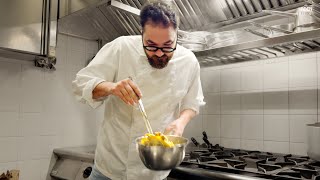
Chef Charo Murozidio, owner of the renowned restaurant in Rome's center, demonstrates his authentic homemade carbonara recipe. The video focuses on using simple, traditional ingredients and a specific technique to achieve a creamy sauce without cream.
Chapters
The chef introduces his restaurant as famous for healthy plates and carbonara, stating he will share his home recipe.
Simple ingredients are listed: guanciale (cured pork jowl), black pepper, eggs, parmesan cheese, and pecorino cheese.
It's important to clean guanciale by removing black pepper, skin, and back. Then cut into small strips (smoke use).
Cook guanciale in its own fat – no water or oil needed for cooking. Use an anti-stick pan for better results.
Start with high heat to warm the pan, then reduce to low heat, adding the guanciale to render fat slowly until crispy outside and soft inside.
For the sauce, use egg yolks (red part). Recommended ratio: 1 whole egg plus 1 yolk per person. If eggs are small, use 3 yolks and 1.5 whole eggs total.
Mix pecorino and parmesan to balance saltiness: two parts pecorino to one part parmesan. This makes the flavor more balanced.
Use spaghetti. Boil water with very little salt. Cook pasta for 12 minutes to ensure it's properly cooked soft – important for the recipe.
Use a bain-marie (double boiler) technique to gently cook eggs at about 65°C, creating a creamy sauce. Add guanciale (hot but room temperature), black pepper, and serve on a special plate.
The carbonara is ready – creamy without cream, balanced flavors from guanciale and cheese mix. Chef emphasizes the restaurant's unique technique.
Chef Charo's authentic carbonara relies on simple ingredients and precise technique – especially cooking guanciale in its own fat and using a bain-marie to create a creamy egg sauce without any cream. The result is a balanced, traditional Roman pasta dish.
Clickbait Check
75% Legit"The title is generally accurate as it features a chef known for carbonara sharing his recipe, but 'King of Carbonara' might be slightly exaggerated for a local chef."
Tutorial Checklist
Study Flashcards (5)
What ratio of pecorino to parmesan does the chef recommend for carbonara?
easy
Click to reveal answer
What ratio of pecorino to parmesan does the chef recommend for carbonara?
Two parts pecorino to one part parmesan.
07:56
Why does the chef cook guanciale with no water or oil?
easy
Click to reveal answer
Why does the chef cook guanciale with no water or oil?
Because guanciale renders its own fat during cooking.
02:20
What temperature should the egg mixture reach when using bain-marie technique?
medium
Click to reveal answer
What temperature should the egg mixture reach when using bain-marie technique?
About 65°C (65 degrees).
15:02
How many eggs per person does the chef recommend for the sauce?
medium
Click to reveal answer
How many eggs per person does the chef recommend for the sauce?
One whole egg plus one yolk per person. If eggs are small, use three yolks and one and a half whole eggs total.
05:56
What type of pan is recommended for cooking guanciale if using induction?
easy
Click to reveal answer
What type of pan is recommended for cooking guanciale if using induction?
An anti-stick pan.
03:25
💡 Key Takeaways
Cheese Balance Technique
Explains why mixing pecorino and parmesan (2:1) prevents excessive saltiness, a key tip for authentic carbonara.
07:39Bain-Marie Creaming Method
Shows how to achieve creamy carbonara without cream by gently cooking eggs at 65°C using a water bath.
14:43Simple Ingredient List
Emphasizes that carbonara requires only guanciale, eggs, cheese, and pepper – no cream or extra ingredients.
00:34Full Transcript
[00:00] Hi guys, I'm Charo Murozidio, the chef and owner of the Charo Gusileraiana, the restaurant in the center of the room.
[00:21] Our restaurant is very famous for health plates, the carbonara. And then today I'm going to show you how to make my home recipe.
[00:34] So, we have a very simple ingredients. And then we're going to mix all these ingredients together. So, we start first from the guanciale, after black pepper.
[00:52] Then, eggs, parmesan cheese and take ordinoses. We blend, we mix the cheese. So, it's very important to clean the guanciale.
[01:05] We remove all the black pepper and top and also the skin and the back.
[01:52] And then, while the guanciale is clean, we start to cut the guanciale. We make smoke use.
[02:05] This one have to be the size of guanciale.
[02:20] It's very important, because we're going to cook the guanciale with this fact. So, we don't use all the water, anything, just guanciale.
[02:35] So, we're going to add some salt and pepper. And then, we're going to add some salt and pepper.
[02:49] And then, we're going to add some salt and pepper. And that's it.
[03:10] When the guanciale is already cut, we go on the fire. So, actually, if you have gas, we use the hydro pan. If you don't have gas, we have an induction.
[03:25] We use anti-stick pan. That is very important for a very, probably, guanciale. And then, we start with the fire.
[03:37] First, we put the fire very high. We warm up the pan. When the pan is warm, we put the fire low.
[03:52] And then, we go ahead with the guanciale. And then, this is good. You can hear it, it's tough, right?
[04:21] Very low. Now, during the guanciale's cooking, we're going to make the sauce with the eggs.
[04:44] So, we're going to make the sauce with the egg.
[04:58] We're going to make the sauce. Now, we start to make the egg sauce with a cup of water.
[05:30] In my recipe, I use already the yolks, so the red part of the eggs. Actually, I use one each for president.
[05:56] If you have eggs as warm, I use three, one and a half. Like in this case, no?
[06:10] That's it. Now, the guanciale starts frying with this pan.
[06:40] No. The guanciale is frying.
[07:16] Actually, just say. When we make the cheese, I suggest to mix pecorino and granabalana because the pecorino sometimes is very salty.
[07:48] And then, I suggest to make this flavor more balanced with the granabalana. So, it's a little bit less salty, so that's why we use two parts of pecorino and one of granabalana.
[08:18] Now, we're going to make the sauce. Now, we're going to make the sauce.
[08:55] To make the carpunara, we use this kind of pan. It's called in Banyumari, then later I'll show you why we use this one.
[09:12] Cheese. Eggs.
[09:26] And the breakfast.
[09:53] Now, the guanciale is the crispy outside and should be very soft inside. So, with this fat, we make sauce.
[10:07] So, we put half with this one in the egg sauce. And then, we remove completely the fat.
[10:24] And then, we keep sautéing the guanciale.
[10:36] Now, we mix the sauce. We put some pasta water.
[11:06] So, we make our carpunara we use as spaghetti.
[11:31] So, it's very important that the boiling water has to be salty because it's not too much. So, we put very less salt.
[11:48] When the water is boiling, we put the spaghetti.
[12:01] And now, we have to wait.
[12:20] So, guys, we are almost ready. We have three minutes left and then we check the pasta. It's very important that the pasta have to be cooked properly. Especially for this recipe, we don't do the pasta then.
[12:35] Because we need the pasta to be cooked properly. We have to be soft because after I'll show you how to make the carpunara with the Banyumari.
[12:57] Check.
[13:27] So, we have to wait for the sauce to be cooked properly.
[13:50] We are ready.
[14:20] Some boiling water. Now, we wait.
[14:58] We cooked the pasta on Banyumari because we have the very right temperature. And then we cooked the eggs very gently. So, because we have to add the temperature of 65 degrees.
[15:20] With this technique, the eggs with the cheese should be very creamy. Then, now, we put the guanciale inside.
[15:52] It's very important that the guanciale have to be hot. But it's a room temperature.
[16:26] And then, we prepare the plate. We have this plate and then we decide to make this plate for the carpunara. It's a special plate.
[16:39] It's an honourable plate because on the back, you have the recipe of carpunara. The eggs start to be very creamy.
[17:07] The eggs start to be very creamy.
[17:37] Now, it's ready.
[18:07] It's ready.
[18:37] It's ready.
[19:07] It's ready.
[19:37] We finish the carpunara with one charlotteau. And then we finish with the pecorino cheese on top and the black pepper.
[19:55] And the black pepper. And the black pepper.
[20:13] And that's it. Our carpunara is ready. This place is the house of carpunara.
[20:33] And the carpunara recipe is very special because we decide to make the carpunara in a different way. Everybody knows.
[20:47] We try to find a very good balance from the guanciale and the pasta. Also, we made a very good flower of cheese.
[21:01] It doesn't like the cheese and the pecorino because it's too salty. And then we decide to balance it with the guanciale because first for the flowers.
[21:15] And after it goes to the guanciale, it's very creamy. Then the guanciale helps us to make this cream and our carpunara. You can see it looks like with the cream inside but there's no cream inside.
[21:29] So, how are you going to enjoy it? Well, everything is just going to be good. Thank you very much.
[22:02] Thank you very much.
[22:32] Thank you very much.
[23:02] Thank you very much.