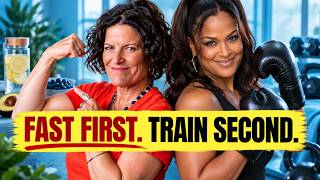

Explaining Fasting to My Daughter
45sA relatable parenting moment about explaining fasting to a child, offering a personal and emotional hook.
▶ Play Clip"The title is generic and doesn't fully capture the personal, anecdotal nature of the content, but it does deliver on the topic of fasting and health."
The video is a conversation about fasting, health, and wellness, featuring personal anecdotes and insights from a professional athlete who discusses the challenges and benefits of fasting, including its impact on food noise and mental clarity.
The speaker explains how she talks to her daughter about fasting, framing it as a health choice and a way to give the body a break, even if the child doesn't fully understand.
The speaker, a former professional athlete, describes how she used to train hard and eat less to lose weight, but this approach stopped working as she aged, leading to frustration and high cortisol levels.
She shares that her first fasting experience was difficult, with hunger waves, but emphasizes that recognizing and pushing through them builds confidence.
She advises against jumping into long fasts immediately, noting that people often pretend to be fine but aren't, and encourages a gradual approach.
Fasting eliminates the constant negotiation with food, as the decision is made, and this clarity helps reduce food noise and mental chatter.
The speaker notes that fasting changes how food talks to you, reducing cravings and improving control, even after the fast ends.
The video concludes that fasting is a powerful tool for health, offering mental clarity and control over food, but it requires a gradual, personalized approach to be sustainable.
Fasting Removes Food Negotiation
Highlights a key psychological benefit of fasting: eliminating the constant decision-making about food.
27:08Athlete's Weight Loss Struggle
Shows that even athletes face metabolic challenges with age, making the content relatable.
23:44Gradual Approach to Fasting
Provides practical advice to avoid common pitfalls, making it actionable for viewers.
26:00[00:00] Have you had a conversation with both of your kids, but you mentioned you have a teenage daughter, about why you fast? Yeah, so my daughter has asked me, and that's why I said sometimes, you know, I don't bring them into it quite as much.
[00:13] Like, they don't need to go through all the emotions with me. But she's like, why aren't you eating, Mommy? Why aren't you eating? And I say, Sydney, what I'm doing, I know you may not understand, but it's for health reasons.
[00:25] It's good for my health. I'm giving my body a break. You know, my body is cleansing itself. I know it's a lot to understand, but that's why I'm doing it. And then because I've talked about this before with my brand, Leilani Lifestyle,
[00:39] and I've talked about my real goal about health and wellness and my why is wanting to be here for my family. I truly believe that we are in control of our health when it comes to what we choose to put in our body,
[00:55] what we choose to have. You know, your skin is your largest organ. Oh, yeah. So we're using all these products and all these chemicals and all these scents and all these makeups and all these things. We're getting our nails done.
[01:07] And I'm not a fanatic, but I am someone who's very conscious of, you know, the detergent I buy and everything I use. You know, I'm not burning candles and plug-ins and things all around the house because all the neurotoxins.
[01:20] And, you know, I'm going to pick my poison. I wear makeup, right? So I know. But I know that I'm putting something on my skin, but I'm not going to use 50 different things. I might choose three and then I'm going to cut out some rest.
[01:33] So for me, it's all about finding that balance. But what I don't want to do is also have a bunch of processed food and all this junk. So I teach my children. I've been teaching them for a long time because they're those kids that don't have the same snacks as the other kids.
[01:47] Right, and mine were too. Yeah, so they're like, well, you know, but I let them have, like I said, I order pizza. Like they can get pizza. I'm not going to make them afraid of the world. I'm going to teach them that you know our body can only take so much you know so much load right so
[02:03] yes you know pick and choose because and cleanse cleansing is so important because you got to move off planet earth at this point if you if you want to be great oh my gosh it's in the water it's in the air it's in the food it's in the grass you know I can be using organic
[02:18] in my garden because I do have a garden you know I'm not using roundup and all that but my neighbors are right so I'm like I'm in the rain rains on my food and what's in the rain so it's like I'm not gonna like be afraid to live this life because at the end of the day I feel like God
[02:32] is in charge right but when you know better you do better so yeah I can answer your question I know it's very long-winded but my children have seen me do a lot they see me get in my infrared
[02:44] sauna they see me um you know using red light therapy they see me you know jumping on my um what do you call it rebounder all these i'm thinking like what are you doing i'm like
[02:56] all these little things that i do i tell them look you may not understand you will at one but just know i'm doing it for health and wellness i grew up watching my mom because people are thinking about my dad because he's muhammad ali in the greatest of all time but my mom used to
[03:10] take really good care of herself and a lot of it was for vanity reasons but she always ate clean I'm talking about, she would literally, we would be driving down, we lived in Malibu at one point, driving down PCH and she'd be hungry.
[03:24] She'd fill up the car for gas and she would get, there was like a PC Greens, like next door. And she would go in there and get a bag of lettuce and eat it like a bag of chips.
[03:36] Like, whoa, that's on my house. And as a kid, I was like, ew. But I grow up now and I'm an adult and I remember. So for those women who are worried about their daughters, I think it's important for us to explain to them why they're going to connect the dots.
[03:54] Don't make it about weight loss. Weight loss is great. Let's not pretend we don't all want to feel comfortable in our bodies. That's different for all of us. But it really is about the health reasons because you can do a lot of things just to lose weight, right?
[04:09] You can do a lot of things. If you want to just go get a shot nowadays, you could just lose weight. So if you're thinking about fasting, you obviously understand there's more to it than just losing weight. It's about taking control of your health. It's about being healthier.
[04:21] I love that name. And I'm in control. Like, I know what I need to do, right, in order to stay on top of my health and wellness. How do you build your workouts? Like, when you do a three- or four-day or five-day water fast, like, what do you do with your fitness?
[04:36] so for me I like um because of the research I've done I like doing the walking on an airplane I have a treadmill um I like to walk because then I don't have the excuse of the weather here in
[04:49] Georgia where I live now it's very hot and muggy outside I don't feel like talking to the neighbors sometimes I just don't so for me I rather just go get on my treadmill and guess what I can also do work if I need to you know if I have to on my phone if I want to read or just watch a podcast
[05:05] whatever um I get on the incline I'll go on for me I'll go on a 10 incline at about 2.5 2.8 so slow but I also have my 25 pound weight vest on yeah so um I like to make it harder
[05:21] right okay so if I want to increase that you know obviously I can increase the speed bring there's different things I can do so I'll do that for 30 minutes to an hour sometimes I get so caught up in what I'm doing I'll just do an hour I also cycle after dinner because I learned about that
[05:38] about right you know yeah that's a good one when you're eating it's a great one yeah because I don't want to go outside and go for a walk again with the weather or the rain or it's nighttime so I'll literally I move my my bike up to the because I have a gym in the house but I move the bike
[05:51] up to the family room area and the family might be watching TV and I'll get on my bike for like 20 minutes not going fast just moving my legs simulating walking that has been really good for me but to answer your question so I'll do the walking I'll also do hot hit high intensity
[06:07] workouts so I might some days I'll walk for 30 minutes then do like 10 sprints on on on hit where I'll jump off and on the treadmill and put it on like an 8.5 or 9 and just run really fast for
[06:22] 15 to 30 um second sprints that way I'm getting that growth hormone and all of that and you know And double stacking. You're double stacking if you're fasted and you're doing that. You're getting your double stacking.
[06:35] That's good for the first two days, though, because then my energy kind of trails off where I don't feel like I'm going to push myself that hard with the actual HIIT workouts.
[06:47] So then I'll just focus on the walking because what I don't want is I don't want to make my body feel like, okay, I need to eat now because that's the other thing. Like when I let go of a lot of energy as an athlete I used to having a protein shake or something So I keep it kind of easy so that I not spiking my cortisol I not out of breath but I getting that that burn and I getting into that autophagy faster by lifting up all of
[07:17] the or the glycogen yeah that's in my body so there's so many different levers that you can pull depending on what your goal is but if I can get into that deep therapeutic autophagy I'm not
[07:29] top of your fasting quicker than I do the thing. I see how you stack this. So I just want to repeat this because one of the big things I preach is everybody can do these tasks differently.
[07:42] And a lot of times I get asked, like, what's the right and the wrong? And I'm like, sometimes there's no right or wrong. There's just different ways. So the first two days you do the treadmill with the rucking vest and you do
[07:54] HIIT training. and then on like the third day you start to and as we both know but the audience might not those are definitely growth hormone stimulators and autophagy stimulators what she's doing and
[08:08] even the rucking vest on on an incline if it feels enjoyable is also lowering cortisol and so you're still doing you're still within a good neurochemical situation but then on the third
[08:22] and the fourth and the fifth day you just walk you bring it down yeah I walk and I also sometimes I just wear the vest around the house I have two I have the 25 pound and I have a 16 pound because 25 pound when that's on you feel it right but um I can carry that those with my size but the 16
[08:40] is kind of really easy for me it's just there yeah um but I'll I do do sit-ups and push-ups um because I can do them just not quite as many um and I don't I do female push-ups
[08:52] you know the modified push-ups listen to that I want everybody to hear that yeah I do too I do too like I don't know yeah I the funny thing is I never have even when I was
[09:06] boxing I never I never did them um the real way yeah so um but yeah and I and I never could do pull-ups and I and and I knew my one of my trainers tried to get me doing it and I was like I'm good
[09:18] I don't want to do it I'm good I do so many other things it's okay and I'm okay admitting that so I really try to get that burn um doing them the other way so but like I said I also listen to my body because I've noticed that some I've had I've done a five-day fast before on the fourth day I
[09:36] started feeling like maybe I need a breakfast fast and I might have had like four more hours to go and I just booked the fast um you know because other things might be going on in my body you
[09:48] You know, and I can break the cast. So, yeah, listen to your body. And have you, you know, a big fear that people have is you'll lose muscle and that you're permanently when you start fasting. Have you had that experience?
[10:02] No. And I actually get on a body, is it called a DECA scan? Yeah. And no, I actually did not lose muscle. I gained muscle. And I will say this, when I do a five-day fast, I'll lose, and you know a lot of it's water weight, but I'll lose like 13 pounds, right, in five days.
[10:24] And I love the way I look. I'm like, ooh. But everything does look flatter, okay? So my butt doesn't look as lifted. But guess what? It comes right back. It's left right back.
[10:36] So it's like, you know, it's like your body has a way, you know, when you're letting water go and everything go down. and then it'll come back up, especially if you eat a can of sardines or some salmon or something like that.
[10:48] It depends. You don't have your protein. Agreed. But I'm definitely not going to lose muscle. It's not like I'm doing a 40-day fast and I'm going to keep doing it back to back to back to back. Like that much is not going to change.
[11:01] And the health benefits way outweigh what I'm worried about with my looks, you know what I mean, in terms of muscles. But, no, I haven't lost it. Yeah, the research actually shows that in the refeed, you can actually regrow muscle even stronger than if you had dieted and worked out through a different lens, the calorie in, calorie out kind of thing.
[11:24] And ketones preserve muscle. So when you go into the state, you're right, it looks flatter. And the reason it looks flatter is because the water is coming out of you and your body is breaking down all the old. So I love your approach.
[11:37] What have you noticed about cognition? Because I know that's a big concern for you. When you fast, have you seen better mental clarity? What I love about fasting is how it makes me feel more than anything.
[11:52] That's why I was like, I'm never going to stop this. And I read that in your book. Before I started going for the five-day fast, I read it. And like I said, I was one of those people who was like, I'm not going to not eat.
[12:04] I did not believe people that said they felt great. I'm like, yeah, right. How do you feel great? Like, so I can still remember how I felt when I'm talking to people. But I feel great. I'm so clear.
[12:17] You know, everything is so clear. And it's going to take more time because I've been doing it now going on two years. It's going to take more time to see if it's, you know, going to last. Or is it just when I'm fasting, you know?
[12:31] But that was part of my theory I was trying to figure out. Remember I told you that I'm going to be having right now where I feel fatigued, I feel tired, I think something's going on in my body, but I haven't been fasting regularly.
[12:44] And the first thing I thought was that's because I stopped fasting. Like, I just feel at my best when I'm fasting. When I say fasting, I'm saying I'll do a five-day fast.
[12:56] My goal, perfect picture for me is to do a five-day fast maybe quarterly, right? or even if it's two times a year, but more quarterly. And then I like to do maybe like a three-day fast once a month.
[13:12] And then, you know, but then be doing the intermittent fasting where I like to cut off my eating. I would like to say sundown, but sometimes it doesn't get dark in Georgia until 9 o'clock
[13:24] and then sometimes it's 6 o'clock. So for me, that's a hard one. I like to eat dinner, then start my fast. So I get that, you know, I wake up in the morning, I party the next amount of hours. That's me. So I like to stop eating by like 8 or 9 o'clock at night on average.
[13:40] And then I start eating again at like 2 in the afternoon. Like I haven't eaten today yet. I feel fine. I'm going to eat after the podcast. But, yeah. I haven't eaten today either. Yeah, I'm like, eh.
[13:52] But what I love, and let me tell you this, it literally makes me look 10 years younger. Like after I do a five-day fast, not right after, but the two weeks following after your body refeeds.
[14:08] And one of the biggest mistakes I was making even after reading your book even knowing the refeed is so important It so important And I was like I know remember I told you about me and negotiating once I like done and I get to eat I would tell myself
[14:26] you can have a donut because you did oh yes yes the award it was so bad because I would have things that I shouldn't have because I was just so happy to be able to eat again.
[14:42] And even if I was like, my stomach's fine, because, you know, if they take your time, ease into it, my stomach will be fine. So I was more focused on how I felt more so than not realizing, no,
[14:55] it's what you refeed with that's going to fuel your cells. You're building new cells with the food that you eat. So now I've taken my game up to where I'm like, okay, I'm going to have the bones off and I'm going to have the eggs and the sardines and the avocado and sauerkraut.
[15:11] And I had those things, but I also had a donut with it. So now I actually break my fast properly. Like if I'm going to build cells, what do I want to build those cells with? That's really my first priority, right?
[15:25] And then I do start eating faster. you know like I might even have a big meal that same day for dinner but it'll be a steak and salad but you know I my stomach's not sensitive when it comes to starting to eat again like some people's
[15:37] might be but yeah I really prioritize really really healthy foods like I have the sea moss now and just different things oh my god I tried the sea moss yeah so you know it's interesting I um
[15:49] I've been following your career for a while and um I think it's humbling when professional athletes go into their perimenopausal years. And you, as a professional boxer with an undefeated career,
[16:04] how the heck did you manage the fitness changes that happen when your hormones change? Oh, it's so hard. I mean, just from the time I retired boxing, you know, I used to have to weigh in, right, to fight.
[16:17] Oh, right. Yes, you weigh in publicly. So weight has always been a thing for me because it's how I kind of know if I'm on track, right? You got to get on that scale.
[16:29] And for me, just not having the same control that I used to have when I was in my 20s and my life was about, my career was about working out, being in shape, right?
[16:41] And there was always an end goal. And that's something I have to get out of now because I need like, oh, I'm fighting in 10 weeks. There's the end. And I'm going to get there. Now there's no end, right? It's just like I've got to take care of myself and continually be focused on being better at every stage for the rest of my life, right?
[17:01] So that was a challenge for me. I began to say just I used to be ever like, oh, I've got to get 10 pounds off this week, right, in order to weigh in. It's not healthy, but that's what we do sometimes. Yeah. I can't do that now if I wanted to. I can't just get 10 pounds off.
[17:14] My body does not react the same way that it used to. and that was one of the reasons why and we'll get into that how I came to fasting because it put me back in I felt like control of my body right yeah so what if you're willing what were the biggest
[17:32] changes you saw because a lot of my audience is concerned about belly fat that the visceral fat that just randomly appears as estrogen goes down the muscle loss where we just can't seem to
[17:47] lift the same level of weights we used to, and then the motivation to work out seems to go down. What were some of the biggest fitness changes that you noticed compared to when you were a professional fighter? Well, for me, I've always been a big girl. So before I, when I say that,
[18:04] I mean 5'11", I have size 12 feet. Yes, I literally mean a big girl in comparison to the average size woman and I was proud of it because hey I got 21 knockouts out of my 24 wins for a
[18:18] reason right so I came oh this is why my hands are so big anyway that's the reason I'm gonna tell myself but um I would say that you know I can carry a lot of weight right I've been as big as
[18:30] 220 pounds I'm about 198 right now I like to be around 185 when I was fighting I was 168 right Wow. Right.
[18:42] So there's a range there. For me, though, because I've had the opportunity to see and feel how it is to be my best, I'm always chasing that. Right? True. I measure myself against myself.
[18:56] And that's something that I kind of have to let go because I've, you know, I've like, okay, no matter what I do, I'm never going to be able to get back to my twins. So it's nice to have that vision. But to answer your question, the hardest thing for me has been just maintaining the weight that I like to be at,
[19:14] where I feel most comfortable, so I don't feel too heavy. I don't feel like there's so much strain on my body. And being that I have a thyroid disease I've had since I was 15 years old, I have Graves' disease, when I hit my late 30s, it became harder and harder to manage my weight and my mood and just all these things.
[19:31] Because, you know, that's a whole hormone situation. Right, right. I would say the hardest thing is the weight because, you know, we're very critical of ourselves. I'm very critical of myself. Yeah, that's amazing.
[19:43] Yeah, I'm very critical of myself. Even though I'm as confident as they come, don't get me wrong. But what is this little voice in your head, right, that's going on, that's playing over and over? And that's when I walk by the mirror and say, oh, my God, my face looks heavy.
[19:57] Oh, my God, you know, my arms don't look as cut. You know, they don't look big. when I'm on TV that's 10 pounds extra I just want to look yeah I look in person so now I'm like oh
[20:09] god I gotta get this extra 10 pounds off so and then I and then I tell myself then I get on myself with that and I'm like just be happy you're healthy what if you got sick or got cancer or something like that you wouldn't be complaining about the way you look so then I get on my so
[20:23] it's like you know we have this constant voices in our head all the time even the most confident of us, you know, so that's something we're always, I'm always fighting. Yeah, and I think you bring
[20:35] up such a valid point, because I've been really speaking this to my community, that there's these voices in our head, and sometimes we didn't make a decision if they should be there or not, but we're still running our life by that, and it's really, I think you bring up such an important
[20:52] point, that when we go through perimenopause, and the muscle changes, that's a big one, where the muscle starts to break down no matter what you do and you don't see the definition that
[21:04] you used to have. That all of a sudden, how do you deal with that voice inside your head? Have you come up with strategies? Is it just constantly being aware and talking it through?
[21:16] Do you have a sense of where the voice came from? Because I think a lot of women deal with this I definitely have a sense of where the voice came from my mom is very was very critical of herself and you know you know so I know I kind of got some of that from
[21:30] her. But I will say that for me, because I know, and I've done it before, I know what it takes. I see a lot of women that are still in their 40s and 50s and even 60s and toned and ripped.
[21:42] It takes a lot more work. It takes a lot of time. It takes a lot of consistency that I don't want give anymore. Gosh, me neither. Right. So I can do it. I'm like, yeah, I know.
[21:54] I can look at someone and say, man, she looks great. I can look that way. But do I really want to do what it takes? No. Yes. Because I'm more focused on my children and my husband and enjoying life. I know how hard. It used to come a little easier.
[22:07] I mean, I trained full time as a professional athlete. I'm now training for health, right, and just my field day. before I had to train to win my fights. I don't have to train like that anymore. So I'm not going to make working out my life.
[22:21] I'm not going to be, I just want to be to where I feel comfortable. We can talk about what I do now. So if I have something coming up and I have a certain goal I want to hit, I know that I can do it. But for me, like I said, remember I told you, for me it's like, okay,
[22:34] I'm doing it to this point. I don't want to do this for the rest of my life. So let's try to do the sustainable that works for me, that makes me feel good. It was all about really finding that balance.
[22:46] Yeah, it's so well said. So a little bit on my background, I was a competitive tennis player, and I played on a tennis scholarship in college. And I used to say I could look at a weight and I would build muscle.
[22:59] I didn't even need to pick it up. It was like I'd look at it, and I was always worried about too much muscle because then I felt like I looked heavy in my clothes. And then I went into perimenopause, and all of that changed.
[23:11] I couldn't build muscle for the life of me. and it became so much more difficult. So let's jump into what you changed, like when you started to approach this differently. What did you look at?
[23:25] Was it diet? Was it workout? Was it fasting? I know we're going to get into your – you're a pro-faster, and you went from professional bosser to professional faster. I give you that title. and so what changed so that people who are still trying to do what they did at 35 can
[23:44] release themselves from that yeah you can't you can't you can't keep up with it um anymore I mean for me what changed is okay so as a professional athlete I used to go to the gym right every day
[23:58] when I was training uh well six days a week I'd run every morning I'd go to the the gym in the afternoon, do my boxing workouts, sparring. We already know that's a lot of work on your body getting hit, right? Then I would do weight training three times a week.
[24:12] And I didn't have to really worry about what I ate because I was young and I was burning off enough, right? Right. Now, once I came away from that, obviously that was a long time ago. I retired in 2007 and I'm now going to be 49 years old on December 30th.
[24:28] Exactly. hits um so I would be like I gotta just train harder whenever I had a goal for whatever reason I want to hit I would train harder because I was like I know how to get this weight off I'm gonna
[24:40] go run four miles I'm gonna you know get on my cycle and I'm gonna do all these high intensity workouts and I would work hard hard hard or I would be eat less none of that was working all I know I was just raising my cortisol wearing myself out stressing my body and I was like how
[24:57] am I not losing weight? This is crazy. And I actually went to a health and wellness place and I was trying to figure it out. At one point, I even was looking at, they were trying to get me to take the shots that everyone's taking now. I was like, I don't want to do that. I'm like, that doesn't make any sense. How old were you at this point? This was probably
[25:13] about 42. Yeah, right on time. That's right on time. 42, between 42 and 45. I was really trying to figure it out. What was your reaction once you first started fasting? What was the first
[25:27] thing you noticed? Well, I know everyone knows how good you feel, right? So everyone's at a different, on a different journey and has different things going on with their health. So sometimes I don't want to pretend and act like that first day or second day or the first time around wasn't
[25:44] horrible because you're used to eating food, right? And you get hungry. You go through these waves but you have to know like you say in your book you recognize it it's there and then it just kind of goes away and you and you get stronger and you get more confident as you pass it what
[26:00] I've seen people do and I've had friends that try to do it is they try to jump in with the forehand like don't do that right that's the way to do it that's not the way I did it and then then I'll check in on them oh no I'm gonna do it I'm gonna do it oh it's going great I'm like she's
[26:13] not telling the truth because I already know I'm like you're pretending you're over there doing something you're not going to do. You're not going to jump into a four or five day fast and then I call you on day two and you're like, oh, I'm great. You're like a fasting detective. I'm like,
[26:30] you're not telling the truth because I already know. So, but I would just say, I always encourage people to know that every season of your life requires a different approach, right? And everyone is in a different season. We're not all, we're going to be at the same place, but I've always
[26:43] in that person no matter what it is I'm doing you know to try to encourage others and I try to meet them where they're at right so you know you can't expect everyone to be at the level that you are
[26:55] but I stopped trying to outwork my hormones um fasting removes the negotiation for me because I'm gonna negotiate when it comes to dieting and and all that yeah I'm gonna negotiate if you because
[27:08] I believe like a lot and it's true like I can be doing a diet and I can eat a peach or something and was on diet and it won't show. So I'm like, I can get away with this. I can't get away with it. I can't eat not one grape when I'm fasting or it's going to ruin my fast.
[27:22] And that's why I love it because I don't have to think. Once I make the decision and I stick to it, there's clear boundaries and there's no constant negotiation. It's so, that's strange to me.
[27:35] I think that's such a good point. And I've never heard somebody say that before, but this is the way I feel too, is if I know I'm not eating, then when the thought comes up, oh, go ahead and get some food,
[27:49] my brain goes, no, remember you're not eating today. And so there's not like what food should I get or I need to make sure I'm eating more protein. Like that whole conversation goes away because you just go, no, we're not doing this.
[28:02] We're actually drinking water today. So I think that is a really important point. And what I'm hearing from a lot of people is that even after the fast, that food noise, the way that food talks to us, has changed because we've trained those neurons in our brain to stop screaming at us and trying to negotiate for a different food.
[28:25] If this helps, don't stop here. Click on the next video and let's see what you find there.

⚡ Saved you 0h 28m reading this? Transcribe any YouTube video for free — no signup needed.