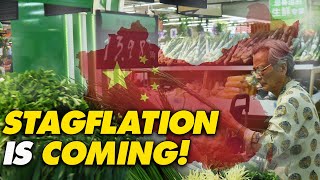

China's GDP Misses Expectations, Stagflation Fears
45sImmediately presents shocking economic data and the buzzword 'stagflation', sparking curiosity and concern.
▶ Play Clip"The title promises a deep dive into China's economic data, and the video delivers a factual breakdown, though it lacks depth and analysis."
China's third-quarter GDP growth missed expectations, raising fears of stagflation. The slowdown is attributed to Delta outbreaks, floods, policy interventions, and power shortages, with analysts predicting further deceleration in Q4.
China's GDP grew 4.9% year-on-year in Q3, below the expected 5% and down from 7.9% in Q2. Q1 saw 18.3% growth due to post-pandemic rebound.
Economists expect Q4 growth to decline to 3-4%. Nomura's Liu Qing estimates 3% growth in Q4 and into spring.
September industrial production grew only 3.1% year-on-year, down from 5.3% in August, due to factory gate inflation at a record 10.7% and soaring coal prices.
Raw coal output fell 0.9% and coking coal output fell 9.6% year-on-year in September, exacerbating coal price increases.
Slow growth, high inflation, and unemployment raise fears of 1970s-style stagflation, similar to the US experience.
The gap between PPI (up ~11%) and CPI (up 0.7%) is about 10 percentage points, a record high, signaling stagflation and weak demand.
Since late September, power outages and production restrictions have affected over 20 provinces, due to factors like emission reduction policies and trade wars.
At least 13 Asia-listed companies announced price increases this year, indicating attempts to pass rising costs to consumers.
Beijing is reluctant to loosen monetary policy, which could slow Q4 growth further, but not doing so risks a real estate market collapse.
China faces a challenging Q4 with slowing growth, high inflation, and policy constraints. The risk of stagflation is real, and the government's response remains unclear.
Q3 GDP Miss
The miss signals a significant slowdown from Q2 and raises stagflation concerns.
00:25Scissors Gap Record
The record gap between PPI and CPI is a key indicator of stagflation.
03:26Power Outages
The widespread power crisis is a major factor behind the production slowdown.
04:09Policy Dilemma
Highlights the difficult trade-off between supporting growth and controlling inflation.
05:29[00:00] Hi, thank you for watching Digging to China. I'm Dong Shuo. On Monday, October 18th, Beijing released new economic data, and it does not look good.
[00:12] The third quarter economic underperformed, and it serves as the harbinger of more pain ahead in the final three months of the year. Some analysts fear stagflation is coming.
[00:25] For the three months ending September, China's GDP grew by 4.9% from a year ago, missing market expectations of 5% growth and well below the 7.9% gain seen in the second quarter.
[00:41] Bear in mind, the first quarter GDP grew at 18.3%. The first half of this year saw a strong growth due to a post-pandemic rebound, But the Delta variant outbreaks, disasters such as floods and Beijing's political policy intervention plus self-inflicted power outage produced lukewarm growth in the third quarter.
[01:06] Zhou Hao is Senior Emerging Markets Economist at Commerce Bank AG. He said, In terms of absolute economic growth rate, the fourth quarter of this year and the first
[01:18] quarter of next year might be a bottom of the current economic circle. Mr Zhou expected China GDP growth rate to decline to about 3 to 3 percent in the last three months of the year Liu Qing chief economist at Nomura is more pessimistic He estimated China economic growth would slump to 3 in the fourth quarter and remain
[01:44] that way into spring. Slower global economic growth hampered China's industrial output. In September, China's industrial production only grew 3.1% from a year earlier, much lower
[01:58] than August's 5.3% growth. The sharp slowdown was partly driven by China's factory gate inflation, which rose to a record high of 10.7% last month,
[02:12] mostly fueled by soaring coal prices. For many smaller manufacturers, production is no longer economically viable. To make the matter worse, Monday's figures should also show that China's raw coal output declined
[02:27] by 0.9%. Coking coal output declined by 9.6% from a year ago in September. The shortage triggered another round of coal price increases.
[02:39] Fixed asset investment, infrastructure, property, machinery, and equipment grew by 7.3% in the first three quarters this year compared with a year earlier. However, September retail sales rose 4.4% better than expected.
[02:57] The overall economic picture has raised concerns about stagflation slow growth combined with high inflation and unemployment Some economists fear that China will face a possible 1970s stagflation
[03:13] similar to that seen in the United States, when commodity prices soar and supply chains slope, followed by periods of interest rate hikes and recessions.
[03:26] I would like to bring your attention to the concept of scissor gap, The difference between the production price index, PPI, and the consumer price index, CPI.
[03:39] In September, PPI, the production price index, rose close to 11%, the highest in the past 26 years. In September, CPI, the consumer price index rose by 0.7% year-on-year, slightly lower than expected,
[03:56] indicating that the demand side is relatively weak. The difference between PPR increase and the CPR increase, the so-called scissors gap, is about 10 percentage point, a record high.
[04:09] This is a sign of stagflation. Since late September, the most severe wave of power outage and production restrictions has swept more than 20 provinces in China.
[04:21] There are a number of reasons. Communist Party infighting, revolutionary-style emission reduction, unable to raise electricity prices, trade war with Australia, a top coal export.
[04:35] If the historical correlation between coal price and the PPI is established the factory gate price increase may soon triple from 11 to 30 If that happens, profit margin will collapse, causing more defaults and supply chain bottlenecks.
[04:53] It will in turn push PPI even higher in the competition for goods. The state-run China Securities Journal reported last week that at least 13 Asia-listed companies announced price increases this year in response to rising costs and tight supply,
[05:12] indicating that manufacturers are beginning to try to pass costs on to consumers. Fear for further price increases, Beijing is reluctant to loosen monetary and fiscal policies to generate more economic activity.
[05:29] This means that the fourth quarter economic performance will slow down further. But if Beijing does not further relax money supply, the already imploded real estate market will collapse.
[05:42] Although last week, Premier Li Keqiang said China had adequate tools to tackle the economic challenges facing the country, including the nation's current power crisis and high commodity prices.
[05:57] But he did not touch base on specifics. I'm eager to know. Thank you for watching. Please leave a comment and subscribe to my channel. Just click the subscribe button right here. I'll see you again shortly. Until then.
[06:12] Be well.
⚡ Saved you 0h 06m reading this? Transcribe any YouTube video for free — no signup needed.