Why I Hate Liberty Bibberty
45sThe intense, humorous rant about a universally recognized ad mascot taps into shared frustration, making it highly relatable and shareable.
▶ Play Clip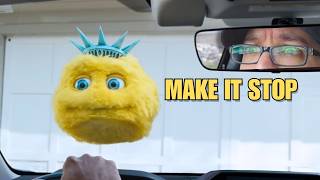
"The title is hyperbolic but the video delivers a substantive critique of insurance advertising, backed by data and research."
The video is a satirical and critical analysis of car insurance advertising, focusing on Liberty Mutual's Liberty Bibberty mascot. It argues that these companies spend billions on memorable but uninformative ads while customer satisfaction declines, and it explores the psychology behind such advertising.
The narrator expresses intense dislike for Liberty Mutual's Liberty Bibberty mascot, which appears in ads across the internet and TV, even in places without targeted tracking.
Advertising moved from clarity to nonsequitur humor (e.g., Cadbury gorilla, Quiznos sponges) to be memorable, often unrelated to the product.
In 2019, Liberty Mutual went viral with an ad where an actor flubs the company name as 'Liberty Bibberty.' The character became recurring, and later a physical puppet was created by the Jim Henson Creature Shop.
Liberty Mutual spent $881 million on advertising in 2025; Geico $1.99 billion; Allstate $2.079 billion; Progressive $4.5 billion (per CFA). Progressive's SEC filing shows over $5.1 billion.
CEOs of major insurers earn $10.2M to $24M annually, while median US household income is $87,460, highlighting a disparity.
Liberty Mutual paid $300,000 in penalties in Delaware for false discount claims; in 2024, refunded $5.2M to Florida policyholders. Geico returned $10.5M and paid $1.2M penalty in New Jersey for improper cancellations and rating.
J.D. Power study shows satisfaction improves only 4 points when repairs are done, but declines 12 points when vehicles are totaled. 26% of claims are total losses, and 25% of those with loans get less than owed.
Only 58% of customers fully understand their policy (down from 62%). Informed customers are 127 points more satisfied and more likely to renew.
Research shows effective ads not only boost recall of the advertiser but also suppress recall of competitors, a phenomenon called competitive interference.
A large-scale RCT (325,000 people) found that while the immediate effect of an ad lasts only days, repeated exposure brings recall back to initial levels, making bombardment necessary.
Car insurance ads prioritize memorability over substance, using mascots like Liberty Bibberty to condition consumers, but this strategy often masks poor service and high costs. The takeaway is that informed consumers are more satisfied, yet advertising rarely provides the needed information.
Liberty Mutual
service
Geico
service
Allstate
service
Progressive
service
State Farm
service
Travelers
service
Jim Henson Creature Shop
service
Nicholas Bowman
person
Stephanie Courtney
person
Navdeep S. Sani
person
Yifan Yang
person
Consumer Federation of America report
link
J.D. Power study
link
Stanford Business Insights
link
Billions in Ad Spend
Reveals the massive budgets insurers allocate to advertising, contradicting claims of financial hardship.
07:49CEO Pay vs. Household Income
Highlights income inequality within the industry, adding a social justice angle.
10:28Informed Customers Are More Satisfied
Shows that transparency benefits both customers and insurers, countering the 'ignorance is bliss' assumption.
23:14Competitive Interference Explained
Provides a psychological mechanism for why ads focus on memorability over information.
25:23Cumulative Ad Effect
Explains why advertisers bombard consumers repeatedly to maintain recall.
28:35[00:02] He is the scourge of car insurance advertising, which is already a wasteland of mascots and vague information. Yet it's worse now because what do you mean I can't watch a single video on the internet without first
[00:18] having to be lectured by this denture-wearing coosh ball from hell? Why is he here? What purpose do you serve? How is your existence supposed to make me want to buy car insurance? I can't go anywhere [clears throat] on
[00:33] the internet without seeing his Gary Busey-ass mouth smiling like he knows the exact time and manner of my death because he's going to be the one that causes it. And this goes above targeted advertising because I get Liberty
[00:48] Bibberty at my sister's house, at my mom's house, at my friend's house, places where I don't have accounts, and places where I have no trackable places where I have no trackable advertising presence. I hate him. I hate
[01:01] him. If I could, I would climb [music] up his rectum and kick his ass from the inside. But this video isn't just about how this blue-eyed, crown-wearing feather duster ruins every one of my golden age Hollywood movie nights on
[01:15] Tubi by droning the Liberty Mutual ad jingle in a tone that can only be described as an activation frequency for man-on-muppet violence. No, this is a deeper look into why car insurance
[01:30] companies advertise this way and, critically, how they can find a billion dollars for BS like this while the actual service they provide results in worsening customer satisfaction. We can rant if we want to. We can send
[01:47] our best regards cuz your friends don't rant and if they don't rant then they're not into cars. I believe it started in noticeable shift in advertising as
[01:59] companies moved away clarity towards a kind of nonsequitur humor that largely had nothing to do with the product being sold, as if the company made commission on how many viewers they could confuse. There was that one Cadbury commercial
[02:14] that's just a gorilla playing drums. There was the little Starburst berries and cream nymph, the Quiznos sponge monkeys, basically any cologne or perfume ad, that one Levi spot where a hamster breaks his wheel and then dies
[02:30] of boredom, or that one Super Bowl spot where a robot working on a GM assembly line gets fired, struggles to find work, and then jumps off a bridge before waking back up on the assembly line to discover that it was all a dream to his
[02:45] great relief because I guess building express vans is preferable to oblivion. Although that ad was a year before the '08 financial crisis, so that robot probably ended up out on his ass anyway. Nah, who am I kidding? As an automated
[02:59] worker, he was probably the only nonexecutive whose job was safe. But the point remains, ads seem to exist for no other reason than to be memorable. Yet it gets to a point, you know? Which brings me to the insurance agency,
[03:15] Liberty Mutual. In 2019, the company went viral for an ad in which a struggling actor films a Liberty Mutual commercial in front of the Statue of Liberty, but can't pronounce the name of the company,
[03:30] pronounce the name of the company, leading to multiple takes. And in one, he pronounces it Liberty Bibberty. That's it. That's the joke. The actor became a recurring character in their ads, and so they gave him a
[03:44] girlfriend with the same propensity for pronouncing things incorrectly, who later completely disappeared because they presumably [ __ ] died. But it extended further because while Liberty Mutual went all in on the buddy cop
[03:58] Mutual went all in on the buddy cop detective duo of Limu Emu and Doug, even giving Doug a wife and a rebellious mustachioed son who hates insurance, and giving Limu a backstory in which he was raised on a farm by an old man who
[04:11] frequently told him his dreams of selling insurance were impossible, the Liberty Bibberty guy arguably remained their most notable figure. This during a time when other car insurance companies were sticking with
[04:24] the exact same mascots they'd had for years. Flo from Progressive, the Geico Gecko, Jake from State Farm, J. K. Simmons, they were all front and center
[04:36] in their respective companies' ad campaigns with no real signs that their them. At most, the company was engaging in world building of their own, expanding Flo's team and having Jake from State
[04:50] Farm regenerate into a different actor like it was Dr. Who or something. Which brings me to Liberty Bibberty himself. Not content to limit the viral gains of the Liberty Bibberty flub to just the struggling actor, as he was
[05:07] named, Liberty Mutual worked with the foremost authorities in felt-based foremost authorities in felt-based puppetry, the Jim Henson Creature Shop, to create a fourth horseman for Liberty Mutual's ad pocalypse. Because I count
[05:20] Limu, Limu, and Doug as separate entities since they've both had numerous ads that didn't involve the other. So if you disagree, go talk to a wall. But either way, Liberty Mutual commissioned the creation of an actual, physical,
[05:34] anthropomorphic representation of the flubbed line. Nicholas Bowman, group creative director for the ad agency Bandits and Friends, would state, quote, Liberty Bibberty was already hugely
[05:50] culturally relevant, and we saw this untapped potential as an opportunity for the brand to capitalize on. So we turned a flubbed line into an entity in and of itself while tying it back to Liberty Mutual. And a fuzzy yellow manifestation
[06:08] of the feeling of great insurance made perfect sense to us. End quote. Well, I'm glad it's making sense to somebody because I can't really say that the justification makes sense to me, but
[06:22] hey, it's not my ad money. And considering the Jim Henson Workshop are among the best in the world when it comes to honest to God, non-CGI, non-AI, real physical touch puppetry, this cannot possibly be a run-of-the-mill
[06:38] business expense like fancier coffee in the break room. This is likely to be a significant investment on the company budget. And that's kind of a problem, even as it's not exactly outside the norm.
[06:54] Every company has an ad budget, but Liberty Mutual spends a lot on advertising, which is weird because companies themselves in recent years have claimed that they have to raise premiums due to rising costs on their
[07:07] end related to things like increased risk, higher repair bills, increased risk, higher repair bills, increased medical payouts, inflated legal costs, and greater claim frequency. It's why companies try to justify tracking your
[07:20] driving and adjusting rates accordingly because they supposedly weren't in a position to not wring as much money out of you as they possibly could. How else were the insurance companies supposed to put food on the table? Won't somebody
[07:35] put food on the table? Won't somebody please think of the insurance companies? Except it's hard to believe insurers are truly struggling when you consider the ad budgets at their disposal. Just last month, the Consumer Federation
[07:49] of America, a consumer advocacy group, found that Liberty Mutual spent an unfathomable $881 million million in advertising in 2025.
[08:03] And they weren't the only ones. Quote. Quote. Geico devoted 1.99 billion dollars to commercials and promotion, attempting to make their gecko mascot ubiquitous. All
[08:18] state spent 2.079 billion dollars on advertising. Those billion dollars on advertising. Those celebrity endorsements don't come cheap. Finally, Progressive was the advertising champion,
[08:31] spending a whopping 4.5 billion dollars in this area. End quote. Now, those numbers are just from the CFA report. Progressive's own SEC filing
[08:47] pushes advertising costs over 5.1 billion dollars. So maybe I'm too hard on Liberty since their ad spend didn't even crack a billion. Who knew Flo commanded that kind of salary? I mean, I'm joking, but I do
[09:02] wonder how much leverage Stephanie Courtney has in contract negotiations when it's time to re-up. After all, State Farm shows that you can recast an actor, but I have a hard time believing they could ever recast Flo without
[09:16] people souring on the brand in some way. Of course, the weirdest part in all of this is that the name for Flo's actress is basically the only fact in this video that I didn't have to look up in some way. I just somehow knew that, and I
[09:29] way. I just somehow knew that, and I have no idea how I knew that or why. But the point this CFA report seems to be making is that increased ad budgets appear to be evidence that insurance companies aren't in the kind of
[09:43] financial danger they want you to believe they are. And to prove this point, they cite some of the absurd payouts that the CEOs of these payouts that the CEOs of these respective companies received in
[10:01] least, but in this case, total compensation still hit 10.2 million dollars. Increments increased by around 2 to three million dollars for each subsequent company listed all the way up
[10:16] to the CEO for Travelers, who earned a staggering $24 million. The article makes the harrowing comparison that during this same time
[10:28] period, the median household income in the United States was $87,460, have guessed, but still only a fraction of what these executives are making just
[10:43] to bombard us with advertising that's growing in both frequency and obnoxiousness. And this is without even mentioning the amount they spend on shareholder dividends or executive luxuries like
[10:57] dividends or executive luxuries like private jets. State Farm and Travelers private jets. State Farm and Travelers each have four, and Liberty Mutual has three. In the case of Liberty Mutual, their
[11:09] 2025 ad spend was one of the reasons cited in their financial report for why the company's underlying pre-tax operating income had actually decreased million over the previous year, although that
[11:25] just means the income was reduced to a lowly $8.7 billion. But even then, if we're just talking annual profit, Liberty reported $6.792
[11:38] billion in net income for 2025, a substantial increase from the $4.383 billion reported in 2024. That is a lot of money. Yet, despite all
[11:54] of that profit, these companies are still being cited for violations, specifically for some really shady practices. Back in April 2025, three Liberty Mutual insurance companies in Delaware paid a
[12:11] combined $300,000 in penalties over false discount claims. The press release directly from Delaware state officials notes that Liberty has
[12:24] state officials notes that Liberty has been a problem in their state for years. Quote. In 8,110 cases, Liberty companies indicated auto insurance consumers could access safety
[12:37] discounts if the consumer's vehicle uses adaptive cruise control, lane departure warning, or collision preparation systems, but they offered no such discounts on Delaware policies. In the past, investigations of LM
[12:54] General Insurance Company and Liberty Mutual Fire Insurance Company from January 1st, 2018 through March 31st, 2021 2021 encountered nearly 35,000 instances of
[13:08] [clears throat] as well as additional violations of the insurance code. The companies each paid $150,000 in penalty, but their non-compliance with orders to correct the issue
[13:23] with orders to correct the issue resulted in an additional examination. This isn't the only time Liberty has been called out for their practices. been called out for their practices. In 2024, they had to issue $5.2 million
[13:38] In 2024, they had to issue $5.2 million in refunds and $560,000 in interest to 46,053 policyholders in Florida that were alleged to have been overcharged. Although Liberty would state that the
[13:51] refund was the result of adjustments made after rate changes were already approved. Either way, not a great look. And while I get that Liberty can't monitor what every single regional branch is up to at
[14:05] every single hour of the day, I also feel like you could at least try when you have close to $7 billion in profit to work with. But then, if we did that,
[14:17] how would we fund Liberty Bibberty and executive payoffs and private jets? Of course, you know I can't do a video without playing devil's advocate. And to be fair to Liberty, they're not the only ones getting called out over their
[14:33] practices. Just last month, October 2026, the Consumer Protection Office of the New Jersey State Department of Banking and Jersey State Department of Banking and Insurance announced more than $10.5
[14:46] Insurance announced more than $10.5 million returned to Geico policyholders along with a separate $1.2 million penalty levied against the company over cancellation, claims, and rating practices. Specifically,
[15:02] quote, a pattern of policy rating impacted from incorrect identification of lending losses, end quote, as well as, quote, a losses, end quote, as well as, quote, a pattern of policy rating impacted due to
[15:17] accident forgiveness not being applied properly, end quote. So these issues appear to be industry wide. And at least in the case of Geico, this has been occurring as car insurance
[15:31] policies continue to increase in New Jersey, a state that, as noted in an article by New Jersey Monitor, consistently ranks in the top 10 for car insurance costs in the United States.
[15:46] As alleged in the New Jersey Department of Banking and Insurances report, Geico was said to have charged rates that were higher than those their department approved. And additionally, they canceled policies
[16:00] for reasons like using a car for ride sharing or to deliver food or canceling it over the number of losses or basically any reason that the report determined was, quote, reasoning that did not justify the action, end quote.
[16:18] And all without including proper language on notices to prevent these kinds of errors and without informing policy holders of their rights. These were policies being canceled mid-term rather than waiting for the
[16:33] policy to expire, which left drivers uninsured. advertising. I talked a bit earlier about the nonsensical ads of the early to mid 2000s and how nobody really seemed to
[16:48] know what was being advertised. And that ideology has continued in the intervening years on everything from a short film that turned out to be an ad for Subway to that one Ford Sport Ka commercial in which the car liberated a
[17:03] cat from its own head. But at least those ads included the product being advertised. In the case of auto insurance, it feels very mascot-centric. I mean, again, at least Farmers Insurance has J.K. Simmons there showing
[17:18] the aftermath of a disaster that Farmers could cover you for. And Allstate has that guy from Law & Order SVU destroying cars and homes to show the kind of damage mayhem can cause for the
[17:30] uninsured. But for the most part, auto insurers face unique challenges in advertising that almost require them to go bigger in order to guarantee that they're remembered. The press release proclaiming the
[17:44] arrival of Liberty Bibberty straight up says as much, stating, quote, the expanded universe gives Liberty Mutual more ways to tell stories that are memorable, relevant, and built for long-term recognition,
[18:01] end quote. Yet even as brands become more memorable, satisfaction with their services doesn't seem to be improving by services doesn't seem to be improving by large margins, if they're improving at
[18:14] all. Case in point, an October 2026 J.D. Power study found that customer satisfaction is mostly steady, but with some notable caveats. Quote,
[18:28] overall satisfaction improves four points year over year when vehicles are repaired and declines 12 points year over year when vehicles are deemed a
[18:40] End quote. As noted in a previous Roman report, it seems like insurers are lowering the bar for what constitutes a total loss and totaling perfectly repairable cars. As the JD Power study noted, 26% of auto
[18:59] insurance claims are deemed total losses, yet 25% of total loss claimants with loans on their vehicles end up receiving payouts that are less than they currently owe on that vehicle. So what was the point of all that coverage?
[19:16] Yet one of the issues here seems to be that people don't actually understand their policies because the insurers don't seem to communicate it that well. Of the people surveyed, the number who claimed to fully understand their policy
[19:31] dropped from the previous survey, going from 62% to 58% Worse, the number of people who admit to not fully understanding their policy not fully understanding their policy increased from 38% to 42%
[19:47] Basic understanding is not something ads really have the time to solve, so the ads just focus on getting the brand lodged in your head so you'll remember to seek them out when you're in the market for insurance, and then an agent
[20:01] can help fill in all the knowledge the ad didn't give you. But my problem is that these ads don't even really try to answer questions that a car guy might want answered. If I maintain or restore
[20:14] a car, does that change its insured value? Like engine rebuild, new brakes, chassis work, stuff like that. Are any modifications going to be covered? Am I affecting the policy if I want to put a tune or a different exhaust? What parts
[20:29] will you pay for? Are we talking only OEM, uh an OEM equivalent aftermarket part or just used parts? What if I need specialist work done on my car? Can I
[20:42] choose the shop or or is it going to be like navigating the American healthcare system? What if I do the repairs myself? Am I covered if I auto cross this Miata? And I get that you can't possibly address all of these things and even if
[20:56] you could, gearheads and auto enthusiasts are so far down the list of demographics these agencies care about appealing to that they might as well be non-existent. But car insurance ads don't even appear
[21:09] to take these kinds of questions into consideration unless there's something I'm missing here. In fact, it's staggering how little any of these ads actually tell you about their business model beyond just bundle home and auto
[21:22] and save. A different JD Power report from June suggests that these companies would be better served providing more information about their business than they do because customers were less likely to
[21:36] save aid renew when that customer has to go through more than one source to answer a question about their own policy, such as going from a website or an app to having to now make a phone call. Although for me personally, I just
[21:50] sort of default to phone calls being the path of least resistance, but with so many of the menus being automated, I can understand the frustration and that frustration is coming out in the wash, so to speak.
[22:04] As the report states, quote, nearly half, 46% of customers used multiple interaction channels in the past 12 months, but that user experience
[22:16] is only meaningfully disrupted when channel switching is required to resolve a single inquiry. Those who cross channels are significantly less satisfied and less likely to renew, with 21% reporting a
[22:32] forced cross-channel interaction and a corresponding drop in perceived seamlessness, especially if the inquiry still does not get resolved. End quote.
[22:47] So in a lot of ways, a lack of information is hurting these businesses more than they might anticipate. I mean, ignorance is bliss, so I could understand why it might benefit companies for customers to have only a
[23:00] cursory understanding of what it is they're signing up for because they'll ask fewer questions and make fewer claims, except the data suggests the Quote. Among customers who fully understand
[23:14] their policy, overall satisfaction is 127 points higher than among those who do not understand their policy, with a greater likelihood to recommend and
[23:26] renew with their insurer and a higher likelihood of saying they definitely will not shop for auto insurance in the next 12 months. End quote. So an informed consumer base is a
[23:39] satisfied consumer base because you know you have a consumer base that knows what they've signed up for. But to what extent can advertising even get that information to consumers when they often only have 30 seconds to work with?
[23:54] If they were to make dry commercials that just told you what their policies did in the most clinical terms as they could, would anybody listen? I mean, it kind of works with those term life insurance commercials and Medicare
[24:09] ads that you see on syndicated television in the morning and early afternoons that's meant mainly to appeal to the elderly, but in prime time, on the internet, I'm not sure.
[24:23] Maybe the businesses are best served by emphasizing style over substance. But is that really the case? Well, earlier, I made the assumption that the point of a character like Liberty Bibberty is to be memorable
[24:37] first and foremost, of what he could plausibly tell you about the services Liberty Mutual could provide, and consequently increase profits by increasing brand awareness.
[24:51] But that's only half right. Research published in March explored the effects of advertising specifically in the automotive insurance industry through a 2015 experiment that tracked website visits following a one-day
[25:07] banner ad campaign for an unnamed auto insurance company. The results showed that not only did more users visit the unnamed advertiser's website over the course of the campaign, traffic to their competitor's website actually decreased,
[25:23] which the study used as evidence of a marketing phenomenon known as competitive interference. In short, an effective ad is an ad that not only makes a customer more likely to think of your company, but also makes
[25:39] them less likely to think of a competing company. The ad interferes with a customer's ability to recall the other competitor, so that when it comes time for a customer to make a choice, your company is the first and sometimes the
[25:55] company is the first and sometimes the only one they think of. only one they think of. Authors Navdeep S. Sani and Yifan Yang go into greater detail on the advertising expenses of major auto
[26:08] advertising expenses of major auto insurers. In their example, Geico, quote, To put these numbers into perspective in terms of the intensity of ad impressions, Geico's spending of $1.5
[26:22] billion in a year is equivalent to more than 1,000 impressions of social media banner ads to every adult in the US, assuming an average cost of half a cent per impression,
[26:37] which is the average cost according to Statista. Our model suggests that advertising exposure shifts consumer associations between brands and the auto insurance purchase context, which favors the advertiser and makes it more likely
[26:53] that consumers will think of and visit the advertiser in the future. A consumer's decisions depend on the information recall during decision making. This aspect is non-trivial,
[27:07] but often overlooked. End quote. surprise to say that advertising involves a form of conditioning for how it makes people want things they probably didn't want before and can't
[27:22] explain wanting now. It's why product placement is such a lucrative aspect of placement is such a lucrative aspect of advertising dating back decades. Mars Inc., the owner of M&M's, may have missed out on millions of dollars in
[27:37] sales by not allowing their candy to be the one that ET was obsessed with. The studio went to Hershey, got the rights to Reese's Pieces, and sales flew higher than children on bicycles because everybody associated the candy with the
[27:52] lovable alien. Advertising can be direct, absolutely, but it can often be a subconscious thing capable of leaving lasting impressions in our minds that influence our future choices. What the company actually does
[28:08] is sometimes subordinate to what they can make you remember them for. And that's across different industries and different companies offering different services, whether it's for home insurance, auto insurance, life
[28:23] insurance, and whether the mascot is a gecko, a an emu, or a yellow dust bunny with teeth. Yet, as Sani explained to Stanford Business Insights in January,
[28:35] one of the interesting developments of their large-scale randomized control trial of roughly 325,000 individuals was that while the immediate localized powerful effect of the advertising only lasts a few days,
[28:52] subsequent encounters with advertising sort of brings that recall power back to where the total cumulative effect of advertising is similar to what is experienced on the day they first encountered that ad. So Liberty Mutual
[29:09] needs to bombard me with ads when I try to watch Straight Pipes or try to watch Joan Crawford movies. They need to bombard me with Liberty Bibberty because there is no escaping him. He is as inevitable as death, taxes, Thanos, and
[29:25] leaking Target tops. And when he opens his gaping felt-lined maw and consumes me whole in the chambered crucible of his digestive tract until I cry uncle
[29:37] and submit to the Liberty coverage that could have spared me this fate, it'll be because I remembered him. And hey, maybe my behaviors online made data trackers believe that Liberty Bibberty is the only ad mascot I wanted
[29:53] to see, the final boss of targeted advertising. I know I've probably ruined my algorithm for a generation just doing research for this video, and that's on me. Maybe it's my own fault that Liberty Bibberty is ruining my life. Perhaps
[30:09] it's just a mindset, and I need to get over it because there are more pressing issues in the world. But then I'm not the only person who feels this way. We literally had people in Boston not even a month ago
[30:22] protesting Liberty Bibberty Bibberty outside company headquarters. We have people placing flyers in cities demanding the public execution of a puppet. And again, I get that there are bigger problems in the world, but it's
[30:38] also the principle of it, you know? Liberty Bibberty is the representation of late-stage capitalism. He's part of the bread and circuses meant to distract us from asking any deeper questions about what we're actually getting in the
[30:52] bargain. And look, plenty of people swear by Liberty Mutual. Plenty of wonderful stories online claim that Liberty saved them when they were in a tight spot, that a service on their car was fully
[31:05] covered, that they were able to buy a new car after an accident, that they didn't end up on the street after a catastrophe hit their house. And the same can be said for so many of the other insurance companies I've talked
[31:18] about here. And I hope that they all continue to help people in these ways. But if I have a life that could even be ruined by a yellow cleaning supply, then it's only because this ball of Simpsonian pubic hair is constantly
[31:33] attacking me with reminders of our capitalist reality and all the inequities therein. I get why it's happening. I don't have to like it. And yet, by the very nature of my job, I need these ads
[31:49] to survive. So in a way, Liberty Bibberty is saving my life. And maybe I Bibberty is saving my life. And maybe I owe the yellow fuzzball my reverence rather than my scorn. But I don't know that I have it in me.
[32:03] Ultimately, companies are paying for those ad slots in hopes of making your brain an unpaid employee. And they might argue that your salary will be the great rates you get when you bundle home and auto and save.
[32:19] But the product you end up getting might not even necessarily be the might not even necessarily be the product that's best for you. It'll just be the product you best remembered.
[32:38] advertising in the modern era. How do you feel about car insurance advertising in general? How do you feel about Liberty Bibberty? I want to read your comments. I want to hear all of your thoughts. Please drop them below. I'm
[32:53] going to be in there with you. And either way, thank you so much for watching. If you enjoyed this video and want to support us to make even more of them, Patreon is the best way to do that because for a dollar a month, you'll get
[33:06] videos early and ad-free along with other exclusive content that you won't But if you want to support us in another way, you can just like the video, comment, share the video, subscribe, tap the bell icon so
[33:22] you're notified for every new video. But barring all of that, thank you for giving it. Have an outstanding outstanding rest of your week and do your best to avoid running afoul of
[33:39] your best to avoid running afoul of Liberty Bibberty.
The creator immediately identifies a relatable annoyance (Liberty Bibberty ads) and agitates it with vivid, humorous complaints, creating an emotional connection that hooks viewers.
Have you ever been annoyed by [PROBLEM]? It's everywhere, and it's [EXAGGERATED CONSEQUENCE]. But the real issue is [UNDERLYING PROBLEM]. Here's what's really going on and what you can do about it.
AI-generated clip ideas for Shorts based on the transcript
The intense, humorous rant about a universally recognized ad mascot taps into shared frustration, making it highly relatable and shareable.
▶ Play ClipExposing the disconnect between massive ad budgets and poor customer service sparks outrage and curiosity, driving engagement.
▶ Play ClipRevealing the staggering amounts spent on ads while premiums rise is shocking and fuels consumer anger, perfect for viral sharing.
▶ Play ClipConcrete examples of false discounts and overcharges provide tangible evidence of corporate misconduct, driving discussion and calls for accountability.
▶ Play ClipThe psychological explanation of competitive interference and targeted ads is both educational and mind-blowing, making it highly shareable.
▶ Play ClipSnapshot 2026-11-26
Performance history is still being collected — a chart appears once TubeSum has 3 or more observations for this video (1 recorded so far).
Exact daily observations; gaps mean no observation was taken that day.
| Date | Views | Avg views / hour | Channel median |
|---|---|---|---|
| 2026-11-26 | 43,911 | 1,996.0 | 65,486 |
Audience reaction — separate from the performance metrics above.