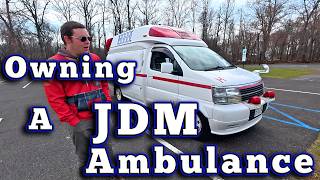

Why I bought a Japanese ambulance
44sUnique vehicle purchase story combined with the unexpected use as a camper creates curiosity and relatability.
▶ Play Clip"The title accurately reflects the content: a detailed tour of living with a Japanese ambulance, including its quirks and conversion to a camper."
This video features a tour of a converted Japanese ambulance, originally a Nissan Elgrand, which the owner bought for $3,000. The owner explains the modifications made for camping, the unique features of the vehicle, and the challenges of driving a right-hand drive, tall vehicle in the US.
The owner needed a vehicle that could haul things and needed a win quickly. The ambulance was for sale and he jumped on the opportunity.
The ambulance came with a pneumatically actuated gurney holder that acts as a gravity bed to absorb bumps for a patient.
The owner cut a memory foam mattress to fit, added 2x4s from Home Depot to level the floor, and placed the mattress on top. He has slept in it three times in cold weather with a winter sleeping bag.
The ambulance has a ventilation fan with low and high settings, controlled by a switch. The ceiling lights have a dimmable selector.
The external power source is a Japanese three-prong plug that is unusable in the US. The owner plans to replace it with a US standard hookup for campgrounds.
The vehicle has an AM radio with one speaker. It also includes a Pat-Lite cassette player designed for public address announcements through the siren system.
The PA microphone has a switch that allows it to be a 'hot mic' without holding the button, enabling continuous announcements.
The engine is tuned to idle at 1,100 RPM, providing a high idle that helps with stability. The vehicle automatically adjusts to maintain stability.
People often ask about the ambulance and are surprised it cost only $3,000 plus import fees, compared to Sprinter vans that can cost over $60,000.
The privacy windows create a massive blind spot on the left side, making merging onto highways scary. The driver relies on a side mirror to check the blind spot.
The V6 engine shifts well before redline. The speedometer shows 95 km/h while a third-party gauge reads 60 mph, indicating a discrepancy.
For right-hand drive vehicles, the driver should look at the white line on the shoulder to gauge lane position, as the natural tendency is to look left.
The ambulance is 8.5 feet tall (rounded to 9 feet for safety), which requires caution around low bridges and parking garages.
The IV poles clunk around while driving, and items like fruit rolls can fall out of place due to the movement.
The ambulance was tuned by Autech, which converted the Elgrand into an ambulance, resulting in a higher idle for more power.
The Japanese ambulance offers a unique and affordable camper conversion, but comes with challenges like a massive blind spot, height clearance issues, and an incompatible power hookup. Despite these quirks, it provides a distinctive driving experience and draws attention wherever it goes.
What was the original purpose of the gurney holder in the ambulance?
It was pneumatically actuated and acted as a gravity bed to absorb bumps for a patient.
00:32
How did the owner level the floor for the mattress?
He used 2x4s from Home Depot cut to fit the sloped areas where the gurney wheels would go.
01:10
Why is the external power hookup unusable in the US?
It has a Japanese three-prong plug that does not match any US standard outlets.
03:16
What is the Pat-Lite cassette player designed for?
It is designed to play public address announcements through the siren system, not for in-car audio.
04:40
How does the hot mic feature work on the PA microphone?
A switch allows the microphone to be held in the 'up' position, making it a hot mic without needing to press a button.
06:13
What is the idle RPM of the ambulance's engine?
1,100 RPM.
06:26
How much did the owner pay for the ambulance?
$3,000 plus import fees.
07:48
What is the main challenge when merging left in the ambulance?
The privacy windows create a massive blind spot on the left side, so the driver must rely on a side mirror.
08:29
What is the height of the ambulance?
8.5 feet tall, rounded to 9 feet for safety.
11:24
Which company converted the Nissan Elgrand into an ambulance?
Autech.
12:49
Reasons for Buying
Reveals the owner's practical and emotional motivations for purchasing a unique vehicle.
00:02DIY Camper Conversion
Demonstrates a simple, low-cost method to convert a vehicle into a sleeping space.
00:57Incompatible Power Hookup
Highlights a common issue with importing Japanese vehicles: non-standard electrical connections.
03:16High Idle Engine Tuning
Explains a specific modification by Autech to improve power delivery for ambulance use.
06:26Blind Spot Danger
Emphasizes a critical safety hazard due to the vehicle's design, relevant to any right-hand drive conversion.
08:29[00:02] this? Why? Well, I have two reasons. Um the easy answer is I needed a vehicle that could haul something because the fire truck wasn't going to do that. Uh the more obvious reason is I needed a win
[00:17] and I needed one fast and this was for sale and I saw it and I had to jump on that and give me give me give me. What was in here when you bought it? Um just
[00:32] uh gurney holder and that is it. The gurney holder is hydraulic, yes? Uh it's pneumatically actuated. When the engine is running, this acts as a gravity bed
[00:44] is running, this acts as a gravity bed essentially which will absorb bumps as a patient. So, my first order of business was I want to sleep in this thing. Uh well, how am I going to do that? I have to put a mattress in here.
[00:57] Okay, so I put a mattress in here by cutting this uh out from just like a little memory foam thing and then I realized, well, it slopes down on the edges because this is where the gurney's wheels would go. So,
[01:10] what I did was I just got some 2 by 4s from Home Depot, cut it to fit right there and slap the mattress right on top. Now, it's level. Have you slept in this thing overnight so far? I have. I've slept in here three
[01:25] And it's it's been perfect. Those were also when it was really cold. So, I needed a very cool winter sleeping bag which I have right down here
[01:37] and that kept me warm all night even in like 30° weather. and have it work? >> I have not tried those yet. yeah. >> And those are 100. I mean
[01:52] yeah. >> Possibly. Tiny little light. You also have uh grounding stuff right here for medical grounding stuff right here for medical equipment as well. What is that? That's
[02:04] Oh. Uh you just have a little ventilation fan which I control right over here. It's just in a low and high setting. setting. And that's what that would be.
[02:19] Little brighter. You just turned on the car without pushing the brake down. Right. There is no brake safety switch. Well, [laughter] yeah. Like modern JDM cars Oh, okay. you have to push the
[02:33] brake down to start the engine. You just turned the key while not in the just back here. Right, yeah. I get uh the light controls for the ceiling are also have a dimmable selector.
[02:46] These are the large roof lights. These are these little spotlights right here. Those also get very hot. So, be careful when you hold them. That's why And you also have external power on this. So, if you had external 100-V you
[03:01] could hook it up right to here. Where's your external hookup? That is on the outside. Uh on your on the right side of the car.
[03:16] What I would love to do is pull this thing out and replace it with a US external power source so that I can use it at an actual campground because this is completely unusable in the US. This three-prong thing, whatever is
[03:30] going on here, you will not find anything that connects to that here, unfortunately. Tell me about the radio that's inside. that's inside. So, all you get
[03:45] You get an AM radio with one speaker right here. >> anywhere in the car. >> There are these maybe there are speakers down here. I don't know.
[03:58] They're not connected to anything cuz if I turn this on, it only comes out of here. The idea is and same with the fire idea is that you're not going to be listening to music on the job. So, why
[04:13] give them anything other than an AM radio? Why give them anything at all then? Why give Yeah. I mean, I guess They just anything there. Who knows?
[04:26] But why just AM? You have the antenna. Is it that hard to give you FM as well? >> Probably not. Yeah. Yeah. Speaking of radios, what's that? Yes. So, you have a cassette player, but this is not just any cassette player. This is Pat-Lite's
[04:40] cassette player. Pat-Lite is the same company that makes the sirens. This is company that makes the sirens. This is designed to play directly out of your siren, not in the car. This is specifically used for playing public
[04:53] address announcements to the public like if you had to drive around town saying, week. Don't set your house on fire, please." That is where you would play it out of. You would use a cassette provided to you
[05:07] You would use a cassette provided to you by the town or city and you would just drive around town playing that. And it's uh auto loop or it automatically rewinds the cassette so it can play the PA over and over as well.
[05:21] and over as well. >> Oh. Yeah. But presumably also, you can these. >> Which I have. Mhm. Uh I I have >> And this also goes directly to your sirens as well. That goes directly to
[05:34] the sirens as well. There it is. Very hard to find this a USB-C to that >> USB-C to quarter >> Didn't know it exist? It does. What how
[05:46] are they cuz this is digital and that's analog unless in USB-C there's one pin in here that is analog. Mhm. Are we hearing the speakers >> Yes, we're hearing the speakers popping.
[05:59] >> This is one thing that's interesting. This is a hot mic. I'm not even holding it. Oh, that's Oh, I'm an idiot. Never mind. Look at this switch. You can hold it up like that instead of having to press it,
[06:13] you just press it up and now it's a hot mic. Oh my god. I learn something every day. Homer, this isn't just any megaphone. It's the Rap Master. Testing.
[06:26] >> [laughter] >> To your homes, it's Hammer. This is no throttle. See, because Allis-Chalmers tuned the engine to 1,100 RPM, it it idles so high that Yeah. I don't even have my foot on
[06:41] How is it stable with him running up and down like that? Uh it automatically Oh. adjusts. That's nice. Wow. Has anybody ever come up ambulance thinking it's a real one and asking for medical care?
[06:56] >> No, no. I'm I'm awaiting the day that happens. but thankfully that has not happened. I am slightly prepared with just basic emergency stuff.
[07:09] Um but I am no in no way trying to be a real ambulance. What sort of interactions have you had while driving this? Oh, I get phones out of the window of
[07:22] cars all the time, just like the other cars I have, but a lot of people will ask me about it and say, you know, wait, this is a camper, too, and that's awesome and I'll be at like a park with other people driving, you know, a
[07:36] Mercedes Sprinter van, like an actual camper. They'll see this and be like, that's such a cool idea. And then they Of course they got to ask me how much I paid for it and I tell them they're like, "What? That's it?" You paid $3,000
[07:48] for this? Yeah. Plus import fees. Yeah. Those Sprinter vans, those are like 60 or 70 grand, right? >> You you can you can get in the low six figures, no problem. >> Oh my god. That's insane.
[08:02] Oh, my lights are all on back here. Oh, right. I forgot about this. Did you see my precision parking when we were here last?
[08:17] anything. Which is nice. So, the worst thing the the one thing that I really don't like about this car Mhm. is merging
[08:29] left. >> Mhm. So, where you are right now, on-ramp. Yeah. Take a look to your left. >> Yep. Those privacy windows, which are great for hiding
[08:44] you operating on patients, are horrible for the driver. You cannot see any cars looking that way, which means you have to use this mirror right there. That is your only source of your blind spot. It's the most It's the scariest thing
[09:00] merging onto a highway in this thing, simply because I have just a massive blind spot to my left. Also, it's very wide, so make sure you're not going over the double yellow by looking at that mirror on your hood to see where your
[09:14] front left tire goes. That's your best indication right there. Back and beginning to again using my head as if it's going to help. goes. There's the V6.
[09:27] Shifts well before redline. My foot's on the floor. the floor. There is 80 km/h. And she's making a good noise while she's doing that. Almost to redline.
[09:40] 100 km is coming up. Nice. Anybody next to me? No. So, we were not able to hit 60. Your third-party speedometer is reading Your third-party speedometer is reading 60 mph, but this is only indicating 95
[09:55] km an hour. So, is saying you're going slower than what you're really going. Or that's wrong. Or that's wrong.
[10:18] >> have a power button down there for your transmission. >> Power. It's probably just up up the shift points. Remember you're driving a right-hand drive car, Brian. Yeah. Look down the white Okay, so this is for
[10:30] everybody who's never driven a right-hand drive car before. You always uh look at the white line next to the
[10:42] shoulder. That's going to be your gauge Yeah. to you tend to want to put your eyes down the left side of the lane cuz that's
[10:57] where your body's used to being. And this ambulance, even though it can go highway speeds and it's more modern than the Hijet, requires more mental concentration to
[11:10] >> Yes. Yes, it does, very much. You are bigger, you are heavier, >> taller. >> Yes. This is how high That's another thing I haven't talked about you have to be careful for is you are
[11:24] 8 and 1/2 ft tall. I like to round up to 9 to be safe, which is out here in PA, you actually do have to worry about because we have several bridges that are, you know, 100 years old or low railroad bridges that are also
[11:40] 100 years old that have low clearance. Some of the parking garages at the KOP Mall are are Oh, forget about it. >> Yeah. clunk. Well, you're Those poles you're hearing
[11:54] are the IV poles that you would run an IV to a patient. Ah. >> assembles in one big fold. You put it next to a person. things just start falling all over the place.
[12:09] place. My fruit rolls out to wherever it goes. there, Nick? I'm doing pretty great. >> Oh, yeah. They just stare at you like, "What am I looking at?"
[12:23] Cuz you see this thing, it's like, "Well, okay, it's an ambulance, but >> Mhm. This is a weird question, but you have have you ever driven this to uh like an Asian grocery store? Oh, yeah. I drove
[12:36] this to a Mitsuwa Nice. >> on the way back from Boston. I stopped un- unfortunately, it was terrible weather. That's when that snowstorm hit, the first one. And so, no one was around.
[12:49] Jumpy off the line. Well, this was also tuned by Autech, the company that converts it into an ambulance. It
[13:05] was tuned to idle slightly higher than a normal Elgrand Right. to give you a little more power. Right. Uh power. Right. Uh electrically speaking. Mhm.



⚡ Saved you 0h 13m reading this? Transcribe any YouTube video for free — no signup needed.