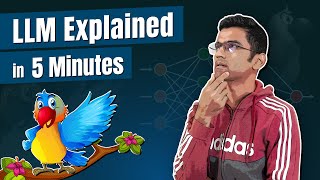

The Stochastic Parrot Analogy
43sUses a relatable pet analogy to explain a complex AI concept, making it highly shareable and easy to understand.
▶ Play Clip"The title accurately reflects the content's focus on explaining LLMs using a parrot analogy."
The video explains Large Language Models (LLMs) using the analogy of a parrot called Buddy that mimics conversations based on probability. It compares a language model to a stochastic parrot, then scales up to LLMs by adding massive data and neural networks with trillions of parameters. Finally, it covers RLHF (Reinforcement Learning from Human Feedback) as a method to reduce toxic outputs.
Buddy mimics conversations based on probability without understanding the meaning of words like Biryani or bicycle.
A language model uses a neural network to predict the next set of words in a sentence.
Gmail autocomplete is an example of an application that uses a language model.
A Large Language Model is trained on huge data like Wikipedia, news articles, and online books, with a neural network containing trillions of parameters.
Examples of LLMs include GPT-3/GPT-4 (ChatGPT), PaLM 2 (Google), and LLaMA (Meta).
RLHF stands for Reinforcement Learning from Human Feedback, used to make ChatGPT less toxic.
LLMs work purely based on training data and do not have subjective experience, emotions, or consciousness.
What does 'stochastic' mean?
Stochastic means a system characterized by randomness or probability.
00:43
What is a language model?
A language model is a computer program that uses neural networks to predict the next word(s) in a sequence based on training data.
00:55
What is a Large Language Model (LLM)?
A Large Language Model is a language model trained on a huge volume of data (e.g., Wikipedia, news, books) with neural networks containing trillions of parameters.
02:04
What does RLHF stand for?
RLHF is Reinforcement Learning from Human Feedback.
02:45
How did OpenAI use RLHF to make ChatGPT less toxic?
OpenAI used human reviewers to mark toxic / safe responses from ChatGPT, then the model learned from that feedback to reduce toxicity.
03:24
Do LLMs have subjective experiences or emotions?
LLMs work purely based on the data they have been trained on, with no subjective experience, emotions, or consciousness.
03:39
Give one example of an application that uses a language model.
Gmail autocomplete.
01:22
Stochastic parrot analogy
It provides an intuitive mental model for understanding how LLMs generate text via probability without understanding.
00:27Neural networks for language modeling
Explains that LLMs are built on neural networks that predict the next set of words.
00:55LLMs require massive data and trillions of parameters
Contrasts small language models with LLMs by highlighting scale.
02:04RLHF uses human reinforcement
Demonstrates the role of human feedback in making LLMs safer and less toxic.
02:45LLMs lack consciousness
Explicitly states that LLMs are not conscious or emotional, correcting a common misconception.
03:39[00:00] Peter Pandey has a curious parot called Buddy. Buddy has a great mimicking ability and a sharp memory. Buddy listens to all the conversations in Peter's home and can mimic them very accurately.
[00:15] Now when he hears, feeling hungry, I would like to have some. For this case, the probability of him saying Biryani cherries or food is much higher than the words such as Bicycle or Book.
[00:27] Buddy doesn't understand the meaning of Biryani or food or cherries the way humans do. All he's doing is using statistical probability, along with some randomness to predict the next word or set of words, purely based on the past conversations he has listened to.
[00:43] We can call Buddy a stochastic parot. Stochastic means a system that is characterized by randomness or probability. A language model is somewhat like a stochastic parot.
[00:55] There are computer programs that use a technology called neural networks to predict the next set of words for a sentence. For a simple explanation of a neural network, please watch this particular video.
[01:07] Just like how Buddy is trained on Peter's home conversations dataset, you can have a language model that is trained on, for example, all movie related articles from Wikipedia, and it will be able to predict the next set of words for a movie related sentence.
[01:22] Gmail autocomplete is one of the many applications that uses a language model underneath. Now that we have some understanding of a language model, let's understand what the hack is a large language model.
[01:35] Let's go back to our Buddy example. Our Buddy got some divine superpower, and now he can listen to Peter's neighbor's conversations, conversations that are happening in schools and universities in the town.
[01:49] In fact, not only in his town, but all the towns across the world. With this extra power and knowledge, now Buddy can complete the next set of words on a history subject, give you a nutrition advice, or even write a poem.
[02:04] Like our powerful parot buddy, large language models are trained on a huge volume of data such as Wikipedia articles, Google news articles, online books and so on.
[02:16] If you look inside the LLM, you will find a neural network containing trillions of parameters that can capture more complex patterns and nuances in a language. Chat GPs and application that uses LLM called GPT-3 or GPT-4 behind the scenes.
[02:33] Other examples of LLMs are palm-to-buy Google and Lama by Meta. On top of statistical predictions, LLM uses another approach called reinforcement learning
[02:45] with human feedback, RLHF. Let's understand this once again with Buddy. One day Peter was having a conversation with his cute little two-year-old son, son, don't
[02:58] eat too much bananas, else… Hearing this, Peter realized that Buddy has been listening to the conversations from abusive parents in his town.
[03:11] What he said was the effect of that. Peter then starts keeping a close eye on what Buddy is saying. For a same question, Buddy can produce multiple answers and all Peter has to do is tell him which
[03:24] one is toxic and which one is not. After this training, Buddy doesn't use any toxic language. While training chat GPT, OpenEI used a similar approach of human intervention, RLHF.
[03:39] OpenEI used a huge workforce of humans to make chat GPT less toxic. While LLM are very powerful, they don't have any subjective experience, emotions or consciousness that we as humans have, LLM's work purely based on the data that they have
[03:55] been trained on. I hope you like this short explanation which was based on analogy, obviously the technical working of this thing is little different than analogy but this should give you a good intuition on this topic.
[04:07] If you like this video, please share with those who are curious about this topic.




⚡ Saved you 0h 04m reading this? Transcribe any YouTube video for free — no signup needed.