
The Only Prompt Formula You'll Ever Need
45sPromises a simple, powerful formula for mastering ChatGPT, appealing to anyone frustrated with generic AI outputs.
▶ Play Clip"The title promises a formula to master prompting, and the video delivers a clear, actionable framework with examples."
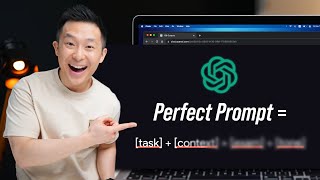
This video presents a six-component formula for crafting effective prompts on ChatGPT and Google Bard. The formula includes task, context, exemplars, persona, format, and tone, ordered by importance. The presenter demonstrates how to apply these components with practical examples to generate high-quality outputs.
The video claims to share the only formula needed to master prompting on ChatGPT and Google Bard, consisting of six building blocks.
The six components are task, context, exemplars, persona, format, and tone, with an order of importance.
Task is mandatory, context and exemplars are important, persona, format, and tone are nice to have.
Start the task with an action verb and clearly articulate the end goal.
Provide just enough information by asking: user's background, what success looks like, and environment.
Including examples or frameworks improves output quality. Examples: resume bullet points, interview answers, job descriptions.
Assign a persona to the AI, such as a physical therapist or recruiter, to get tailored responses.
Visualize the desired output format, e.g., table, email, bullet points, markdown.
Specify tone (casual, formal, witty) or ask the AI to suggest tone keywords.
A full prompt combining all components: persona (senior PMM at Apple), context (Apple car launch), task (write email), format (with sections), and tone (confident yet friendly).
Mastering the six-component formula—task, context, exemplars, persona, format, and tone—enables users to consistently generate high-quality, tailored outputs from AI language models.
What are the six components of the prompt formula?
Task, context, exemplars, persona, format, and tone.
00:34
Which component is mandatory in a prompt?
Task.
01:15
What three questions help provide good context?
What's the user's background? What does success look like? What environment are they in?
02:16
What is the pro tip for the persona component?
Think of someone you wish you had instant access to for the task.
04:38
How can you get tone keywords if you can't think of adjectives?
Ask ChatGPT to give you a list of tone keywords based on the feeling you're going for.
06:46
Six Building Blocks of a Good Prompt
Provides a clear, memorable framework for prompt engineering.
00:34Hierarchy of Components
Explains which components are mandatory vs. optional, helping users prioritize.
01:15Three Questions for Context
Offers a practical method to avoid overloading the prompt with irrelevant info.
02:16Persona as a Wish-List Expert
Makes the persona component relatable and easy to apply.
04:38Tone Keyword Generation
Shows a clever workaround for specifying tone when you're unsure.
06:46[00:00] I don't usually overhype myself but in
[00:02] this video we're going over the only
[00:04] formula you will ever need to master
[00:06] prompting on ChatGPT and Google Bard
[00:08] so let's get started hey friends welcome
[00:11] back to channel if you're new here my
[00:12] name is Jeff I work full-time in Tech
[00:14] and if you're anything like me a couple
[00:15] months ago you know prompting is an
[00:18] important skill to learn but you're not
[00:19] exactly sure why some prompts generate
[00:22] outputs that are super generic While
[00:24] others give you precisely what you're
[00:26] looking for since then I've spent
[00:27] hundreds of hours taking prompt
[00:29] engineering courses and applying what
[00:31] I've learned in my daily life and so in
[00:33] this video I'm sharing the six building
[00:34] blocks that make up a good prompt so
[00:36] that you can use this formula to
[00:38] consistently generate high quality
[00:41] outputs first it's critical to not only
[00:43] know what the six components are task
[00:45] context exemplars Persona format and
[00:47] tone but also know that there's an order
[00:50] of importance to these six components to
[00:53] show you what I mean let's use this
[00:54] simple example I'm a 70kg male give me a
[00:57] three-month training program the first
[00:59] part is context followed by the task the
[01:01] reason why the task is higher up in the
[01:03] form of the hierarchy is if we just
[01:05] input the task without the context
[01:06] there's still some sort of meaningful
[01:08] output but if we just give ChatGPT the
[01:11] context nothing really happens put
[01:13] another way it's mandatory to have a
[01:15] task in your prompt it's important to
[01:18] include relevant context and exemplars
[01:20] and it's nice to have Persona format and
[01:23] tone when you think of writing your
[01:25] prompt go down this mental checklist so
[01:28] this formula will act as a constant
[01:29] reminder for you to include just enough
[01:31] relevant information when writing
[01:33] prompts and as you'll see in this next part
[01:35] you do not need all six components in
[01:38] every prompt to have a good output now
[01:40] let's break down each building block
[01:42] with specific examples starting with the
[01:44] task the rule of thumb is to always
[01:46] start the task sentence with an action
[01:48] verb generate give write analyze Etc and
[01:51] clearly articulate what your end goal is
[01:54] it could be one simple task like
[01:56] generating a three-month training
[01:57] program or a complex three-step ask like
[02:00] analyzing hundreds of user feedback
[02:02] sharing the top three takeaways and
[02:05] categorizing the feedback based on the
[02:07] team responsible for following up the
[02:09] second component context is the
[02:10] trickiest to get right because
[02:11] technically there's an infinite amount
[02:13] of information you can give so I found
[02:16] asking myself these three questions to
[02:18] be super helpful in coming up with just
[02:20] enough information to get a good result
[02:22] from ChatGPT first what's the user's
[02:24] background second what does success look
[02:27] like and third what environment are they
[02:29] in Back to the workout example we now
[02:31] have I'm a 70kg male looking to put on
[02:34] five kilograms of muscle mass over the
[02:35] next three months I only have time to go
[02:37] to the gym twice a week and for one hour
[02:39] each session give me a three-month
[02:41] training program to follow could I have
[02:43] added more background information of
[02:45] course only prioritize the muscle groups
[02:47] that make me look good on Instagram
[02:49] but the key to staying productive with
[02:51] ChatGPT and Bard is giving just enough
[02:53] information to constrain the endless
[02:55] possibilities by the way although this
[02:57] video is not sponsored it is supported
[02:59] by those of you who subscribe to my paid
[03:01] productivity newsletter on Google
[03:02] workspace tips Link in the description
[03:04] to learn more moving over to the
[03:06] exemplars component it's just a fancy
[03:08] way of saying examples basically all the
[03:10] research on large language models LLMs
[03:13] have shown that including examples
[03:15] within the prompt drastically improves
[03:18] the quality of the output starting with
[03:20] a simple example this is a poorly written
[03:22] bullet point from a resume we can now
[03:25] ask ChatGPT to rewrite this bullet
[03:27] point using this structure I accomplished
[03:29] X by the measure y that resulted in Z
[03:31] which is actually best practice by the
[03:33] way so actually do this in your resume
[03:34] for example I lowered Hospital mortality
[03:37] rate by 10% by educating nurses in new
[03:39] protocols which translates to 200 lives
[03:41] saved per year here's a slightly more
[03:43] complicated example for interview prep
[03:45] based on my own resume write me an
[03:47] answer to the interview question what's
[03:49] your biggest weakness use the star
[03:51] answer framework situation task action
[03:53] and results here instead of using a
[03:56] full-blown interview answer as an
[03:57] example which would be overkill the star
[04:00] framework acts as an example structure
[04:02] for ChatGPT to follow last example
[04:04] let's say you need to write a job
[04:05] description you give some context around
[04:07] the opening and ask ChatGPT to
[04:09] reference an existing job description if
[04:12] I use this one I found on LinkedIn the
[04:13] output will follow the same formatting
[04:15] and use the same professional HR-y
[04:17] language saving me a bunch of time main
[04:20] takeaway here exemplars are not
[04:22] necessary for every prompt but including
[04:25] a relevant example or framework will
[04:27] greatly improve the quality of your
[04:29] output moving along the Persona
[04:31] component is basically who you want
[04:33] ChatGPT and Bard to be and the pro tip
[04:36] here is to think of someone you wish you
[04:38] had instant access to with the task
[04:40] you're facing if you enjoyed yourself
[04:42] working out that person might be a
[04:43] physical therapist with experience
[04:44] helping athletes recover if you're a job
[04:47] Seeker that person might be a recruiter
[04:48] or hiring manager if you're working on a
[04:51] creative brief that person might be a
[04:52] senior product marketing manager who's
[04:54] great at storytelling Pro tip you can
[04:56] also name specific individuals but I
[04:58] found the results to be good only when
[05:00] they're famous enough like Warren
[05:01] Buffett Steve Jobs Jeff Su
[05:04] by the way I just have to share this we
[05:06] have a team off-site with a superheroes
[05:08] theme so I asked ChatGPT to draft an
[05:10] email from Batman and it even included
[05:12] things like please let Alfred know and
[05:14] signed off as Your Dark Knight
[05:16] um so fictional characters work as well
[05:18] and I'm actually going to use this the
[05:19] fifth component format the pro tip here
[05:22] is to literally close your eyes and
[05:24] visualize how exactly you want the end
[05:26] result to look like a million likes on
[05:28] my thirst bomb Instagram photo damn it
[05:30] didn't work back to the user feedback
[05:32] example I don't want to read each
[05:34] sentence so I asked ChatGPT to take
[05:36] all the feedback and output a table with
[05:39] three headers the original feedback the
[05:41] team responsible for following up and
[05:43] priority and now I can copy this
[05:46] directly and paste it into a Google
[05:48] sheet sort by priority and filter by team
[05:51] other common formats include emails
[05:53] bullet points and code blocks but the
[05:55] one I found to be the most useful as a
[05:57] full-time working professional is
[05:58] paragraphs and markdown for example I
[06:01] just received a lengthy industry report
[06:03] for my director first give me the three
[06:04] key takeaways then summarize based on
[06:07] topic use H2 as section headers here is
[06:10] the report Pro tip whenever I use ChatGPT
[06:12] to proofread any document I specify
[06:15] that all changes need to be bolded so I
[06:17] can easily see exactly what has been
[06:20] changed let's quickly go through the
[06:21] last component tone before we put all
[06:23] this together in one example the good
[06:25] news is tone is easy to understand use a
[06:28] casual or formal tone of voice give me a
[06:31] witty output show enthusiasm sound
[06:34] pessimistic the bad news is we're
[06:37] usually not very good at recalling the
[06:39] thousands of potential adjectives and
[06:41] adverbs at a moment's notice so here's a
[06:43] pro tip tell ChatGPT the feeling
[06:46] you're going for for example I'm writing
[06:48] an email to a team I haven't worked with
[06:49] before and I want to be taken seriously
[06:51] without coming off as too stuck up and
[06:53] cringy can you please give me a list of
[06:56] five tone keywords I can include in a
[06:58] prompt for ChatGPT and look now in the
[07:00] actual prompt I can say use clear and
[07:02] concise language and write in a friendly
[07:04] get confident tone putting all this
[07:07] together let's look at this
[07:08] comprehensive prompt you are a senior
[07:10] product marketing manager at Apple
[07:12] Persona and you have just unveiled the
[07:14] latest Apple product in collaboration
[07:16] with Tesla the Apple car and received 12
[07:18] 000 pre-orders which is 200% higher than
[07:21] Target context write an email to your
[07:23] boss Tim Cookie sharing this positive
[07:25] news task and format the email should
[07:28] include at tl;dr too long didn't read
[07:30] section project background why this
[07:32] product came into existence business
[07:34] results section quantifiable business
[07:36] metrics and end with a section thanking
[07:39] the product and Engineering teams
[07:41] example structure use clear and concise
[07:44] language and write in a confident yet
[07:46] friendly tone tone note that if I had an
[07:49] existing email to reference I could
[07:51] delete the instructions around the
[07:53] structure and simply tell ChatGPT the email
[07:56] should follow the exact same format as a
[07:58] one I'll share below and paste the email
[08:00] from before by the way you can compare
[08:02] the output from this prompt to that of a
[08:04] simpler prompt I just launched a new
[08:06] product at the Apple car I received 12
[08:08] 000 pre-orders please write an email to my
[08:10] boss with this update there's a pretty
[08:12] big difference in terms of how generic
[08:14] and usable the end result is now that
[08:16] you know the basics of prompting my next
[08:18] video is going to take you from beginner
[08:19] to Pro so make sure you're subscribed
[08:21] for that check out my top five ChatGPT
[08:23] productivity tips for work see you on
[08:25] the next video in the meantime
[08:27] have a great one
⚡ Saved you 0h 08m reading this? Transcribe any YouTube video for free — no signup needed.