
Roulette: The House Always Wins
46sExplains the basic rules and reveals the casino's built-in advantage, sparking curiosity about why players always lose.
▶ Play Clip"Title accurately reflects content: the video thoroughly covers the mathematics of roulette."
This video explains the mathematics behind roulette, demonstrating that no betting strategy can overcome the house edge. Through detailed calculations of various betting strategies—including single bets, split bets, and the James Bond strategy—the presenter shows that the expected loss per dollar bet is always 5.3 cents. The Martingale system is discussed as a theoretical exception requiring infinite wealth, but it is impractical.
Roulette wheel has 38 numbers: 1-36, 0, and 00. Each number has equal probability. Various bets have different payouts: single number (35:1), low/high/even/odd/red/black (1:1), double (7:1), row (11:1), corner (8:1), double row (5:1), column (2:1), dozen (2:1).
Betting $1 on the first column (12 numbers) yields expected winnings of -2/38 ≈ -$0.053, meaning a loss of 5.3 cents per dollar bet.
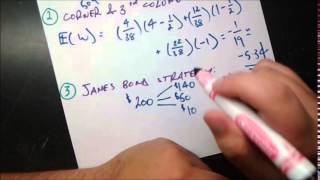
Betting $0.50 on a corner (8:1) and $0.50 on the third column (2:1) also results in expected loss of -2/38 ≈ -5.3 cents per dollar bet.
Betting $140 on high numbers (19-36), $50 on 13-18 (double row), and $10 on 0 yields expected loss of -$10.5 per $200 bet, which is -5.3 cents per dollar bet.
The Martingale strategy involves doubling the bet after each loss until a win, which recovers all losses plus $1. It guarantees a $1 profit if the player has infinite wealth, but is impractical due to finite bankroll and table limits.
No betting strategy can overcome the house edge in roulette; the expected loss per dollar bet is always 5.3 cents. The Martingale system is theoretically profitable only with infinite wealth, making it impractical for real-world play.
How many numbers are on a standard roulette wheel?
38 numbers: 1-36, 0, and 00.
00:13
What is the payout for a single number bet in roulette?
35 to 1.
00:53
What is the expected loss per dollar bet on a single column in roulette?
5.3 cents.
03:40
What is the payout for a corner bet?
8 to 1.
02:01
What is the payout for a double row bet?
5 to 1.
08:19
What is the James Bond strategy in roulette?
Bet $140 on high numbers (19-36), $50 on 13-18 (double row), and $10 on 0.
06:52
What is the expected loss per dollar bet using the James Bond strategy?
5.3 cents.
09:32
How does the Martingale strategy work?
Double the bet after each loss until a win, which recovers all losses plus $1.
10:26
Why is the Martingale strategy impractical?
It requires infinite wealth to guarantee a win, and table limits restrict bet sizes.
12:48
What is the house edge in roulette for a 1:1 bet?
The probability of winning is 18/38 ≈ 47.37%, so the house edge is about 5.26%.
01:19
House Edge Revealed
Demonstrates that the expected loss per dollar bet is always 5.3 cents, regardless of strategy.
03:40Martingale Strategy
Explains a theoretically winning strategy that is impractical due to finite resources.
10:13Moral of the Story
Summarizes that roulette is a game of losing 5.3 cents per bet, emphasizing the house edge.
13:41[00:01] roulette now a lot of people are familiar with roulette but we can just review all the rules and then we'll go into the math and see why it's very game because in the long run you'll be
[00:13] number come up over and over and over again as we do a few test cases but first let's just explain the basic rules so the game is played very simply you take this ball and you spin around this wheel which is lined with 38 numbers uh
[00:26] which are the numbers 1 through 36 as well as 0 and0 but each number has an equal chance of being of the ball landing on it that is glitches in the wheel or anything like that so there's no exploits you can do
[00:40] of bets and depending on the kind of bet you make the payoffs are different so the easiest kind of bet you make is on a single number so let's say I bet on the 18 for some reason so the ball rolls around round round and miraculously it
[00:53] lands in the number 18 I've have one if I bet $1 on 18 then my payout is 35 to1 which means I get $35 back which is quite a lot but of course it's that high because the casino knows that's very unlikely and that's kind of how these
[01:07] bets work the more and more likely something becomes to happen the less and example the lowest payout you can get is one to one which means you put down $1 and if that event happens you'll get a dollar back and those include getting
[01:19] something like 1 through 18 which is called low numbers uh notice something many numbers are in here there are 18 numbers how many chances how many numbers are there total 38 so that 18 over 38 is a little bit under a half so
[01:33] casino's Advantage because you're just getting a one to1 payout we'll make this all concrete later on again High numbers are 1 to one even numbers are 1 to one odd black red all one to one uh there's a few other kind of bets a double means
[01:46] two adjacent numbers so I could do 1112 or 1215 and that would be 7 to1 payout a row is one of these rows so 1 2 3 or 13 14 15 that row will pay out 11 to1 a corner is four numbers such as 8 9 11 12
[02:01] the corner payout will be 8 to one we'll see that later on a double row is just a two rows uh a column is just one of these three columns not including the zero or double zero here and a dozen is just three rows so sorry four rows so
[02:16] it's going to be 1 through 12 13 through 24 or 25 through 36 and that's a dozen of the order it goes and that's basically the basic rules now let's see if you should play this game let's do a few different test cas to see if we can
[02:30] find some winning strategy or something like that so we're going to go to this strategies just to see what kind of things we get by doing these things so First Column so what that means is we're going to bet a dollar so we'll just do a
[02:45] we're going to bet a dollar on the First Column that is the numbers 1 through 34 just this whole First Column right here so that includes 12 numbers so if we betting a dollar right so what's the expected winnings we're going to I get
[03:00] so there's a few different things that can happen we could win in which case we column so if we look at this chart right here we see the column odds are 2 to1 so we're going to get $2 back so we could win $2 and what are the odds of doing
[03:14] that well there's 12 numbers in a column 38 numbers total so that's our chance of getting $2 now the other more likely thing is that we just lose the dollar we well it's the rest of the probability so it's going to be
[03:26] it's going to be 26 over 38 so this is a very basic calculations so on top we have 24 - 26 so we have -2 over 38 also known as -1 calculator and we figure out what it is
[03:40] approximately 5.3 so here's the first instance of that 5.3 cents coming up and let's explain what this means that means if you use this over and over and over again you keep betting a dollar on the first
[03:53] column in the long run on every single every single time you play this game you're expecting to lose ne5 .3 cents so you're expecting to lose money even use this strategy if you're if you're trying to make money okay that's fine
[04:07] you try a more complicated strategy you put two different bets so we're going to put 50 cents half a dollar on a corner and we're going to put 50 cents on the third column let's explain what that means and
[04:21] the payouts so for example we're just going to choose a corner let's say we choose the corner 1 2 4 5 so the one that's in green right here and and we're going to we're going to put 50 cents on that corner and we're going to put 50
[04:33] other cents on this entire third column so we see that there's no overlap in the expected value calculation is a little more involved but it's still pretty simple so what are our expected winnings now now there's three things that can
[04:47] happen the first thing that can happen is we win our corner bet so that means one of those uh numbers in the four uh in the corner that we picked gets landed on by the Wheel by by the ball so what's what's the probability of this the prob
[04:59] numbers and there's 38 total numbers that's the probability now we bet 50 cents or half a dollar how much are we expecting to win so a corner is 8 to one so we'll be getting 8 times 50 c or $4 back if we
[05:15] win this but there's something to keep in mind even though we'll win $4 we'll that column will not have come up so we have to subtract half a dollar so you you're doing these calculations now the other Cas is of course the column could
[05:30] probability is 12 over 38 so we have 12 over 38 and what are the payouts we remember the payout was double so it's going to be getting $1 since we only bet 50 cents this time but again we lose the 50 cents
[05:43] we bet on the corner because that didn't come up uh because the column came up so the last case which is that we don't get either of them that we Leed something probability of this so these probabilities add up to 16 over 38 which
[05:56] probabilities add up to 16 over 38 which leaves what that leaves uh 20 2 so we have plus 22 over 38 and what's the payout here well the payout here is we just lose the $1 now if we go ahead and we calculate this
[06:11] this comes out to -2 over 38 or -1 over1 19 again and as we saw from up here that 19 again and as we saw from up here that is about -5.3 C so that number has come more complicated strategy putting our bets in two different places kind of
[06:25] like splitting our bets up which people think sometimes is advantageous we're the strategy we're expecting to lose uh 5.3 cents so again we should not use this strategy if we're trying to make money uh in the long run now we're going
[06:38] and something that's been even written in a book so the original author of the Bond strategy and it involves three places rather than just two or rather than just one and we're going to Ju Just
[06:52] doing we're not going to have $1 this time we're going to start with $200 we're going to take $200 and we are going to put it in three different places so we're going to put $140 in one place we're going to put $50
[07:06] in another place and $10 in another place and I'll explain right now where each of those places is so we're going to put $140 on the high numbers that is numbers 19 through 36 we're going to put $50 on 13 through 18 in the form of a
[07:21] the number zero and that that's where they're all expected value using the same kind of strategies we' doing up here so just really a big deal so what are our expected winnings now there's three
[07:37] different things that could happen uh so we can let's say this $140 bet pays off so how many of these are there there's 18 and how many are there total there's 38 numbers so as we noted in the beginning this is slightly under a half
[07:52] and those odds are just one to one so that means we're gaining $140 but then we're losing the 50 and the 10 because by default these wouldn't have come up if this came up right because they're all none of these are uh
[08:05] there's no overlap between all these bets here so we're losing $60 total that's one thing that can happen another thing that can happen is if this numbers is that that's six in the form of double row right so there six numbers
[08:19] so we could be getting plus 6 over 38 and a double row payout let's refer to our chart here a double row is 5 to one so we're getting 5 * 50 or $250 but by default again we're losing this 150 that's contained in the 140 and
[08:35] the 10 so minus 150 now there's just two more cases the next case is this very unlikely case that this zero comes up uh which is a 1 over 38 chance but if it does happen that's 35 to1 odds so we're getting
[08:50] to1 odds so we're getting $350 but we're losing this $190 from here and the last case would be that none of these events happen so what's the total probability here it's 18 and 6 that means 24 this is 25 so that leaves
[09:03] that means 24 this is 25 so that leaves uh 13 so we have + 13 over 38 that's the chance that nothing comes up that means we lose the whole
[09:16] $200 and this uh in the end comes out to Nega we bet so much more in these first two bets we bet $1 total in this one we bet all $1 on the First Column this we split up our bets here we're betting $200 so
[09:32] of winnings per dollar that we're going to get we should divide this -1.5 by 200 and when we do that we end up with you guessed it this -5.3 cents so that means even using this complicated more complicated strategy
[09:47] call the James Bond strategy we are going to on average every time we play this strategy every round we play it we're going to be losing 5.3 so every cents and you can prove that playing roulette playing this game we just
[10:00] described every single time you play it there's no you cannot do better than round it's just that's the way the casino made it so that the house could have the advantage at all times now it
[10:13] is a theoretical gambling strategy we haven't talked about yet and which we'll talk about right now now we say theoretical because it's not really applicable in the real world but if it were if you had an infinite amount of
[10:26] money then you would be guaranteed to you always win exactly $1 playing with this strategy um and let's explain it right now it's very simple the way you always win $1 so this is called a Martingale so how you play is very
[10:41] bet playing roulette now you have a $1 bet now two things can happen you can either win or lose so let's say you can either win or
[10:53] the casino and let's say you're just doing a onetoone BET right so uh if you you'll take your dollar and you'll leave the casino so we'll just we'll depict leaving by just this you start a little house
[11:07] house for go home take your dollar home so if you win you just go straight home with your dollar you won a dollar now let's say you lose you lost your dollar what you do now is you bet $2 okay so we're
[11:19] assuming you have an infinite amount of money uh or not infinite you have a very money is no issue right now so you bet $2 again you can either win event that you win so what what's happened so far you've bet a dollar
[11:35] currently have a balance a winning balance of negative $1 now you bet $2 and you win so you get those two you get $2 so right now you have a winnings of $1 so you're in you've won from the casino so far now you've won so you just
[11:50] take your $1 and you go home now what's more likely is that you're going to lose again now if you lose you double your bet so you bet $4 I'll try drift towards this side so we have space uh $4 now either you win or you lose now if
[12:06] calculation so if you've been if you got to this stage what's happened you've bet negative one you've bet $2 you lost those $2 you won your $4 though so you're going to get plus 4 4 - 2 - 1 is + one so you take your $1 of winnings
[12:22] and you go home and if you lose you bet $8 and that just keeps happening so at either you win or lose and if you win you just go straight home if you lose you double your bet so we we see that playing the strategy if you're able to
[12:36] double your bet every single time then as soon as you win you're going to recuperate all of your losses plus a dollar so that means using the smarting Gale strategy and if you have a very very very very very large amount of
[12:48] then you will always leave the casino with $1 now you can probably already see major problems the first is that it could take a long time before you win uh
[13:00] a round and that could involve since you're doubling your bet every time this is this is this is uh getting bigger and bigger and bigger at a very very very money to cover the next bet and you might run out of money before you're
[13:13] even able to win and cover all your previous losses the second thing is even is kind of required for this game if you're very wealthy and you're guaranteed that the strategy will get you $1 in the end is there really a
[13:25] know it doesn't really seem worth it to spend all all that time at the casino to be guaranteed $1 no more no less of a payout so that's why the Martingale for always winning a dollar and definitely better than um our our
[13:41] strategies outlined here where you're losing money every single time it's not really practical so so the the moral of this game is roulette might be fun but really it should be called the game of losing 5.3 cents because that's what's
[13:54] losing 5.3 cents because that's what's happening so until next time
⚡ Saved you 0h 13m reading this? Transcribe any YouTube video for free — no signup needed.