
The Two Choices That Solve Job Scheduling
45sThis segment reveals a counterintuitive insight that a seemingly complex problem boils down to a simple binary decision, which is both surprising and educational.
▶ Play Clip"Delivers a clear DP explanation but is brief and lacks depth; title is accurate but not exceptional."
This video explains the concept of dynamic programming through the classic job scheduling problem, where the goal is to maximize profit by selecting non-overlapping jobs. It contrasts the exponential brute-force approach with the efficient DP method, illustrating how each decision reduces to either skipping a job or taking it and jumping to the next non-overlapping one.
Given a list of jobs with start time, end time, and profit, the goal is to pick jobs to maximize profit without overlapping.
Trying all combinations of jobs becomes exponential in complexity.
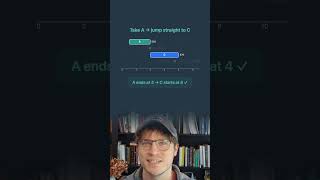
For each job, only two choices: skip it (move to next job) or take it (earn profit and jump to next non-overlapping job).
Example: Job A earns 20, B overlaps so skip (still 20), C follows A (20+70=90), D follows B (20+100=120). Each job builds on future answers.
Instead of trying all combinations, choose the best option at each step, which is the core of dynamic programming.
Dynamic programming optimizes job scheduling by making optimal local decisions that build on future results, avoiding exponential time complexity.
What is the goal of the job scheduling problem?
To pick jobs to maximize profit without overlapping.
00:02
Why is brute force approach exponential?
Because it tries all combinations of jobs.
00:17
What are the two choices for each job in DP?
Skip it or take it and jump to the next non-overlapping job.
00:31
In the example, what is the profit when taking job C after A?
90 (20 + 70).
00:45
What is the core idea of dynamic programming?
Choosing the best option at each step, building on future answers.
01:00
Two-Choice DP Framework
Simplifies the problem into a binary decision, making it tractable.
00:31DP Array Example
Concrete example shows how DP builds optimal solutions incrementally.
00:45DP Essence
Captures the fundamental principle of dynamic programming.
01:00[00:02] it's actually just one decision. You're given a list of jobs. Each job has a start time, an end time, and a profit. Your goal is to pick jobs to maximize profit, but they can't overlap. Most people will try all combinations, but
[00:17] that becomes exponential. A better option is to think like this. For every job, you only have two choices. Either skip it or take it. If you skip it, you just move to the next job. But if you take it, you earn its profit, and you
[00:31] jump to the next job that doesn't overlap, like taking job A and jumping straight to C. So, every decision becomes either skip it or take it and add the best profit from the next valid job. Now, watch the DP array fill. We
[00:45] job. Now, watch the DP array fill. We start with zero. Job A earns 20. Job B overlaps, so we skip. Still 20. Job C can follow A, so 20 + 70 is 90. Job D can follow A, so 20 + 70 is 90. Job D can follow B, so 20 + 100 is 120. Each
[01:00] job builds on future answers. You're not trying all combinations. You're choosing the best option at each step, and that's dynamic programming. Learn more problems like this with interactive visualizations on Hello Interview, and
[01:13] visualizations on Hello Interview, and follow us for more.



⚡ Saved you 0h 01m reading this? Transcribe any YouTube video for free — no signup needed.