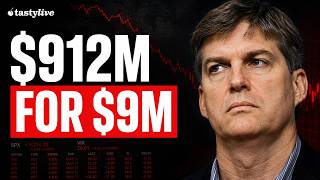

How Michael Burry Turned $9M into $912M
42sThe jaw-dropping leverage ratio of Burry's position is shocking and instantly grabs attention.
▶ Play Clip"Title promises a deep dive into Burry's trade, and the video delivers a solid explanation of put buying mechanics, though it's more about options math than Burry himself."
This video analyzes the recent disclosure that Michael Burry controlled a $912 million short position using only $9 million in put premium, focusing on the mechanics of buying put options in high implied volatility (IV) environments. The host uses Micron (MU) as a case study to illustrate why downside moves yield lower returns than equivalent upside moves, and offers strategies like diagonal spreads and near-term in-the-money puts to mitigate these challenges.
Michael Burry's portfolio includes short positions in notable stocks like Micron, with a $912 million exposure controlled by just $9 million of put premium, highlighting the leverage of options.
In Black-Scholes, the current stock price is a major input; higher stock prices increase option premium, so puts on high-priced stocks have higher extrinsic value, reducing profit potential.
A $100 stock moving to $150 yields a 3x return on a call, while a drop to $50 yields only 50% on a put, due to lower extrinsic value at lower stock prices.
In Micron, a 200-point upside move (1000 to 1200) increased a call option from $13K to $30K (3x), while a similar downside move (1000 to 800) only increased a put from $10K to $15K (50%).
With Micron at ~90% IV, puts are expensive; a 200-point move is within expected range, so options don't appreciate as much as in lower IV environments.
Suggestions include near-term in-the-money puts, diagonal spreads, or calendar spreads to reduce extrinsic value exposure and lower cost basis.
Longer-dated options have more time value and less IV exposure, helping retain value, but holding to expiration is risky due to high extrinsic value.
In lower IV stocks like Meta (40% IV), a put can double in value on a similar move, making them more attractive for directional bets.
Buying puts in high IV stocks like Micron is inefficient; traders should consider lower IV names or use spreads to manage costs and improve risk-reward.
What was Michael Burry's reported short exposure and premium?
$912 million exposure controlled by $9 million in put premium.
00:14
Why do puts on high-priced stocks yield lower returns than calls?
Because lower stock prices reduce extrinsic value, so puts appreciate less on a percentage basis.
01:41
In the Micron example, what was the return on a 200-point upside move vs. downside move?
Upside: 300% (13K to 30K); downside: 50% (10K to 15K).
05:37
What is the implied move for Micron in December?
Plus-minus 330 points.
06:51
What strategies does the host suggest for high IV products?
Near-term in-the-money puts, diagonal spreads, or calendar spreads.
07:47
Leverage of Options
Shows how a tiny premium can control massive exposure, a key insight for risk management.
00:14Asymmetric Returns
Explains a fundamental options principle that affects all directional trades.
01:56Real-World Example
Concrete numbers illustrate the theoretical point, making it actionable.
05:37Practical Strategies
Offers actionable alternatives to naked puts in high IV environments.
07:47Lower IV Advantage
Highlights how IV affects returns, guiding stock selection for directional bets.
10:50[00:01] portfolio of short positions and some of them have been in notable stocks. Micron them have been in notable stocks. Micron for one, but it's not all short shares. Some of them have been with short options positions by way of maybe long
[00:14] puts. That's one of the headlines that stands out. A $912 million exposure was really controlled by $9 million of put premium. So, the question is what kind of setups make sense and what kind of setups might lean us toward short stock
[00:30] versus buying something like a put option. I think implied volatility and especially implied volatility skew if it exists in some of these products may help tell the story, but that's what we're talking about on today's options
[00:43] math check. Let's dive in right now. So, we're in the tasty platform and Micron is at a crazy run. I mean, it's gone from $300 a share to 1,200 back down to 800. I believe he put in the short positions around 10:50 or so, so
[00:58] looking good right now. But, that does beg the question, you know, buying calls versus buying puts, which one wins more often? I've actually done a video on this on Options in Action. When you look at buying calls versus buying puts,
[01:11] Options in Action is another series we talk about that I run on tasty live and concepts and bringing them to the platform, taking a more advanced lens. So, if you're buying put options, you need the stock price to drop, but one of
[01:26] the things that is not talked about enough is that options premium is based whether you're talking about calls or puts. The current stock price is a huge input in the Black-Scholes model. So, a higher stock price is going to create
[01:41] higher options premium and a lower stock price is going to create lower options problems comes into play with put buying. You simply will not make as much on the same move than a call option. For example, if you you a $100 stock and you
[01:56] buy a 150 strike call and the stock price goes from 100 to 150, your multiple of gains, if we're looking at the same period of time, let's say it's a a year-long option and it happens in a week or two, you have plenty of time
[02:10] left on that option, so you're going to have plenty of extrinsic value, but the increasing stock price from 100 to 150 really plays a huge role in the options price itself and the ability for that options price to appreciate. If you look
[02:24] at the other side of the coin, if you have a $100 stock price and you buy a 50 strike put in the same time frame, let's call it a year and the stock price drops in half by uh a week or two, you're going to make money on that trade, don't
[02:37] get me wrong, but you're not going to make nearly as much as that stock price going to 150 because of course the stock price is lower. And again, a lower stock price means lower extrinsic value premium across the board. So, there's a
[02:50] there. I think the stock price is the number one thing. Uh I believe Michael Burry specifically said he didn't want to buy puts in other names, specific other names because the put premium was too expensive. And that
[03:03] makes a lot of sense when you think about first of all, the fact that the downside profit from an out of the money move to an at the money move in something like Micron isn't going to be nearly as much as if you have the
[03:15] opposite side of the coin here. So, uh we can actually exemplify this if you'd like. Uh I'm sure a lot of you would like that, so let's do that right now. So, we're looking at Micron at 800.
[03:27] So, really what I'm looking at is like, okay, the option price going from uh if we're looking at a thousand strike or a thousand priced uh share right here of MU, what is the difference or what's the premium where it goes from a thousand to
[03:41] premium where it goes from a thousand to 820 versus a thousand to 1200? So, if we take this time frame, uh we can look at, you know, from June to July where we you know, from June to July where we went from 1,000 to 1,200. Let's just
[03:55] look at like an a year-end call here and we'll look at the 1,200 strike call. So, we'll go to December of this year. We'll right-click on the option price here, view option in the chart, and we will look at the 1,200 strike.
[04:12] And we'll look at it from a daily perspective. And really I think what we'll see is we'll see this option price dramatically changing here. So, again, from June to July, you basically had an options price
[04:25] that fluttered around 12 to 15K. If we're looking at this range here, right in the middle, June 9th, and it appreciated all the way up to $34,000. appreciated all the way up to $34,000. So, from 13 14K all the way up to 30K.
[04:40] That's about a 3X return. Now, if we look at the other side of the Now, if we look at the other side of the coin, going from 1,000 to 800, where we are now, this is going to be
[04:52] we're going to look at the current price of 825. So, let's just look at the 820. It's trading for 15K. Let's view this option in a chart. And let's look at the option in a chart. And let's look at the drop. So, from the recent time, so let's
[05:07] look at July. Okay, here you go. So, in July, when the stock price was all the way at, you know, 1,200-ish, know, 1,200-ish, you saw this option go from a low price
[05:21] option hasn't really dropped more than 10K. And it's currently trading at 15K 16K. So, this is an increase of 50% on the downside, a 200-point downside move if we're looking at, you know, from 1,000
[05:37] back to 800, where we are now. So, your option does gain value from 10K to 15K, but the option we just looked at, going to to upside, went from 13K to 30k. So, that exemplifies it. You make 50% on a downside move, you can make 300% on an
[05:53] upside move. So, totally get it when it comes down to not wanting to pay a ton of premium for a downside play in something like Micron that already has 90% implied volatility because you just don't make as much. Like literally, we
[06:07] just looked at it an option that made 50% in the December cycle, nice and long-term, but the stock price dropped 20% and you're only making 50% on this this long option where you get it a 20% increase on the upside and you can 3x
[06:22] these are the problems you can run into when you're buying puts and and creating bearish positions with just long put options, especially in products that are super high IV because again, these options aren't cheap down here. If
[06:38] we had a much lower implied volatility environment like a 20 or 30 or 40% implied volatility reading, you would have the ability to purchase these out of the money options for far less value and if you did get that move to the
[06:51] downside, they would appreciate a lot more because the market isn't expecting this kind of volatility. If you look at December, we have a plus-minus 330 point implied move in Micron. So, a 200 point move is actually within expectation in
[07:05] this expiration cycle. So, when you're looking at longer-term options and playing for a directional exposure, you can make money on the nearly as much as the upside. So, how do we counteract this?
[07:19] Well, going to near-term cycles is one answer, buying naked puts out of the money in a near-term cycle can be really a tough options, they're still trading for $2,000
[07:34] 125 points out of the money. That's still a pretty penny to pay for 18 days still a pretty penny to pay for 18 days of exposure. So, I really like near-term in the money puts. Like if you're really playing for a directional move and you
[07:47] want that high delta, buying an in the money put is one way to try and reduce extrinsic value exposure. In Micron, it's going to be really hard to do because these options still have thousands of dollars of extrinsic value.
[07:59] So, I think that's kind of out of out of the table. Instead, maybe you look at diagonal spreads, calendar spreads. Like that's where I like to live because with a diagonal spread or calendar spread, at least when you have a trade on, like
[08:13] you're buying this option, let's say the 750 in September for $6,200, instead of just buying that option by itself, if you're playing for a move, like hey, I'm going to get out of this thing if Micron reaches 700, maybe you
[08:26] sell the 18-day 700 against it. You can create like a time-based sort of trade where you're like, hey, over the next 18 days, if Micron is at 700 or below, I'm going to close this trade anyways. So, why not collect $2,000 and reduce your
[08:40] cost basis by 30%? I think it makes a ton of of sense there. So, buying naked options in Micron, you know, it's not necessarily going to be that home run trade because you're paying up for implied volatility value. You're paying
[08:55] up for just the fact that even if Micron does collapse, you're not going to make as much on a put option that you bought compared to the other side, the call side. So, it can be a tough trade. It can still be a profitable trade, and I
[09:07] think, you know, the the best phrase that I like to hang my hat on with long options is you get what you pay for. The further out in time you go, the less implied volatility value you're paying for. So, you look at August and
[09:19] September sitting in the high 90s. MU does have earnings coming up at the end of September, so that changes things, but you look at December, you've got a The further out in time you go, the more time-based value you have in your option
[09:32] versus implied volatility value. So, that helps you retain a lot of that value, but that's basically it. The further out in time you go, the better off you will you'll be in terms of maintaining that value assuming the
[09:44] stock price doesn't go crazy to the upside, you would still lose value on that kind of move, but again, if you're constructing positions where you're giving yourself a lot of time if you can do it makes a lot of sense because not
[09:57] only do you have less implied volatility exposure, you have a lot more time for that thing to work in your favor and for that move to actually happen. We're not expiration. I would I wouldn't hold a trade to expiration that I'm especially
[10:11] buying cuz again, you look at December and these far trading for 20K. If I bought this 700 strike put, I would literally need if I held it to expiration, for me to just scratch the trade, I would need
[10:26] just scratch the trade, I would need Micron to be significantly lower here. You can see I would need Micron to be at 500. 200 points in the money. Like the extrinsic value you're paying for just doesn't make a ton of sense to hold
[10:38] these things to expiration, so I think if you're paying up for high IV products and you're playing for those big moves, they got to be kind of in and out trades even if you're in a long-term expiration cycle. But, let me know what you think.
[10:50] things, specifically Micron and Sandisk and these chip stocks that have been market seems to have rallied straight to the moon, especially those Mag 7 stocks. Uh and really, if I'm placing directional bets, I like to live in that
[11:05] you know, 30% range, 40% implied volatility range. Like you can make a lot more on Microsoft or Meta playing it to the downside or upside because they simply have significantly less implied volatility. So, last last little point
[11:19] here, let's look at Meta. 40% implied volatility, we just saw that recent down move uh in Meta and it's it's rallied 100 points from the low basically. But, 525 I believe was the low. Let's right click
[11:31] on this put and see what this was trading for. So, Micron, you made you make 50% on a 200-point move here. You look at Meta in the recent crash it had after earnings, I'm willing to bet you're going to make more of a multiple.
[11:45] Yeah. So, at the lowest price when Meta was pretty high in price, you paid you could get this for like 1,800 1,900 bucks and it exploded up to $4,500. So, that's more than a double in terms of the option price. And that's where, you
[12:00] know, if you're going to place a bet and have a directional bet, obviously, being money means you don't have to win as much on those directional bets cuz you're making way more on those assumptions relative to a high implied
[12:14] volatility stock. But, again, let me know how you're trading Micron, Meta, whatever it is in the comment section and the YouTube chat on Tastytrade. that's it for this edition of Options Math Check. We'll see you next time.




⚡ Saved you 0h 12m reading this? Transcribe any YouTube video for free — no signup needed.