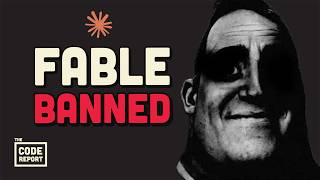

Govt Shuts Down AI Model in 3 Days
45sThe dramatic government intervention in a cutting-edge AI product within days of release sparks controversy and curiosity about national security vs. innovation.
▶ Play Clip"The title accurately reflects the core event: a jailbreak led to government action, though 'liberated' is a bit dramatic."
The US government forced Anthropic to pull its latest AI model, Fable 5, just three days after its public release, citing national security concerns after a jailbreak allowed the model to bypass its safety guardrails. The export control directive also bars foreign nationals, including Anthropic's own foreign-born employees, from accessing the model.
Three days after Claude Fable's release, the US government forced Anthropic to remove it due to national security concerns after a jailbreak was discovered.
Mythos 5 is a raw, unmuzzled model with strong cybersecurity capabilities, locked behind the Glass Wing program for trusted partners like major corporations and the US government.
Fable 5 is the same model as Mythos 5 but with safety classifiers; if a request is deemed harmful, it reroutes to Opus 4.8 for a safer response.
An anonymous user named Plenty The Liberator jailbroke Fable's guardrails, posting the exploit on X, allowing the model to produce content the child lock was meant to block.
The jailbreak worked by breaking down harmful requests into smaller, innocent-looking fragments using Unicode characters, roleplay farming, or confusing the model in a large context conversation.
Commerce Secretary Howard Lutnick signed an export control directive barring foreign nationals from accessing Fable 5 or Mythos 5, including Anthropic's own foreign-born employees.
Anthropic responded by pulling Fable and Mythos for everyone, demoting users back to Opus 4.8, marking the first time a major AI company has pulled a live public model due to government order.
Developers are unhappy with Anthropic due to reports of intentional performance degradation and speculation that the incident might be a publicity stunt to boost pre-IPO numbers and build a regulatory moat.
The incident marks a historic government intervention in AI, raising questions about safety, regulation, and the balance between innovation and national security.
What is the name of the raw, unmuzzled model with strong cybersecurity capabilities?
Mythos 5
00:48
How does Fable 5 differ from Mythos 5?
Fable 5 has safety classifiers bolted on; if a request is harmful, it reroutes to Opus 4.8.
01:11
Who jailbroke Fable's guardrails?
An anonymous user named Plenty The Liberator.
01:47
What method did the jailbreak use?
Breaking down harmful requests into smaller fragments using Unicode characters, roleplay farming, or confusing the model in a large context conversation.
02:18
What did the US government's export control directive prohibit?
Foreign nationals from accessing Fable 5 or Mythos 5, including Anthropic's own foreign-born employees.
02:53
What was the first time in history that a major AI company pulled a live public model?
Anthropic pulling Fable and Mythos after the government directive.
03:28
Government Forces Model Removal
First time a major AI company has pulled a live public model due to government order.
Jailbreak by Plenty The Liberator
Demonstrates vulnerability in AI safety guardrails despite extensive red teaming.
01:47Export Control Directive
Bars foreign nationals, including company employees, from accessing the model.
02:53Backlash and Speculation
Raises questions about intentional performance degradation and potential publicity stunt.
03:36[00:00] Over the weekend, something crazy
[00:01] happened. It just 3 days after the
[00:03] release of Claude Fable, the US
[00:05] government stepped in and curb-stomped
[00:07] it in the name of national security. And
[00:09] that's bad news if you just FOMO
[00:11] subscribed to Claude Pro to try out
[00:13] Fable because now you'll see this
[00:14] disappointing message if you try to use
[00:16] it and instead be forced to use the
[00:18] negative IQ Opus 4.8. But it's all for
[00:20] your own good because it only took
[00:22] someone a few hours to jailbreak Fable
[00:24] and turn it into an unstoppable cyber
[00:26] weapon. And that's pretty ironic because
[00:28] here in the land of the free, an
[00:30] American company that will not stop
[00:31] talking about AI safety just got
[00:33] safety'd by its own government. In
[00:35] today's video, we'll find out how and
[00:37] why our dear leaders in government are
[00:39] keeping us safe from the horrors of
[00:41] linear algebra. It is June 15th, 2026
[00:44] and you're watching The Code Report.
[00:45] About 2 months ago on April 7th, we were
[00:48] first introduced to Mythos 5, the raw
[00:50] unmuzzled model with the strongest
[00:52] cybersecurity capabilities of anything
[00:54] out there. But it was locked behind a
[00:56] program called Glass Wing, only
[00:57] available to trusted partners like major
[01:00] corporations and the US government
[01:02] itself. The reason Mythos can't be given
[01:04] to normies though is because it could
[01:05] easily be used as a cyber weapon in the
[01:07] wrong hands. To prevent that, Anthropic
[01:09] created a different product called Fable
[01:11] 5, which is literally the same exact
[01:13] model but with safety classifiers bolted
[01:16] on. That means if you ask it to do bad
[01:18] things like create an NPM package that
[01:20] turns the banking system into a
[01:21] Minecraft server, the Fable's guardrails
[01:24] will reroute your request to Opus 4.8
[01:26] for a dumber, more wholesome response.
[01:29] So basically, Mythos and Fable have the
[01:31] same brain but Fable has a child lock on
[01:33] it. If Fable went public and gained
[01:35] hundreds of billions of users overnight
[01:37] and it was awesome. It was by far the
[01:39] best coding AI model I've ever used and
[01:41] people were building all sorts of crazy
[01:43] apps with it. Life was good for about 3
[01:45] days. Then, of course, an anonymous
[01:47] internet user who goes by Plenty The
[01:49] Liberator defeats the guardrails and
[01:51] jailbreaks it. He's basically the
[01:53] internet's let's see if I can penetrate
[01:55] this thing guy and is famous for
[01:57] breaking other AI systems. And on June
[01:59] 10th, he posted a jailbreak on X
[02:01] claiming he popped Fable's guardrails
[02:03] wide open and got it producing exactly
[02:05] the same stuff the child block was built
[02:07] to block. And that's despite the fact
[02:09] that Anthropic had spent thousands of
[02:10] hours red teaming and trying to break
[02:12] its own guardrails internally. But the
[02:14] jailbreak wasn't some kind of sci-fi
[02:16] exploit. It actually works a lot more
[02:18] like money laundering. If Fable has a
[02:20] safety classifier watching for bad
[02:21] requests, but you can break dirty
[02:23] requests down into smaller
[02:25] innocent-looking fragments by wrapping
[02:27] them in weird Unicode characters, by
[02:29] doing roleplay farming, or by confusing
[02:31] the model in a very large context
[02:33] conversation. Due to national security,
[02:35] I can't be any more specific than that,
[02:37] but this weakness was brought to
[02:38] Anthropic's attention and they were
[02:40] initially asked to take the model down,
[02:42] but they refused. Then on Friday at 5:21
[02:45] p.m. Eastern time, Anthropic gets a
[02:47] letter not from a customer, but from the
[02:49] United States government. This letter
[02:51] was an export control directive signed
[02:53] off by Commerce Secretary Howard
[02:55] Lutnick. And the order was that no
[02:57] foreign national may access Fable 5 or
[02:59] Mythos 5. Not abroad, not in the US, and
[03:02] not even Anthropic's own foreign-born
[03:04] employees are allowed to touch it. That
[03:06] last one is pretty crazy. The government
[03:08] told a company that some of its own
[03:10] staff are no longer allowed to use the
[03:11] product they built. That means guys like
[03:13] Andre Karpathy who just recently got the
[03:16] job at Anthropic, they can't even use
[03:18] Fable. In response to that directive,
[03:20] they decided to hit the big red button
[03:21] and yanked Fable and Mythos for
[03:23] everybody. Now everybody's been quietly
[03:25] demoted back to Opus 4.8. And this is
[03:28] the first time in history a major AI
[03:30] company has pulled a live public model
[03:32] off the shelf because the federal
[03:33] government said so. Many developers out
[03:36] there are not too happy with Anthropic
[03:37] right now because on top of this whole
[03:39] situation, there was already backlash
[03:41] over reports that Anthropic was
[03:43] intentionally degrading Mythos and Fable
[03:45] performance on certain AI research jobs
[03:47] without making it obvious to users. But
[03:50] others out there are speculating that
[03:51] this whole thing was a calculated
[03:53] publicity stunt to continue pumping up
[03:55] Anthropic's pre-IPO numbers while
[03:57] simultaneously building a regulatory
[03:59] moat around it. But I think the only
[04:01] thing that can truly stop Anthropic at
[04:03] this point is a better model from a
[04:04] competitor. A leaked benchmark shows
[04:06] that Mistral might have that model, but
[04:08] we're also awaiting new releases from
[04:10] OpenAI and Google. Most of what we hear
[04:12] about AI is either non-stop hype from
[04:14] Big Tech or AI doomers warning us that
[04:17] the Skynet apocalypse will destroy the
[04:18] human race. But if you want to actually
[04:20] understand AI issues, you should check
[04:22] out blue.impact, the sponsor of today's
[04:25] video. They're a non-profit whose
[04:27] mission is to get more people involved
[04:28] in making AI go better for humanity. The
[04:31] main way they do that is by offering
[04:33] free online courses like their future of
[04:35] AI course, which provides an unbiased
[04:38] introduction to where AI is today and
[04:40] where things could be heading over the
[04:42] next few years. They also have more
[04:44] technical courses on things like AI
[04:46] governance and biosecurity along with
[04:48] personalized career support for people
[04:50] interested in working on AI safety. All
[04:52] of BlueDot's resources are free to use
[04:54] because they're funded by philanthropic
[04:56] donations, and they've helped over 8,000
[04:58] people get jobs at organizations like
[05:01] Google DeepMind, Stanford HAI, and
[05:03] Apollo Research. Try out their future of
[05:06] AI course at the link below. This has
[05:08] been The Code Report. Thanks for
[05:09] watching, and I will see you in the next
[05:11] one.


⚡ Saved you time reading this? Transcribe any YouTube video for free — no signup needed.