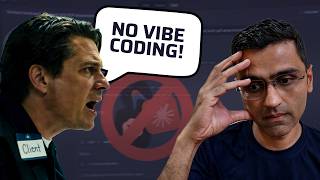

40-50% of Clients Ban Vibe Coding Over IP Leaks
44sA shockingly high number of real clients reject AI coding because of data and IP leaks, fueling the ongoing debate.
▶ Play Clip"Delivers exactly what the title promises: real client feedback and a balanced comparison of vibe coding vs manual coding."
This video compares vibe coding (AI-assisted coding) with manual coding based on real experience at two companies, Atlik and Code Basics. The founder interviews Atlik's CTO Pranav about why 40-50% of clients reject vibe coding due to IP and data sensitivity, then discusses benefits, drawbacks, and real incidents. The core takeaway is that AI accelerates development but human engineers with strong fundamentals are still essential as orchestrators.
The speaker introduces the debate, mentioning that while vibe coding can boost efficiency up to 10x, there are cases where manual coding is useful. Two companies, Atlik (50 people) and Code Basics (25 people), have been using vibe coding for months and will share observations.
Atlik's CTO Pranav reveals that about half of their SME clients in the US and UAE explicitly ask not to use vibe coding. The primary reasons are IP protection, unique algorithms, and data sensitivity, as code and data go to GPT/cloud servers.
Running local models via Ollama is possible but costly (GPU servers) and models like Quant or Mistral can't match GPT or Opus code quality.
CTO says one developer can now build in a couple of months what used to take 4-5 developers a year. However, token utilization means he works more now, and vibe coding can break other modules when working on related ones.
There's a growing trend of people who vibe-coded apps hitting production bugs they can't fix, and hiring experienced programmers to manually clean up inconsistencies.
Another Upwork job type involves apps already built but facing functionality, integration, and performance issues—where seasoned programmers and manual coding are needed for scaling and production deployment.
Claude generated code for a RAG pipeline using Docile that couldn't parse markdown hierarchy. A human engineer had to find a known GitHub issue and apply the result processor workaround because Claude couldn't figure it out.
The AI-native company every.to serves as an example of vibe coding success.
Non-technical team members built real SaaS tools: a marketing manager created an ad visual generator, an ops manager made a mock interview tool, an AI team member built a practice platform, and the speaker (who doesn't know mobile dev) built a mobile app in 4 days vs. an estimated 6 months for a professional.
To deploy production systems, non-technical people need engineers for scaling, monitoring, cost control, and avoiding costly errors—critical in healthcare/finance.
The speaker summarizes that humans must act as orchestrators using tools like Claude Code, Cursor, AWS, and DataDog, maintaining strong fundamentals and not being blind/ignorant. Currently, human intervention is crucial for deployment and scaling.
AI will improve in the future, but today's reality is that manual coding knowledge remains essential. This is an honest opinion based on their experience.
The video concludes that while AI-assisted coding can deliver massive productivity gains, human engineers with deep fundamentals are indispensable for handling edge cases, deployment, and scaling. The role of the developer is shifting to that of an orchestrator who directs AI tools while maintaining strong technical judgment.
What share of Atlik's clients ask not to use vibe coding?
40-50%.
00:46
Why do clients reject vibe coding?
IP protection, data sensitivity, and preserving algorithmic novelty.
01:03
What are the two drawbacks of running AI coding models locally?
Expensive GPU server costs and inferior code quality compared to GPT/Opus.
01:46
What productivity gain did Pranav report?
A year's work for 4-5 developers now takes one person a couple of months.
02:28
What did Pranav say about vibe coding and related modules?
It can break another module when working on related modules—fixing one thing breaks another.
02:42
What type of Upwork jobs are appearing due to vibe coding?
Jobs to fix production bugs and inconsistencies in apps built with AI tools that the original builders can't fix.
03:09
What was the Docile workaround found on GitHub?
Use the result processor.
05:08
What percentage of every.to's code was AI-written?
95%.
06:05
How long did the speaker take to build a mobile app without knowing mobile development?
4 days.
07:10
Why do non-technical people need engineers to deploy their AI-built apps?
They lack knowledge of production deployment, scaling, monitoring, and cost control.
07:52
What is the human's role in vibe coding according to the speaker?
Orchestrator—orchestrating AI tools, cloud, and monitoring platforms.
08:20
40-50% of clients reject vibe coding
A surprisingly high share of enterprise clients refuse AI-assisted coding over IP and data sensitivity concerns.
00:4610x productivity boost possible
One developer replaced a 4-5 person team for a year's work in just a couple of months, quantifying vibe coding's upside.
02:28Human judgment still needed for workarounds
AI generated flawed code and couldn't find the GitHub workaround, proving that strong fundamentals and debugging skills are irreplaceable.
05:08Non-developer builds mobile app in 4 days
A non-mobile developer created an app that would have taken a professional 6 months, demonstrating the democratization of development.
07:10Humans are orchestrators, not coders
The speaker frames the future role of developers as orchestrating AI, cloud, and monitoring tools rather than writing every line.
08:20[00:02] that, "Do not use wipe coding. Use manual coding instead." While wipe coding is extremely powerful, it can boost the efficiency [music] 10x. There are cases where manual coding is useful. I run two different companies. Atlik, a
[00:17] team of 50. Code Basics, [music] a team of 25. And we have been using wipe coding in both of our companies for past few months. In this video, I want to share a difference that we have observed between wipe coding [music] and manual
[00:31] coding based on our real experience. Let's go ahead and talk to the CTO of Let's go ahead and talk to the CTO of Atlik, Pranav. Majority of our clients in Atlik are small to medium-scale enterprises based
[00:46] in US and UAE. Out of all these clients, how many clients are specifically asking us not to use wipe coding? So, I would say around 40 to 50% still kind of interesting. So, what is the reason behind it? The primary reason is
[01:03] their IP either on code algorithm. And [music] let's say if they have a unique idea. And one of the major reason is also data sensitivity. Okay, understood. When you're doing wipe coding, your product
[01:16] you're doing wipe coding, your product idea, your data uh even any algorithmic novelty or IP that you're bringing in your product is going to cloud server. It is going to GPT server. And they definitely don't want uh
[01:30] >> to leak that information. Now, I can think about easy solution, which is you set up a local machine, you set up Ollama, and you run your models there, and you use it for wipe coding. So, why can't they do that? They can do [music]
[01:46] But, uh I see two drawbacks over there. First of all, it is very costly to set up a server for a model including GPUs. And
[01:58] second thing is those models are not as good as uh GPT or Opus. Understood. >> using Quant or Mistral, it is not going to provide that quality of code. Okay, [music] that's interesting.
[02:14] In terms of benefits and drawbacks that you have seen for wipe coding, like do you want to mention few of them? Yeah, sure. Uh I will start with benefits. So, first of all, productivity has increased a lot. What I
[02:28] was used to build in a year with four to five developers, now I alone can build it in couple of months. If I tell you about drawbacks, like because of token utilization, I'm working more [music] now. Mhm. And another thing is I still
[02:42] see uh issues with certain technologies like let's say mobile application or like let's say mobile application or certain languages that it is breaking another module if I'm working on some of the related modules. Okay.
[02:55] So, you're trying to fix something and it will break something else. Yes. Okay, that's interesting. Also, I want to mention something interesting that we are noticing on the popular freelancing platform Upwork. On Upwork, nowadays we
[03:09] are seeing many jobs where people have wipe coded an app and they have created this mess, and now they need programmer's help to fix those. So,
[03:21] let's look at those jobs. Okay, so this is the first job that we are going to saying that I have been wipe coded app, whatever. It generates this thing. And the app mostly works, but we are hitting production blocking
[03:38] bugs and inconsistencies. Now, using Claude code and AI tools, they are not able to fix these inconsistencies. And they are hiring experienced programmers. So, the experienced programmers will do manual
[03:52] coding. So, this is one place where manual coding will have a value. Look at this other job. The app is already built, but currently experiencing issues with functionality, integration, and performance. Okay. So, this is where
[04:07] manual coding will shine, where you have coded something using Claude code or AI tool. Now, you want to scale it. You want to fix an issue which AI cannot fix. You want to deploy things to production. At that time, you need
[04:21] seasoned programmers and manual coding. The discussion that we just had now with Pranav was our perspective on wipe coding uh in our company Atlik, which is big companies like Amazon, you hear all these news stories where they had an
[04:38] outage because of AI-assisted coding. Okay, and you are hearing many such news in social media all the time. I want to share another incident where our AI share another incident where our AI engineer was building a rag pipeline,
[04:52] and Claude produced this particular code. They were using Docile. And apparently, this code was not parsing things properly, you know? It was not giving us this kind of nice markdown for a hierarchy. So, he went to GitHub
[05:08] a hierarchy. So, he went to GitHub issues for that Docile library, and he found a known issue, and he scanned through all the discussions, and there was a workaround. And the workaround was to use this result processor. Okay. So,
[05:21] later on, they added this code. Now, with Claude, after some iteration, it was not able to figure it out. So, now at this time, you need engineering skills. You need strong fundamentals. So, that you understand what is going
[05:36] on, why is it failing. And you need that attitude that you can go to GitHub. You need to know, okay, how to scan through issues. You need to know how to apply workaround. You can't apply a random workaround. You need to have a judgment
[05:50] and knowledge. Okay, that was one of the incidents where we thought wipe coding is not working, and manual coding, strong fundamentals, engineering skills are required. Now, obviously, there are many success stories that we have seen
[06:05] with wipe coding. One example is this company every.to, where they have company every.to, where they have written 95% of their code using AI. was watching, so I thought I would uh
[06:17] bring this up. This is one of those AI-native companies. In our company Code AI-native companies. In our company Code Basics, we ran a 45-day builder sprint, where even non-technical people built real SaaS products. Okay, for our own
[06:31] usage. For example, our marketing manager, her name is Padmini, she created a tool called Sigma, not Figma, Sigma, Figma, Sigma, which can help her create the visuals
[06:44] which can help her create the visuals and the necessary assets to run her PPC ads. Okay. Now, this is not just Gemini, okay? It is something on top of it, where you can add all your parameters, uh different configuration that you need
[06:58] to set for your ad, and it will create a nice-looking visual. Our operations manager generated a tool for uh mock interviews. Then we had our AI team
[07:10] member who generated practice platform, where you can practice Python problems, where you can practice ML problems, and so on. And I myself created a mobile app for Code Basics in 4 days. I don't know mobile app development, by the way.
[07:26] And if I had a mobile app developer working on this, they would have taken at least 6 months. So, we are seeing this kind of enormous this kind of enormous productivity gains. But, at the end, to
[07:38] deploy all the things that we built during this 45-day sprint, engineering team. Because these non-technical folks do not know how to deploy things in production, how to set
[07:52] deploy things in production, how to set up scaling, monitoring, cost control. They don't know many things, actually. So, you can't just go ahead and blindly deploy it, otherwise it can make errors, you know? If you think about sensitive
[08:06] industries like health care and finance, a single mistake can cost you so much. Okay. Uh to summarize, based on our experience in our two companies, our experience in our two companies, our view is that as a human, your role is
[08:20] that of an orchestrator. Then you use all these tools, okay? Claude code, Cursor. You are deploying things in AWS. You're using monitoring platform like DataDog, etc. You need to orchestrate things. So, you
[08:33] You need to orchestrate things. So, you can do it really fast using AI, but you can't be blind and ignorant. You need to have strong fundamentals. You need to understand, you know, what is observability, what is monitoring, how
[08:46] do you do your DataDog setup. How do you set things up in cloud, etc. Maybe the you just give it a command and it will take care of everything. Uh but right
[08:59] now, we are in this stage where, at least what we are feeling based on our experience, is that the human intervention is needed. You can, of course, build things really fast, but when it makes mistakes, when it comes to
[09:13] deployment, when it comes to scaling, all of these scenarios, the manual coding, the knowledge of engineering, the knowledge of strong fundamentals is extremely crucial. Folks, in the future, of course, AI models will improve, and
[09:29] they will be able to do things which they are not able to do today, but that is future. I just wanted to mention the today's current state based on our experience. Maybe somebody working for some big companies or working in a
[09:42] different perspective. We are not judging. We just wanted to share our honest opinion. Uh if you have any questions, please post in the comment box below. Uh I'll be happy to discuss it out. Thank you very much for
[09:55] it out. Thank you very much for watching.


⚡ Saved you 0h 10m reading this? Transcribe any YouTube video for free — no signup needed.