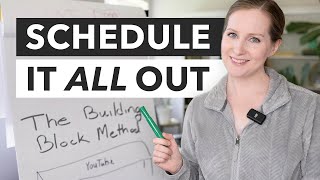

5 Kids, 4 Businesses, 20 Hours a Week
57sThe wild combination of five kids and four businesses in only 20 hours a week makes people immediately want to know how.
▶ Play Clip"Accurate title — a genuinely useful year-planning system delivered in roughly the promised time, with only minor filler."
This video presents the 'building block method' for planning an entire year of content in under 20 minutes. The creator argues that batching related work is the key to efficiency, and demonstrates a step-by-step framework to define a main platform, content formats, topics, subtopics, and AI-assisted content ideas, ending with calendar scheduling and a repurposing strategy.
By filming four videos in one day instead of one per week, each video takes about one hour instead of two to three hours, because setup and mental preparation are shared.
The building block method helps create a full year's content plan in roughly 14–15 minutes and makes content marketing more strategic.
Your main platform is where you post your biggest, most substantial content. For the creator it's YouTube, plus he also has two podcasts and a blog.
Choose at least two formats, but three is plenty; don't go beyond four or five. Examples include vlogs, how-to/tutorial videos, storytime, and listicles.
List three to five major content categories, such as startups, sales strategy, and visibility. These are the broad buckets your content covers.
For each main topic, list five to ten more specific subtopics. AI tools like ChatGPT can save time by generating subtopics for you.
Divide 52 weeks by the total number of subtopics to know how many ideas you need per subtopic. Example: 25 subtopics means about two ideas each.
Repeat the subtopic-to-idea process for all topics. Ask AI for 10 ideas per subtopic so you can pick the best two for your audience.
Schedule the 52 core pieces on a visual calendar, one per week, for the entire year.
Choose just two or three subplatforms, define a consistent repurposing process for each, and use AI to turn a YouTube transcript into a quality blog post or short-form clips.
The building block method turns content planning from a guessing game into a repeatable system: choose a platform, define formats and topics, generate ideas with AI, schedule 52 pieces, and repurpose consistently. The ultimate goal is not just visibility, but converting that visibility into paying customers.
Why does the creator care so much about efficiency?
He has five kids and wants to spend as much time with them as possible, so he runs four businesses in 20 hours a week.
00:29
How much time does filming one YouTube video per week take, versus filming four in one day?
One video takes two to three hours; four videos filmed in one day take four to five hours total (about one hour per video).
01:12
What is the first step in the Building Block Method?
Choose your main platform — where you create your biggest, most substantial content.
02:48
How many content formats does the creator recommend?
At least two, but three is plenty; don't go beyond four or five.
05:04
How many main content topics should you have?
Three to five.
06:57
How many subtopics should you list for each main topic?
Five to ten, ideally 6–10 if you have only about three main topics.
07:26
If you have 25 subtopics and want 52 pieces of content a year, how many content ideas do you need per subtopic?
Just over two (52 divided by 25 ≈ 2).
09:25
Why ask ChatGPT for 10 content ideas when you only need two?
Because AI suggestions aren't necessarily good; requesting more lets you choose the two best for your audience.
11:08
Why did repurposing content fail before AI tools?
Publishing a video transcript as a blog post didn't perform well because people talk differently than they write.
13:04
What is The 100K Method?
A limited 10-episode podcast series that walks step by step through the creator's sales strategy to turn visibility into paying customers.
18:38
Batching cuts production time dramatically
A concrete efficiency example that demonstrates the core value of grouping related work: four videos in one day equals roughly one hour per video instead of two to three.
00:41The Building Block Method compresses a year of planning
The main framework of the video: a 15-minute process that turns broad strategy into an executable annual content plan.
01:39Use AI to generate subtopics and ideas
Practical application of ChatGPT to remove the heavy lifting of brainstorming while keeping editorial control.
07:10AI makes repurposing finally work
Explains why old repurposing failed and how modern AI tools can transform transcripts into quality blog posts and shorts.
13:29Leads don't make a business
A sharp strategic principle: content visibility must connect to a sales process to generate actual revenue.
17:54[00:02] am all about efficiency. And I think sometimes efficiency gets a bad rap because sometimes people assume that when you talk about being efficient that you mean that you get a lot of kind of busy work done. But that's not what I
[00:15] mean and that's not why I care about efficiency at all. When I talk about efficiency, I am talking about getting meaningful work done, getting actually productive work done, producing things in less time and producing high quality
[00:29] work. And the reason I care about efficiency is because, as you probably efficiency is because, as you probably know, I've got five kids and I want to spend as much time with them as possible. So, I run my businesses, all
[00:41] four of them, in just 20 hours a week. And the only way that that's possible is these businesses. And one way that we can be more efficient with how we run our businesses is by doing things in batches, by batching related work.
[00:55] waste a lot of time when we switch between different tasks. So, for example, if I film one YouTube video each week, then each video takes me, I would say, two to three hours, if not more, to film. But if I film, let's say,
[01:12] four videos all on one day, I can get all four videos done in just four to five hours, making it only a little bit more than one hour per video. And that's into setting up to record a video and getting mentally prepared to record a
[01:26] video and all sorts of things like that. And it's not just big production things. The little tasks can really add up and they can overwhelm your entire day if you're doing a million little tasks. But if you group those tasks together, then
[01:39] not being very efficient about this. Today, we're going to talk about how to plan out your content for the entire year. And you can do this in just about 14 or 15 minutes. And the method that I like to use to do this is the building
[01:53] block method. And I find that not only does this save a lot of time just because you are batching the work, but it also means that you have a plan for the year, which can help you to be a lot more strategic with your content
[02:05] marketing, which is huge. Now, one little concern you might have with that might stop you from wanting to plan it for the entire year, is you don't you change your mind? And I just want to
[02:18] You can have a plan and you can choose at any time to go a slightly different route. You can choose to make a different piece of content than you initially planned, but most of the time you can just go with what you planned
[02:32] and not have to worry about it and it'll save you a lot of time and a bit of a more strategic. Okay, so let's talk about what the building block method actually is. So the very first step is to choose your platform. Okay. So visual
[02:48] here we're choosing a platform. This could be YouTube. This could be a podcast. This could be your blog. Okay. But where are we building this content? Okay, for my little example here, let's just say this platform is YouTube. The
[03:02] reason I'm using that as my example is because YouTube is my main platform. Now, you might post on other platforms, too. But the point here is what's your main platform? Where are you going to create your core content? And generally,
[03:15] whatever platform you post kind of the biggest, most substantial content on. So, I also have a podcast. In fact, I've got two podcasts. And I have a blog and maybe I post on social media. We'll talk more about that a little bit later, but
[03:29] substantial content is on YouTube. So, that's my main platform. Now, you question, so that shouldn't really take you any time at all. The next part of this process is identifying what formats you like to create content in. So in my
[03:45] building block framework here, we're thinking about building a structure. And basically just use rectangles of different sorts. But the visual will be better if we use different shapes. So maybe we have triangles, maybe we have
[03:59] circles, maybe we have squares. And like I said, these are the different formats. I said, these are the different formats. So maybe these are vlogs, howto videos or tutorials, maybe they are storytime videos. What are the different formats
[04:11] of content that you make? This is going to be easier if you have been making content for years, you know, and you know what those formats are already. And in that case, this won't take hardly any time at all. But if that's not the case,
[04:25] if you are starting from scratch, that's okay. You'll just need to spend a few minutes here thinking about what the different formats of content you would like to create are. So, just figure out what those are. Make a short list. And I
[04:37] would recommend that you keep it simple. Three is plenty of different formats for talking about formats for this one platform. So, I'm not even talking about long- form YouTube videos and YouTube shorts. I'm talking about if long- form
[04:50] YouTube videos are your main platform, then, you know, are you posting vlogs? Are you posting howtos? Are you posting storytime videos? Are you posting listical videos? What are the different formats that are your go-to? I'd
[05:04] recommend you have at least two different formats, but three is plenty. And four or five, don't go more than four or five. Okay, so you've got your formats chosen. Now, we are going to think about the actual content of the
[05:18] content. What is this content about? And basically, we're going to look at like topics that you cover. Maybe we'll flip to another page here for this part. And sometimes people call these content buckets because I like things to be
[05:30] visual. I'm going to instead talk about colors. So you might have some different colors that you talk about. Again, these are the topics of your content. So you might talk about red things and blue things and green things. And so these,
[05:44] for example, might be if you have a brand that is about digital marketing. marketing. Maybe you talk about social media marketing. And maybe specifically
[05:56] you talk about content marketing for example. If you have a fitness brand, Maybe specifically you talk about supplements or macros or diet. Okay. So what are these kind of like main categories that you talk about? So I'm
[06:11] going to use kind of my business as an example. One thing that I like to talk about is startups. Okay? So how do you start an online business? Another thing that I talk about is sales strategy. So, I'm just going to put sales.
[06:27] And then a third thing that I often talk about is visibility and particularly have been the red one, but oh well, I didn't plan that out. So, those are know YouTube seems a little unrelated to the others, but it ties in because it's
[06:44] Anyway, so you've got your three to five. That's how many I would recommend. three to five different main content topics which you can think of as the different colors that you talk about.
[06:57] And this again should take you very little time because you probably already know what these big buckets or these major topics are. So maybe spend a minute just thinking about them and listing them out. Now this next part
[07:10] but it also I think is the place where Chad GPT or some other AI tool could be the most useful. What you're going to do is for each of these topics, you are going to list five to 10, preferably closer to 10, but five to 10 subtopics.
[07:26] Okay? And so these are going to be things that fall within this category, but are much more specific. And of course, if you have more main topics, then you can get away with fewer subtopics within them. But I would say
[07:39] ideally really you have fewer main topics only about three and slightly more somewhere in the range of like 6 to 10 or so of these subtopics. So for example in my category of starting a business one subtopic I cover is how to
[07:56] business one subtopic I cover is how to decide what business to start. Another topic I cover is the legal side of how to start a business. Another
[08:13] of how to start a business. Another topic would be how to get customers. software to use when you first get started. Okay, so I think you get the
[08:27] idea here. For each of these, you're going to list out five to 10 subtopics. Now, like I said, these should be more specific, but they don't need to be actual content ideas, okay? You might make a video about how to decide what
[08:41] business to start, but there's a bunch of other related videos or podcast episodes or blogs that you could make that relate to that specific topic. Now, like I said, this could take a moderate amount of time. It doesn't necessarily
[08:54] but you can save the time by asking ChatGpt to do this part for you. Okay. Now we come to the real meat of this. Okay, all that pre-work was very important. But now you're going to come up with a few different specific content
[09:10] ideas for each of these subtopics. And if you want to plan your content for the consider how many different subtopics you have. So for example, maybe you have 25 total. You divide 52 for 52 weeks in the year by 25. So you see how many
[09:25] different u pieces of content you need to create about each of these subtopics. And 52 divided by 25 is obviously just a little bit more than two. So what that means is you just need to come up with two specific content ideas for each of
[09:38] two specific content ideas for each of these subtopics. And if we go back to the pre-work we did before this, we identified those different content formats of which you have at least two up to about five. And so what you're
[09:51] going to be doing basically is figuring out some different pieces of content you could create in these different formats. So for example, if I am going to make a video about, let's say, the legal side of starting a business, I might decide
[10:05] that I want to interview a lawyer as one of my pieces of content. And for another one, I might want to make a listical, maybe that's my circle piece of content about different important legal things that you need to make sure that you do
[10:20] when you start a business. So those are just two little examples there. Marketing basics. Maybe I decide that I want to make a howto for planning my marketing basics and I also want to make a listical of different marketing basics
[10:34] to check off when you are first starting your business. Or maybe I want to do a storytime video about the biggest marketing mistakes that I made when I different content formats, they can immediately kind of spark some ideas for
[10:49] approach these topics. Of course, you definitely can use chat GPT for this step, too. You could tell it, "I want to make several videos about different business ideas that people could easily start. Give me 10 specific video ideas
[11:08] that I could make around this topic." And the reason I say 10, because remember, you only need about two, is because JPD is going to suggest just, you, right? They're not necessarily good. So ask it for more ideas than you
[11:22] need so that you can choose two that are actually good that you know your audience would actually really like. And also if you're not sure which ones to YouTube and you can search for the main keywords from each of those and see how
[11:37] other videos about those topics have performed on other channels. Okay. Now is just repeat these steps for each of your main topic categories. And by doing that, you will come up with 52 or a whole lot more of your main content
[11:53] whole lot more of your main content ideas. And the next step will be to put I've been mentioning 52 because I'm assuming you're going to make 52 pieces assuming you're going to make 52 pieces of main content or core content per year
[12:07] on pretty much every platform. That is a good amount because remember, we're talking about substantial content here. Now, beyond that substantial content, beyond those core pieces of content where you're posting maybe one video a
[12:20] week or one blog post a week, you might want to you probably want to be on some other platforms and it is very efficient to repurpose your content for other platforms. Now, I used to not be much of an advocate for repurposing because
[12:34] while it sounds efficient, remember that you are only being efficient if the things you are producing are actually useful, right? doing busy work is not largely be busy work because I would make for example a YouTube video it
[12:50] would do really well on YouTube but then if you do what a lot of people say and you publish the transcript of the YouTube video on your website as a blog post it doesn't perform well at all because we talk a lot differently than
[13:04] we write and so it doesn't read well so it's not content that people want to YouTube video and you publish it as a work very well either. Sometimes it does. It kind of depends on the video
[13:17] but a lot of the time it just doesn't carry over or the audio quality isn't I found that I didn't get very good results when I repurposed content. But
[13:29] these days things are a bit different because of all the AI tools we have. We can actually repurpose content really effectively. turning a video or any sort of audio content into really well-written, wellorganized written
[13:43] content that people will enjoy reading and also very effectively pulling out short sections to publish on short form platforms like Instagram or Facebook if you still use that or LinkedIn or Twitter or whatever platform you like to
[13:59] use because we're not now just choosing some random sentence from the article or from the transcript. script and copying and pasting it. Now, the AI can actually and pasting it. Now, the AI can actually rewrite and kind of reconceive some of
[14:13] in the main piece of content and summarize them into something that is bite-size but really communicates the whole value and is useful in and of itself. So, these final couple of steps that we've got here, one is putting
[14:28] everything on the calendar. So, you're going to look at your calendar. Maybe you're using Google calendar, maybe you are using a sauna. Whatever it is, you should have some sort of visual layout, I would say, or at least a a list with
[14:41] dates of when you're publishing these different pieces of content. So, you're going to put them all on your c your content calendar, so they're all scheduled out, one per week for the entire year. And then the very last step
[14:55] is your repurposing strategy. So, which platforms do you want to repurpose on? And I would say really um less is more here. You probably will get bigger here. You probably will get bigger better results if you focus on just a
[15:10] couple or three even of these subplatforms and you don't try to be everywhere because your resources are limited I'm sure and by that I mostly mean your time or your team's time and so you can only create the best quality
[15:24] if you limit the quantity to some degree. So which platforms are you going to repurpose on? And then for each of those, what is your repurposing strategy? So just a little example from my business. My main platform is
[15:37] YouTube. I make these YouTube videos. Obviously, they include the audio and the visual aspect. We take the transcripts from the YouTube videos and then I programmed a custom GPT that we can literally copy and paste the
[15:49] transcript into. And then because of the careful programming that I put into this custom GPT, it will turn that transcript into a well-written, wellorganized blog post. It actually reorganizes the ideas, rewrites everything kind of from scratch
[16:04] while still communicating my ideas, telling my stories, etc. And I've given it content I've written in the past so that it has examples of how to write like me. So it's not just well written and well organized, but it also sounds
[16:18] like me. So, it ends up being, I would say, higher quality content than I probably could make on my own because the AI honestly can write better than most of us can. The problem, of course, is that it generally sounds too generic.
[16:33] But if you give it your ideas and you give it your writing style, you end up all. And if you want to learn exactly how to do that for yourself, how to actually really easy and I made a video
[16:46] about it earlier this year. So, we will include a link to that down below for you to watch. Anyway, so these are the basic steps. Let's go over them just really quickly here. So, you're starting by choosing your main platform and
[16:58] identifying your main content formats. Then, you're going to identify your main topics you're covering and then choose specific subtopics within each of those and then come up with the specific content ideas. From there, you are going
[17:15] to then schedule those on your calendar, right? You're going to put one per week for your main platform. And then you're going to create your repurposing strategy. Decide what platforms you are going to repurpose for and what's the
[17:28] strategy for each of those platforms. And I would highly recommend that once you nail those two things down, that you are consistent and you just do it for every single piece of content you create and use the same process over and over
[17:40] again. you might decide to skip some pieces of content, but whenever you are repurposing that you have a process you follow because that will make things a lot more efficient as well. Now, to wrap this all up, content marketing, as you
[17:54] probably know, can be really powerful at generating a whole lot of leads, but leads do not make a business. You can have thousands of leads pouring into your business, but if you don't do anything with them, then your business
[18:08] want to show you how to get visibility here. I would love to show you more about how to turn this visibility into leads and then turn those leads into paying customers. Obviously, we don't have time today, but what I did is I
[18:23] recorded a limited podcast series. It's a podcast that just has 10 episodes that walks you step by step through my entire sales strategy that I use in my business it into leads to turning those leads into paying customers. Um, the podcast
[18:38] into paying customers. Um, the podcast is called The 100K Method, and I will as well. Like I said, it's just 10 episodes, and I did that on purpose because I often struggle when I start listening to a new podcast. I'm not sure
[18:51] whether I should listen to the most recent episode or the first episode or know in the comments if you can relate to this struggle. And so I thought, you know what would be really nice since this is a business podcast is let's make
[19:04] it more strategic, more intentional than just new content every single week. Instead, let's make something that has a distinct start and a distinct finish so that you can obviously start on episode one and then just listen all the way
[19:17] through to understand all the ideas in a logical order. I tend to be kind of a logical thinker as you've probably noticed. Anyway, so the 100K method link down below if you want to learn how to turn your visibility that you'll get
[19:31] from your content marketing into sales for your business, then definitely check this video. Thank you so much for watching. If you're new here, make sure you subscribe before you go so you can catch my new videos that I make about
[19:44] business strategy and digital marketing every single month to help you grow your online business. And right now, after you click subscribe, you can watch this video right here about how to create a custom GPT to turn your videos into
[19:57] well-written blog posts that sound like you or to do almost anything else you want it to do for you in a really intelligent Away.



⚡ Saved you 0h 20m reading this? Transcribe any YouTube video for free — no signup needed.