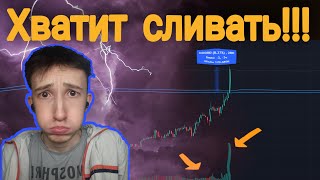

Why random density fails
40sShows a real trading mistake with clear visual proof, making it relatable and educational for aspiring traders.
▶ Play Clip"Title accurately reflects the content: a clear demonstration of why not to trade standalone densities."
The video demonstrates why trading based on order book densities without additional context leads to losses, using three failed trades as examples. The key lesson is that standalone densities are easily eaten by the market, while densities aligned with key levels or formations have higher rebound probabilities.
Densities in random places without additional information are easily eaten by the market, leading to losses.
Entered a futures trade on a coin with density, but the density was in a random place. Got eaten instantly, exited at worst price, resulting in 0.2% loss plus commission.
Similar situation: density in random place without formation. Limit order placed, but density eaten immediately, causing a loss.
On FDM coin, density seemed good but a powerful impulse ate it. No time to set stop, exited manually at market. Density lacked additional formations.
Densities without additional information or recent placement should be avoided. The speaker no longer repeats this mistake.
Trading based solely on order book densities without considering market context or formations is risky. Densities aligned with key levels have higher success rates.
What is the main reason standalone densities fail?
They lack additional information or formations, making them easily eaten by the market.
00:02
What was the loss on the first trade?
0.2% plus commission.
01:38
What additional factor increases the probability of a rebound from a density?
When the density is aligned with a key level or formation, other market participants also enter.
01:24
What mistake did the speaker make in all three trades?
Trading from densities without additional information or formations.
03:06
Core lesson
Establishes the fundamental principle that densities need context to be reliable.
00:02Why densities with formations work
Explains the mechanism: other traders see the formation and join, increasing rebound probability.
01:24Avoid recent densities
Adds nuance: recently placed densities are less reliable.
03:06[00:02] to show why you shouldn't trade based on densities if they are in some random place without additional information. Well, before you start, don't forget to subscribe to the channel and show some activity because it
[00:14] greatly affects the promotion of the channel. Also, subscribe to my free telegram channel. There I post coins that I monitor for both breakouts and rebounds, my trades and statistics. There is also a chat for communication. If you are interested,
[00:28] you can follow the link in the description under the video or the parcels in the pinned comment and subscribe. Thank you all. Our first trade will be on a coin with 98. As you can see, I enter the futures, place my elemental
[00:42] buy order and wait for it to be picked up so that I can set my stop. If you look at the clusters and the volumes that occurred in 5-minute candles, you can say that the density for this coin was good, but look at the chart, it
[00:56] was generally in some random place and was simply substituted to sell at the market. There was no additional information here, but the density was simply there. I decided to No, I ended up getting taken away and instantly eaten by this
[01:10] density, I didn't have time to set my stop and had to exit simply by the market. If the density stands on its own, it is very easy to eat it away, but if the density information, for example, we are going to test the
[01:24] level, then other market participants also see this formation, additionally enters along with you, thereby we have a higher probability of a rebound, but this is what this trade looks like because I didn't have time to set my stop, I had to
[01:38] close simply by the market and ended up exiting at the worst prices at the very peak of this candle. The planned loss for this trade was zero one percent, but in the end I was squeezy and the minus was 0.2 percent plus another
[01:53] commission. Our next trade will be on the coin. I got out on futures, the density is there. I place my limit order to buy, immediately align the stop to this density, and the same situation as in the last trade. Our density
[02:08] is in some random place. There is no formation here at the level that is on the chart, it's just Some levels with past formations mean nothing, so I enter and I immediately get the same error again, and as a
[02:23] result, we catch a loss, but our next trade will be on the FDM coin on futures, there is a fairly good density from it. I place my limit order to buy, and then a powerful impulse occurs, it eats up this density,
[02:37] and again I don’t have time to set my stop, and I had to exit manually according to the market. Everything is the same about the density, there were no additional formations, and as a eaten away. You can say that these densities are eaten away because they
[02:52] are on futures, but in fact, there is no difference between the density on futures or us, they all work well. The error here is precisely that the density does not have any additional information, and also this
[03:06] density was set quite recently. realize, so you shouldn’t trade from such densities
[03:18] with a probability of ninety percent I made these trades a long time ago and now I don't repeat this mistake anymore. I just wanted to clearly show you which densities you shouldn't trade from. But this
[03:32] to subscribe to the channel, like it, and subscribe to Telegram. Thank you all for watching. Goodbye, bye.




⚡ Saved you 0h 03m reading this? Transcribe any YouTube video for free — no signup needed.