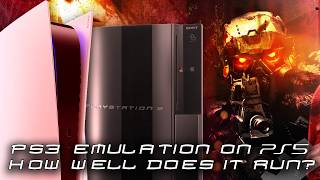

PS3 Emulation on PS5: The Dream vs Reality
45sOpens with a bold comparison between Xbox 360 and PS3 game availability, tapping into console wars nostalgia and the frustration of missing PS3 classics.
▶ Play Clip"Title accurately reflects content: extensive testing of PS3 emulation on PS5 Linux with multiple games."
This video tests PlayStation 3 emulation on a PlayStation 5 running Linux, using the RPCS3 emulator. It explores how well the PS5's hardware can emulate the PS3's unique Cell processor, showcasing both impressive performance gains and significant limitations.
The Cell processor's alien architecture makes PS3 emulation difficult, preventing Sony from releasing an official emulator.
RPCS3 is a remarkably good PS3 emulator running natively on Linux via the RadV GPU driver, bypassing Proton translation.
The goal is to assess PS5 silicon capability using RPCS3, not to achieve a perfect Linux experience.
Ridge Racer 7 runs smoothly at 4K (2160p) with quadrupled resolution, demonstrating PS5's GPU power for games that don't heavily use SPUs.
Heavenly Sword runs near locked 30 FPS at 5K (5120x2880), a 16x pixel increase over original 720p, fixing original performance issues.
GTA 4 and its episodes perform poorly due to heavy SPU usage, with no improvement from resolution boosts, indicating CPU bottleneck.
MGS 4 runs slower than original hardware, with double buffer Vsync causing frame rate halving; CPU-limited even at higher resolutions.
Killzone 2 runs worse under emulation than original, while Killzone 3 benefits from disabling MLAA, achieving 30 FPS at 4K.
MotorStorm: Pacific Rift runs well at 4K, while the original has mysterious slowdown above 1440p; MotorStorm: Apocalypse runs at 4K with MLAA disabled.
Cell architecture remains challenging; PS3 emulation may become viable on next-gen consoles with Zen 6 CPU, or possibly on Project Helix.
PS3 emulation on PS5 via RPCS3 shows promise for games that don't heavily use the Cell's SPUs, but CPU limitations prevent full-speed emulation of more demanding titles. Full viability may require next-generation console hardware.
What is the main reason Sony never released a PS3 emulator?
The Cell processor's architecture is too alien for today's X86 processors, making emulation challenging.
00:48
Which PS3 emulator is used in this test?
RPCS3.
01:03
What resolution boost was achieved in Ridge Racer 7?
Native 1080p became native 2160p (4K), a quadruple increase.
05:09
Why does GTA 4 perform poorly under emulation on PS5?
Rockstar uses the Cell's SPUs intensely, and the PS5's Zen 2 CPU is not powerful enough for SPU emulation.
07:54
What is the pixel count increase for Heavenly Sword at 5K compared to original?
16x increase (1280x720 to 5120x2880).
06:58
How does disabling MLAA affect Killzone 3 emulation?
It allows hitting 30 FPS at 720p, 1440p, and 4K, whereas with MLAA active it cannot maintain 30 FPS.
13:52
What is the frame pacing issue noted in Resistance: Fall of Man?
Frames are not paced correctly despite running at 30 FPS.
06:06
Which MotorStorm game could only run at 1440p without mysterious slowdown?
The original MotorStorm.
17:12
What is the speculated future for PS3 emulation viability?
Next-generation consoles with Zen 6 CPU architecture may have the horsepower for full-speed Cell emulation.
20:24
Heavenly Sword at 5K
Achieving a 16x pixel increase over original hardware and near-locked 30 FPS is a stunning demonstration of PS5's GPU power.
06:33Killzone 3 MLAA Toggle
Disabling MLAA transforms Killzone 3 from unplayable to smooth 30 FPS at 4K, a clever workaround.
13:52Cell Architecture Haunts Again
The conclusion that PS3 emulation may only be viable on next-gen consoles underscores the enduring challenge of the Cell processor.
19:42[00:03] Chad one just likes a system that's the best, all right? That's that triple. about that PS3. I'm going to be talking about that Wii or indeed the Xbox
[00:17] circle, but uh PlayStation 3 didn't fare so well in our platform comparisons back in the day, but it did build a library of great games, many of which aren't of great games, many of which aren't available to play on PS4 or PS5 today,
[00:32] unless you play them on what is a pretty poor cloud solution. That's a shame, especially when so many Xbox 360 games run just great even on Xbox One, many of which operate at higher resolutions and frame rates today on series hardware.
[00:48] But the thing that made PlayStation 3 technologically unique, uh the cell processor, is almost certainly the reason Sony never released a PS3 emulator. Its architecture is just too alien uh for today's X86 processors,
[01:03] making emulation challenging for all but the most powerful PC CPUs. But a the most powerful PC CPUs. But a remarkably good PS3 emulator does exist, RPCS3. We've talked about it in the past, and with the arrival of Linux on
[01:19] PlayStation 5, we have a rare opportunity. We can see just how well uh the best PlayStation 3 emulator around can run on PS5 hardware. And RPCS3 isn't
[01:31] running through any Proton translation layer here. It's actually a native Linux app using the impressive RadV GPU driver. Now, in this video, you'll see some great games locked to PlayStation 3, not just running on PlayStation 5,
[01:45] but running great with huge resolution upgrades. But where there is triumph, there is also tragedy, and the legacy of the cell processor returns to haunt us once more. I'll go into that in a lot more depth shortly, but for now, a word
[01:59] You know this view. You've seen it hundreds of times on DF Direct Weekly, but just out of frame here, there's a whole other world happening. This is the side you never see, the working side. This is where my monitors and general
[02:13] workspace live day in and day out. And over the last month, it has evolved thanks to the FlexiSpot E7 Pro, which has quietly become the backbone of my entire DF setup. When FlexiSpot approached us, I already
[02:28] had my eye on one of these desks, and I'm pleased to see that it ticks off exactly all the checkboxes I needed. Yes, it's a motorized standing desk, something I've already used for years, but as display sizes increased,
[02:41] stability became a real issue. With the E7 Pro, even at full height, it barely moves, which is important when you're dealing with, well, Digital Foundry grade hardware. The E7 Pro is rated for a load capacity of up to 160 kg, so this
[02:57] thing barely registers. When I have the urge to put the FW900 back on the desk, it's ready. There's a wide range of table sizes, too. This 180 cm tabletop perfectly handles a large 45-in ultra-wide monitor, as you can see here.
[03:12] I'm also a fan of the control panel with the presets and USB-C charging on the side. Plus, it's a whole lot faster going up and down than my previous desk. It also has proper cable management down here, which, as you might expect, is
[03:25] pretty important. I run a lot of different hardware on my desk and was easily able to organize my cables, mount a sizeable power strip, and tuck away some power bricks. So, yeah, you always see this view on DF
[03:38] Direct, but behind the scenes, the FlexiSpot E7 Pro is doing the heavy lifting. And to celebrate FlexiSpot's 10th brand day and Memorial Day sales, prices are reduced by up to 80%. You also have a chance to win your order for
[03:53] description and leave a note saying Digital Foundry at checkout and use the code YT730 to get an extra $30 off on the E7 Pro So, let's get down to business. But, before we move on, I think it's worth
[04:08] pointing out here that the object of the exercise um isn't in attempting to get a perfect Linux PS5 experience, though I'm sure there are ways and means of doing so. What we're interested in doing here is using the work of the RPCS3 team to
[04:24] see just what the PlayStation 5 silicon is capable of and how viable PS3 emulation on the console actually is using the very best emulator around that's had years worth of development time poured into it. And well, it's
[04:39] clear that we are able to tap into a vast amount more GPU power than we could on original hardware and initial results, as you're seeing here, are Allow me to explain. When I first tried this, I went back to the beginning to my
[04:52] own first PlayStation 3 retail console experience. Ridge Racer 7 delivered on the 1080p 60 frames per second dream on the triple and as it was very, very Namco didn't really trouble the cell processor too much with heavy usage of
[05:09] those exotic SPUs. The end result is a game I'd still love to play today on the I'm doing here with a twist. We can boost anisotropic filtering, but more to the point, we can quadruple the rendering resolution. Native 1080p
[05:24] rendering resolution. Native 1080p becomes native 2160p, 4K and perhaps unsurprisingly, PlayStation 5 doesn't break a sweat. This is what we want from PS3 emulation on PS5, right? Silky smooth performance and improved visuals
[05:37] and that's exactly what RPCS3 delivers and it's the same here in another launch title, Resistance: Fall of Man. So, by today's standards and well, to be first-person shooters on the console, including this game's sequels, it's a
[05:53] bit basic. Nonetheless, it's a game many may wish to replay, and based on RPCS3 performance on PS5, you can do it with original resolution limits effectively removed. One thing you'll note here, though, concerns frame pacing. It's not
[06:06] even. We're at 30 frames per second, but those frames are not being paced correctly. Now, this would be fixable if it were to ship for the actual PS5, of course, and likely there are ways to do so on Linux as well. But, as I said,
[06:19] this is all about testing the viability of PS3 emulation, not getting a fully polished experience. Uh but, moving on, since we're in launch window release territory, this one's quite remarkable. Check this out. Heavenly Sword by Ninja
[06:33] Theory wasn't exactly a great game as such, and as you can see in this head-to-head, the PS3 version had pretty atrocious performance and eye-rending screen tearing. Not great. Meanwhile, the PS5 gets pretty close to a
[06:46] completely locked 30 frames per second, and I guess the only reason it isn't a is that I've pushed up resolution even further this time, from 4K to 5K. Uh
[06:58] that represents a 4x boost on both axes compared to the original PS3 version, which means a 16x increase in pixel count. 1280 by 720 becomes 5120 by 2880.
[07:11] Pretty hilarious, really. Not every game can do this kind of graphic scaling, but there are, indeed, plenty of wins here for running PS3 games on PS5 with vastly cleaner visuals. But, we are running under emulation here, and not every game
[07:26] is going to be an out and out upgrade on PS5. So, let's begin by running through some titles I'm sure people would love to replay on the PS5, but well, can't. So, here's a section of the introduction to GTA 4: The Ballad of Gay Tony,
[07:40] running on the triple. This is actually pretty good performance for this game. It can get pretty bad, especially when you're focused more on the open world. But even this section is far, far worse when running at the same resolution on
[07:54] Does seem to be the case that maybe we're CPU limited here because Rockstar does actually use the Cell processor's SPUs intensely, and the CPU in PS5 simply isn't up to scratch. Um it's Zen 2 in nature, which isn't especially
[08:09] 2 in nature, which isn't especially recommended for PS3 in the PC space. And the PlayStation 5 CPU is actually a cut-down Zen 2, further hampering performance. In game is a lot worse, as you can see
[08:22] here as we stack up the original GTA 4, not the episodes, at 720p output resolution versus 2160p. I'm saying output resolution here as the I'm saying output resolution here as the actual native res at 720p is 640p, but I
[08:35] digress. Even when we boost resolution by 9x in moving to a 2160p output, there's no effective change to performance. So, what this tells me is that we aren't being limited by graphics as such, more the inefficiencies of
[08:49] emulating the Cell's satellite SPUs on what is a pretty weak CPU for the task. So, to get down to the basics here, the PS3 CPU was capable of some tremendous
[09:01] started to shift graphics-intensive tasks like anti-aliasing and post-processing to those SPUs. immense power there, but the GPU, not so good.
[09:13] The RSX, not that great. As we've seen already, particularly when looking at Heavenly Sword, we could be held back significantly by the limitations of that RSX chip. Meanwhile, [music] with emulation on PS5, the reverse is true.
[09:27] Judged by 2006 levels, we have god-like levels of graphics horsepower, but in trying to emulate that CPU, the octa-core Zen 2 cluster is obviously falling short. Which brings us to Metal Gear Solid 4.
[09:40] Okay, so the good news is that a proper remaster is on the way and as you'll see that's good news because well, PS3 emulation even with RPCS3 is not particularly great on the PlayStation 5. Let's start by taking a
[09:53] look at the game's introductory cutscene. This actually runs okay on original hardware, mostly at 30 FPS with decent frame pacing. Gameplay that can be quite different, but we'll get into that shortly. But you'll see here that
[10:05] RPCS3 is much much slower than OG triple hardware, not helped by the game's use of a double buffer Vsync. So if you can't hit 30 FPS, you get 20 FPS. If you can't get that, 15 frames per second. You get the idea. Still it's
[10:19] quote-unquote not great on PS5 here. And yeah, on PS5 we're operating with 720p and 2160p output here. Well, native res actually a weird 1024 by 768 with
[10:31] trying to make here is that even with a 9x boost to pixel count, we're still at performance which means that yeah, once again we're limited by the CPU, presumably in its attempts to emulate those SPUs. That situation is mirrored
[10:48] for the most part in gameplay as well. But Metal Gear Solid 4 on PlayStation 3 has areas where it just doesn't run great at all. So you'll get sequences like this where all of the three readouts are very similar, but the
[11:01] chances are that the OG hardware is GPU limited in this situation while our limited. Even so, this highlights to me at least that the PS3 even on some of its most memorable games could actually run quite
[11:15] badly. And I think that audience expectation would be for better than original performance in these scenarios. And that's something that any emulator to contend with. And the further you go into the PS3's
[11:29] used [music] and the less effective RPCS3 on PlayStation hardware can be. Here's a game that's basically been forgotten by Sony at this point, but is one of the
[11:43] most impressive tech powerhouses PS3 ever delivered. We've got a two-way split for you here, OG triple capture versus RPCS3 running with MLAA anti-aliasing off. MLAA was run on the
[11:57] SPUs, and back in the day it sucked up around 5 ms of processing time per SPU. So, disabling MLAA means there's less for RPCS3 to emulate, meaning higher
[12:09] frame rates. But in Ascension, the cell processor is pushed hard, very, very hard, and even without MLAA, original hardware is still faster. You can play hardware is still faster. You can play God of War: Ascension on RPCS3 on PS5
[12:24] under Linux, but it's not great. But all is not lost. The challenge of SPU emulation varies from game to game, even within the same series, and often with within the same series, and often with some curious results. In 2009, Guerrilla
[12:38] Games unleashed Killzone 2 on PlayStation 3, which pushed technological boundaries across the board. And here, we're seeing it running on original hardware, along with 720p and 1440p emulation on PlayStation 5.
[12:52] There can be areas in this cutscene where emulation, even at 1440p, outpaces original PS3 hardware. But once we move into gaming proper, the situation reverses, and I'd call the PS5 emulated experience poor. Quite the
[13:08] thing when performance on the original PS3 version isn't exactly hot to begin with. Again, SPU emulation on a sub-par CPU is the likely explanation here, but this time there's no matching performance between 720p and a higher
[13:21] Killzone 2 pushes a lot of post-processing to the SPUs, and having checked in with the RPCS3 team, increasing resolution increases that post-processing load, meaning the SPU emulation on post-processing becomes
[13:37] more demanding on the CPU, likely depressing the frame rate here. Killzone 3, though, well, this one is very, very interesting. Check out this visualization. MLAA is used in this game where it wasn't in Killzone 2, occupying
[13:52] where it wasn't in Killzone 2, occupying a ton of SPU time. With MLAA active, we can't hit 30 frames per second here, even in a relatively light scene. But, turning off MLAA via game patches means we can hit the 30 FPS target, not just
[14:07] we can hit the 30 FPS target, not just at 720p, but at 1440p and 4K, as well. Excuse the poor frame pacing again, but vast swaths of gameplay within Killzone 3 play out just fine at 30 frames per second, no matter how intense the
[14:22] environments or the pyrotechnics. So, in this sense, Killzone 3 is clearly better suited for emulation than Killzone 2, which is certainly a surprise when you would expect Gorilla Games to really be pushing the Cell architecture more later
[14:38] they are. But, you know, this is However, it's not plain sailing throughout my tested clips in Killzone 3. There can be dips, and it happens like this. Looks like areas that have a
[14:52] higher than average amount of Helghast enemies to contend with can cause performance problems. We're dipping down into the 20s here. Aside from some traversal blips across the experience, Killzone 3 on original PlayStation 3
[15:06] runs effectively locked at 30 FPS in the same test areas. Also curious here is how the lower resolution on the PS3 version there weirdly seems to have kind of like more atmosphere than the much cleaner 4K version we're emulating on
[15:21] PS5. Either way, we have a very odd situation here in that Guerrilla's Killzone 2 from 2009 runs much worse under the emulation than the more advanced sequel. So, to recap our experiences so far, launch titles that
[15:36] didn't really push PS3's unique architecture run like a dream with RPCS3 on PS5. We have a tremendous amount of graphics power relative to original increase resolution. But, once we encounter games that do seek to explore
[15:51] the Cell processor, we start to have some issues that do vary on a title-by-title basis. But, even so, the more games you play, the more surprises you do uncover. As the MotorStorm trilogy never left the PlayStation 3
[16:04] ecosystem, emulation is the only way to play them. And the closest thing you can get to that experience today without emulation is actually the brutally overlooked Onrush from Codemasters, made by the same developers, which you really
[16:17] should play, by the way. Which is going to be tricky because actually the game looking for a digital purchase, you couldn't even buy it if you wanted to. So, you'd actually need to get hold of a physical disc, believe it or not. But,
[16:30] it's a great game, and it is worth it. For the MotorStorm originals, well, all curiously, the first game, a launch game, is the one that I had the most struggles with. The original MotorStorm then, 720p on the triple. Or is it?
[16:45] Turns out that it actually does use dynamic resolution scaling, something we only thought became a thing on PS3 when WipEout HD launched a couple of years Um, but it is confirmed. It is actually running here on a launch game. You don't
[16:59] see it so much as the threshold for when it does kick in is quite low. So, you do get some frame rate drops, and you can see some tearing in GPU-intensive scenes. Under emulation on PS5, we can push pixel counts by a factor of four
[17:12] and run at 1440p. Any higher and we get some mysterious slowdown. Not quite sure what's causing that, as I'm not sure of the extent [music] to which the SPUs may be handling game graphics as such, but that
[17:24] was the comfortable limit while mostly maintaining 30 frames per second. It is MotorStorm and it runs great on PlayStation 5. Here's where things get a little more interesting though. The sequel, MotorStorm: Pacific Rift, is
[17:36] similarly easy to run on RPCS3 at the same 30 frames per second, but this time the PS5 comfortably accommodates 2160p rendering. A 9x boost to overall resolution. Even in the intensive fire stage or the more foliage-rich stages,
[17:53] MotorStorm: Pacific Rift runs well and looks significantly improved thanks to the big resolution boost. Dynamic resolution scaling is also in effect here, but just like the first game, it can be disabled thanks to game patches
[18:06] under RPCS3. A lot more variety in this rendition of the game compared to the original and the extra resolution really does serve to elevate the experience. And now, let's really try to push things.
[18:18] trilogy and unfortunately it's known more for unfortunate release timing as opposed to the quality of the game, which is excellent. Um a 1280 by 1080 rendering resolution along with optional stereoscopic 3D support made this title
[18:33] stand out along with dynamic circuits that shifted owing to huge environmental destruction set pieces. We would expect Evolution Studios to really tap into the SPUs here, potentially making emulation difficult, but we are blessed by the
[18:48] fact that a good deal of SPU time is spent with the integration of MLAA anti-aliasing. By turning off MLAA, thanks to a game patch and then boosting thanks to a game patch and then boosting internal resolution to 2160p, 4K, we get
[19:02] a much cleaner-looking game. Although there is a weird crosshatching artifact, particularly noticeable on shadows, which is a touch problematic. Performance is there though, 30 FPS, even though there are some moments where
[19:14] original. Got to say that original actually runs very, very well. Again, dynamic resolution scaling is in effect there. Bottom line, though, if RPCS3 were adapted for the actual PlayStation 5 development environment, I think all
[19:28] three MotorStorm games could run well. But until then, if it ever happens, like I said, if you've not played Onrush from Codemasters, well, do check that out. So, in a sense then, I guess the results we've seen here are clear and kind of
[19:42] predictable. The Cell architecture continues to cause challenges for emulation, and at this point we've only actually seen one actual PlayStation 3 emulator on [music] PS5, and it's running a very, very basic game. The
[19:54] capabilities, but we kind of need to see more there. But beyond that, I can't help but feel that if Sony were to deliver an emulator for PS5, they would have done so after 5 and 1/2 years. Now, a developer called Implicit Conversions
[20:10] delivered the PS2 emulator for PS4 and PS5, and there has been talk of Implicit handling a PlayStation 3 emulator project on the back burner. But based on everything I'm seeing here, my best guess would be that PlayStation 3
[20:24] emulation may finally become viable on the next generation of consoles, where the Zen 6 CPU architecture should in theory have the horsepower and features to deliver full-speed emulation of the Cell.
[20:37] problem, right? If it's more powerful than the GPU we have in the PS5, which is already delivering great stuff. But more to the point, I can't help but wonder, well, I'm wondering whether perversely perhaps, RPCS3 on Project
[20:52] Helix might get there first. If that console is indeed as open as a Windows PC can be, something we're not entirely sure of yet. So, PS5 Linux blows open
[21:04] the closed console architecture, and allows us a fascinating window into the Sony consoles capabilities outside of the walled garden ecosystem the hardware was built for. We've done path tracing on PlayStation 5 and now PS3 emulation
[21:19] perspectives on new ways the hardware may be utilized and where it may find this one like subscribe share if you're into that kind of thing but please do consider the DF supporter program. Support the team in what we do get early
[21:34] access to DF direct weekly, early access to other stuff, ad-free high quality video downloads, ad-free website and much much more. That's all for me on this one thanks as ever for watching and supporting Digital Foundry.
[21:48] supporting Digital Foundry. >> [music]


![Inside STAR WARS: Galactic Racer: The Tech Behind The Big Arcade Racing Revival [Sponsored]](https://img.youtube.com/vi/EIPgivtETng/mqdefault.jpg)
⚡ Saved you 0h 21m reading this? Transcribe any YouTube video for free — no signup needed.