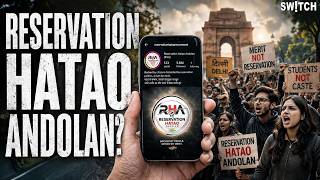
Reservation Hatao Andolan: 5M Followers in Days
45sThe rapid rise of a radical social media movement reignites India's most explosive debate on merit and reservation.
▶ Play Clip"Delivers exactly what the title promises—a balanced look at the merit vs. reservation debate, though it leans on discussion rather than deep data."
This video discusses the Reservation Hatao Andolan (RHA), a growing social media movement demanding the abolition of reservation and caste-based identity from public life. It explores the historical roots of the caste system, the impact of British colonial rule, data on caste attitudes and reservation outcomes, and the complexities of merit, inequality, and representation in India.
RHA has amassed over 5 million Instagram followers and describes itself as politically independent. Its slogan, 'Educate, Agitate and Organise', was coined by Dr B.R. Ambedkar in 1942.
The Purusha Shukta of the Rigveda symbolically links society to a cosmic being's body: Brahmins the head, Kshatriyas the arms, Vaishyas the thighs, and Shudras the feet. Dalits were considered Avarna, outside the caste hierarchy.
While caste existed before the British, colonial administration documented and institutionally classified caste identities, making divisions more rigid. Warren Hastings' 1772 legal framework relied on Brahmin scholars to interpret Hindu laws.
In 1906, an open-entry exam for administrative posts still resulted in Madras Brahmins taking 80% of positions despite being only 3% of the population, due to the English-language requirement and their historical access to education.
The SARI survey found that 39% of non-Dalit Hindus in Delhi admitted untouchability is still practiced in their homes, while 60% of non-Dalit respondents in Rajasthan opposed reservation and favored merit-based selection.
An examination of 215 engineering colleges found no conclusive evidence that students admitted via reservation are unable to cope with the syllabus, countering a common argument against reservation.
Reservation has improved representation in Group C and D jobs, but Dalit communities remain disproportionately concentrated in sanitation work, with an estimated 40% of sanitation workers belonging to SC communities.
If caste is removed from government forms and admissions, we lose the ability to measure caste discrimination and craft policy. Without data, inequality becomes invisible despite persisting on the ground.
RHA is part of a trend of issue-based social media movements in India. However, the video questions whether millions of followers translate into ground-level support or meaningful policy change.
The video argues that merit includes privilege and socio-economic advantages accumulated over generations, challenging the simplistic merit vs. reservation binary.
The reservation debate in India is not a simple yes/no; it involves measuring historical disadvantage, addressing persistent discrimination, and redefining equality. The RHA's digital mobilization has intensified the conversation, but erasing caste data or reservation without ending discrimination risks making inequality invisible rather than solving it.
What is the slogan of the Reservation Hatao Andolan?
Educate, Agitate and Organise — coined by Dr B.R. Ambedkar in 1942.
00:47
According to the Rigveda's Purusha Shukta, which body part corresponds to the Shudras?
Feet.
01:32
What does 'Avarna' mean?
It refers to those outside the caste system, historically used for Dalits.
01:47
How did the British colonial administration affect caste identities?
It documented and institutionalized caste, making divisions more rigid and hierarchical.
03:51
Who developed the legal framework for Hindu and Muslim personal laws in 1772?
Warren Hastings.
04:05
In the 1906 exam, what percentage of administrative posts were held by Madras Brahmins and what was their share of the population?
80% of posts, while they were only 3% of the population.
07:34
According to the SARI survey, what percentage of non-Dalit Hindus in Delhi admitted untouchability is practiced in their homes?
39%.
08:31
What did the study of 215 engineering colleges find about reserved-category students?
No conclusive evidence that they are unable to cope with the syllabus.
09:56
What is the estimated proportion of sanitation workers in India from SC communities?
Around 40%.
10:38
Why is caste data considered important for policy-making?
Without it, we cannot measure caste discrimination or design policies; inequality becomes invisible.
12:02
How does the video define merit?
Merit is not just personal talent; it includes privilege and advantages accumulated over years.
14:38
Caste's mythological origins and exclusion
Explains how ancient texts created a rigid hierarchy and labeled Dalits as Avarna, setting the stage for millennia of discrimination.
01:32Colonial rule institutionalized caste
Shows that while the British didn't invent caste, their classification and documentation made it more rigid and systemic.
03:51The myth of equal opportunity
Demonstrates how a color-blind exam still favored the privileged 3% who had English-language access, yielding 80% of posts.
07:34Erasing data doesn't erase discrimination
Articulates the central dilemma of the RHA's demand to remove caste categories—without data, inequality becomes invisible.
12:02Rethinking merit
Challenges the merit argument by asserting that privilege is embedded in talent, reframing the reservation debate.
14:38[00:02] grabbing a lot of attention on social media. That is the Reservation Hatao Andolan i.e. RHA. This movement claims that reservation should be abolished and caste-based identity should also be gradually removed from public life. And do you know that
[00:18] this movement has come on social media only after the recent CJP led JNC protest. But the debate on reservation is not new in India at all. This debate is related to education, jobs, married, caste,
[00:32] discrimination and social justice. Absolutely. RHA's new Instagram account has attracted over 5 million followers in a short time. The group describes itself as politically independent. Its
[00:47] slogan is Educate, Agitate and Organise, a line coined by Dr B R Ambedkar in 1942. And this is where the debate begins. Ever since this page was created, a debate has started on social media. On one hand, some people say that
[01:03] reservation is a tool to reduce caste discrimination. On the other hand, some people believe that reservation is against merit and it should be abolished eventually.
[01:15] So now the question is whether caste discrimination can be eliminated in India by ignoring caste ? And is equality possible without reservation ? So, to understand this debate on dignity reservation, let us go
[01:32] tell that a symbolic description is found in Purusha Shukta of Rigveda. Where the a symbolic description is found in Purusha Shukta of Rigveda. Where the society has been linked to the body part of a cosmic being. Brahmins are denoted by head, Kshatriyas by arms, Vaishyas by thighs and Shudras by feet
[01:47] Kshatriyas by arms, Vaishyas by thighs and Shudras by feet important for us to understand an important distinction. Dalits were not traditionally included as a separate varna in the varna system. For this reason, historically they were
[02:03] called Avarna. That is, outside the caste system and caste hierarchy, there was no hierarchy at all, not just limited to occupation. Even the restrictions in areas like social practices, marriage and food areas like social practices, marriage and food
[02:19] and historical studies.
[02:31] also been defined according to the hierarchy and such that a Brahmin woman
[02:47] Brahmin woman cannot marry a Shudra. That means the caste system was not just a social classification. Over time it transforms into a rigid hierarchy. Where a person's social status started being decided on the basis of his birth.
[03:03] Absolutely. And many social movements also emerged in history against this caste rigidity. many social movements also emerged in history against this caste rigidity. emerged and challenged the hierarchies, and these
[03:18] kinds of things continued to happen from time to time. And centuries later Dr. B.R. Ambedkar also centuries later Dr. B.R. Ambedkar also In 1956, Ambedkar accepted Buddhism along with his followers in Nagpur.
[03:37] This was not just a change of religion but was considered a social protest against caste hierarchy. but was considered a social protest against caste hierarchy. British era. So the caste system existed even before the British. It was
[03:51] n't like he became stronger after that. But historians and sociologists have argued that the administration made caste identity more rigid in many places by officially classifying and documenting it
[04:05] and they came up with such rules that the existing caste division became more hierarchical and stronger and this division in the society gradually increased. You know, according to reports, in 1772, during the
[04:19] time of Vernon Hastings, a legal framework was developed to administer Hindu and Muslim personal losses. a legal framework was developed to administer Hindu and Muslim personal losses. Now here the Brahmin scholars played an important role in interpreting Hindu laws.
[04:35] socialists and scholars also argue that in the colonial period, argue that in the colonial period,
[04:47] administrative identity in the sensible administrative categories and institutional processes. Basically, people from upper castes were given such opportunities that their social status could become stronger. But here also there is a no, it would be an oversimplification to say that
[05:03] caste discrimination, the caste system, was created by the British. Caste and untouchability have existed in India for centuries before him. But colonial rule played a role in documenting, classifying, and institutionalizing identities.
[05:19] Moreover, in the study that Verin Hastings was talking about, the administrators were asked to administer both Hindu and Muslim groups, the majority in that were Brahmins, so the new rules that he made at that time were made by
[05:33] his own people, this is also an understandable thing, there have been continuous debates on this that when you make such rules and laws and if the people in that committee are not in that group, for whom you are making the rules, then the question
[05:48] of representation comes up again and this fight has always been about representation. This means that the law makers are the same as they are, so they made the law as per their own wishes. This makes sense.
[06:02] Absolutely, the debate regarding this has been going on for a long time. So according to reports and scholars, they say that during the British period, representation was a major issue in education and government jobs. For
[06:18] given where Brahmins were a relatively small part of the population. But their representation in education and administrative services was disproportionately high. It was not that the rest of the people could not read,
[06:32] but in this it becomes very important to understand who has how much resources and how they use it. This means that those who historically had greater access to education and the English language had an
[06:49] important question arises that if everyone is not the same from the starting line, then can you achieve equality in the society by just measuring the married people or not. And what you were talking about at that time was the Brahmins of Madras.
[07:05] I remember there was a report in which it was told that the then Viceroy of India around 1906, he decided that all the administrative posts would have open entries, like there would be no caste based entry in them
[07:20] and anyone could apply for it. But what happened was that the exam was to be held in English. Now, the access to English language was Now, the access to English language was
[07:34] mostly available to the Brahmins of Madras at that time. So overall the conclusion was that 80% of the administrative posts were occupied by Brahmins from Madras. But when we look at the overall demography of that time, their number was only 3%.
[07:47] And this is where the issue of privilege comes into play, that it was a privilege that if he could read and understand the English language, then only he could apply for that job and then he remained in those higher positions from the beginning. Of course, people can justify this by saying that
[08:00] look, in the rules and regulations, the British said that we are understood who has things cannot be seen in black and white. Even today, when the issue of reservation
[08:13] comes up, a common argument against reservation is that admission and jobs should not be based only on merit. Around 2016, there was a discussion on caste attitudes regarding the survey of SARI i.e. Social Attitude Research India. The
[08:31] states were asked questions about caste practices, intercaste marriage and reservation, and in Delhi, according to a survey finding, 39% of non-Dalit Hindus said that untouchability is still practiced in their homes.
[08:48] And do you know that in the same survey, 60% of non-Dalit respondents in Rajasthan reportedly
[09:01] opposed reservation and said that seats should be on the basis of merit. Now a new contradiction arises here that if caste based discrimination and caste preferences still exist in a society, then will
[09:16] removing reservation be a solution to equality or will the continuation of reservation make the caste identity more permanent, so these questions are continuously going on. Exactly and this debate is not a simple reservation
[09:29] Exactly and this debate is not a simple reservation yes or reservation no. This is a debate on how to measure social inequality? How to address historical disadvantages and what does equality mean? Of course, another
[09:44] argument against reservation is that students who take admission from reserved categories are But according to a study done on engineering colleges, it was
[09:56] found that 215 engineering colleges were examined. In that, researchers have not found any such conclusive evidence that the students who have come through reservation are not able to cope up with the syllabus. And do you know that if we talk about SC and ST representation in government jobs, the
[10:10] And do you know that if we talk about SC and ST representation in government jobs, the important issue is that this representation has been
[10:23] For example, the representation in Group C and Group D jobs has been relatively higher. And historically there has been a disproportionate representation of Dalit communities in occupations like sanitation work. Dalit communities in occupations like sanitation work.
[10:38] a significant proportion of sanitation workers belong to SC communities. Some estimates put this figure around 40%. Absolutely. So the question is also that how much social mobility did reservation
[10:53] create and whether its benefits were equally available to people at all levels? This is also a big question that we talk about, so many years have passed. More than seven decades have passed. So did those people benefit from the reservation? So if we
[11:08] look at the data, the representation has definitely increased if we compare it with before, but by how much percentage has it increased? Even now,
[11:20] current issue. The Reservation Hatao Andolan or RHA is growing rapidly on social media. The group's Instagram account has amassed over 5 million followers. The group claims that it is not affiliated with any political party.
[11:34] People supported this campaign on social media. So some people said that first remove caste discrimination and then we will talk about reservation. So, a group called Garima discrimination is to be ended then the government and society should stop recognizing caste identity
[11:50] in public life. removed from government forms, college admissions and job applications. All this is what
[12:02] this group says and this group is continuously talking about it. But the biggest question here is that if we stop recording caste then how will we measure caste discrimination? If we don't know which
[12:16] community is lagging behind in education, jobs or representation, how will we make policies? The second question is that if caste discrimination has not ended but we stop collecting caste data, then will this inequality
[12:31] not become invisible? I mean, basically, it will be the same thing, according to me, that some things are still existing in the society, but we are collecting them, basically we are stopping looking at them because if we do not look at them, then it will happen
[12:43] that those things are not existing and the rise of RHA is also showing another trend, the rise of issue-based movements on social media. After the CJP led protest, campaigns like E20 Janata Party have also come up on social media and
[12:57] now the Reservation Hatao Andolan is also doing digital mobilization on a specific policy issue. Absolutely. That means, apart from political parties, citizens are now building movements around their issues on social media.
[13:09] citizens are now building movements around their issues on social media. whether a million followers also mean ground-level support. Can Instagram campaigns bring about actual policy change, and will simplifying complex issues
[13:24] into social media slogans keep the debate meaningful? The debate on reservation in India is not limited to just debates on jobs and college seats. This is a debate on caste discrimination, equality representation and historical injustice.
[13:40] And the Reservation Hatao movement has brought an old debate to a new digital platform. But here it becomes important to answer an uncomfortable question: will answer an uncomfortable question: will
[13:53] first caste based discrimination will have to be ended so that this disparity and division in the society will end. So this is a very important question. The debate on this is going on continuously. And yes, I want to ask those
[14:06] who are leading this movement that even today a child is beaten up because he drinks water from the pot which was meant for certain castes. Even today, it is a big challenge for a Dalit groom's wedding procession to pass through some particular areas.
[14:24] because it is prepared by SC or ST. So prepared by SC or ST. So saying that everything will be fine if caste is removed is not right. And it would also be important for these people who are talking about merit to understand
[14:38] what is the definition of merit? Is merit just personal talent or is it beyond that? The privilege you come from also defines what your merit is. Because merit cannot be considered just personal talent. Years of
[14:52] privilege are also added to it. So, what is your opinion on all these issues, should reservation remain or should it be removed? Whatever your opinion is regarding this, please do share it in the comment box. I am Garima, I am Swarana and you are watching The Sister Show.



⚡ Saved you 0h 15m reading this? Transcribe any YouTube video for free — no signup needed.