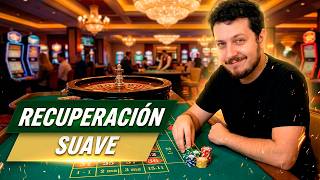

This Roulette Hybrid Could Change Everything
38sThe opening promises a surprising roulette system that recovers losses and profits simultaneously, triggering curiosity.
▶ Play Clip"Delivers on its promise with real math and live examples, despite a casino promo insert."
This video analyzes Sotachi, a roulette recovery system that fuses the classic Shotwell method with the Fibonacci sequence instead of Martingale. It walks through the base betting structure, demonstrates the Fibonacci ladder on a live table, and compares the risk and profit profile against Shotwell Linear. The conclusion: Sotachi works, but it sacrifices explosive profit for lower risk and smoother recovery.
Sotachi is a hybrid roulette method combining the Shotwell strategy with the Fibonacci sequence, designed to recover losses and generate profit at the same time.
The creator stresses that playing at a licensed, fair casino is essential; unlicensed casinos may rig games or make it impossible to withdraw winnings.
The Shotwell method, created in the 1970s, exploits physical wheel defects using three fixed combinations, each with a six-number bet and four straight numbers, covering roughly 27% of the wheel.
With a €1 base bet, you place €5 on the six-number group and €1 on each of four straight numbers, totaling €9. A win pays €21 profit on the six-number bet or €27 profit on a straight number.
After a loss, you move up the Fibonacci sequence (1, 1, 2, 3, 5...). The second '1' means repeating the same base bet, then doubling at step 3, tripling at step 4, and so on.
Hitting a win at the 5th Fibonacci level produces a €42 profit, which is decent but noticeably lower than what the Martingale-based Shotwell Linear would deliver.
Martingale is normally used on bets with ~48% win probability; with Shotwell the hit rate drops to 27%, but the higher payouts make recovery profitable. Fibonacci works similarly to its traditional use on columns, producing a 'non-explosive' recovery.
At the fifth recovery step, Fibonacci requires only €45 total bet compared to €288 with Martingale from a €9 starting bet. You trade potential profit for much lower risk and easier bankroll management.
The creator ended a roughly 10-minute session with €375 balance, about €100 profit, but reminds viewers that no system is infallible and losing everything is always possible.
What is the Sotachi system?
A hybrid roulette recovery system that combines the Shotwell method with the Fibonacci sequence.
00:53
What does each fixed combination in Shotwell consist of?
One six-number bet and four straight numbers, covering about 27% of the wheel.
02:24
With a €1 base bet in Shotwell, what is the total bet and potential profit?
Total bet is €9 (€5 on the six-number group and €1 on each straight number). Profit is €21 for a six-number hit or €27 for a straight hit.
03:37
What payout does a straight number hit give in Sotachi?
€27 profit when using a €1 base bet.
03:50
How much would the fifth recovery bet cost under Martingale vs Fibonacci starting from a €9 base bet?
Martingale costs €288, while Fibonacci costs only €45.
10:10
Why does Sotachi produce lower recovery profits than Shotwell Linear?
Because Fibonacci is a less aggressive progression than Martingale, so each win recovers less cumulative profit.
09:57
What is the Fibonacci step order used in Sotachi?
1, 1, 2, 3, 5... with the second '1' meaning a repeat of the base bet.
05:21
What is the main trade-off when choosing Sotachi over Martingale?
You trade higher potential profit for lower risk and easier bankroll management.
10:25
Introducing Sotachi
It frames the entire video: a hybrid that promises smoother recovery by replacing Martingale with Fibonacci.
00:53Shotwell's wheel coverage and payouts
The core fact that defines the system: 27% coverage with payouts of 21 and 27 units.
02:24Why Martingale + Shotwell works differently
Explains how a 27% win rate with high payouts turns Martingale from simple loss recovery into a profit-generating recovery.
09:16Risk vs profit trade-off
Quantifies the practical difference: €45 Fibonacci bet vs €288 Martingale bet at the fifth step.
10:10Session result
A real example closes the video with approximately €100 profit in 10 minutes, but with the caveat that no system is infallible.
10:39[00:01] Softwell linear method was one of the very few roulette systems that during the recovery using Martingale. But now, what happens if we replace the Martingale with Fibonacci? It is a system designed to recover and
[00:15] generate profit at the same time. Does this imply much greater gains when we recover? Are there any factors we're ignoring? Today we will delve into Shotai, a hybrid between the classic Shotwell configuration and the legendary
[00:28] Fibonacci sequence. We'll break down how it works, what the advantages are, and where it could backfire if you're not careful. The results, honestly, are going to surprise you, so stay tuned
[00:40] because it could change the way you play roulette forever.
[00:53] , today we will dive headfirst into the Shotachi method, a fusion between the Shotwell strategy, which we recently covered, and the now famous Fibonacci sequence. If you haven't yet seen the video where I break down the
[01:05] here in the top corner. I first because I will not repeat the basic concepts here. Also, I remind you that for this strategy or any other to really work, we need to
[01:18] make sure we're playing in a safe and fair casino like the one I'm using today. There are many online casinos out there, but many are unlicensed. They operate from dubious jurisdictions and some even have rigged games.
[01:31] By playing on the wrong one, they could lose all their money with no way to get it back. unsure which casinos are legitimate, check the link in the description and the first comment for an updated list of safe and
[01:44] legal options in Latin America and Spain. Now then , let's begin. Here we are in a Shotwell strategies should only be played at live tables to maintain the fidelity of how the method was originally designed and, of course,
[01:59] rigged mesmeas. [music] You will find some insurance policies listed I'm currently in an Italian casino playing with euros, but any currency works the same way. Let's review the strategy
[02:12] to be ready for this new turn of events. The Shotwell method was created in the 1970s based on the idea that physical defects in the roulette wheel could be exploited by placing bets around the roulette wheel, not just on the
[02:24] table's betting area. There are three fixed combinations, each consisting of a six-number bet and four straight numbers, covering about 27% of the wheel. You will find the document with the three combinations in
[02:37] the description. Download it and have it at hand. Coverage is low, but the payouts are substantial. 21 units if you guess the six-number combination, 27 if a straight number falls . Now, with the base version, you place the same "it sucks" over and over again,
[02:53] even after losing, hoping that the next win will cover everything. But with the linear shortwell version we apply the martingale and that's where it gets wild. Not only do you recover your losses, but you also make a profit as
[03:05] you recover. This is because although the success rate is only 27%, the enough to eliminate losses and leave you with extra cash. So Martingale already makes Shotwell profitable during the recovery, what
[03:22] system designed to make profits while recovering? In theory, that should mean even more profits, but is that really how it works? Let's find out in this new Sotachi version. We will begin with the second
[03:37] combination of the Shotwell configuration. I'm using a base bet of €1, so I'll place €5 on the six numbers from 10 to 15 and €1 on each six numbers from 10 to 15 and €1 on each of the straight numbers: 16, 17, 18, and
[03:50] 28. We'll stick with this combination for a while. It's a total bet of €9 and depending on the result, we're looking for a profit of €21 or €27. Let's see how it develops. Let's go.
[04:23] Brilliant. That's €30 in total winnings, which means €21 profit on a €9 bet. Not bad at all. As you can see, the payouts are solid, but remember, we only have a 27% chance of hitting a number
[04:38] right away. Let's continue with the same configuration. I'll skip ahead to the configuration. I'll skip ahead to the slow parts.
[04:55] So, what do we do now? Since we are running Sotachi, we follow the Fibonacci sequence. which you can see right now on screen. You can also download it from the link in the description. If you've been following the
[05:08] channel, you already know how Fibonacci works, the same classic sequence. And if not, check out the video I linked above. Now we move on to the second number in the sequence, which is still one. So we repeated exactly the
[05:21] one. So we repeated exactly the same bet as before.
[05:33] moved up a step in the sequence. The third number in Fibonacci is two, which means we double everything, 10 in the six-seven and two in each direct number. the six-seven and two in each direct number. Let's see what happens.
[05:57] That covers everything and leaves us with €24 profit. It's not bad at all. But wait, it shouldn't be any more than that. Let's do another round and see. We return to the basic setup. Five in the six and one in each of the four numbers. For now, the same
[06:11] combination. Let's keep it simple. Let's move forward a little again.
[06:24] We lost. So, second number in the sequence and we repeat the same bet.
[06:38] Another loss. We move on to the third step. Time to double down. four, that is, three times the base. It's time to triple everything.
[07:06] totally ruined it, it sucks. Time was deleted everything. [laughs] Well, it's better to skip a round than to wrong bet. That's one of the disadvantages of live roulette. It can
[07:20] get quite intense with short countdowns. Alright, time to bet again. Let's do it right this time. 30 in the saena and three in each this time. 30 in the saena and three in each direct number. Total bet €27. If
[07:34] bets, there is a system that can automate roulette bets.
[07:50] And another loss. That means we move on to step five. Five times the base. Let's go big. 50 in the six-number group and five in each of the four numbers. Since this bet takes a moment to set up, I'll let
[08:04] I prepare the bet using the quick pick planner. A super useful feature. Many live DJ booths have it and believe me, it saves live DJ booths have it and believe me, it saves time.
[08:21] go. Now the time for action has arrived. And just like that, we loaded our saved bet. Honestly, they give so little time at the live tables , that's why I sometimes prefer the virtual ones where you can take all the
[08:34] time you need. Let's see what happens next.
[08:49] the deeper we go in potential gain. So we should have made a huge profit here, right? Okay, let's analyze the numbers. The total profit is €150 minus everything we
[09:04] have bet now. That leaves us with a profit of €42. It's not bad, but it's not massive either. With the martingale we would have obtained much more. So what's going on here? Here's the math behind it. The
[09:16] martingale is generally used on outside bets like red, black, with around a 48% probability of winning and a payout of 11. The goal there is just to recoup your losses, but when you apply the martingale to the Shotwell method,
[09:30] things change. The probability of winning drops to 27%, but the payouts increase significantly. So when you win, it covers all your losses and leaves you with a nice unusual for a Martingale setup. Fibonacci, on the other hand, is
[09:44] generally used in bets such as columns that cover about 32% of the table. Softwell covers 27%, so it's not far off, and the payments between the 21st and 31st are quite similar.
[09:57] So playing Fibonacci with Shotwell feels very similar to using it in its traditional, solid, non-explosive form. In summary, Sotachi works, but it's not as risky as linear software. The advantage is that it is easier
[10:10] to manage with the Martingale. In the fifth step you would be betting €288 starting with €9. With Fibonacci it only costs you 45, so you trade some potential profit for less risk. Both systems work. It all comes down
[10:25] to how much risk you're comfortable with. Higher profits with greater risk, or lower profits with more control. Just remember, no system is infallible. There is always a possibility that you could lose everything. Play smart.
[10:39] Here we go. The balance is now €375. That's almost €100 in profit in about 10 minutes. It's not a bad move. So tell me, which one do you like more, Sotachi Owell Linear? Let us know in the comments. We try to answer
[10:53] you can find a list of safe and certified online casinos in your country in the link in the description. I recommend using certified casinos if scams, rigged games, or even playing
[11:06] trouble with the law. Don't let your next throw end up being a court summons. If you enjoyed a comment, and subscribe to the channel, of course. See you in the next
[11:19] lesson with the teachers of chance. See you soon . Go!




⚡ Saved you 0h 11m reading this? Transcribe any YouTube video for free — no signup needed.