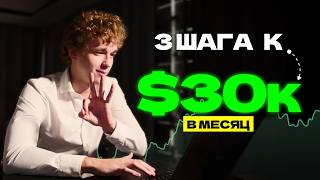

Why 90% of Traders Lose Money
57sThis segment combines a shocking statistic with a relatable pain point about trying to catch market reversals instead of trading with the trend.
▶ Play Clip"Title promises a complete Smart Money strategy, and the video delivers a coherent system, though it also heavily promotes a paid course."
This video presents a comprehensive trading system based on Smart Money concepts, focusing on trend trading using liquidity and imbalance zones. The speaker outlines a three-stage path to achieving consistent profitability, emphasizing the importance of discipline, a trading journal, and using proprietary trading firms to overcome capital limitations.
The video targets traders who understand basics but struggle with emotional control and systemization, aiming to build a coherent trading system.
The video covers how to make money from the market (not just understand it), why 90% of traders lose money, and a step-by-step system to achieve five-figure monthly profits.
Trend movements consist of growth phases and corrections, with only one reversal. Trying to catch reversals leads to multiple stop-losses, while trading with the trend is easier and more profitable.
To systematically earn, a trader must choose one setup (e.g., catching the end of a correction in an uptrend) and stick to it, sacrificing other opportunities.
Price continues the trend after touching an imbalance zone or removing liquidity (stop-losses). These are the two main drivers of market movement.
Using a trending movement, the speaker shows how each correction ends either by touching an imbalance or removing liquidity, allowing entry in the trend direction.
Synchronize daily and hourly timeframes to confirm trend direction. For example, if both are upward, trade long; if both downward, trade short.
After confirming trend and liquidity removal on higher timeframes, enter on the 5-minute chart. Stop-loss is placed above the liquidity point (local high/low).
Each asset has optimal trading hours. For example, for certain assets, the Frankfurt and London sessions (9:00-12:00 Kyiv time) are best.
The system includes: 1) a setup (entry rules), 2) emotional control (journal, statistics, discipline), and 3) capital management (using prop firms).
A successful trader averages 5-10% monthly return. With a $10,000 deposit, that's $500-$1,000 per month. To earn $10,000/month, you need a large deposit or use prop firms.
For $500, you can get a $100,000 prop firm account, risk 1% per trade, and earn substantial profits without risking personal capital.
1) 200 trades on a simulated market, 2) strict adherence to system rules, 3) maintain a trading journal. A mentor can accelerate progress.
The speaker offers a 7-day test drive for $15, including theory lessons, practical club access, and a personal mentor call, with a money-back guarantee.
The video provides a practical trend-following system based on liquidity and imbalance, emphasizing the need for discipline and proper capital management. The speaker promotes a low-cost test drive to help traders implement the system with mentorship.
What are the two main tools that drive market movement according to the video?
Liquidity and imbalance.
04:07
What percentage of the time does price return to an imbalance zone?
Approximately 63% of cases.
04:44
What is the recommended stop-loss placement after a liquidity removal?
Just above the liquidity point (local high for short trades, local low for long trades).
10:18
What is the average monthly return of a successful trader according to the video?
5-10% per month.
13:47
Why does the speaker recommend using prop firms?
Because a personal deposit under $30,000 yields insufficient profits, and prop firms provide larger capital with controlled risk.
15:34
What are the three steps to mastery mentioned in the video?
1) 200 trades on a simulated market, 2) strict adherence to system rules, 3) maintain a trading journal.
17:48
What is the optimal trading time for the asset discussed?
Frankfurt and London session, from 9:00 AM to 12:00 PM Kyiv time.
11:13
What is the main reason traders fail according to the video?
Lack of a system, emotional control, and discipline.
00:16
Trend vs. Reversal
Explains why trading with the trend is more profitable than trying to catch reversals, using a clear phase model.
01:13Liquidity and Imbalance as Drivers
Identifies the two fundamental market mechanisms that consistently cause price to continue trends.
03:41Multi-Timeframe Trend Confirmation
Provides a simple, actionable method to confirm trend direction using daily and hourly charts.
08:24Capital Realities of Trading
Highlights the mathematical challenge of earning meaningful income with small personal deposits, introducing prop firms as a solution.
13:32Three Steps to Mastery
Outlines a clear, structured path for traders to develop discipline and consistency.
17:48[00:02] types of people. If you already know the basics, but your graph is constantly in chaos and confusion, that is, it seems like you understand, but everything breaks down on the graph. If you understand that the problems are not with theory , but rather with emotional drains,
[00:16] discipline, and so on, or you simply cannot gather all the knowledge you have together and build a system for confident trading. If you recognized yourself in any of these points, then watch this broadcast to the end. It will be worth it
[00:29] , because today I will analyze what the infocygans do not talk about. We'll cover three main things: how to make money from the market, and not just how to understand it, because these are two fundamentally different things. We'll explore
[00:43] why 90% of traders don't make money and how to avoid being one of them. We'll explore a step-by-step system and a three-stage path to achieving a five-figure monthly trading profit . In short, guys, today we will build a
[00:58] trading system together that will make trading smooth. This is the most key thing. Trading with the trend is easier than trading against the trend, and more profitable. Because even if we take an example of how a trend movement moves, it moves, well, it’s
[01:13] never looks like that, and we’ll look at that now. It doesn't look like this, yes, but in the end it moves there phase, growth phase, correction phase, growth phase, correction phase, growth phase, correction phase and the reversal happens only
[01:27] once. That is, if you tried to catch a big reversal, you will be hit by stop-loss four times, and you will get take-profit once. And it seems like after the fourth stop-loss you hardly want to live, not to mention take-
[01:40] profit, yes. Uh, okay, maybe you 'll catch these little corrections. Well, here the question is, why? Firstly, they are difficult to catch. You never growth phase will end because it is the most aggressive phase of the market. When it's
[01:54] trending, it's at its most aggressive. He, well, it’s hard to stop him there and turn him around like that, you know that. Eh, well, and secondly, you catch, it turns out, these small, small, small movements, these small corrections.
[02:07] movements, these small corrections. For what? The most profitable stage here is profitable point where you can trade. And here, guys, is why I say the most profitable, because we can only choose one. That is,
[02:21] if you want to systematically earn money from the market, you ultimately need to choose , for example, one setup for yourself and move only with it, because no trader can ever know every market move and
[02:35] constantly predict where it will go. It can elevate some market movements while sacrificing others. For example, you and I
[02:47] accordingly, we are trying to complete the correction phase and continue the growth phase. That is, our task here is to catch the end of the correction and move further with the chart along the upward trend. Well, or if the chart was inverted like
[03:02] this, then it would simply be downtrend, yes. This is our task. Okay, great, it does our task. Okay, great, it does n’t seem difficult, but the most important thing I want to say right away is that you can’t catch these corrections and
[03:15] also try to catch reversals. You need to choose one thing because that's the only way you'll have focus. Therefore, we will erase all the most unprofitable examples and focus only on the fact that it is easiest to continue
[03:27] trading with the trend and the most profitable. Why do I say this is the easiest? Because, uh, in order to continue trading with the trend, you the correction will end. That is, our main task and the
[03:41] question we are now trying to answer is where the price will end its correction. To answer this, we simply need to understand the liquidity of the imbalance. That's it, the price will always go up and
[03:54] continue this trend. from touching some imbalances, or from withdrawing some liquidity, it will always do the same thing. That is, it doesn’t change, this constant price will either touch the imbalance, or [snorts]
[04:07] remove liquidity, and through this it will continue this upward movement. For those who don't know what liquidity imbalance is, and who are sitting in a tank in a tank, these are simply, let's say, two main instruments in general, due to
[04:19] which the market moves. So good morning if you don't know what it is. But an imbalance is simply an area of imbalance, where there was, for example, a large upward candle, a gap between the candle on the left, a gap between the candle on
[04:32] large upward candle. This is an imbalance zone where there were a lot of buyers. comes back here, and he comes back here in about 63% of cases. Some kind of
[04:44] statistics, these are statistics, someone was definitely making them up. When the price returns here, the buyer, as a rule, pushes us further along the trend, yes, like here, here, and so on. That is the
[04:57] first thing. Secondly, liquidity is the imbalances. It's simply any local price minimum, or local price maximum, or even better, some kind of
[05:10] resistance level, because most people place their stop losses behind them. That is, elementary points. let's say, points of local minima, points of local maxima, right? And our task is to go against them, to go against the
[05:26] These are the two main tools we use. How do we use them? Let's take this trend movement as an example. And using this trending movement as an example, we will focus on answering
[05:40] one main question. Where here, well, more precisely, how here could we understand that each correction ended? correction ended? Let's designate for this,
[05:53] uh, let's take this circle and start from here. so that for each correction we will try to answer why it ended exactly here. This correction, yes,
[06:09] here? this correction and so on. And now said, that the correction will end from one of two or two
[06:21] [music] things at once. From touching the imbalance or withdrawing liquidity. And in this example, for example, here we had, well, our imbalance was lower. This is this imbalance. And the withdrawal of liquidity was here. We removed this
[06:34] local minimum, and the price went up through it, because the price went up through it, because knock down the stop losses of most traders and fly further upwards. Then we fly
[06:47] up and make adjustments. Where are we adjusting? Pay attention. We correct ourselves within the imbalance and through it we move further upward. Let's go, let's go, let's go up. I ran out of strength. Where did they come from next? because the price
[07:01] has removed liquidity. [snorts] And this is not just a theory, this is the logic of market pricing. We remove liquidity, that is, we knock down the stop losses of the majority. this point, can enter into a deal. He enters a trade here against the
[07:17] majority's stop losses and pulls the price up. Further here the price came out from the withdrawal of liquidity. Here she came out on top through the touch of this imbalance. Then it fell, took away its liquidity, and went up further. Here
[07:30] we made a correction, removed this local minimum, and went up. Here we touched upon the imbalance and went up. Do you see? See what I'm talking about? This means that the price will continue to move along the trend in any case. Either from
[07:44] liquidity withdrawal or from imbalance. And this is what we use for trading. We need to see that the price either removes liquidity or fills the imbalance. And from there we continue moving along the trend. The most important thing, guys, is just following the trend.
[07:58] trend. There is no need to make up any nonsense. You trade with the trend, you trade with it. If the price gives, uh, the most important thing is a clear trend,
[08:11] for example, here is a clear long trend, you will definitely, because I just showed you this example, you can 100% find good deals with this setup. 100%. The most key thing here is to correctly identify the trend. In order to
[08:24] determine it correctly, we will simply synchronize the daily log. We , for example, it is ascending. And we synchronize the watch. And here we understand that the trend is also upward. This is what we
[08:37] use. Super, super, great. This is what we use to trade. It turns out that this is just on my fingers, uh, how I trade. Now there are some parts that, let's say, increase the winray
[08:52] of this system, there up to 70%. Let's take this short as an example for a change . See what kind of short this was? See what kind of short this was? Downward movement, correction, withdrawal of liquidity. Oh, here is where
[09:06] this liquidity is removed. And notice how beautifully the price flew further upward. And on the four-hour clock there was, probably, yes, this filling of the imbalance of this little one. Well, it
[09:18] hourly basis. In short, we saw on the daily chart that the trend here was downward. Here on the daily chart we saw that the trend is downward. Then we go to the hourly chart and see that the trend is also downward. This confirms our first point, the trend.
[09:32] After this, we look at the local maximum so that the price can remove it. Super. Once we remove it, we move on to the third stage. This is already being worked out through a five-minute model. That is, here we enter for five minutes. And
[09:49] through this downward exit, the most important thing is that we are not trying to go long right here after the liquidity is removed . After the price went down, it went down, then we understand that yes, the trend here is confirmed to be
[10:05] short. On the five-minute chart we went down after removing hourly liquidity. This means that a major player has entered into sales here and we are entering into sales along with them. Stop-loss is the most important thing, not here, not here, not here
[10:18] , not where you want. It always stands firmly behind this point, behind this maximum, because this point is the point where all stop losses were cleared. And there is minimal interest in the price returning there . If you
[10:32] set these stops correctly, great, you're a hottie. Then your winray will be you're a hottie. Then your winray will be normal. Well, we put the profit on the entire collection began. Stop-loss there, if you can,
[10:45] you can put it there with a reserve. This is what it looks like. This is an example of a perfect deal. Let's return once again to the five basic rules. Trend: daily up, hourly up too. Or, if it’s a shot, then the daily period is down, and the hourly period is also down. Withdrawal of
[11:00] liquidity, the most important thing is that it is possible to withdraw liquidity in the imbalance, or without it. Entry model on the five-minute timeframe. This is this primary [music] return. And , of course, the most important thing is to trade at the right timing.
[11:13] Each asset has its own trading time. For 40 of this, this trading time is the Frankfurt and London session. That is, from 9:00 am Kyiv time until approximately 12 pm. That is, each asset has hours when it performs better and
[11:28] hours when it performs worse. Here. And this is very important to understand. when it moves worse. If you try to trade it, even when the setup there looks perfect, you'll later think: "Why did I have a
[11:40] stop-loss here? Why didn't it work out?" This is the important thing. This setup makes trade with it, it will become much easier for you. But here it is important to understand that it only works when it is built into the right system. That is, the setup
[11:56] is one of the components that needs to be built into the correct system, because we already talked about this at the beginning of the broadcast. And now I want to this at the beginning of the broadcast. And now I want to mention it again. Knowing the rules and
[12:09] exploring the rules are two completely different worlds. Because, for example, when you want, when you got three stops and want to fight back, then the rules somehow don’t matter to them. Or when the market flies away without you and you think where it’s going,
[12:23] I want to go with it. Or when you're in a good deal, but greed tells you, "Hold it a little longer." Or, on the contrary, greed tells you: “Come on out already, there’ll be a profit soon,” and you’ll earn a little less. And you break your own rules.
[12:36] Because the system is not just a prop, guys. The system is about controlling your emotions, it's about a trading journal and statistics, and it's about adapting the rules to you so you can trade comfortably and not get carried away by emotions.
[12:49] Okay, we've covered this point. Now the next thing we'll Now the next thing we'll look at is the third pillar of the look at is the third pillar of the trading system, which
[13:02] answers the question of where you trade. There I am. And this is the cash deposit, you will never make decent money. If you are not yet a profitable trader and you are trading with a personal deposit, you will not earn a decent amount of money
[13:16] trader and have statistics and you're trading on a personal deposit, then yes, but if you're not yet profitable, and especially if your deposit is under $30,000, you won't be able to make a profit from trading. Let's look at the
[13:32] will analyze the weighted average as a percentage of the deposit. Let's not talk about numbers, interest on the deposit. And so the average weighted profit of a successful, super-cool trader per month over a long distance is
[13:47] per month over a long distance is 5-10%. start with 10,000 bucks, you earn up to 1,000 dollars a month.
[14:01] 10,000 dollars, you try, you trade, you earn 1,000 bucks, if you are the most successful trader in the world, well, not the most successful trader in the world, but 10% per month is a very
[14:13] cool result, you need to get to that. And here And here we come to this thought: 50 dash 100 years ago, profitable trading was available only to rich people who could
[14:25] start, well, at least 30-50,000 dollars in order to earn at least three , right? Only for the rich or the lucky? Because if you have your own 500 bucks deposit, you can't expect to earn
[14:37] much from it, I just showed you real statistics. Well, you understand that 500 bucks is not some kind of money marathon where they give you free money. You won't get them to make a big deposit. And now, when
[14:51] we are no longer in the past, but in the present, there are two ways to earn, for example, $10,000 a month trading. The first way is $10,000. First of all, you have to have a deposit
[15:04] [music] and risk 10 times more than the normal risk so as not to normal risk to never lose your deposit is 1% for each transaction. And month. You can be a super smart guy and risk 10% per trade, but
[15:21] and you won't have half your deposit. You don't have 5,000 bucks. That means the risks not everyone has 10,000 dollars, and that’s normal. Second option:
[15:34] pay $500 for testing in prop. Get $100,000 to manage, risk 1% and make that money. With props, it's much easier to earn a lot, and most importantly, it's
[15:47] to earn a lot, and most importantly, it's third ket with you. It doesn't make sense to start your own $100,000 at this stage, even if you have it. If you don't have them, then especially since we
[16:02] just discussed it, you won't be able to earn up to $30,000 with your deposit there . Trading with proprietary firms is an option you should consider. Trade with props and receive capital there for management.
[16:14] Because a personal deposit is a small profit, which leads you to excessive risks, which leads you to the fact that due to excessive risks you constantly have to sit at the chart, as if you were in handcuffs. Because
[16:26] only start to get confused and end up in the same cycle as a losing trader. And when trading with props according to a system, you simply take on minimal risks, don’t sit at the chart around the clock, follow the system and that’s it.
[16:43] And, for example, if you spend 500 bucks or even, well, not necessarily 500, you can start with any amount, but for simplicity of calculation. 500 bucks will buy you samples worth 100,000 dollars. If you completed it with one profitable trade,
[16:55] for example, you risk 1% of your deposit - that's $1,000. You will earn from that's $1,000. You will earn from back tests there, and saw that the whole system works, the main question
[17:08] is how to prevent all this information from becoming another layer that you simply digest and then go on to dump on the market. Because it often happens that you watch some video, you understand everything,
[17:23] your eyes light up, but you still don’t have a system. There is still no discipline of a roadmap, and no mentor who supports you. Now, how can we turn this into a growth point? You don't just need a theory, you do
[17:36] n't just need a video. In fact, you need a clear roadmap that will keep you on track and will be tailored specifically to you. The three steps that each of you guys needs to go through is 200 trades on a simulated market. This is
[17:48] trading only according to a strict set of trading system rules. This is a trading journal so you have statistics so you can improve. And it all sounds simple. But in the real market, you yourself understand how easy it is to screw up at a
[18:01] critical moment and how much harder it is to put all this into practice. Because on a backtest it's one thing, but in the real market there are always emotions, chaos and, as a rule, losses. And the solution for this is very simple. I want to suggest to
[18:13] everyone who has watched up to this point not to go alone, but to have a mentor nearby who has already walked this path, knows the pitfalls, traps, and will show you how to get around this pebble . Don't do that here. In
[18:25] general, it will show how to go this way faster, more efficiently and with the least losses. And so, guys, I have prepared the which you don’t just watch videos, but put all of this into practice.
[18:42] You go through it so that you understand, in 7 days you go through the theory of my system, these are three lessons. You go through a practical course - this is 7 days in a closed through a practical course - this is 7 days in a closed club, where 12 live broadcasts are held per
[18:54] week, ranging from joint trading to psychology. And then you go through the mentor's feedback. A trader from my team will personally call you and create a roadmap for you . That is, I want to suggest that you
[19:06] in order to speed up this path as much as possible. And I'll offer any signals or anything that will change your life. I want to offer everyone who is interested to integrate a step-by-step system into your life and your trading
[19:20] so that trading finally becomes profitable. During the test drive, you will receive a lesson on how my system works. 10 laws of a profitable trader, entry models, and most importantly, 7 days of practice
[19:33] with us. 7 days of practice in a closed club and, most importantly, a money-back guarantee . That is, if you don’t like something, you can come in, go through the theory, practice, call a mentor, or even just decide that you
[19:47] don’t want to do all this. You just write to me at any time, for any reason, and I will return to you, without any conditions or limitations, test drive. Because I'm sure that a test drive is a starting point for those
[20:01] results. They will reach this result; they will do it through a test drive. And most importantly, it does n't cost $500, or $1,000, or even $150. The
[20:13] whole thing costs just $15. That is, this is the best option so that go through the theory without any risks. These are three lessons in my system. These are the laws of a profitable chart to a result, my trading system. Then complete a 7-day internship with
[20:29] us at the club. During these seven days, you get can turn on the microphone, ask questions to a profitable trader, on. And the third is a mentor. You personally call a trader from my
[20:43] create a roadmap for your development for $15. Guys, if anyone is interested, you can sign up for a test drive using the link in the description or the link in the chat. Click on it and you pay 15 bucks. After that, there will be a contact
[20:58] where you will need to send a screenshot of the payment of these 15 dollars, and we will immediately begin a test drive and work together. I'd be happy to see anyone who wants to sign up for a test drive with us, so that this isn't just
[21:11] another video, but a real turning point. That is the main reason why I am doing this test drive, so that everyone has the opportunity to turn their trading around. Because to turn trade around through videos, well, I know,
[21:23] of them will actually change their trading? Only those guys who will implement it. I want to make sure that as many people as possible have the opportunity to implement all of this. [music]
⚡ Saved you 0h 21m reading this? Transcribe any YouTube video for free — no signup needed.