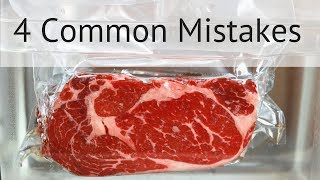

Sous-Vide Secrets for Perfect Results
43sChallenges the common myth that sous-vide is foolproof, promising expert tips for next-level cooking.
▶ Play Clip"The title accurately reflects the in-depth, pro-level techniques covered in the transcript."
This video is an in-depth guide to sous-vide cooking, aimed at home cooks who want to go beyond basic techniques. It covers the history of sous-vide tools, essential equipment setup, packaging methods, and optimal cooking times. The host also debunks common myths, such as the idea that you cannot overcook with sous-vide, and provides advanced tips for achieving perfect sears and crispy skin.
Sous-vide means 'under vacuum' in French, but the key is precise temperature control, not the vacuum.
Immersion circulators have become small, cheap, and accessible, with brands like Anova selling for around $100.
Use sturdy freezer bags (e.g., Ziploc) and the water displacement method to remove air. Add oil for fish and shrimp to prevent sticking.
Most steaks, pork chops, chicken breasts cook in 1 hour; fish fillets and shrimp in 20 minutes.
Longer cooking times increase tenderness but decrease juiciness; the myth of no overcooking is a marketing strategy.
Cool meat in the fridge for 10 minutes or an ice bath for 2 minutes before searing to allow a longer sear time (2 minutes per side) for a better crust.
For skin-on chicken or duck, chill completely before searing to achieve crispy skin (7-10 minutes) without overcooking the meat.
Pre-cook meats on weekends (1 hour), then reheat for 30 minutes on weeknights. Seafood should be cooked fresh but can be pre-seasoned and bagged.
Sous-vide is more flexible and less error-prone than reverse sear, especially for cooking multiple steaks of different thicknesses.
What is the most important aspect of sous-vide cooking?
The precise temperature control, not the vacuum.
00:49
What temperature is recommended for a medium-rare steak in sous-vide?
130°F.
00:58
What type of bag is recommended for sous-vide instead of expensive vacuum sealers?
Sturdy freezer bags (e.g., Ziploc).
05:21
What is the recommended cooking time for most steaks, pork chops, and chicken breasts in sous-vide?
1 hour.
06:39
How long do most fish fillets and shrimp cook in sous-vide?
20 minutes.
06:50
Is it true that you cannot overcook food with sous-vide?
No, longer times increase tenderness but decrease juiciness.
06:53
What technique allows for a better crust when searing sous-vide meat?
Cool the meat in the fridge for 10 minutes or an ice bath for 2 minutes before searing.
09:02
How long should you sear skin-on chicken or duck to get crispy skin after sous-vide?
7 to 10 minutes.
10:13
What is the recommended method for using sous-vide for weeknight meals with steak or chicken?
Cook them sous-vide for an hour over the weekend, then reheat for 30 minutes during the week.
10:51
How does the reverse sear method differ from sous-vide?
It uses an oven instead of a water bath.
12:14
Cooling Meat Before Searing
This technique solves the common problem of achieving a good crust without overcooking the interior.
09:02Overcooking Myth Debunked
Clarifies that sous-vide can overcook, especially with long times, affecting juiciness.
06:53Weeknight Sous-Vide Meal Prep
Provides a practical method to use sous-vide for quick weekday dinners by pre-cooking on weekends.
10:51Precision Temperature is Key
Emphasizes that temperature control, not vacuum, is the core of sous-vide cooking.
00:49[00:00] let's talk about sous-vide most sweet
[00:03] guides don't like to overwhelm the poor
[00:05] home cook with all the details thinking
[00:07] that even the worst attempt at sous-vide
[00:09] will likely result in better proteins
[00:12] than most people are currently cooking
[00:14] at home and I'm guessing that for an
[00:17] average cook
[00:18] they are absolutely right but if you're
[00:21] watching this channel you are probably
[00:23] not the kind of cook who is satisfied
[00:26] with pretty good you are the kind of
[00:29] person who will only settle for great
[00:31] and for that even the Soviet method
[00:35] requires good technique so today I will
[00:38] share with you my bag of tricks that
[00:40] will take your soviet game to a whole
[00:43] new level in case you're new to this
[00:47] here is sous-vide in a nutshell in
[00:49] French the term means in vacuum but the
[00:52] most important aspect of this technique
[00:54] is not the vacuum but the precise
[00:56] temperature if you want the center of
[00:58] your meat to be 130 Fahrenheit you cook
[01:01] it in a hundred thirty Fahrenheit what a
[01:03] broth this completely eliminates the
[01:06] need to catch a perfect moment when you
[01:09] meat is done to do that you set an
[01:11] immersion circulator into a pot of water
[01:13] and it will keep any temperature you
[01:16] want for as long as you want put the
[01:18] meat into a plastic bag put it into the
[01:21] water wait for one to two hours
[01:23] depending on the thickness then sear and
[01:25] serve why is this so revolutionary
[01:27] because doneness is the biggest problem
[01:31] cooks have with proteins and the Soviet
[01:34] method solves that but it is not without
[01:38] its challenges sous-vide food can look
[01:41] and taste anemic here is an example from
[01:44] a Nova's website this year you get after
[01:48] the water bath can be wimpy here is a
[01:51] video from America's Test Kitchen sure
[01:53] that darkness is perfect but I like my
[01:56] meat more Brown than that the meat can
[01:58] taste dry even when cooked to a perfect
[02:02] temperature is it possible that you can
[02:05] overcook your meat even with sous-vide
[02:07] long cooking times are a killer for
[02:11] weekday nights today we'll address
[02:13] and many other problems and help you
[02:16] save it like a pro but first a little
[02:18] history I heard about sous-vide about 15
[02:21] years ago when immersion circulators
[02:23] would sell for more than $1,000 and were
[02:26] completely out of reach of most home
[02:28] cooks of course they didn't stop some
[02:30] people from going where no home cook has
[02:33] gone before
[02:34] I heard of grad students who would bring
[02:36] home old immersion circulators that
[02:39] their university labs were going to
[02:41] retire and cooking them
[02:43] I've heard of electrical engineers
[02:45] rewiring their crock pots to turn them
[02:49] into temperature controlled water bath
[02:51] since I had no electrical engineering
[02:53] skills and I was too chicken to cook in
[02:55] old lab equipment my preferred method
[02:57] was babysitting a big pot of water on
[03:00] the stove with a thermometer eventually
[03:02] I switched to Ken G outs brilliant huge
[03:05] beer cooler method beer coolers I
[03:08] insulated so if you fill them with hot
[03:10] water it'll maintain it for a while of
[03:12] course we didn't have to cook and beer
[03:15] coolers for long about 10 years ago the
[03:19] first sueded tool marketed to home cooks
[03:22] hit the market it was this very big
[03:25] heavy awkward and expensive box called
[03:29] sous-vide supreme obviously there was
[03:31] plenty of room for improvement and the
[03:34] race to create the best sous vide tool
[03:37] for the masses was on thanks to the
[03:40] competition the immersion circulators
[03:43] became small cheap and accessible to
[03:46] everyone I use the one by a Nova but
[03:50] there are many brands to choose from
[03:52] another sells for about a hundred and
[03:53] the link for it is below the video
[03:56] if you use your immersion circulator
[03:59] once in a while you can certainly clip
[04:01] it onto the side of any large pot but if
[04:04] you're planning to use it on regular
[04:06] basis I strongly suggest that you get a
[04:08] plastic box specially designed for this
[04:11] purpose I bought a size that fits into
[04:14] my sink nicely so there is no need to
[04:16] move it anywhere filling and emptying
[04:18] this box is a breeze I can fit at least
[04:21] eight portions into it at the same time
[04:24] so if I want to par cook some proteins
[04:26] for the week or if I'm having a party
[04:27] it's very convenient these boxes come in
[04:31] many sizes and they're very inexpensive
[04:33] I'll link to them below this video I
[04:35] fill my container with hot water so that
[04:38] I'm ready to cook almost instantly here
[04:40] is the current temperature of my water
[04:42] here is the temperature that I want it
[04:44] to be and I can change this temperature
[04:46] with this wheel by going up and down
[04:49] when I press the play button the
[04:51] circulator starts heating and moving the
[04:53] water once the machine reaches my
[04:55] desired temperature it will be and
[04:57] allowed the food now that we get the
[04:59] temperature covered let's talk about
[05:01] packaging the food restaurants use
[05:04] chamber vacuum sewers that are insanely
[05:07] expensive the vacuum sealers sold for
[05:10] home use like food saver that sells for
[05:12] about 100 are pretty useless for this
[05:14] purpose they will deform your food and
[05:16] won't let you add the oil which is very
[05:19] useful for some proteins my bag of
[05:21] choice is the ziplock not the flimsy
[05:23] sandwich bags but the sturdy freezer
[05:25] bags fold the back over to keep the
[05:28] zipper clean season your protein with
[05:30] salt and add to the bag when cooking
[05:33] fish and shrimp I find that adding lots
[05:35] of oil to the bag prevents pieces from
[05:38] sticking together and makes the shape
[05:40] and surface of the finished dish look a
[05:43] lot better I prefer a neutral oil so
[05:45] that it doesn't interfere with the
[05:47] flavor of the fish you'll be dumping the
[05:49] soil so no need to use anything
[05:51] expensive if you're putting more than
[05:53] one piece of meat into a bag put them in
[05:56] a vertically this way they won't tumble
[05:58] on top of each other as you submerge the
[06:01] bag into the water when you submerge the
[06:03] bag open it up completely this lets the
[06:06] water push the air out much more
[06:08] effectively than if you zip it up
[06:10] leaving a tiny hole keep pushing the bag
[06:12] under the water until you get to the
[06:14] zipper if the water is too hard for you
[06:16] use a utensil to help you zip it up if
[06:18] the bag sinks you did it correctly if
[06:21] the bag floats you still have too much
[06:23] air in open it up and try again
[06:25] flip the bag to the side of the
[06:27] container so that the water circulates
[06:29] around it having a bag lying on the
[06:31] bottom of your pot won't result in very
[06:33] even cooking below this video I'll give
[06:35] you the times that I like to use for
[06:37] many common proteins but just to give
[06:39] you an idea most steaks pork chops
[06:42] chicken breasts duck breasts and other
[06:44] meats that I mentioned have all s cookin
[06:47] one hour and most fish fillets and
[06:50] shrimp cook in 20 minutes so is it true
[06:53] that you can't overcook with sous-vide
[06:56] absolutely not
[06:58] the longer times mean more tenderness
[07:01] but less juiciness the myth that you
[07:03] can't have a cook with severe came about
[07:06] due to a clever marketing strategy used
[07:09] by sous-vide appliance manufacturers use
[07:11] it to market and new home appliance you
[07:14] have to combine the exotic with the
[07:17] familiar so the exotic sales pitch was
[07:20] the promise of restaurant quality food
[07:22] at home with no effort or skill the
[07:26] familiar sales pitch was comparing the
[07:28] immersion circulator to an appliance
[07:30] most home cooks already had at home the
[07:33] slow cooker cooking something sous-vide
[07:36] will inevitably take longer than any
[07:39] other method and that was not going to
[07:42] fly in our Fast Food Nation so the club
[07:44] marketing people told you that you could
[07:47] use the slow cooker model you could take
[07:50] your meat put it into the water bath in
[07:53] the morning go to work come home sear it
[07:57] for two minutes and the nurse surfed too
[07:59] bad they didn't tell you that this kind
[08:01] of steak would be very mushy and dry but
[08:04] chicken method isn't yet very flexible
[08:06] when it comes to meat and poultry if you
[08:10] hold them in a water bath for an extra
[08:12] hour - it won't make any difference
[08:15] for fish and eggs that's not quite the
[08:16] case if you need to hold them in the
[08:19] water bath after they are done try to
[08:20] limit that time too
[08:22] ten minutes after that the texture will
[08:24] gradually start to suffer the shrimp
[08:27] will turn mushy the fish will become dry
[08:30] and the egg yolks will firm up now let's
[08:34] talk about searing issues the usual
[08:36] solutions that you'll see people using a
[08:38] really hot skillet and blowtorches Oh
[08:41] personally I don't really like the
[08:44] flavor that the blowtorch is gifting it
[08:46] and the skillets well no matter how long
[08:49] you hit them and overheat them instead
[08:51] of your fire alarms nothing ever seems
[08:54] to be enough because the sous vide meat
[08:57] tends to use out juice no matter how
[08:59] much you dry it but there is a solution
[09:02] to this life's persistent problem and
[09:04] that is cooling limit when the meat
[09:08] comes out of the water bath it's at a
[09:10] perfect temperature so every minute you
[09:12] spend in the hot skillet you are ruining
[09:14] that sous-vide perfection but
[09:17] unfortunately one minute per side is not
[09:19] quite enough to brown meat that keeps
[09:21] using but all you have to do is get your
[09:24] steak or pork chop out of the bag dry it
[09:27] with a couple of layers of paper towels
[09:29] and put it in the fridge for about 10
[09:31] minutes if you meet this thick enough
[09:33] stand it up so that both sides dry
[09:36] evenly cooling the outside of you meat
[09:38] will allow you to keep it in the skillet
[09:41] for roughly two minutes per side instead
[09:44] of one resulting in a much better crust
[09:46] you can speed up the cooling process by
[09:49] putting your bag of meat into an ice
[09:52] water bath for about two minutes the
[09:54] water bath will not give you as dry over
[09:57] surfaces the fridge but on a weekday
[09:59] night when every minute counts that
[10:01] might be fine with skin on chicken and
[10:03] duck I take the cooling a step further
[10:05] and cool them completely before I sear
[10:08] them you see to get really crispy skin
[10:11] takes time and even two minutes aren't
[10:13] enough you probably will need about 7 to
[10:16] 10 minutes and if you start with warm
[10:19] chicken or duck you will either get
[10:21] great meat or great skin but not both
[10:24] but chill them completely and you'll get
[10:27] beautifully crispy skin while the meat
[10:30] warms up gently the reason that meat is
[10:32] not going to suffer another cook is
[10:34] because most
[10:35] of the time at least 95% is spent on the
[10:38] skin and the skin is an insulator
[10:40] protecting you meat from overcooking I
[10:44] realized that waiting for more than an
[10:47] hour for your dinner on a weekday night
[10:49] might not work for everyone so here are
[10:51] some tips to avoid that choose steaks
[10:54] pork chops chicken breasts duck breasts
[10:57] that I add most one and a half inches
[11:00] thick
[11:00] cook them sous-vide for an hour over the
[11:02] weekend when you're ready to cook during
[11:05] the week put them back into immersion
[11:07] circulator for 30 minutes how come the
[11:10] second time around the shorter that's
[11:12] because there are two reasons that we
[11:14] hit omit the first reason is to change
[11:16] its texture and the second reason is to
[11:19] make it Pleasant warm temperature for
[11:21] eating now the texture you'll take care
[11:23] of that over the weekend when you
[11:24] sous-vide it for a full hour so that's
[11:26] done and making it pleasantly warm for
[11:28] eating is not nearly as precise in
[11:31] particular as the texture so if you meet
[11:33] reached only 115 instead of 130 it won't
[11:36] be noticeable chicken and duck breasts
[11:39] are excellent choices for with the meals
[11:41] since you cook them sous-vide in advance
[11:43] anyway
[11:44] they go straight from the fridge into
[11:47] the skillet
[11:47] so we're basically talking dinner in 10
[11:50] minutes shrimp and fish cookin only 20
[11:53] minutes I don't recommend that you par
[11:56] cook them over the weekend because that
[11:58] will ruin their texture it's best to
[12:00] cook all the seafood only once but what
[12:03] you could do to speed things up is
[12:05] season them and bag them over the
[12:08] weekend so that when you come home on a
[12:10] weekday you can just grab the bag and
[12:11] plop it into your immersion circulator a
[12:14] reverse sear method is very similar to
[12:16] sous-vide but instead of using a
[12:19] temperature controlled water bath it
[12:20] uses the oven I have covered this method
[12:23] and great detail on my channels if
[12:25] you're not familiar with it check out
[12:27] the link below this video both sous-vide
[12:29] and reverse sear have their advantages
[12:32] and disadvantages sous-vide method is
[12:35] much more flexible if you got caught up
[12:38] doing homework with your kids your
[12:39] guests an hour late your side dishes and
[12:42] done no worries just keep your meat in
[12:45] your water bath until you're ready
[12:48] sous-vide method is also less
[12:50] error-prone it does not require you to
[12:52] insert the thermometer perfectly and
[12:54] find the center of you meat to figure
[12:56] out what is the minimum temperature and
[12:58] say one of your steaks is a little bit
[13:00] bigger than another if you're cooking
[13:02] six takes that could be a nightmare
[13:04] using the normal methods you have to
[13:06] figure out when each steak is done
[13:08] versus what Soviet if one steak is an
[13:11] inch and another is an inch and a
[13:12] quarter no problem you can cook them all
[13:14] together and sear them all together the
[13:17] downside of the Soviet method is that it
[13:20] takes longer and requires special
[13:22] equipment if you watch my reverse video
[13:25] which is from about a year ago you'll
[13:27] probably notice me complaining about
[13:29] this year after sous-vide being that
[13:32] nearly as good as after reverse sear but
[13:35] I have found a solution to this problem
[13:38] since then so it's no longer an issue in
[13:41] the next few weeks we'll apply all this
[13:43] theory to chicken duck pork chops shrimp
[13:47] and fish so stay tuned don't forget to
[13:51] subscribe hit that little Bell button
[13:53] for notifications and if you're ever in
[13:55] the Boston area maybe I'll see you in
[13:57] one of my classes
[13:59] [Music]
⚡ Saved you 0h 14m reading this? Transcribe any YouTube video for free — no signup needed.