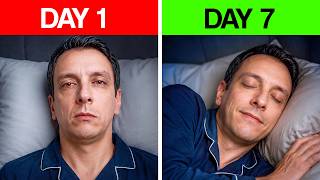

7-Day Sleep Hack Without Effort or Cost
44sPromises a quick, easy, and free sleep improvement, tapping into a universal struggle.
▶ Play Clip"Title accurately reflects the study, but the main insight is about avoiding screens, not just reading."
A large trial with 1,000 participants found that reading before bed improved sleep quality for 42% of participants, but the control group also saw 28% improvement, revealing that other factors like avoiding caffeine and screen time may be more impactful.
A trial with 1,000 participants split into two groups: one read 15-30 minutes before bed, the other did not.
42% of readers reported improved sleep quality after 7 days.
28% of the control group also reported improved sleep, suggesting other factors at play.
All participants were instructed not to eat or drink caffeine 1 hour before bed, which may explain control group improvements.
The control group may have changed habits simply due to being observed, known as the Hawthorne effect.
Having a bedtime routine signals the brain to wind down, and reading is relaxing unless it's a horror story.
Reading replaces stimulating activities like phone scrolling or work, which emit blue light that suppresses melatonin.
Other routines like meditation or breathing exercises may work as well or better than reading.
Consistent sleep/wake times and morning sunlight exposure also improve sleep quality.
Reading before bed can improve sleep, but the key may be replacing stimulating activities like screen time. Consistent routines and avoiding caffeine before bed are also crucial.
What percentage of readers reported improved sleep after 7 days?
42%
00:58
What percentage of the control group reported improved sleep?
28%
01:26
What is the Hawthorne effect?
The phenomenon where people change their behavior simply because they are being observed.
02:22
Why does blue light from screens affect sleep?
Blue light shuts down melatonin production.
03:43
Name two alternative routines that may improve sleep as well as reading.
Meditation and breathing exercises.
04:10
What two additional habits improve sleep quality according to the video?
Going to bed and waking up at the same time every day, and getting sunlight soon after waking.
04:10
Reading Improves Sleep for 42%
Shows a simple, cost-free intervention with significant results.
00:58Control Group Also Improves
Highlights that other factors like caffeine avoidance may be equally important.
01:26Hawthorne Effect in Sleep Studies
Explains why control groups often show improvements in trials.
02:22Reading Replaces Screen Time
Identifies the real mechanism: avoiding stimulating activities and blue light.
03:04Consistent Schedule and Sunlight
Provides additional evidence-based tips for better sleep.
04:10[00:01] What if you could improve your sleep significantly in 7 days only without any without making any extra effort, and without spending a dime? A large trial showed this is actually possible. Poor-quality sleep is one of the most
[00:15] common complaints in our society, and for good reason. It can raise risk of a heart disease, dementia, and obesity. So, a lot of people end up resorting to sleeping pills, which often are a band-aid and don't
[00:29] really solve the problem. So, scientists took 1,000 participants, and they split them randomly into two groups. Half were told to read a book 15 to 30 minutes before going to sleep. The other half were told not to. Now, this trial was
[00:44] billed as the effect of reading before bedtime on sleep. interesting part of the trial, and the results hide two other golden nuggets that might actually be more powerful
[00:58] than reading before bedtime. So, basically, in the trial, after 7 days, 42% of the participants asked to read reported improvement in their sleep quality. So, that's pretty impressive.
[01:11] Almost half reported noticeable improvements, better sleep, anything, doesn't require any extra effort, and has no downsides, right? In 1 week only. So, why do I say that's not the main finding? Well, the control
[01:26] the main finding? Well, the control group that was told not to read, 28% of those people reported improved sleep. So, the difference is 14%. That's the So, the difference is 14%. That's the percentage that benefited from reading.
[01:39] group is actually larger, twice as large, 28%, than the benefit seen with reading, 14%. So, why are we seeing all these people reporting benefit in the control group? Well, one reason is the trial also had
[01:53] everyone, all All participants in both groups, not eat and not drink anything caffeinated like coffee 1 hour before bed. So, that might be why we see so much benefit in the control group already. Although we have to be a
[02:08] have a group that was told to do nothing at often see in trials that the control group, just by being in the trial, they change their habits just because they're being observed and get some
[02:22] benefits. It even has a name, it's called Hawthorne effect. Now, as for the 14%, the actual benefit of the reading group I actually suspect that's less about reading per se and more about
[02:36] what that means. And if I'm right about that, this might actually give you more options and more control. We know that a huge part of sleep is behavioral conditioning and your psychology. So, having a specific routine before bedtime
[02:51] gives your brain that signal that it's time to start winding down. And reading in particular tends to be pretty relaxing for the most part, assuming it's not a horror story. So, that could be another factor, just having a routine
[03:04] scheduled that already tells your brain it's time to start powering down. But I actually suspect that the number one factor here is none of those things. It's more about what you're not doing. If you're reading in bed, you can't be
[03:18] on your phone scrolling social media and you can't be on your laptop doing work. And those are activities that are really stimulating for the brain. Both because of the type of brain functions that they involve they put you in a more alert
[03:31] state, but also because the type of light that is emitted from those devices, from the cell phones or from the laptop, directly into your eyes, this does the exact opposite of what you're trying to do
[03:43] when you're trying to fall asleep. Cuz you want your melatonin to go up, that's And blue light shown directly into your eyes shuts down melatonin production. So, reading in bed for 15 to 20 minutes from
[03:58] an actual book or from a Kindle with low light gives your brain all the right signals that it's time to sleep. And if I'm right about that, then other routines that are not reading might work just as
[04:10] well or maybe even better, like meditation or breathing exercises. Two other phenomenal habits that improve sleep quality and are evidence-based are going to bed and waking up at the same time every day and getting some sunlight
[04:25] soon after waking up within the first hour or two. That resets your body clocks. For a lot more science-backed tips to improve your sleep, check out this previous video. It's really comprehensive. I'll see you in there.
[04:39] comprehensive. I'll see you in there. Take care.




⚡ Saved you 0h 04m reading this? Transcribe any YouTube video for free — no signup needed.