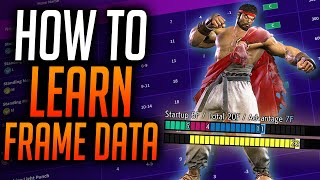

Frame Data Made Simple
45sDemystifies a complex topic with a promise of simplicity, appealing to beginners intimidated by frame data.
▶ Play Clip"Title accurately promises an easy-to-follow guide, and the video delivers a thorough, beginner-friendly explanation."
This video explains frame data in Street Fighter 6, breaking down concepts like startup, active frames, recovery, and frame advantage. It covers how to read frame data charts and apply this knowledge to improve combos, punishes, and overall gameplay.
A frame is a single image rendered by the game. Street Fighter 6 runs at 60 frames per second, so one frame equals 1/60th of a second. Frame data uses frames as a unit of time to measure move properties.
Every action in Street Fighter 6 is consistent; pressing the same button always takes the same number of frames. The frame meter in training mode displays total frames for each move.
Attacks are divided into startup (green), active (red), and recovery (blue). Startup is the time before the attack can hit, active frames are when it can hit, and recovery is the period after where no actions can be performed.
Frame advantage indicates who can act first after a move hits or is blocked. Positive (blue) means the attacker acts first; negative (red) means the defender acts first. This determines turns and combo opportunities.
If a move is highly negative on block (e.g., -12), the opponent can punish with a guaranteed hit. Moves that are -4 or less are generally safe because the fastest attacks are 4 frames.
Counter hits add +2 frames, punish counters add +4 frames, and Drive Rush adds +4 frames to frame advantage. Burnout also adds +4 frames to block advantage, making normally unsafe moves safer.
Official Street Fighter 6 website and resources like fullmeter.com list startup, active, recovery, and frame advantage. Note that active frames may overlap with startup in some charts.
A frame trap uses a move that is plus on block, then delays the next attack to catch the opponent mashing. The attacker's faster recovery ensures they hit first, scoring a counter hit.
Understanding frame data helps you know when it's your turn, optimize combos, and punish unsafe moves effectively. Focus on startup and frame advantage first to improve your gameplay.
What is a frame in the context of fighting games?
A frame is a single image rendered by the game; Street Fighter 6 runs at 60 frames per second, so one frame is 1/60th of a second.
0:49
What are the three parts of an attack in frame data?
Startup (green), active (red), and recovery (blue).
4:03
What does positive frame advantage (blue) indicate?
The attacker can act before the opponent after a move hits or is blocked.
10:36
What is the fastest startup for a normal attack in Street Fighter 6?
4 frames.
15:47
How many extra frames of advantage does a counter hit provide?
+2 frames.
19:00
How many extra frames does a punish counter add?
+4 frames.
19:31
What is a frame trap?
A situation where you use a plus-on-block move and delay your next attack to catch the opponent mashing, scoring a counter hit.
26:45
What happens to block advantage when the opponent is in burnout?
An additional +4 frames are added to the block advantage.
21:08
How do you determine if a move can link into another?
The frame advantage on hit must be equal to or greater than the startup of the next move.
11:46
What is the difference in active frame representation between the official website and community charts?
Official website lists active frames as a range (e.g., 4-6), while community charts list a single number that may overlap with the last startup frame.
23:30
Frame as a unit of time
Establishes the fundamental concept that frames measure time, not just graphics.
0:49Three parts of an attack
Core framework for understanding move properties.
4:03Frame advantage determines turns
Simplifies complex interactions into a turn-based system.
10:36Dynamic frame advantage changes
Explains how counter hits, punish counters, and Drive Rush alter frame data.
18:42Frame trap example
Practical application of frame advantage to create offensive pressure.
26:45[00:00] hey what's up everyone it's Mir and
[00:03] finally in today's video we're going to
[00:05] approach the dreaded Frame data I know
[00:08] that this is a topic that a lot of
[00:09] people find really difficult to
[00:11] understand especially because they see a
[00:13] lot of numbers that they don't
[00:14] necessarily know what it means but I
[00:17] will try to break it down in the
[00:18] simplest possible terms I'll start from
[00:21] something very basic and then later on
[00:22] in the video I'm going to look at the
[00:24] topic more in depth and at the end we
[00:26] can even read some Frame data charts let
[00:29] me explain how they work for you if
[00:31] there's anything that I want you to
[00:32] remember from this video before you shut
[00:34] it off is that Frame data and frames are
[00:38] a measurement of time and the properties
[00:41] of moves and thanks to these
[00:43] measurements we can understand how they
[00:45] behave in game and how we can best use
[00:48] them to our advantage
[00:49] so first things first let's understand
[00:52] what a frame means in the context of our
[00:56] video game so computer and consoles
[00:58] Hardware render images on screen so that
[01:00] we can play our video game and every
[01:02] individual image is called a frame which
[01:06] are currently actively displayed a
[01:07] certain frequency which is the frame
[01:10] rate so right now for example Street
[01:12] Fighter 6 runs at a constant frame rate
[01:15] of 60 frames per second so 60 images per
[01:19] second and you can see for example if I
[01:21] slow the game down to 50 which is a
[01:24] feature that we have available in
[01:26] training mode you'll see that it's a
[01:28] little bit choppier and this is because
[01:29] the game is now running basically at 30
[01:32] frames per second which is half the
[01:35] speed
[01:36] so again what this means is that one
[01:38] frame is 1 60th of a second and this is
[01:42] the basic unit of measurement on which
[01:44] the game logic runs on you might wonder
[01:48] why we're not talking about fractions of
[01:49] a second like milliseconds and this is
[01:52] because one frame is the equivalent of
[01:55] 16.6666 milliseconds and you know it's a
[01:58] little bit unwieldy so we just use the
[01:59] frames instead now that we know that the
[02:02] game always runs at a fixed frame rate
[02:03] of 60 frames per second we can use this
[02:06] Frame as a measurement of time and if
[02:09] you look at anything in the game it
[02:11] could be an attack like a jab a medium
[02:13] punch heavy punch whatever a jump back
[02:16] dash all of this can be measured in
[02:18] frames we can break it down uh to its
[02:22] basic you know you know the measurement
[02:23] and see how many frames does it take for
[02:25] this move to complete like how many
[02:27] friends does it take for my draft to
[02:29] complete from a heavy punch to complete
[02:30] from a jump to complete and so on
[02:32] in the terms of 346 and almost every
[02:36] fighting game every action is consistent
[02:38] so every time I press my lug punch it
[02:40] will always take the same amount of
[02:42] frames now one way to count frames would
[02:44] be to you know have a recording and then
[02:46] slow it down and count each frame
[02:48] individually but luckily enough we don't
[02:49] have to do that because in training mode
[02:51] if you open your menu and you go to
[02:54] screen display settings here we will
[02:57] have this option frame meter which we
[02:59] can turn on and it gives this bar at the
[03:02] bottom of the screen which is a very
[03:03] useful tool to help and count frames as
[03:07] you can see whenever I press a button it
[03:08] will be displayed at the bottom how many
[03:10] frames it takes in this case it's a
[03:13] total of 13 frames for my standing light
[03:16] punch and as you see every time I press
[03:18] it it says 13 frames every time if I
[03:21] change the attack you'll see it's a
[03:22] different amount of total frames and
[03:25] again it's consistent it's always the
[03:27] same of course knowing the total amount
[03:30] of frames of a move is only scratching
[03:32] the surface it can only tell us so much
[03:34] it is mostly useful for movement like a
[03:37] jump or a back dash a forward Dash which
[03:40] don't have any special properties
[03:42] because they're not attacks so the total
[03:44] duration is really the only thing that
[03:46] we care about but it doesn't tell us
[03:48] very much about for example normal moves
[03:51] or special moves again if you look at
[03:54] the frame tool you can see how every
[03:56] move is divided into three color-coded
[03:59] sections and this is where Frame data
[04:01] starts getting really interesting
[04:03] any attack can be divided into three
[04:06] different parts there's the startup
[04:07] which you see in green the active frames
[04:10] which are in red and then the recovery
[04:12] in blue the startup is the amount of
[04:15] time it takes for the attack to be able
[04:17] to hit the opponent so it's all the
[04:20] frames before the attack is actually an
[04:22] attack so as the name implies the
[04:25] startup of the move usually light
[04:27] attacks a very fast startup a medium
[04:29] attacks are a little bit slower and
[04:31] Heavies are slower still this is not
[04:33] necessarily the case there's plenty of
[04:35] attacks that have maybe a total duration
[04:37] that is very long like for example uh
[04:39] Jamie's VP as you can see the tall
[04:42] duration is a 66 frames which is quite a
[04:45] lot but the startup is comparatively
[04:47] quite fast another example would be uh
[04:50] is any heavy punch here which again
[04:52] quite long total duration but actually
[04:55] relatively fast startup some attacks are
[04:58] slow enough that you can actually react
[04:59] and block them in time and this is most
[05:01] common with certain over heads for
[05:04] example a Jamie silver head here is slow
[05:08] enough that it should be reactable if
[05:09] you're looking out for it the second
[05:11] part of the attack in red is the active
[05:14] window for active frames this is the
[05:16] amount of time the attack stays out and
[05:19] is able to hit the opponent so usually
[05:22] attacks are active just for a couple of
[05:25] frames like for example the standing
[05:27] light punch here and we can see standing
[05:29] medium punches active for a total of
[05:31] four frames standing heavy kick is
[05:33] active for three some attacks are active
[05:35] for longer usually special moves for
[05:37] example this DP is seven frames active
[05:40] and this determines again the amount of
[05:42] time the move stays out there so that it
[05:45] can hit the opponent so for example good
[05:48] and tiers tend to be active for a very
[05:50] long time which means that you don't
[05:52] have to be as precise for the timing
[05:55] when you're trying to hit an opponent
[05:56] that is jumping in on you for example
[05:58] however some attacks are active for an
[06:01] unusual amount of time very long in fact
[06:03] then this is most common in projectiles
[06:06] as the projectile is basically active
[06:08] all the way to the other side of the
[06:09] screen depending on the move of course
[06:11] another good example would be uh Chang
[06:14] Lee's level one as long as the
[06:16] projectile stays on screen that is all
[06:18] active frames and you can hit the
[06:19] opponent during those active frames
[06:22] foreign
[06:26] as you see I walked in there really
[06:28] really late and I still got hit after
[06:31] the active frames are over we have the
[06:33] recovery frames so for example in the
[06:35] case of Jimmy's steny heavy kick here we
[06:37] have 21 frames indicated in blue that's
[06:39] the recovery and what that means is that
[06:41] during recovery I'm unable to perform
[06:43] any actions usually this includes
[06:46] blocking attacking throws using movement
[06:49] using other moves and stuff like that so
[06:51] when I press sending heavy kick even if
[06:53] I hold up I have to wait until the move
[06:55] is done if I want to jump as I can
[06:58] demonstrate right here this is true for
[07:00] anything like a four dash or a back Dash
[07:03] as you see nothing came out because I
[07:05] did it before the move was over even
[07:07] pressing other buttons I couldn't press
[07:09] anything there I have to wait until the
[07:11] move is over for it to come out
[07:13] there are some exceptions uh like for
[07:15] example you can block out of the
[07:17] recovery of Perry but for the most part
[07:19] 99 of the cases during recovery you
[07:21] cannot perform any action at all One
[07:24] Last Thing Worth explaining that I kind
[07:25] of glossed over intentionally is that
[07:27] you can see that the frames in green
[07:30] that tell us about the startup at the
[07:32] bottom are different than what the game
[07:34] calls a startup as you see there's only
[07:37] five green frames and then the startup
[07:39] is listed as six that is because
[07:41] traditionally uh the startup includes
[07:44] the first active frames so in this case
[07:47] it means that there's five frames where
[07:49] nothing happens when I press a standing
[07:51] medium punch on Ryu and then on the
[07:53] sixth frame I'm actually able to hit the
[07:56] opponent so effectively the startup is
[07:59] uh five frames plus the first active
[08:02] frame which gives a six and this is what
[08:04] the game is trying to convey
[08:06] all of this combined gives us a lot of
[08:08] information on how moves behave some
[08:10] attacks that might have a very long
[08:12] duration like I sure you can which is in
[08:15] this case 65 frames for the heavy
[08:16] version even the light version is 47
[08:19] frames might have very fast startup
[08:21] another great example would be a reuse
[08:24] level 3 super even though it takes a
[08:26] long time to whiff this a total of 87
[08:28] frames it only has a 5 frame start which
[08:32] is not necessarily obvious looking at it
[08:34] another one would be attacks with a very
[08:36] long active window again in the case of
[08:38] a DP you can see how many active frames
[08:40] there are which makes them great and
[08:43] tiers for example as opposed to
[08:44] something like a jab which has barely
[08:47] any active frames there's attacks that
[08:50] have fast recovery like I said light
[08:52] attacks are great examples that don't
[08:54] have much recovery at all which you can
[08:56] use to for example hit an opponent
[08:58] safely while they're using an armor move
[09:01] and so on
[09:03] an example of a situation that is very
[09:05] common in Street Fighter 6 where
[09:06] recovery matters is dealing with Drive
[09:09] Impact as moves that have a long
[09:11] recovery period are much more unsafe to
[09:14] use against it as I won't be able to
[09:15] block in time so for example if I do
[09:18] standing heavy punch here even though
[09:20] I'm trying to block I'm unable to but if
[09:22] I were to do something like a light
[09:24] attack which has much faster recovery
[09:25] you can see how I can block in time
[09:27] which means I can do my own Drive Impact
[09:29] pack another example of what recovery
[09:32] matters is when you're playing a neutral
[09:34] and your Woofy moves maybe you're doing
[09:36] a buffer or whatever and moves that have
[09:38] long recovery
[09:39] are much easier to with punish for your
[09:42] opponent so sometimes using moves that
[09:44] have less recovery might be beneficial
[09:46] because it will makes you less
[09:48] vulnerable to with punishment now that
[09:51] we know startup and Recovery another
[09:54] extra tidbit of information is that in
[09:56] Street Fighter 6 if you're hit during
[09:58] the startup or the active range of a
[10:00] move you're going to suffer a counter
[10:02] hit well if you get hit during the
[10:04] recovery of a movie you're going to
[10:06] suffer a punish counter and these
[10:08] properties have extra effects that I'm
[10:10] going to discuss later but I'm going to
[10:12] show you how they look right now so that
[10:14] you may familiarize yourself with them
[10:17] but zengi fear to do a jump heavy kick
[10:19] which is quite a slow move and you'll
[10:21] see that if I hit him before the move
[10:23] starts up I will score a counter hit
[10:26] but if I hit the recovery of the move
[10:29] instead I will get a punish counter
[10:33] the last piece of information that ties
[10:36] everything together is what is commonly
[10:38] referred to as frame Advantage this is
[10:41] also listed in the frame tool so for
[10:43] example if I hit jury with Galaxy
[10:45] standing medium punch you can see that
[10:47] it says Advantage 6 frames in blue at
[10:50] the top of the frame tool this describes
[10:52] in the case of whether a move hits or is
[10:54] blocked which of the two characters can
[10:57] act first and by how many frames so the
[11:01] frame Advantage is positive so it's in
[11:03] blue like in this case it means that the
[11:06] character that did the move gets to act
[11:08] first so in this case gal gets to act
[11:11] six frames before jury if I do a
[11:13] standing light punch for example it's
[11:15] only four frames if I do a standing
[11:17] heavy punch I actually have a red frame
[11:21] Advantage also known as frame
[11:22] disadvantage which means the jury gets
[11:25] to act first in this case by one frame
[11:28] you can think of this as turns if it's
[11:31] blue it means it's my turn if it's red
[11:33] instead it's the opponent's turn if the
[11:36] frame Advantage is high enough namely it
[11:39] is higher than the startup of another
[11:40] move that you have we can use that move
[11:42] in a sequence that your opponent cannot
[11:44] interrupt and what do I mean by this so
[11:46] using the example of Gauss standing
[11:49] medium punch again which is uh six
[11:51] frames of Advantage I can use a move
[11:54] that is 6 frames or faster to create an
[11:57] in interruptible sequence so something
[11:59] like a crunchy medium punch which is six
[12:01] frames or cartoon light punch which is
[12:03] four frames and this is what we know as
[12:05] a combo or more specifically a link
[12:07] combo so I can do sending medium punch
[12:09] Factory medium punch and you see the
[12:11] game says it's a two hit combo and the
[12:13] opponent cannot do anything about this
[12:15] you can do sending medium cartoon light
[12:17] punch that's the same thing if I were to
[12:19] use a move that is a little bit too slow
[12:21] like say standing heavy punch this is 7
[12:23] frames so uh it's not faster than the
[12:26] six frame advantage that we have here
[12:28] you'll see that we'll never be able to
[12:30] combo them together and this is how you
[12:33] figure out using frame Advantage which
[12:36] moves combo into each other you can do
[12:39] the same thing on block and this creates
[12:41] what is known as a true blocks ring in
[12:44] Street Fighter 6 it's a little bit
[12:45] difficult to find attacks that are very
[12:47] positive on block for example gals are
[12:50] standing medium punch is zero on block
[12:52] is for hey punches plus three on block
[12:54] which is just not enough but a jumping
[12:57] attack is usually very positive in this
[12:59] case is plus nine so I will demonstrate
[13:02] now how a true block stream behaves so I
[13:05] have a jury set to do a crutching light
[13:08] punch after blocking anything and you
[13:10] will see that if I do for example a
[13:12] standing medium punch into another
[13:14] standing medium punch that I will get
[13:16] interrupted by jury scratching light
[13:18] punch however if I do the same standing
[13:22] medium punch after a jump in they have
[13:24] so much frame Advantage even on block
[13:26] that Drew is not able to press anything
[13:29] and nothing will come out
[13:31] as you saw the crashing light Bunch only
[13:34] came out after the block string was over
[13:36] and this is a true block stream another
[13:38] thing that's very important to keep in
[13:39] mind for link combos is that your
[13:41] opponent has to be standing and not
[13:43] knocked down so a certain moves like a
[13:46] crashing heavy kick almost universally
[13:48] knocked down like this and even though
[13:51] the advantage listed by the game which
[13:53] is 34 frames seems like it would be
[13:55] enough for me to uh combo and move
[13:58] afterwards because the opponent is
[13:59] knocked down no matter how hard I try
[14:01] and just unable to connect with anything
[14:04] because the opponent is effectively
[14:05] invulnerable as they wake up off the
[14:08] ground so this is something that you
[14:10] should keep in mind
[14:11] in a similar manner if the frame
[14:13] disadvantage is too high your opponent
[14:16] can attack you with their moves without
[14:19] you being able to retaliate at all and
[14:21] most notably being able to block and
[14:24] this is what we call a punish which is a
[14:26] guaranteed hit this is most common on
[14:28] block and a great example would be if I
[14:31] try to sweep my opponent as you can see
[14:33] gal sweep is -12 frames of Advantage
[14:36] which means that jury in this case has
[14:39] 12 frames to do anything she wants to me
[14:41] and I won't be able to do anything about
[14:43] it including blocking a very common
[14:46] response in a situation like this is to
[14:48] sweep back as you can see if I go and
[14:51] sweep jury or catching heavy kick is
[14:54] completely unavoidable even though it's
[14:55] holding down back the entire time I
[14:58] still got hit and scored a punish Gunner
[15:00] again using the Frame data you can
[15:02] discover potentially new and more
[15:05] damaging punishes for any given
[15:07] situation so we're talking about gal
[15:10] scratching heavy kick how it is my minus
[15:12] 12 on block I have a jury set to do a
[15:15] standing heavy punch which is 10 frames
[15:18] of startup just like her sweep and if I
[15:20] sweep her and she does it's any heavy
[15:23] punch you can see how it punishes me in
[15:25] this move unlike her sweep is canceled
[15:28] so I get to continue a combo here and do
[15:30] a lot of damage so this is another tool
[15:33] that is very useful for you to find out
[15:35] about how you can effectively get damage
[15:38] on an opponents using unsafe moves on
[15:41] him something very important to keep in
[15:42] mind for the concepts of punishing and
[15:44] Link combos is that the fastest attack
[15:47] in Street Fighter 6 as of now is 4
[15:49] frames of startup so in the case of Ryu
[15:51] for example would be a standing light
[15:53] Punch or a scratching light punch
[15:54] they're both four frames so if I have a
[15:58] move that is not advantageous enough
[16:00] even though it might be my turn I just
[16:03] wouldn't be able to continue the combo
[16:06] so for example if I hit Cami with
[16:08] stunning heavy punch you see that my
[16:10] advantage is three frames which means
[16:12] again it's my turn as Ryu however
[16:14] because my stain light punches 4 frames
[16:17] I won't be able to combo one into the
[16:20] other unless I have you know some
[16:22] special properties that let me do that
[16:24] so this will never be a link combo no
[16:27] matter how hard you try and this is true
[16:30] for anything that is negative on block
[16:32] as well so an example again using Ryu is
[16:36] something like standing medium punch as
[16:37] you can see the advantage is -1 frames
[16:40] so my turn is over however if Cami tries
[16:43] to retaliate with her fastest normal
[16:45] which as I've established is four frames
[16:47] so there's any live punch for example
[16:49] she will never be able to punish you I'm
[16:52] always able to block here just because
[16:54] she doesn't have enough frames to use to
[16:57] punish me and this move is what is
[16:59] considered safe
[17:01] of course advantage on hit and block is
[17:03] not the entire story a great example
[17:06] here is Honda I haven't said to do a
[17:09] Sumo headbutt which as we can see is
[17:11] minus four frames on Block it's four
[17:14] frames of advantage for you so in theory
[17:17] I would be able to do my staying live
[17:18] punch for my cartoon life punch and it
[17:20] would be unable to avoid it but as you
[17:22] can see I'm just too far for the normals
[17:25] to connect which makes it impossible to
[17:28] punish in this way
[17:29] this knowledge is very useful both on
[17:31] offense and defense as it helps you
[17:33] understand whose turn it is and how to
[17:35] structure offense and defense yourself
[17:36] so in the case of Rasheed for example if
[17:39] I do my stunning medium Punch or my
[17:42] crushing medium punch you'll see that
[17:43] the advantage is one frame of in favor
[17:47] of Rasheed so Rasheed gets to act one
[17:49] frame faster than the opponent what that
[17:52] means is that if the opponent retaliates
[17:54] with their fastest normal in this case
[17:55] for JP it's is crushing light punch
[17:58] which is four frames and I also press my
[18:01] fast as normal which again is four
[18:03] frames Rashid will come out on top as I
[18:05] can demonstrate right here as you see
[18:07] I'm kind of hitting JP because I act
[18:11] faster and we are doing the same length
[18:14] of move and so I come out on top as my
[18:18] move will hit the opponent first if
[18:20] you're trying to learn the Frame data
[18:22] for a character I would highly suggest
[18:23] that you make the startup and the frame
[18:25] Advantage your number one priority when
[18:28] it comes to learning as they're the most
[18:29] important stats to determine which moves
[18:32] to use based on the situation as we've
[18:34] established before for combos for
[18:36] punishment pressure and so on
[18:39] another thing that is very important to
[18:41] know about frame Advantage is that there
[18:42] are certain situations and properties
[18:45] that dynamically change it during
[18:47] gameplay so if I hit JP with cami's
[18:51] standing medium punch you can see that
[18:52] the advantage is six frames which makes
[18:55] this combo impossible has a stunning
[18:57] heavy punches eight frames however if I
[19:00] score a counter hit which again as we've
[19:03] established before happens when I hit
[19:05] the startup of an opponent's move then
[19:08] you'll see that the frame Advantage all
[19:10] of a sudden is 8 frames up from six this
[19:13] is because counter hit always adds two
[19:16] extra frames to your frame Advantage
[19:18] which makes that combo from before
[19:19] suddenly possible if you score a hit on
[19:23] an opponent's recovery like for example
[19:25] in a punished situation or if you with
[19:27] punish their attack as they with it in
[19:30] neutral you will get a punish counter
[19:31] and a punish counter gives you plus four
[19:34] extra frames of Advantage so that
[19:36] standing medium punch from before is now
[19:39] plus 10 on hit and this lets us do
[19:42] combos like this which normally wouldn't
[19:44] be possible again as you can see the
[19:46] crunchy heavy punches 10 frames of
[19:48] startup and I'm using the 10 frames of
[19:50] advantage to combo them together
[19:52] another situation where we get extra
[19:55] frames of Advantage is when I use a dry
[19:57] brush if you do a normal out of a dry
[20:00] brush it will be enhanced and get extra
[20:02] frame Advantage so again using the
[20:04] example of sending medium punch from
[20:06] before which is six frames of Advantage
[20:08] if I do it out of a dry brush you will
[20:10] see how it is 10 frames of Advantage so
[20:12] we get an extra plus 4 frames and this
[20:16] property actually Stacks with counter
[20:18] hits and punish counters so for example
[20:21] if I put punish counter on the move that
[20:24] is normally plus six with the punishment
[20:26] becomes plus 10 and you will see that if
[20:28] I do it out of the drive brush we get
[20:30] the extra plus 4 of the drive rush to a
[20:33] total of plus 14. so if you know how to
[20:37] use these together especially in certain
[20:39] punish situations like if an opponent is
[20:41] within a move that has long recovery
[20:43] like a sure you can for example you can
[20:45] get some very damaging combos started
[20:48] this way just to make it a little bit
[20:50] more confusing another situation where
[20:52] Frame data changes is during burnout
[20:55] normally a move like a cami is a
[20:57] standing heavy punch for example as you
[20:59] can see is a minus three frames on block
[21:02] that means as the end of my turn it's
[21:04] safe but I don't get to do anything else
[21:06] however if the opponent isn't burnout
[21:08] you will see how now this move all of a
[21:11] sudden is one frame of advantage in
[21:14] cami's favor and this is because if an
[21:16] opponent blocks a move during burnout 4
[21:19] frames of Advantage are added to the
[21:22] block Advantage so from -3 this becomes
[21:24] plus one this is part of the reason why
[21:26] Bernina is so scary is because moves
[21:28] that normally are minus or even unsafe
[21:32] become much safer or Plus on block when
[21:35] you're in Burnout which means that it's
[21:37] so much harder to get your opponent off
[21:38] of you especially because he cannot use
[21:40] any of your drive mechanics as your
[21:43] drive gauge is depleted
[21:44] so to recap the situation briefly frame
[21:48] Advantage is a measure of who gets to go
[21:50] first and by how much time again
[21:53] measured in frames because that's a unit
[21:55] of measurement so sometimes you might
[21:57] have an attack like this one which is
[21:59] three frames of advantage that's not
[22:01] good enough for me to get a combo or
[22:03] anything like that it's just not enough
[22:04] Advantage but at least it's my turn
[22:06] still so it means that I can press
[22:08] buttons after this then you have attacks
[22:11] that are very plus something like
[22:12] discharged for the heavy kick that's
[22:14] plus 10 that means a combo here is
[22:16] guaranteed as long as I choose the right
[22:19] attacks on block you have the opposite
[22:21] situation where you have an attack that
[22:23] is safe in this case again minus three
[22:25] it means that there's no attack that is
[22:27] fast enough to score a guaranteed punish
[22:30] on me and then there's other attacks
[22:32] that are very unsafe like the sweep
[22:34] which is -11 which means that Ryu has 11
[22:37] frames to do whatever he wants to me and
[22:39] there are attacks that are fast enough
[22:40] that can punish me and score uh
[22:43] guaranteed damage now we're going to
[22:45] look at some Frame data charts and how
[22:48] to read them specifically we will start
[22:50] with the official Street Fighter 6 Frame
[22:53] data which is now available on the
[22:55] street fighter website you can see this
[22:57] by going to this 356 website going to
[22:59] characters and then you will be able to
[23:01] see The Frame data right next to the
[23:03] command list at the top of the page so
[23:05] as an example let's use Chun Li's
[23:08] standing light punch we can see that the
[23:10] move name is listed first with the input
[23:13] so standing light punch then we have the
[23:15] Frame data proper with the startup
[23:18] frames the active frames and the
[23:19] recovery frames the way the active
[23:22] frames are listed in this format is that
[23:24] it basically specifies a range so in the
[23:27] case of the challenge standing light
[23:29] punch we see that the Surplus four
[23:30] frames and then the active frame is
[23:33] arranged from four to six which means
[23:35] it's the fourth the fifth and the sixth
[23:39] frame of the attack are the active
[23:41] frames which means we have a total of
[23:42] three active frames and then we have
[23:45] seven frames of recovery then we can see
[23:48] the frame Advantage both on hit and
[23:50] block in this case plus five frames on
[23:53] hit and -3 on block of course there's
[23:57] much more information on this page
[23:58] including cancels damage combo scaling
[24:01] and so on but this is beyond the purpose
[24:03] of this video for today another kind of
[24:06] chart that you might find is something
[24:07] like on fullmeter.com with their frame
[24:10] assist online tool they also have an app
[24:12] I believe or the super combo Wiki where
[24:14] they have the 356 Wiki which is listed
[24:16] like this and this is the more
[24:17] traditional way of doing a Frame data
[24:20] chart
[24:21] where you have the move name first and
[24:23] then you have startup active and
[24:25] Recovery Premium advantage on hit and
[24:27] block which is very similar to how we
[24:28] have in the original uh Street Fighter
[24:31] website however the active frames are
[24:33] listed as a number as opposed to a range
[24:36] like they are in the street fighter
[24:39] website the difference here that it's
[24:41] very important to keep in mind is that
[24:43] the first active frame overlaps with the
[24:47] first startup frame so in the case of
[24:50] Chang Lee's steny life punch for example
[24:53] we can see that she has four frames of
[24:55] startup three frames active seven frames
[24:58] of recovery however if we add all of
[25:00] these together we get a total of 14
[25:03] which is actually one extra frame
[25:05] compared to what it is in game which is
[25:08] 13. and like I said that's because the
[25:11] first active frame overlaps with the
[25:14] last startup frame so that's something
[25:16] to keep in mind if you are doing your
[25:18] calculations on the Fly you need to
[25:20] remember to move this one frame as there
[25:24] is some overlap I highly suggest you
[25:26] familiarize yourself with these Frame
[25:28] data charts as they are something that
[25:31] is very useful to consult quickly in
[25:33] case you have a question about you know
[25:34] whether something is unsafe how unsafe
[25:36] it is or the startup of some move that
[25:39] you've never seen before and so on
[25:41] without having to go to training mode
[25:43] and actually test it for yourself so
[25:45] this is a very valuable resource that
[25:48] like I said you should familiarize
[25:50] yourself with as a final section of this
[25:53] video we can look at some practical
[25:55] examples on how to use Frame data again
[25:57] just to drive the point home so that I'm
[25:59] absolutely clear this involves some
[26:01] basic arithmetic but there's nothing to
[26:03] be scared of
[26:05] so I've talked before about the concept
[26:07] of a true block string which is
[26:09] basically a string where your opponent
[26:11] is unable to mash in the middle of so I
[26:15] have right here Blanca to do a standing
[26:16] light kick that's his fastest normal
[26:18] attack and if I do a jump in and then
[26:21] another attack you can see how I was
[26:24] plus enough that Blanca was unable to
[26:27] attack in between those two normals that
[26:30] I did however this is only useful to a
[26:33] certain extent as the opponent is not in
[26:35] any risk because they can just press the
[26:37] button and nothing will come out as is
[26:40] just too tight for anything to come out
[26:42] what we want to use is a so-called frame
[26:45] trap which is a situation where we use a
[26:48] move that is Plus on block like for
[26:50] example Ken's heavy Dragon lash kick and
[26:53] then we specifically tried to leave a
[26:55] gap so that your opponent can press a
[26:58] button but because we are at a frame
[27:00] Advantage we're going to hit them before
[27:02] this button is out and the score a
[27:05] counter hit
[27:06] so in the situation that we have just
[27:08] here I have Blanca to do is light kick
[27:10] which is four frames and after my heavy
[27:14] Dragon lash kick I'm going to press my
[27:15] cartoon life
[27:17] as you see they both are moves with four
[27:20] frames of startup as you can see at the
[27:22] bottom of the screen Blanca is saying
[27:24] liking his four frames my cartoon light
[27:26] punches four frames so the reason why
[27:30] Ken comes out on top and scores a
[27:32] counter hit is because the heavy Dragon
[27:34] lash kick again is one frame of
[27:37] Advantage so Ken gets to act one frame
[27:39] earlier and now I created a situation
[27:42] where basically
[27:45] um regardless of what your opponent does
[27:46] as long as there's nothing Invincible I
[27:48] get to stuff them and continue my combo
[27:52] how's this
[27:57] when you are performing a frame trap
[28:00] you're most often going to score a
[28:01] counter hit which gives you two extra
[28:03] frames of advantage that you can use to
[28:06] get a better combo and in some
[28:07] situations it's particularly useful so
[28:10] in the case of Luke is cartoon medium
[28:12] punch is plus one on block again it is
[28:15] my turn afterwards and I can set up a
[28:17] frame trap here so if I have a cami to
[28:19] do a reversal light punch my own
[28:22] crouching light punch will beat first
[28:24] however if I try to do a normal combo at
[28:27] this range my second light punch just
[28:29] doesn't connect but thanks to the extra
[28:32] advantage that we get from that counter
[28:34] hit I get to convert from Far Away by
[28:38] comboing into my crushing medium punch
[28:40] instead which is a counter hit only
[28:42] combo
[28:48] let's go
[28:50] something else that is fairly common in
[28:53] Street Fighter 6 and the street fighter
[28:54] in general is blocking something that is
[28:57] unsafe but not using your best punish
[28:59] that you have available and this is
[29:01] because you might not know the Frame
[29:03] data so a great example here is uh Jerry
[29:06] she's doing her light pinwheel which is
[29:09] an unsafe move and a lot of people
[29:11] either don't know that and fail to
[29:13] punish it entirely or do a very simple
[29:16] punish like jab jab special something
[29:19] like this I'm sure you've seen in plenty
[29:21] of times but actually if you look at the
[29:23] frame Advantage at the bottom of the
[29:24] screen you can see that I that I have
[29:27] eight frames to act the move is -8 on
[29:29] block so if you want to compare the
[29:32] damage of these two punishes just to
[29:34] show you the difference you'll be
[29:35] surprised by how much it can change if
[29:38] you use your best punish and use the
[29:41] frame that at your advantage to discover
[29:42] what it is
[29:44] so first I'm showing the light light
[29:46] planet from before as you can see it
[29:49] does little damage if you are a more
[29:51] advanced player maybe we might do a
[29:53] basic uh punish kind of combo to get
[29:55] some extra but if you do an actual
[29:58] punish you'll see how much the
[29:59] difference really is
[30:03] as you can see we've almost doubled our
[30:05] damage just by doing the correct combo
[30:07] and this is true across the cast there
[30:10] are plenty of examples like this so
[30:12] knowing Frame data can help you
[30:13] understand the situations like these and
[30:16] optimize your punishes accordingly
[30:18] again to go over the concept of a basic
[30:21] combo through linking we have more
[30:24] examples here I'm going to do it with
[30:27] reuse standing medium punch now are you
[30:29] standing medium punch as we can see is
[30:31] an advantage of seven frames which means
[30:33] that any move that has a startup of 7
[30:35] frames or less should combo as long as
[30:38] the range is right so we can see that we
[30:40] use all of his lights their five frames
[30:43] or faster so they should all work and
[30:45] they do because they're all in range as
[30:47] I can demonstrate right here of course
[30:50] some of them are more desirable than
[30:51] others then we can see uh all of his
[30:54] mediums his standing medium punch itself
[30:56] is six frames of startup so it actually
[30:58] combos into itself then we have uh
[31:01] Partridge medium punch that's also six
[31:03] frames and it combos correctly however
[31:06] is median kick is nine frames which is
[31:09] too slow and this cartoon media kick is
[31:11] also 8 frames which is too slow and as
[31:13] you can see I won't be able to combo
[31:15] them the game doesn't register this as a
[31:17] combo I will need something like a
[31:18] counter head or a punish counter for
[31:20] this to be effective another thing that
[31:22] we can see is that is back heavy punch
[31:24] is actually seven frames and if you're
[31:26] very close to the opponent that is
[31:28] indeed a combo so you can use the
[31:31] advantage of every move to figure out uh
[31:34] combos in a variety of situations for
[31:36] example with the knowledge that we have
[31:38] here the standing medium punch is uh
[31:41] seven frames of advantage on hit and
[31:43] knowing from what we said before that if
[31:46] you score a punish counter you get an
[31:48] additional four frames of Advantage we
[31:51] can determine that it should be 11
[31:53] frames of advantage and as I can
[31:56] demonstrate right here it is
[31:59] as you can see it's plus 11 a move that
[32:02] is 11 frames or less is a stunning heavy
[32:04] punch 10 frames and as such this combo
[32:07] is now possible
[32:09] so these are just a few examples of the
[32:11] power of friend data and why it is
[32:13] important to learn it so that you may
[32:14] use it to your advantage to learn more
[32:16] about your characters about your
[32:19] opponent's characters and how to make
[32:21] the best out of any situation I hope you
[32:24] guys enjoyed this video and it was
[32:25] useful to you I understand this is a
[32:28] more complicated subject and a lot of
[32:29] people find it very difficult to
[32:31] approach especially because they see a
[32:32] lot of numbers and they get scared but
[32:35] as long as you break it down in simpler
[32:37] Concepts as I try to do in this video I
[32:40] think it's much easier to approach and
[32:42] hopefully you can see the power of brain
[32:44] data and how it can help you improve
[32:47] your gameplay in Street Fighter 6. now
[32:49] it is not so necessary to know the ins
[32:52] and outs of the printed of every single
[32:55] character as long as you know when it's
[32:57] supposed to be your turn and maybe the
[32:59] most notable moves that you can punish
[33:01] that your opponent might do on you and
[33:04] this should be good enough at least for
[33:07] a beginner an intermediate level to
[33:09] continue playing the game and learn more
[33:11] about it of course I understand this is
[33:14] a more complicated topic so if you have
[33:16] any questions on the matter please do
[33:18] not be afraid to put them in the
[33:19] comments below we will try to answer to
[33:22] as many as we can and maybe someone else
[33:24] in the comments might be able to help
[33:25] you as well we have plenty more guides
[33:28] like these planned for the future and we
[33:30] already have a playlist of guides on the
[33:32] channel so if you're interested in other
[33:34] things Street Fighter 6 make sure to
[33:36] subscribe and there's gonna be more
[33:37] videos on the way as I mentioned and I
[33:40] hope you enjoyed and I'll see you next
[33:42] time bye bye
[33:54] thank you
⚡ Saved you 0h 33m reading this? Transcribe any YouTube video for free — no signup needed.