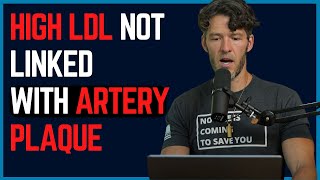

High LDL on Keto? No Plaque Buildup?
44sThis segment presents a surprising scientific finding that challenges mainstream cholesterol beliefs, sparking curiosity and debate.
▶ Play Clip"Delivers the study's core finding but pads it with sponsor reads and lengthy Q&A tangents."
This video breaks down a recent study by Nick Norwitz and colleagues, which examined whether significantly elevated LDL cholesterol levels in 'lean mass hyperresponders' on long-term ketogenic diets are associated with increased coronary artery plaque. The analysis compared 80 keto-adapted individuals with 80 matched controls from the Miami Heart cohort and found no significant association between high LDL and coronary calcium scores. The host also addresses viewer questions on topics like homocysteine, insulin resistance, and statins.
The video discusses a study by Nick Norwitz et al. examining LDL cholesterol levels and coronary artery plaque (CCTA) in lean mass hyperresponders on a low-carb ketogenic diet for at least 4.5 years, compared to 80 matched controls from the Miami Heart cohort.
Despite significantly elevated LDL cholesterol in lean mass hyperresponders, there was no significant association with higher coronary artery calcium scoring compared to matched controls.
The study is titled 'Carbohydrate restriction induced elevations in LDL cholesterol and atherosclerosis: the KETO trial' by Nicholas Norwitz, David Feldman, Matthew Budoff, and others.
Lean mass hyperresponders are defined by LDL cholesterol >190 mg/dL, HDL cholesterol >80 mg/dL, and low triglycerides (<70 mg/dL). None had familial hyperlipidemia.
The 160 subjects (80 per group) were matched for age, gender, race, diabetes status, high blood pressure, and past smoking status. The keto group had lower BMI but significantly higher total and LDL cholesterol (more than double), lower triglycerides, and higher HDL.
There were non-significant differences in coronary artery calcium, stenosis, and plaque scoring between the two groups, despite the keto group having significantly higher LDL cholesterol.
After a mean of 4.7 years of carbohydrate-restricted elevations in LDL, a metabolically healthy cohort did not have greater atherosclerotic plaque burden than a population-based cohort with lower LDL. The study calls for more research on the lean mass hyperresponder phenotype.
The host suggests plaque buildup is multifactorial, involving high blood pressure, blood viscosity, and oxidative stress in the presence of LDL. LDL is necessary but insufficient; it requires an oxidative step to become modified and engulfed by macrophages.
There is evidence that insulin resistance is part of the problem of coronary artery plaque and major adverse cardiovascular event risk.
High LDL can also be caused by eating sugary, refined foods like muffins, cream pies, and pop-tarts, not just a low-carb high-fat diet.
Knowing ApoB without ApoA1 is incomplete; the ratio is important. An ideal ApoB to ApoA1 ratio is around 0.56.
The number needed to treat for statins ranges from 60 to 400, and they work partly by anti-inflammatory effects. They also block the isoprenoid pathway, reducing coenzyme Q10 production.
Reduce refined carbohydrate intake, cut out sugar, and take walks after meals. Movement improves insulin sensitivity, which is key to lowering triglycerides.
The study suggests that in metabolically healthy individuals, high LDL cholesterol from a ketogenic diet may not be associated with increased coronary plaque, but more research is needed. The host emphasizes the importance of metabolic health and lifestyle factors over LDL alone.
What is the definition of a 'lean mass hyperresponder'?
LDL cholesterol >190 mg/dL, HDL cholesterol >80 mg/dL, and low triglycerides (<70 mg/dL).
03:20
What was the main finding of the KETO trial regarding LDL and coronary plaque?
No significant association between high LDL cholesterol and coronary artery calcium scoring in metabolically healthy keto-adapted individuals compared to matched controls.
01:11
What is the ideal ApoB to ApoA1 ratio?
Around 0.56.
20:39
What is the number needed to treat range for statins?
From about 60 to 400.
26:43
What are the two primary ways to lower blood triglycerides mentioned?
Reduce refined carbohydrate intake and take walks after meals.
30:07
What is the role of oxidative stress in atherosclerosis?
It modifies or oxidizes LDL, which is then engulfed by macrophages to form foam cells and fatty streaks, leading to plaque.
13:41
What is the mean duration of carbohydrate restriction in the keto cohort?
4.7 years.
08:07
No Link Between High LDL and Plaque
This is the central finding of the study, challenging the assumption that high LDL always leads to atherosclerosis.
01:11LDL is Necessary but Insufficient
Explains the multifactorial nature of plaque formation, emphasizing the need for oxidative stress.
13:13Statins' Number Needed to Treat
Provides a concrete metric for evaluating statin efficacy, which is often misunderstood.
26:43Movement Lowers Triglycerides
Highlights the importance of exercise and carbohydrate reduction for metabolic health.
30:07[00:01] we're going to break down a recently published study by Nick norwitz at all um I'm sure you've heard about this up to now if you follow Nick norwitz over on YouTube and also Instagram he's putting out amazing content uh he is a
[00:13] really really interesting guy really really intelligent individual uh who's still at Harvard I believe but he's U helping to orchestrate a lot of studies looking at lean mass lean mass hyperresponders and I think this study
[00:27] that we're going to talk about today was look looking at LDL cholesterol levels associated with coronary uh C cctas this is a coronary computed uh topography angiogram I believe is what the acronym stands for this is a way to enumerate
[00:42] how much cornery plaque there is uh comparing controls 80 controls of individuals as you can see on the screen here who have been on a low carb ketogenic diet for at least four and a half years compared to 80 matched
[00:56] half years compared to 80 matched controls of the Miami Heart cohort and there was not a significant association between LDL cholesterol levels in either group and coronary artery calcium but that's not the focus of today's session
[01:11] what we're going to focus on here is how these signif significantly elevated LDL who were identified as lean mass hyperresponders was not was not associated with higher amounts of coronary calcium scoring uh compared to
[01:26] coronary calcium scoring uh compared to the uh matched controls in the Miami Heart study okay now I know sometimes on these live videos uh what can happen is there's a little lag on my audio uh on the video so what I'm
[01:42] going to do I'm going to maximize uh the screen here hopefully you can still see this my friends and any nutrition related question is fair game uh here we related question is fair game uh here we go you can see on the screen we have um
[01:57] o this is the study that we're diving into uh any questions I see your chat right here thank you all again for being here uh appreciate your likes your comments your shares and any questions that you have just let me know so let's
[02:10] get into it so the title of this study now this was not a randomized controlled trial we're we're looking at associations between one cohort of individuals compared to another that are matched in many different categories
[02:24] title is carbohydrate restriction induced elevations in iio cholesterol induced elevations in iio cholesterol and atherosclerosis the keto trial okay so you can see here Nicholas NWI norwitz David freedan uh sorry David Felman um
[02:40] Matthew budoff a lot of uh interesting people that you've heard over the years I'm sure uh Feldman has been doing this work for a long time he's an awesome uh work for a long time he's an awesome uh individual okay um let's get into it so
[02:54] for some reason this screen isn't so big so I'm gonna I'm gonna make this a so I'm gonna I'm gonna make this a little bit bigger for y'all all right so little bit bigger for y'all all right so how is that all right so I zoomed in a
[03:06] graphical abstract and then we can further dive into the details okay so as I mentioned there's 80 subjects in each cohort the keto cohort which have been identified as lean mass hyperresponders
[03:20] identified as lean mass hyperresponders as you know these are individuals with an exceedingly high LDL cholesterol the threshold is uh 190 milligrams per deciliter a high HDL cholesterol I believe it was
[03:33] 80 milligrams per deciliter and a low triglycerides level I think this is 70 milligrams per deciliter uh could be off on the triglyceride uh levels here sorry on the triglyceride uh levels here sorry um yeah so LDL is greater than
[03:47] 60 and I can't remember the Trier cut point but it is on the lower side so none of the individuals in the uh keto cohort were identified as uh having a cohort were identified as uh having a familiar familial hyper idemia uh but
[04:01] essentially what they found is there wasn't a despite the fact that the LDL cholesterol levels were significantly higher uh as you can see here in the keto cohort there was not a strong statistical association with arterial
[04:17] plaquing and LDL cholesterol despite the fact that these individuals had been on a keto diet for at least 4 and a half uh plus years and they are matched in many plus years and they are matched in many other aspects and so I think this is uh
[04:32] really really interesting let's look at some of the uh analysis here and I think the characteristics of the anytime we're looking at a epidemiological study or a the Baseline characteristics of the study subjects so
[04:50] we have 160 total subjects 80 of which uh were matched to 80 other 80 of which keto lean mass hyperesponse were match to 80 Miami Heart study subjects for age gender race diabetes status high blood
[05:05] pressure and past smoking status okay so here's what we have here uh you can see here no difference uh you know in terms of age pretty well matched body mass index was a little bit lower on the keto group compared to the Miami Heart Group
[05:19] uh not sure what to say about that maybe we'll have to uh get Nick or Dave on the podcast to talk more but here's where things get really interesting total cholesterol is significantly higher on the people who are identified as lean
[05:31] mass hyperresponders compared to the Miami Heart study subjects LDL cholesterol is near is more than double okay for these individuals and triglycerides are significantly lower uh L sorry hgl is
[05:46] one and a half times higher um pretty well matched for blood pressure diastolic and and so forth not significant differences in hemoglobin A1c past smoking status uh very similar Okay so we also want to look at the
[06:01] this is the way that we can look at coronary artery atherosclerosis and uh as you might understand uh there's non-significant differences between the two groups despite the fact that LDL cholesterol levels were significantly
[06:18] higher in the individuals who are identified as lean mass hyporesponders who have been doing a ketogenic diet for 4 and a half years no difference in coronary artery calcium stenosis plaque scoring and so forth so I think that's
[06:32] graphical abstract of the study that we've been talking about comparing two groups of individuals that have significantly different LDL cholesterol levels uh and despite all that the
[06:46] levels uh and despite all that the cornery plaing uh is not much different so I think this is really interesting my friends and something to take note of now this doesn't mean that there's never a situation where LDL cholesterol is
[06:58] the thumbnail is a little bit Sensational but again we're comparing two cohorts of people the Miami Heart cohort 80 subjects matched for age
[07:10] gender diabetes status smoking status compared to people have been doing a low carb ketogenic style diet for at least four and a half years they are age matched uh hypertension matched you know diabetes status matched past smoking
[07:23] status Etc okay the keto group has significantly more than the ldo cholesterol is twofold higher than the Aged match individuals in the Miami Heart cohort but there are no significant difference in coronary
[07:38] artery plaing between the two groups so this is really interesting because a lot of you have been on a low carb diet for uh you know quite a long time and your doctors are concerned about it so I think you know we're really in the
[07:52] infancy of this uh of this information when it comes to understanding the when it comes to understanding the so-called lean mass hyp or phenotype so uh the the study goes on to talk about you know some of these uh other details
[08:07] uh which we can get into of course there are some limitations and so forth um but in conclusion you know after a mean duration of 4.7 years of carbohydrate restricted elevations um in LDL cholesterol levels a metabolically
[08:22] cholesterol levels a metabolically healthy cohort of subjects with crd did not have a greater atherosclerotic plaque burden than participants from a populationbased cohort with marketly lower LDL cholesterol levels given the
[08:35] preponderance of Prior evidence on LDL is a risk factor for atherosclerotic disease the increasing prevalence of the lean mass Hypes and lean mass Hypes phenotype and the rise in the popularity of the carbohydrate restricted diet and
[08:48] the general lack of evidence on this phenotype this study of lean mass phenotype this study of lean mass hyperresponders should be a research priority okay so let's let's look at some of the images
[09:01] some of the images again very very interesting so we have the LDL cholesterol levels as I mentioned they are about double When mentioned they are about double When comparing the Miami uh heart coher again
[09:13] age match diabetes match hypertention matched gender matched past smoking status matched compared to the people had been doing a keto diet for at least 4.7 years on average but the coronary plaque score
[09:27] there's not not a strong correlation in um in fact in um in fact overall um it it's the median is very similar there are outliers on both sides you know you have this individual uh
[09:40] here in the keto diet um study arm who had been doing this for four and a half Rader plaque but then you also have these two outliers here with a Miami heart so the median uh plaque level I'll
[09:53] make this gosh um I see that some of you can't see this so if I zoom in and then go like this okay so you can see that there okay so
[10:05] what we're looking here is is at uh the cornery artery calcium score per the CCTA and um we're comparing again this coher of 80 individuals age matched gender matched smoking status diabetes hypertension matched Etc compared to
[10:20] people have been doing a low carb keto diet for 4.7 years on average uh no significant difference in total plaque score coronary artery pla plaing score um despite the fact that LDL cholesterol level in this group as you can see is
[10:35] level in this group as you can see is more than double more than double so I think this these analysis uh you know raise more you know questions than answers um I would love to know what you think let me know in the comments uh
[10:48] below my friends but uh grateful that you're here live thanks for tuning in um as I mention I'm going to leave this uh abstract right here of the study thank you Nick norwitz and uh David Feldman for obviously putting out amazing
[11:02] research and helping us better understand uh the uh lean mass hypers sponder phenotype and the lipid energy uh model and Beyond so I'm going to pop out your chat here uh super grateful for your likes my friends your comments uh
[11:15] your likes my friends your comments uh awesome let's get to some live questions okay so this is a great question by timsh please talk about homosysteine mine is 17 so you know a lot of people don't talk about this but the
[11:28] homosysteine as is really not a good assay it's just not not that doesn't mean that you don't have a B vitamin or homosysteine metabolic problem
[11:42] problem um but homosysteine is in dynamic equilibrium with idino homosysteine so they're going back and forth back and forth uh and you might be wondering well what is idos soomin so this is all in
[11:55] what is idos soomin so this is all in the uh pathway of making glutathione and Beyond and it turns out that you know the homo sissine test is not really a good assay a good test so I don't recommend people freak out about this um
[12:12] I would of course you know consider if you have a really high homosysteine to you have a really high homosysteine to possibly consider B vitamins uh methyl folate methyl B12 things like that but I don't put too much weight on this so
[12:24] let's just say for example you go to lab core or Quest and test your homosysteine if it gets spun down in the centrifuge uh the vacuum container and it's not immediately put on he on Ice your levels uh could be all over the place so I'm
[12:40] not really too worried about that um but if your homosysteine is consistently High you know you might want to supplement with activated or methyl B12 and methylfolate so great question there Tom uh says he's a lean mass Hypes
[12:55] who's 69 years old and his coronary artery calcium score is zero so good for you Tom okay uh Westfield 90 says now if we can only get mainstream medicine on board yeah good luck with that
[13:13] um so Bill B has a great question he says well if LDL is not related to Corner rery plaque buildup then what is now this is a great question Bill the thing is I don't know that everyone I don't know that anyone really
[13:26] understands I think it's multifactorial I I think it's a combination based upon interviews that I've done with individuals um higher blood pressure higher blood viscosity increase oxidative stress in the presence of LDL
[13:41] oxidative stress in the presence of LDL could initiate an A and exacerbate atherosclerosis so it's not to say that LDL is unrelated whatsoever obviously as Dr Peter ARA has talked about LDL is causally linked with the initiation and
[13:54] the process of atherosclerosis but it's it's necessary but it's insufficient so you need this initial oxidative step where LDL will become modified or oxidized it will be engulfed by the maccrage and create this
[14:09] foam cell in this fatty streak and then get calcified and on and on so LDL is is obviously part of the problem but in metabolically healthy people is LDL the sin quinon of the ideology of cardiovascular disease as we know it
[14:23] people so this is what we need to focus on is metabolic health okay David says is insulin resistance more closely related to plaque buildup
[14:35] you know there's pretty good evidence David to suggests that insulin resistance is part of the problem of the coronary riari plaque and and you know
[14:47] um you know major adverse cardiovascular disease event risk is insulin resistance so yes certain injections didn't help with yes certain injections didn't help with clots yes I would agree okay Chris says
[15:02] what are the elements in a plaque that's being built up besides microplastic yeah so you know part of this is oxidation so oxidative stress so having uh free radical stress which comes from you know um obviously maybe eating too much sugar
[15:19] and the ratio of of you know oxidation to reduction is off um you know heavy metals affect that of course uh PL possibly uh diets enriched in refined
[15:32] oils seed oils because they don't have vitamin E and things like that uh to prevent the oxidation uh and so on so that's really interesting okay it takes six men to carry a man to his grave but only one
[15:48] woman to put him in there interesting so I think he's referring to stress possibly uh stress is a major problem that can exacerbate atherosclerosis so that's a really interesting point thank you for sharing that
[16:04] you for sharing that um uh Tom says should someone with a zero cor artery calcium score but an ascending aortic anism stand low carb question for your health professional I you know I would work with someone who
[16:18] really understands this there's there's a lot of people around the country who are pretty Savvy um with low carbon nutrition so I would I would consider that uh I can't give give you a yeah or nay on this um I would just say make
[16:32] sure you're walking you're exercising balancing Mo moderating your stress managing sleep and optimizing circadian rhythm Health crash Bandit I thought rhythm Health crash Bandit I thought the nurses health studies show that LDL
[16:46] the nurses health studies show that LDL was a lowrisk factor to other things um I mean guys the very interesting thing about LDL is obviously it is connected to cardiovascular disease but the Curious Thing is the actuaries at
[17:01] life insurance companies they don't even care about L the they don't even ask about it that's really interesting to me because they're in the game of making money and betting uh you know they don't want to pay out uh a lot of money if
[17:13] you're high risk right they look at your blood pressure they look at hgl but they that's really interesting to me me um so let's see
[17:33] Daniel says another question does apil be elevated due to intake of fructose and glucose yeah so this is a really interesting thing guys is it's not just a low carb high-fat diet that that can increase you know your your LDL right
[17:47] you can eat muffins um cream pies cheese cake poptarts uh breakfast ceros en rich in Sugar like you can eat a bunch of trash
[17:59] and guess what that's going to raise your cholesterol as well you can undere lot of things that can affect cholesterol so um I I just think there's this is definitely a more nuanced conversation than compared to what the
[18:13] mainstream medical community uh has portrayed to us over the years so I think this is uh really interesting to consider again thank you all for being know by hitting that like button I look at your likes right now we have 94 likes
[18:29] so I guess this is okay not amazing but if it is great uh please hit that like button we are talking about a new analysis here by Nick norwitz at all I'm going to cut back to the screen so you guys and gals uh can see uh the study
[18:43] I'm taking some of your live questions which is really fun uh this is the study this is not a randomized control trial we're comparing two sets of people one set of people that is not on a ketogenic diet that is matched by age by blood
[18:59] pressure by gender by diabetes status compared to a subset of individuals who have been on a CO low carb diet for 4.7 years on average and we're
[19:11] comparing seeing if there's any statistical association with the high LDL cholesterol that is commonly found in individuals who go on a carbohydrate restricted diet we're seeing if there is any association with that high LDL and
[19:26] plaque buildup in the coronary arteries and the assessment tool here is a and the assessment tool here is a coronary CTA and this is a coronary CT scan of the of the coronary arteries and it turns out that there was no
[19:42] statistical association with uh coronary plaque buildup as it is pertained to LDL cholesterol levels in metabolically healthy people compared to uh age and gender matched individuals who do not have high ldo cholesterol that's the
[19:57] summary of the of this analysis now I'm sure Nick Noritz and David Feldman uh can Enlighten us on even more details of this study but I think it's just very interesting to learn that when you compare metabolically healthy people
[20:11] who just so happen to have a high LL cholesterol that that was not excuse me linked with higher prevalences of coronary artery calcium scoring
[20:24] so that my friends is what we've been talking about man my throat is okay Melissa thank you for being here Melissa is 45 years old and she has an
[20:39] Melissa is 45 years old and she has an APO B of 79 Melissa what's your APO A1 like we need to know we need to know we need to know the ratio of APO B to apoa1 knowing your
[20:54] apob without knowing your apoa1 is like saying saying you know I I don't know a good analogy here it's like looking at your
[21:06] this is loose but if you're trying to say well hey do I have enough money to afford this house we need to know your debt to income ratio what's your cash flow and so in in essence a b to A1 we need to know the ratio so you need to
[21:20] definitive answer ideally your apob B to A1 ratio answer ideally your apob B to A1 ratio would be around 0.5 six that would be would be around 0.5 six that would be great drct or de opt TDR says I've tried
[21:35] everything naturally over a year and my efforts did bring it down sorry did bring what down oh your total cholesterol okay um Lynn says so aspirin will slow the buildup of
[21:51] plaque you know I think aspirin helps thin the blood a little bit um but that's all I know about aspirin I don't know Donnie says I once the plaque was
[22:03] build up is it possible to reduce or even make it disappear you this is a there's only been one study to the best of my knowledge that has actually really of my knowledge that has actually really looked at this uh so great question
[22:16] great question friends I just want to take a quick pause and mention our sponsor myoscience look the new year is upon us intermittent fasting you want to cut back on some of the excess calories that
[22:30] you may have consumed over the holiday season the bourin fasting accelerator is a great tool to help kickstar your fast what makes this product really unique uh what makes this product really unique uh is it helps curb food cravings for Junk
[22:43] that is derailing your health effort so if you haven't yet tried it there's over 330 reviews over at myos science.com use the code podcast to save I'll put links in the description below burbine is really cool it's been used for 3,000
[22:56] years it's one of the only natural products it actually works you can test this in real time about 60 to 90 minutes using a blood glucometer or a ketone meter it raises your ketones it helps support healthy glucose metabolism tons
[23:10] that out and save if you want to optimize your metabolic Health in 2025 and Beyond okay question here from Angelica what do you think about cayenne pepper and tumeric cool like go for it yeah I think
[23:26] turmeric's great uh
[23:38] some people are asking about that cool okay zigzag says I take about one gram of EPA per day so this is one of the long chain pufas remember we have polyunsaturate fatty acids people talk about linolic acid from seed oils oo
[23:53] about linolic acid from seed oils oo right um but there's all kinds of puas right um but there's all kinds of puas you have you know OIC acid you have um conjugated linolic acid like you know then you have EPA you have DPA you have
[24:06] then you have EPA you have DPA you have DHA you have all sorts of um Pua EPA EOS sueno acid is a health promoting longchain poofa and it it can lower triglycerides so that's why zigzag takes it so
[24:21] it so cool um whoa so this is deopt Trader he says he or she says my doctor and cardiologist said it's
[24:36] probably a genetic defect is there anything I can do to bring it down is anything I can do to bring it down is it8 or 800 sorry I I'm not level of 8 heard of such a thing but maybe okay ER has a great question if
[24:50] it's not cholesterol what causes a plaque so cholesterol is plaque so cholesterol is involved it's it's it's related of of involved it's it's it's related of of course but it seems that the research is
[25:03] suggesting that poor metabolic Health can exacerbate the atherosclerotic propensity of cholesterol to cause plaque it helps to exacerbate or worsen the plaque formation and it it seems that LDL
[25:16] cholesterol is susceptible to becoming because LDL has to get into your vascular endothelial tissue like it and you know it's a messenger it goes in the artery wall and then it goes back out but for most people they have a high
[25:29] enough HL and healthy enough HL to pull the cholesterol out before it becomes modified or oxidized so how does it become modified or oxidized if you smoke have high glucose if you have high insulin High oxidative stress or free
[25:42] radical stress where do we get all the these conditions right high blood these conditions right high blood pressure blood viscosity iron overload how do we get there in the first place consuming junk food smoking not
[25:54] exercising being sedentary these are all risk factors for having uh an increased propensity for our LDL cholesterol to become modified oxidized and get trapped in our artery walls where then it can translate into this foam cell this fatty
[26:10] streak and create plaque all right Debbie says she took berberine and had adverse effects headache and vomiting which you never headache and vomiting which you never want to have um you know about 5 to 7%
[26:24] of people who take bouring just they have GI issues Debbie I'm really sorry myoscience was it just something on Amazon I would suggest taking it with food next time but maybe it's just not for
[26:43] if statens are so widely prescribed why is heart disease still Sky High you know is heart disease still Sky High you know this is a this is a great I love this question I you know I'm not sure what to say on that other other than the fact
[26:58] that you know when you look at the research on statins is kind of at the research on statins is kind of not good uh in terms of the number needed to treat to prevent one death from heart disease I would encourage you
[27:13] to go into google.com scholar or you can go into PubMed they're use they're the same I just like Google Scholar because I can create alerts and you look at some of the data on the on the nnt the number needed to treat this is often how in
[27:29] pharmacologic research we're able to ascertain the efficacy of a drug and the number needed to treat for a Statin can range based upon the clinical trial from range based upon the clinical trial from On The Low End like 60-ish up to
[27:44] On The Low End like 60-ish up to 400 and so it seems that how statins you they block the isoprenoid pathway and so it's just basically they uh you know it's the Achilles heel of the whole isoprenoid pathway and and they lower
[27:59] Alo cholesterol but they also have an anti-inflammatory effect so it seems that how satins might have impact some people and reduce especially after someone's had a heart attack statins have been shown to help prevent future
[28:12] heart attacks probably because they're anti-inflammatory but it seems like inflammation without having to just suffocate the isoprenoid pathway and and it's it links with its Associated consequences such as diabetes such as
[28:27] you know rabdom analysis I mean there are consequences when you just block a biochemical pathway you can prove me wrong go Google isoprenoids uh this is the whole synthesis this is where we get co-enzyme
[28:40] Q10 this is where we get fat some you know other um there's this other other compound called gynol garol and I know it seems like I'm making stuff up here quite important you need coenzyme Q10 in your mitochondria so when you take even
[28:57] red ye rice or statins for a long time you know you're decreasing the amount of coenzyme Q10 that your cells are making uh largely in the liver but this is also probably in in other tissues in the body and there are benefits to these
[29:12] different molecules so uh relle has a great comment right I this comment right here relle says my LDL cholesterol is 102 milligrams per
[29:24] deiler presumably and my HL is 98 yet myct wants me to take statins that you know what relle that's that's absurd that's just looking at your LDL to HDL that's a little interesting um I would suggest you
[29:40] interesting um I would suggest you retest your APO B to APO A1 ratio I would also want to look at say your fibrinogen uh and your LP little a and if your doctor is just insistent that you and relle I'd like to know your age
[29:54] you know if you're a young woman I don't know if there's really any good data to would actually benefit you in terms of reducing your risk for cardiovascular disease uh so that uh is quite interesting okay a lot of questions are
[30:07] coming in about lowering triglycerides really important how do you lower your blood triglycerides well the first step is to reduce the carbohydrate especially refine carbohydrate intake in your diet so cut out the sugar guys it's easy to
[30:20] do uh no more pizza no more pasta no more cookies no more bread no more sweets no more ice cream cut out the carbs it'll drop triglycerides like a Walk Like a Rock I was going to about to say and take walks right walking after
[30:34] meals is one of the best ways to lower your blood blood triglycerides by eating a lot of liquid fat so fried foods are out no dressings with oil and things like that reduce them but most people get a
[30:51] elevation in blood triglycerides because they are insulin resistant the best way to improve your body's sensitivity to insulin it's by moving your muscles it turns out that guess what guess where insulin does its job at the level of
[31:05] skeletal muscle if you don't move your muscles you will be insulin resistant just take someone and go if you don't believe me go sit in your bedroom for a week test your glucose before and after then go do a glucose tolerance test you
[31:19] will be insulin resistant from just being sedentary most people are sedentary right now I've already walked 9,000 steps and I still I'm going to go movement is one of the best ways to lower your blood triglycerides in
[31:34] carbohydrates that you ingest in your diet so that's really important are you all in digging this let me know by hitting that like button um okay so theas says I'm jealous of those numbers relle yeah so she has great lipid levels
[31:50] relle yeah so she has great lipid levels I mean um another tool that can lower fatty fish it turns out that the Omega-3 that are found in fish and grass-fed beef by the way
[32:02] um lower blood triglycerides Bill b says a 20 minutes on a spin bike drops my blood glucose like a rock yeah love hearing that bill hearing that bill be all
[32:24] right uh I it's amazing exercise is I I I really think that we un value the importance of exercise when it comes to metabolic health so um anyway guys and gals I appreciate you being on hopefully got some value from this quick
[32:39] study breakdown uh here's a study if you're still you know you can take a screenshot of this uh graphical abstract by Dave Felman Nick norwitz at all uh really really interesting stuff there uh and again if you want to optimize your
[32:53] metabolic health check out the novel buring fasting accelerator by myoscience phenomenal product well over 300 reviews from people just like you uh the best way to take this is with your last meal two to three capsules uh and it's going
[33:06] to help start Kickstart your fast and you can test this with blood glucose or one to two capsules in the morning to a long day year fast but compressing your feeding window especially uh eating closer to bedtime has been shown to help
[33:20] closer to bedtime has been shown to help with uh preventing weight gain uh and and so forth so um grateful that you all here I really appreciate app your engagement uh thanks for your likes your comments your shares we're going to do a
[33:32] fuller Deep dive on this study uh down the road but Happy New Year to all of you this is the first live of 2025 can't believe it's 2025 uh already 2025 can't believe it's 2025 uh already and uh yeah any other questions just let
[33:47] looking here to see if there's any uh other questions that we should really other questions that we should really dive into but um yeah awesome to see you all appreciate your comments your likes your shares we will catch you tomorrow
[33:59] morning about a raw milk debate yeah this is a good one you want to tune in Subscribe that's going to be an awesome video launching tomorrow at 7:30 Pacific tonight I'm going to go hit the gym hopefully you are exercising tonight as
[34:14] well and we'll catch you on a future one down the road bye now


⚡ Saved you 0h 34m reading this? Transcribe any YouTube video for free — no signup needed.