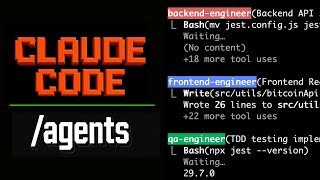

TDD with AI Agents: Live Experiment Begins
45sShows a real-time, hands-on experiment with test-driven development using AI agents, appealing to developers curious about practical AI workflows.
▶ Play Clip"Title accurately reflects the stream's focus on TDD with agents, though the Bitcoin tracker is secondary to the workflow experimentation."
The streamer experiments with test-driven development (TDD) using Claude Code's new sub-agents feature. They build three agents (test, build, verify) to create a Bitcoin price tracker app across multiple sprints, while also reviewing community reactions to the sub-agents update and the winners of a vibe coding hackathon.
The streamer introduces the session: researching test-driven development with AI agents using Claude Code's new sub-agents feature.
Three agents are created: a test agent (writes failing tests first), a build agent (writes minimal code to pass tests), and a verify agent (runs test suite, checks coverage).
The app is a simple Bitcoin price tracker using a free API, with sprints for API integration, display, graphs, and UI theming.
The test agent writes unit tests for the API integration and 60-second price fetching, ensuring they fail initially.
The streamer watches a video by BMAD Code discussing Claude Code's new sub-agents feature, highlighting context preservation and flexible permissions.
The build agent begins writing code to pass the tests written by the test agent, using 51,000 tokens and taking 15 minutes for sprint one.
Key benefits: each sub-agent operates in its own context (prevents pollution), can be configured with specific tools, and supports reusability across projects.
The streamer watches another creator's perspective on Claude Code agents, emphasizing the importance of unique descriptions to avoid non-deterministic behavior.
The verify agent validates sprint one implementation, confirming all tests pass and coverage meets the 70% threshold.
The test agent writes tests for the real-time price display, then the build agent implements the code.
Chat discusses using hooks to make agent selection more deterministic, avoiding the probabilistic nature of tool selection.
The streamer shows a non-coding agent (Trend Surfer) that scrapes Reddit and X for trending topics, demonstrating Claude Code's versatility beyond software development.
The streamer reviews the top winners of the Bolt.new vibe coding hackathon: Tailor Labs (video editor, $100k), Weight Coach (meal planner, $75k), and Keyhaven (API key management, $50k).
The streamer concludes that TDD with sub-agents is viable but slow, best run as background tasks. Plans to explore parallel agents and hooks in future streams.
Test-driven development with Claude Code sub-agents is a promising but slow workflow, best suited for background execution. The sub-agents' context preservation and flexible permissions are key advantages, though non-determinism remains a challenge that hooks may help mitigate.
What are the three agents used in the TDD workflow?
Test agent (writes failing tests), build agent (writes code to pass tests), verify agent (runs test suite and checks coverage).
01:30
What is the purpose of the test agent?
To write minimal failing tests that cover core behavior before any implementation exists.
01:30
What is the purpose of the verify agent?
To validate that the implementation meets test requirements and quality standards by running the complete test suite and analyzing coverage.
03:00
What are the key benefits of sub-agents in Claude Code?
Context preservation (each agent has its own context window), specialized expertise, flexible permissions, and reusability across projects.
20:00
How does context preservation help with token usage?
Each sub-agent operates in its own context, preventing pollution of the main conversation and potentially saving tokens since the main context is not included in every sub-agent call.
20:00
What is a potential issue with having many agents or MCPs?
Non-determinism: the LLM may accidentally select the wrong agent or tool if descriptions are not unique enough.
45:00
What is the recommended way to create a sub-agent file?
Use the /agents command in Claude Code to generate the file with the correct YAML front matter, then edit the description and prompt.
25:00
What is the role of the description field in a sub-agent?
It is used by Claude Code's orchestrator to discover which agent to call for a given task; a unique and precise description is critical to avoid false positives.
25:00
What are hooks in Claude Code and how can they help with determinism?
Hooks are scripts triggered by events (e.g., pre-tool use, post-tool use) that can enforce deterministic behavior, such as always using a specific agent for a task.
45:00
What was the first-place winner of the Bolt.new vibe coding hackathon?
Tailor Labs, a video editing platform built in the browser with AI, winning $100,000.
50:00
Three-Agent TDD Workflow
Introduces a practical multi-agent system for test-driven development using Claude Code sub-agents.
01:30Context Preservation Benefit
Explains how sub-agents' separate context windows prevent main conversation pollution and may reduce token usage.
20:00Description Importance for Agent Selection
Highlights that the description field is critical for deterministic agent selection, similar to MCP tool discovery.
25:00Non-Determinism and Hooks
Discusses the probabilistic nature of agent selection and how hooks can enforce deterministic workflows.
45:00Vibe Coding Hackathon Winners
Showcases real-world applications built with AI tools, demonstrating the potential of vibe coding.
50:00[00:00] Hello Victor Blessard down. Nice to see you. So I am um just going to check my audio. Looks good. Hello depth boss. Let me know if uh sound is good. Okay, great. Hello, Alan. So, yeah, I'm going to give it a few minutes, but today uh I just wanted to We have been looking at agents, right? So, what I wanted to do today was do a bit more research around um like test driven development with agents.
[00:34] So I was kind of looking at uh anthropic here. So I kind of want to learn a bit more about testdriven development using agents. So I don't really have any great workflows on this but I kind of want to learn about it today. So I have some videos I want to watch. Uh I want to do some experiments here. So I have built three agents. So, I have a test agent, uh, a build agent, and a
[01:08] verify agent. So, we're going to try that out, but I don't know really like what is the absolute best way to do this. So, it's going to be some experimental stuff, but basically, this is what I hope to follow. Oops. So if anyone is watching that has done this with great success would be pretty cool to hear your setup workflow. I also took a look I saw yesterday bolt.new that is they had this words large hackathon
[01:42] kind of the results. So we might take a look at some of the projects that won this uh vibe coding hackathon. Hey one. Hello Annie Juan. Maybe you you have done have you done this test uh test uh driven development with agents in cloud code? I know you had a lot of um you use a lot of tokens. So I kind of looked around trying to find some information but uh there are some information but this
[02:16] is kind of the basic one I found. So this is from anthropics. Okay, good one. So maybe you can give me some tips uh if you are staying for a while. What is kind of the best way to do this since I'm going to do some research today and try to learn a bit more about it? But basically I looked at uh Anthropics Claude code best practices. And here they kind of talk about that this is
[02:51] uh an antropic favorite workflow for changes that are easily verifiable with unit integration or end to end tests. So testdriven development. So I think the idea is basically that you write the tests first and here you kind of tell Claude to run the tests and confirm that they fail. Uh yeah, I guess you can commit them. I don't think we need to do that. But then and then you write the code that passes the tests. So
[03:25] this is what I wanted to try by using the new agent setups. So I'm going to give it like a few minutes. Then I'm just going to go through the agents I created and then we're going to try it. I created this um this uh a simple just um software project uh development plan here that I'm going to try to do. So, this is just going to be like um the app is just going to be
[03:59] a simple bit price uh Bitcoin price tracker at the beginning here now where we just use a free API to try to track the Bitcoin price in real time with some nice graphics just to see how the workflow is. And we can do different we have sprints. So we have sprint one that is kind of going to be to set up the API integration. We're going to do sprint two that is going to be the display.
[04:33] Sprint three is going to be implementation of the graph and the real time graph updates and the UI theming. And we're going to do some testing and stuff. But basically we want all the agents to follow this uh test driven development logic. So I don't think they can run in parallel for this because we need a test first before we can do any code. I did a quick test. Hello Dimma. Is there any way uh is
[05:07] there any known to you ready project? So uh that you can see the screen through the glasses and is there any known uh to you ready projects so that you can see the screen through the glasses and that they were connected to the AI. I'm not 100% sure what you mean. See the screen through the glasses? You mean like uh VR glasses or like meta what they called? Ray Ban Meta or something. So let's just uh
[05:41] I just want to have a look at the agent. Yeah, I don't know any open source project. Maybe someone else does. Okay, that's cool. So, since this Okay nice. So since this uh I see you soon then one. So since this the first thing we're going to do is write the tests. So we just created this I tried to make it quite simple now just for my testing. So you are a test firstdriven test first development
[06:15] specialist. Your only job is to write the tests before uh any implementation exist. So the role is just going to be write minimal failing tests that uh cover core behavior. Right? So we're just going to write some tests that kind of cover the core behavior for the for the app we're going to build. Search for claw swarm. Okay, I can do that. Just going to look at the agents first. So the test agent basically it's just
[06:49] going to start by writing all the tests we need for our sprints, I think. So never write the implementation code. It's only going to be the tests. Okay, Juan, I'll check it out. I'm vibe coding uh with Claude and Gemini right now. Okay, that's cool. Uh Shield Studios, what are you building or just playing around? So, the rules for the test agent is Yeah, like I said, we just going to write tests. No uh implementation code
[07:24] and yeah we have some test frameworks here we can do and critical only by test never implemented code being tested. Okay so you're making a to-do app cloud swarm in GitHub. Okay I can check that out. Just going to go through the agents first. Hello. H how I was about to start W coding with Claude and I finally live. Cool. Yeah, we are testing kind of some test driven development workflow to see how it works. So
[07:58] we have done a test agent. We have three different one and we have a build agent. Of course, the build agents is again pretty straightforward, but this is going to be like a full stack uh implementation specialist. So, it's going to write both the back end and the front end. I didn't want to split that up now. So, your job is to write the minimal code that makes failing test pass just to keep it simple. So
[08:32] the workflow is going to be read the existing tests so you kind of understand what needs to be built, import the test contracts, write the minimal implementation and run the tests. We have some kind of structure here we want to follow. So never modify test. Tests are only uh tests are the contract and we're going to write code to try to pass them. And yeah, that is kind of the build agent. And the final one, yeah,
[09:06] I heard about clo agents. I want to use it. Yeah, I'm trying to learn more about it, too. TJ, hello. Uh, how about uh uh peerreview agent uh checks to ensure the code follows the plan before moving to the next sequential step? Okay, that's pretty smart. Yeah, that's we could have something like that, but let's try with these three first and then we might add one. Hello, FJ. Uh, did you ever see any cloud code WordPress
[09:40] things? I haven't seen anything yet, but I guess you could use maybe some MCPS that is kind of connected to WordPress that could work if you want to build some websites. So we have this verify agent. I don't know if you need this but uh the idea behind the verify agent uh is to validate that the implementation meets the test requirements and quality standards. So the role is just to run all the test suits after the
[10:14] build agent has uh created the the code and So we're going to run the complete test suit to it. Analyze the coverage. So I think we set 70% now test coverage for pass. That might be a bit low I guess but just for testing. Yeah, that's a good idea TJ. I think the verify is almost the same but it kind of it comes in at the end of every sprint. So if you think that that is
[10:48] the same, let me know. So I think the idea behind this verify agent is that after every sprint, this is going to try to test that everything passes that we have 70% coverage. But I'm open for suggestions because uh this is something I haven't tried before. So those are the three agents. Uh we might change them up, but this is the basic idea I have. Just going to quickly check what uh GitHub Claude swarm. Not quite
[11:22] sure what this is. Cloud swarm or multiple cloud code instances. Okay. But do we do we need this when we have the the agent set up now? I might have to look more into this. Okay. TJ, you say, uh, not quite. I tend to use 03 when I'm web coding as an independent check before I implement. Perhaps using an agent does the same. Yeah, I'm not quite sure, but let's just see how this turns out now.
[11:56] So, I think the idea is that we're going to read this uh the development plan. I used the 2.5 Gemini 2.5 to create this simple plan for the price tracker app. So, I think we're just going to start I'm not quite sure, but let's just keep it safe. Uh, let's let close code read. It should know about the agents, but let's just let it read um this path here, right? So, we kind of know about all
[12:31] the agents we have. And let's do something like simple. The task is to create the app in SPD. Markdown. That's our software de SPD. Was it? Yeah, supposed to be SDP. That's fine. Software development plan. Uh use the agents for this. Uh create the sprints and use the agents to complete uh complete the assignment. I'm just going to see how this goes. I tried it a bit this morning and I had different results, but that was
[13:05] with a different setup. So I don't want this to be run in parallel. This has to be sequential, I think. Oh, it's a lot of sprints. Use test agent to write the tests. Uh, use the build agent and then use the verify agent. Okay, looks good. But let's see now. Uh, it's not using the agents here. Why not? H. Okay, let's give it a shot because the first sprint was to initialize the project structure. So, the
[13:39] second part is going to be to do the agent. I guess that's fine. Okay, so we have the BTC tracker here. So my plan is right between maybe the agents the working. I want to see there were some videos about cloud code agent what other people are saying about this. So if we get um they could be a bit slow. So we might take a look at those videos. Okay. Now I launched the test agent to
[14:13] write the test for sprint one. Okay. Yeah that's good. So the idea here is that we're going to write the test for the API integration and 60-second price fetching. Okay. So yeah, it's probably writing all the tests now. So the first video I wanted to check out was uh this one. He's going to talk about cloud code sub agents. Thought it could be interesting just to hear what other people are saying about this. Uh yes. Okay.
[14:47] So we wrote a test unit test coin gecko API test. Okay. So here Yeah. I'm going to watch the video. Okay. So, here we have a test we can run. Interesting. So, uh I'm just going to play a few seconds of this and uh if you're watching, let me hear how the audio is. Might be a bit too loud. Hey everybody. Y'all know if you've been watching this channel for some time that I am not one
[15:21] for hype and jumping on bandwagons and releasing a video of the day something. Does anyone was it too loud or was it too low or was okay? Ah, nice. Yeah, I kind of want to hear what uh or wait a bit. That was I think I need to change it up a bit. Uh so I go So I'm going to try again. Hey everybody. Y'all know if you've been watching this channel for some time that I
[15:55] am not one for hype and jumping on bandwagons and releasing a video the day. Is that better? video is okay. Uh your you mean volume. Okay. I can change it back. What about now? better. Okay. Yeah. Yeah. So, let's watch a bit of this. So, you can see we are still writing this tests here. I'm just going to let this run. You can see we have created a few unit tests. We have some API tests. We
[16:29] have some shared. So, we're just going to let this run in the background while we watch some of the video. Uh, I might have to just mute my mic here. Hey everybody. Y'all know if you've been watching this channel for some time that I am not one for hype and jumping on bandwagons and releasing a video the day something comes out or calling things game changers. But uh I'm going to break that today and just say
[17:04] that I am so excited to see this new feature that just got announced. Look at this. Cloud code is getting a brand new feature custom sub agents. type the slash agent commands and we get automatic switching and automatic selection of agents running by claude code. What does this mean? Now claude code can take on any persona and do it automatically when it needs it. This has been one of the things that I have been wanting to
[17:38] build into the BMAD method for some time. So I am just so excited about this. So, I'm going to be working on the installer and updating the BMAD method to have the install option for when you select claude code to set it up with these new sub agents. And we'll yeah, I remember someone talking about this yesterday. I'm just going to quickly check it up. Be mad code. I didn't have time to check it out. Is
[18:12] it this one? I might check. Does anyone have anyone heard of that? He might have something here. Yeah, here it is. Okay, so this got 6,000 stars on GitHub. That's pretty cool. So, it stands for breakthrough method for agile AIdriven development. Okay, that's pretty cool. I might have to check this out more. Uh, but let's listen a bit more to what he has to say. See how it works. This could be a potential I guess I'm
[18:46] going to say it. This could be a potential game changer. I didn't want to say game changer cuz I know that's overused and cliche, but I'm just really excited about this. You know, I made my own claude/ agents command because a lot of times I don't want to build up the whole heavyweight uh BMED method. Sometimes, for example, I'm just taking notes and I just want a quick agent to chat chat with like I used to
[19:20] do with custom GPTs. And so I have a slash agent command. I just throw a file in a folder. I give that a name and I put my agent persona and what it's about in there and any information it needs and I put my agent persona. I just wanted to see. Okay, so it has a slash agent command. Hey Igor, nice to see you. Thanks for stopping by. Yeah, it's been a long time. Are you still
[19:54] doing your live streams? So, I was going to mention he he just has the slash command agent and he's going to do Yeah, he loads. Okay. So, he he just does slash command agent and the name of his agent. Hello, Blizzard. That's nice. Yeah, we're just watching a video on uh the code sub agents. Okay, so he just has he has this slash agent and he's going to do the agent name. Okay, Eager, not so much.
[20:28] Uh you're planning to explore this feature in CL today. Let's do it manually before. Yeah, I was looking at this yesterday. Uh CL got agents and it looks pretty cool. So, you're probably going to do a video on it. I guess you haven't built proper instructions for reasoning uh and also for uh concentrations. No, I haven't. But I just want to watch to watch how he does this. So, he has his agents and he has a
[21:02] slash command. That's pretty interesting. throw a file in a folder. I give that a name and I put my agent persona and what it's about in there and any information it needs. Which, by the way, if you ever just want to get, you know, get going yourself. And if you're ever wondering how I, you know, came out with this BMAD method or how other people comes up with these methods, just try to make your own agents.
[21:36] Cuz what are agents really? They're they're prompts that you've stored. Maybe you maybe you have like a really good prompt or a way to you know work with chatbt or claude right not even on coding potentially and then you know later on you want to do the same thing and so you're repeating that whole prompt save that prompt put it in a file give it in a name and a persona you now have your own custom
[22:11] agent made for anything you want to do right that yeah that's what they kind of talked about uh if we go to claude sub agents. Uh this is kind of the reusability part, right? So once created, sub agents can be used across different projects, shared with your team for consistent workflows. Yeah, TJ, it's almost like a custom GPT. That's pretty cool. Hello, Jesse. So cloud code per month, you can kind of decide. So, if you do
[22:45] cloud code uh plans, you could do you could do the the pro plan, that's like the $20 plan, and you have the max plan that is uh 200 or 100. I'm on the 100, but you can also use your API key, but that could get very expensive. I'm on kind of the $100 plan at the moment, but I know a lot of people like Blizzard, I think he's on the 200 plan. So, let's see how our
[23:19] agent is doing now. So, still having some issues here, but it's kind of working through creating all the tests and beuring that they are failing. Yeah, I think the $200 or maybe the $100 plan too is a good value if you create a lot of code. So this is our test agent now. If you came in late, it's trying to to write some test for our testdriven development. So that's what we're going to test out today.
[23:53] Yeah, this failed too. I think that's good in this case. So yeah, he talked about reusability for the agents. That's pretty interesting. I kind of agree. It's like a custom GPT for your cloud code. Yeah, Blizzard, it's good value. I think so. Do the same with the API. It's going to be expensive. That at the end of the day is the core of the BMBA method. But now the ability to take these and easily create these
[24:27] in claude is very or excuse me in um in claude code is very exciting. So what I had done actually up until today is I have this lightweight just little agent framework that I set up you know two or three files. I type slash agent and then the name of one of my agent files in a folder and it loads it and I'll scope those. For example, I have a whole Obsidian notebook that I run out
[25:01] of VS Code and I have folders for different projects that I work on. I have folders about different subjects and I'll have agents that are expert in each of those different subjects. So when I do slash agents and talk to say agent Bob, right? Agent Bob knows about folder fu and he knows about all those files and he knows how to help me with that subject. Yeah. So I guess I could have like let's say I
[25:35] create this flash commands. I could have um I could have different agents that has different uh tools like we looked at yesterday with this flexible permissions. So maybe one of my agent only has access to the Gmail API and that could be my Gmail agent and since it has kind of its own context that could be very interesting. I might have to try this setup and we can restrict some agents to only have uh access to
[26:09] yeah some specific tools. think it could be pretty interesting and this has worked great. But the magic of what's coming now with this built-in/ aents command that I'm so excited about is these are all actually running in their own subprocesses. Look, let's let's check out the cloud code documentation here. Y'all, this is I don't know. I mean, I don't know if y'all are as excited about this as I am. I'm so excited to get this into
[26:44] the BMAD method, but uh yeah, check this out here, right? So, like what are sub agents? You know, they have a specific purpose and expertise area. They use their own context window. They can be configured with specific tools. In other words, you can set them up and control which MCPs they have access to. And this will be enforced. Yeah, that was just what I was talking about. I think that's pretty cool. So Blizzard, so Basparin says,
[27:18] "Someone don donate Claude Max to this poor guy. Yeah, I don't even know what to build next. I got two computers running CloudMax accounts. I have my place I have my I have placed my main business project in a local environment." Yeah, you could get this like uh what is it called? Uh paralysis that you don't know what to do next. But uh he kind of mentioned here what I was talking about. I think it can
[27:52] be pretty cool to do when you have these different sub agents that has its own kind of context window and it can be configured to have its own tools. So maybe my agent has only access to this MCP server and you can get a lot more control. I think it even has its own custom system prompt, right? 21 uh on your agent team. Yeah, remember a few days ago we saw that guy with 50 agents. This
[28:26] has been one of the weaker points of the BMAD method, but we've had things like that in uh cursor where you can, you know, create the agents from the BMAD Mona personas. For example, your PM agent. In cursor, you could tell it what it is and is not allowed to do and what MCP tools it can't do. So for example, when you set up your PM agent in cursor, you can make sure it will never start
[29:00] randomly going off the rails and modifying clo uh modifying code. But in Claude, you know, we would do that with with words that we put into the agent file, you know, before this. But sometimes, you know, it might not follow that. Yeah. So this kind of with the new with the new agents now, we can kind of work around that. it could be more um deterministic right? So, that's a good thing. I think we have more
[29:34] control over each agent. I get I guess we could also uh take away the write tools and the file edit tools for some agents if you wanted to. So, we only have uh they only have read access. Okay. So, just to stop by. So you can see the test agent now was done with sprint test sprint one test phase and now we have started the build agent to write the code to pass these tests. That's good.
[30:08] And these are all the sprints we have today we're going to try to complete. So this build agent now is going to try to write the code to pass the tests that the test agent build. But again, we're just going to let this run in the background. So, this spent 51,000 tokens, 15 minutes. Okay. But with this now, we can actually tell it what it's allowed to do, what it's not, and Claude will help us enforce
[30:42] that. And we can also include custom system prompts that guides it, guides its behavior. This is going to be a new feature that I think is going to unlock so many things. But let's look at some of these key benefits that they're laying out here. Context preservation. Each sub agent operates in its own context, preventing pollution of the main conversation and keeping it focused on highlevel objectives. Yeah, I think that's super interesting because couldn't this also
[31:16] save you token count? So, we don't get the main conversation in all the calls. So, I think this could actually save us some tokens, right? Since it doesn't mix in the main conversation into each call, I think this is very smart and it's very good for agentic coding. Uh how right uh how many tests were written for sprint one? We can take a look. I think it was uh for sprint one it's uh let me see
[31:51] um I think it was a lot of test. It was one for the API, one for the integration, two shared tests, and two unit tests. So maybe six, something like that. And maybe a setup test. I'm not quite sure. Six maybe of the main conversation. and keeping it focused on highlevel objectives. This is now going to be able this is now going to give us the ability to have a true orchestrator that could potentially run in
[32:25] the same chat instance and then have different agents do different things. So imagine you're working through your developer cycle and you have the scrum master come online, generate the story and then go out of scope. It's going to free up that context and then the developer comes in and starts working on it and maybe you're following TDD so you could have the QA agent actually producing tests switching to the developer implementing. I just have to heard
[32:59] here this again uh uh hello uh nice to meet you again. Thanks for tuning in. Yeah, six tests in 15 minutes. I think that's pretty good. I think that's going to be hard to beat. Uh, but I'm just going to listen back to what it says here. I think it was pretty interesting. The developer comes in and starts working on it. And maybe you're following TDD, so you could have the QA agent actually producing tests, switching
[33:33] to the developer, implementing, switching back and forth until the story is done. They both go out of context. You're still in the same context window. And now your QA agent comes in and we have it actually reviewing the code, maybe refactoring it, making sure that all the acceptance criteria was really met, getting that extra level of sophistication that we want to ensure that we're producing good quality, clean code, that it's actually following our architecture and the
[34:07] instructions that the scrum master laid out. And then that goes out of context. And then your scrum master can come in and potentially even do a final review or pull information that the dev and the scrum master left his notes in there. Excuse me, the dev or the QA take. Yeah. So, this sounds like a I don't know. Uh, Blizzard, is this kind of something you have when you have 21 agents, you have all of this
[34:41] uh you have the QA agent, you have the what do you call it? The scrum master and the orchestrator. I guess you have a lot of these setups. It sounds like a full development team, right? Okay. So, we are still writing some code. Yeah. Yeah. I figured that was something you have, right? So, how long would you say, Blizzard? Like, let's say you want to implement a new feature. How long does it take for everything to
[35:15] go through the full team? Take those notes, prepare the next story, and the cycle repeats. So, integrating the BMAD method or whatever method you use, again, you don't have to use the BMAD method, but with these sub agents, this is going to be so powerful. Imagine you're not a software developer. And I've been saying this for a long time, the BMAD method is about so much more than software development. Product managers and project managers, they use
[35:49] it for planning road maps or Hello, Zack. Nice to see you again. So a full run takes about three hours. That is crazy, right? Hello, Lan Lan. Uh, have you heard of these LLM things? I heard they're going to be big. Yeah, I've heard of them. Okay, so you mean to your finished app. Hello Mojave, nice to see you again. Thanks for tuning in. velopment product managers and project managers. They use it for planning road maps
[36:24] or creating big picture visions. Um I talked about in the last video uh one of my great supporters that I'm so thankful for again Emanuel a clinical psychologist using it to help him with clinical psychology nothing to do with software development. I know people that are using the con. Yeah, he's kind of right about that. I have also done that. You don't have to use code for only uh software development. You can use these agents for
[36:58] other things too. So, I think someone in the chat here was talking about they want to write some kind of book. I guess you could use these agents to have like a a writer. You can have an editor. You can have like a spell checker if you wanted that. I don't know so much not not so much about writing, but in theory you could use agents also to do other stuff. It doesn't have to be writing
[37:32] code, right? If you just are a bit creative how you set it up could basically do anything with the MCP servers. So I have my email connected. I can have my YouTube connected. So if you're a bit creative, you could do a lot of stuff with this. Yeah Eager. So, are you kind of looking into how people use it for other things than just coding? I think that's a pretty cool angle. A I know a lot
[38:06] of people cover only for AI agentic coding, but I think it could be pretty cool to do a video for other things too. Uh, how do you keep the contacts efficient with something like 21 agents? Yeah, you can ask uh Blizzard about that. It's pretty crazy. Okay, Eager. Yeah, I've seen some of your CL code videos. They look pretty interesting. You rebuilt your entire website. Cool. Yeah, I have uh I built my course platform using Cloud
[38:40] Code and it's working pretty good. concepts of creating these small agents to help them with their business, help them run their lives. It's like using chatbt but programming it with knowledge and understanding at the end of the day creating your own custom agents. And now this gives us a much better way to do it in cloud code. So context preservation is a huge one. Specialized expertise. If you've been using the BMAD method or anything I've just
[39:14] been talking about, of course, you understand what that means. Flexible permissions. I just mentioned that. That's going to be a great thing because now we can scope different agents to only do certain different things. Very exciting. And reusability sub agents can be used across different projects and shared with the team for consistent workflows. Yeah, that was what we were talking about right? Because uh when you first have created an agent, I guess it can be local
[39:48] or you can also create a a global agent too. I think you can choose between that. Uh uh I can send you the link eager. Give me a second. The AI It's um it's this one. This is a huge one and this is going to be a big impactful change to BMAD method when you're using the clawed version of the installation. So big changes coming soon. I can't wait to see what this is capable of. I'm
[40:22] just learning about this right now. I just heard about this a little bit ago. Again, I know this is probably seeming like a little bit too much hype and being rushed out. And I don't know how well this is going to work, but if this is any like anything like what I've seen from some of the other frameworks in the past that have had sub agents, I know this is going to be a gamecher. And just
[40:57] with the quality of claude code in general and what it's able to do, you know, with its own internal tasking and it already had, you know, yeah, I kind of I kind of believe him, right? I don't know. Blizzard, do you think this is going to be like a big change for cloud code? Uh, hello Matias. Yeah, you can choose between global and local uh and local will have priority. Okay, that's pretty good to know. So,
[41:31] if I have it in both, if I have a similar agent, it will always choose the local one. But yeah, I think it's what it's talking about here. This could be like a game changers for for cloud code. It's going to be interesting to see. So, you told me. Yeah, I know. You told me. The biggest release I've seen up to now. Pretty cool. It's been kind of low key, though, uh on Reddit and X and
[42:05] stuff. I haven't seen I guess I said something about it, but uh yeah, Eager. Uh cool. I feel this whole AI space is just getting started. Fun times ahead. Yeah. Yeah, it would be nice to have a chat one day just to hear how everything's been for you. I know you have um I think you have a team now, don't you? Do you have many employees, Eager? Yeah, I agree. Blizzard. So, if you don't know uh
[42:39] Eager, go check out his YouTube channel, The AI Advantage. has a big channel. He's got some pretty cool stuff. Wow, you're 10 people. That's crazy. Yeah, I'm really happy for you. That's good. So where are you located now? Subprocesses where it could shard and do things in parallel and not pollute the context. This is basically building on top of that but now giving us the ability to inject those agents and keep them separate and not polluting
[43:13] the main context. So this opens up the door again to real parent orchestration of different agents. Automatic switching, automatically loading them when they're needed, controlling what tools they do and do not have access to. So exciting. So exciting. Everybody, I encourage everybody if you're using cloud code, check out the docs here and start trying to use this agent mode. Just slash agents. And what's really cool, too, is if you just want to prototype an agent, you
[43:47] it's it's so easy. You just type / agents and just describe the agent you want and it will create the agent file for you. This is almost like autogenerating rules and cursor, right? Or some of the Yeah, I think the the UI here is very intuitive, right? It's very easy to use and since kind of uh Claude rewrites the the configuration file for you. It's very easy to use. Okay, so you're playing classic Wava and trying
[44:21] things with code. Okay, so you're in Lisbon now. That's pretty cool. I guess the weather is nice. Yeah, happy to hear you're doing well. That's good. Cloud code is miles ahead uh of other air tools. It's insane. Yeah, I kind of agree. Dream dream slow. I have like been uh I kind of switched from cursor to only cloud code. Okay. Uh Eager. Yeah, let's do that. I have you on Discord. So, have a nice Sunday and
[44:55] we speak soon. Yeah, Dreams for I kind of switched from I went back to the free version of Cursor and I kind of upgraded my cloud code to Max instead. So, I'm really happy so far since I don't I only I don't only use it for coding. I also use it for like people talk about how we can we can do to-do lists. We can uh I create content. I do videos with it. I check for
[45:29] trends. We can do a whole stream about that another time. But it is pretty cool. We are still writing code here. So this is taking a lot of time but it's fine. It's just running in the background. Anyway, we are still on sprint one though others and then you can go in there and tweak it just like we do with rules in other systems. create the rules, keep it simple, see what works, see what doesn't work,
[46:04] and then tweak the file and try it again. Very exciting, guys. This is this is unexpected. I did not even know that this was coming out yesterday, today. I don't know if they've been talking about this, but this just kind of fell out of nowhere. Uh, some people in the Discord community let me know about this, and I was just so excited to reach out and see this. I went in, I updated claw code, and you
[46:38] can see right here when you update, here's the message about it. It's giving you instructions how to use it. So have fun with this everybody. I look forward to hearing how people are using this and look for big changes with the cloud code version of the BMAD installer very soon as we work hard in the community to get this incorporated and worked into this amazing system. Thank you everybody. My name is Brian. This is BMAD code.
[47:12] I know this was a little bit more hype than normal, but please uh you know just just understand that I'm just very excited about this and I wanted to share this with all of you. So enjoy and we will see you next time here on BMAD Code. Yeah, it was a pretty cool video, right? I think we kind of had the same thoughts. So go check him out. Uh it's BMAD Code. I think he had some
[47:46] pretty good stuff to say here. Seems very knowledgeable. For years I've d Okay, so Dreams, you mainly use augment code. Yeah, I heard about that. I haven't tried it so much. So it's excellent for large code bases and you also use it for production scale at work. That's cool. But I've been trying out cloud code for the last two days. I'm really impressed. Yeah, that's kind of me too. I kind of started the CLI uh Aentic
[48:20] tools with clawed code when it kind of came out and I haven't really switched because when I tried the other versions I um uh I wasn't that impressed. So I always come came back to kind of cloud code but uh I haven't since I'm not doing any like big code bases or any software development for work I don't have that experience but I hear like people like blizzard here and when you say too uh I think
[48:54] a lot of people have switched to cloud code especially after that cursor they had some issues they had some bad communication around their uh uh payment. People signed up for pro or like max and they thought it was unlimited but then it was then it got charged like thousands of dollars. So I think like claude code is maybe up on the way up and maybe cursor has flat. They might be growing still, but um yeah, but
[49:28] I guess for many developers, maybe you kind of want the IDE. Uh I'm not quite sure. Hello, Akash. Nice to meet you. Codeex is good as well. Yeah, I haven't really used a lot of spend a lot of time on Codeex. Uh I tried it when it came out. Uh but that was very new so it had some issues. So I just went back to code again. I tried Gemini CLI. Same pretty good. That's very I
[50:02] guess Gemini CLI is uh is uh free to use mostly. Hello Maple Dev. Yeah, I think they lost a lot of reputation on that uh that issues with the payment there. Hello Shison Sonic, nice to see you again. So if you came in late, what we are doing today is that we are trying out this testdriven development with cloud code sub agents. So we had an agent here that uh was writing all the tests first. Now
[50:37] we are kind of on the build agent that's going to write all the code and try to pass it with the code and we have a verify agent at the end that's going to validate the implementations. So it's taking a lot of time. I think the first agent spent 14 minutes and 51,000 tokens. But the good thing is that we can run in in the background. Hello, Nigel. What do you recommend for running Cloud Code agents?
[51:11] What do you recommend for running Cloud Code agents at specific times? Hm. I'm not quite sure. Hello, Night Spider. Do you mean like uh specific times to avoid uh overloading on the API? Say daily. Okay, I see. Yeah, I think you can just you have this refresh. I mean, you have the max plan. I think every five hours you get new token limits, so you can just run them basically all day almost. So, Night Spider, you've
[51:45] been trying to get into clo code, but I keep running into stop gaps. So, I'm still using wind surf until I can get it sorted out. Uh, you was able you got your MCP servers. That's pretty good. If you uh came all the that way, are your agents on any repo? Uh nope, not at the moment. You're using Sonnet most of the time or Opus. So today I'm just going to use Sonnet. But uh what I've
[52:19] been doing is that I've been doing uh uh set for non-coding tasks and I just used the opus when I'm doing coding. But uh for this test I'm just going to use set. Those cloud codes also take in uh take into the open files. Does cloud code also take into the open files in VS code for context? So cloud code uh doesn't really I don't think it indexes anything. It's just using search like GP and stuff
[52:53] to find relevant content uh context. I don't think it indexed anything. Okay, so this is still running. I'm not going to interfere. So, we're just going to let it run and see if it can complete our app. Yeah, it's a graph only. Yeah, I think so. Has anyone played with agent OS? I have not. Hello, Hockey. Hello, Tim. Hello Christian. Do you also feel like after agents token consumption and time taken after agent tokens consumption and
[53:27] time taken has increased? Yeah, I haven't really lately I haven't really built any like big big project so I haven't noticed a big difference but I read kind of online that that's the case. If you open in terminal of VS Code, it seems to know what files is in it when a code is selected. Yeah, it might do that. I haven't used it so much in VS Code. There's command you can use to link it to
[54:01] your ID. Yeah, that's true. I remember that now. You can link it to cursor. Hello, Benjamin. Nice to see you again. Yeah, I'm having a really chill Sunday. What about you? So today we are just testing out uh the agents on like this testdriven development. So we just going to create an app that is just going to do real time Bitcoin tracking. But the main idea is to test out this system with sub agents that's going
[54:35] to do this test driven development style of working in different sprints. So it's going to write the tests and then it's going to uh write the code uh that passes these tests and we're going to verify. So we're just going to let it run in the background today. So yeah, this video was pretty good. Not this one, but this one. I enjoy this. Uh I had some more videos. Uh this guy was talking about uh CL
[55:09] code agents. We might listen in. Okay. So I guess you a different time zone than Benjamin. Do you ever use MPX cloud code cost to see how much tokens would have cost at API pricing? I've heard about that, but I haven't used it yet. I think I think the value is good. Now I need a CL code agent that makes agents and test them. Yeah, you can just make agents with clo code. Uh, I also want
[55:44] to take a look at this video to see if it's interesting. Ah, okay. That's quite late. Uh, so I think we're going to start watching from Matt here to see what he says about uh, Clo agents because I kind of want to hear what other people are saying about this. Get some different perspectives. So, you would have spent almost $3,000 last months on tokens. That's pretty crazy. So, you paid like less than 10% then, I guess,
[56:18] of your real cost. That's insane. Uh, Night Spider, I'm on the max 100 plan now at the moment. So, I'm on this max 5x. Uh, so if I need more, I could upgrade to 20. But for now, this has been fine for me so far. So, I can send 225 messages every 5 hours. Good thing there's more and more competition. Yeah, competition is good for our consumers, right? If we convert cloud codes 200 plan to tokens,
[56:52] is buying cloud code cheaper option? I think so, but it really depends on how much you use it. If you just use it for like a half an hour a day, then it's not worth it, I think. But uh let's hear what Matt here has to say uh about agents. Just play it for a Okay, Blizzard. See you soon. Uh who just uh some customers have been contacted by Cla with a survey and they were asking
[57:26] about limit per week. Okay. Any idea how many tokens you usually use with the max plan? I haven't really checked, but there are some like uh open source project uh MPX cloud called cost. I think you can check how much you're using. Changed the game again. They released agents that live in your project and seem to be able to read your mind and do exactly what you need, even if you don't exactly ask for them. Today,
[58:00] I'll show you how to build agents in Cloud Code that really have a chance to change your use of the tool. But there are a few things to be aware of. Okay. What exactly are agents? Think of agents as little prompts that live in a special folder waiting for you to call them up or mention something that they do. This is going to feel a little bit like MCP and a little bit like agents and a
[58:34] little bit like slash commands. There's a lot of moving parts here under something that seems so simple. So, I really want to show you how to use them today. First, let's look at what Anthropic announced very simply. They have a page for sub aents inside of their their documentation. What I will point out here, the Yeah, we kind of had a look at it this earlier, but uh let's see what he has to say about it.
[59:08] It's just interesting to get different perspectives since I I get a lot of feedback from you guys here in the chat too. Of course, like everyone seems pretty excited about this. So, that's cool. It's good to know, but it's cool to get other perspectives, too. And maybe we can pick up some some stuff we can learn here. The only part that's really meaningful to us at this point is what are the key benefits of writing these
[59:42] agents? Now they call them sub aents but when you use the command there's a slash command to find them and that slash command is slash aents but the two things that are really meaningful here is that they have their own context which means everything inside of that agent area. That's why they're sub agents is they have their own subcontext area that they might do hundreds of steps and all of the context that they build up to
[1:00:17] do all of their moving parts stays within that agent. So when it's complete, what it's done with, it passes back out and everything else is consumed and goes away within that sub agent. Now, yeah, that's pretty good. I like that way they are kind of set up here with their own context. I'm just going to quickly check here. Yeah, they're still writing. God, it's been a long time. Now, what's important about that is it doesn't pollute
[1:00:51] your main context. If you're having a chat and you want something to occur, please write a file or go research the best account. I think I want to move my camera a bit so we can see him. I didn't think of that that I need to use for this sample that might need to go read a database or look at the web or whatever it might need to do. All of the extra moving that it's doing
[1:01:25] in there, you don't need in your main chat context. You're trying to work through a problem, whatever that problem may be. And so all of these little subtasks that go off and do their own thing need to kind of manage their own memory space, if you will. Now you're sending in some information that it can consume and work with and it's sending its response back out. And we'll take a look at how I determined that in
[1:01:59] a moment. But that's the one really major thing that these things are actually doing for us is kind of encapsulating the space of of the context that they're part of. The other thing that really is truly important here is they have flexible permissions. So yeah, we talked about that. So, I was just wondering I just want to open up a new window here or I can do a new I just want to see. Can I edit
[1:02:33] here? Okay, I'm not going to do that now. Agents. Okay, so here is where you select a new one, right? This is project and personal manual. Okay. Yeah, I might look at that afterwards. Just kind of wanted to see. I haven't really checked out all the permissions, but I think you can be very precise with their permissions. Uh I think we need to be flexible and just go wherever the best value is. Yeah, there's no point
[1:03:07] being like uh um yeah, how can I say it? Like if you don't have like a big company, just go where it's cheapest and the best. You don't have to. And now I'm only going to use Open AI no matter what. At least I'm not doing that. Uh so Tim says, "Yeah, I think the trick is working on many different projects at the same time. Each project can have a CL instance working on it." Yeah, that's
[1:03:41] what's pretty cool, right? So you can It's really hard if you have like you run three different apps or something and that's a lot of work if you're like a solo I guess developer or you have some other things you're going to do solo. Getting help from cloud code to manage all those projects at the same time could be pretty cool, right? This is a way to say what can this agent do? We will look very
[1:04:15] clearly at this though you so you understand it. But it's basically saying can this agent write files? Can it read files? Can it use this MCP or that MCP? All of those kinds of things can be described inside of the definition of the agent itself. And that way you can greatly limit or or even enhance what any given subtask or sub aent is doing for you and the tools that they have to do it. All right.
[1:04:49] So with that, let's dive in and take a look at how you first interrogate the agents that exist and then build our own. Okay, let's build a dice rolling agent. It's simple enough to understand and maybe complex enough to really show off how to build your own agent. For anybody that doesn't know, I am running claude code inside of cursor. Really, that just basically means you are seeing terminal environment here and cursor on the outside. And
[1:05:24] that really gives Yeah, I don't know why I never do that. It's very easy to do, right? It's just I think it's just and just do claw. It's not very It's not I never do that. I don't know why. I guess maybe on camera it looks a bit better when I blow it up like this. Hello Joe. Nice to meet you. Yeah, just uh listen in and chill. We're just going to talk about cloud code today
[1:05:58] and some other AI stuff just to see how this goes. So you don't have to pay 100% attention. Yeah, I think it looks when I do this. Uh okay, so we are done now. So when I do video, I think blowing it up like this is better. So the agent finished 37 minutes 113,000 tokens. So that was sprint wand the build phase. So now we're going to start the verify agent to validate the integrations. Hello Narius
[1:06:32] from villainous Lithuania. That's cool. I don't Yeah, I don't think I'm stuck. Uh Hugh, it's just I don't think this has anything to do with the agent. Uh this is a different context. So this is kind of my main context and this is kind of the agent's context I think. So these two are separate. Hello Tetuin. Uh no trading bots. We are just doing like a simple test of creating um we're mostly focusing on the workflow
[1:07:06] with testdriven development. I kind of want to learn more about that. So, we're just creating like a Bitcoin price tracker. I never run that skip permission mode. I know some people are running that flag, the dangerous skip permissions flag. Okay. So, now we launched our verify agent to kind of validate the implementation. So, this is going to do a quality check on the code to see if it passes all the integration tests. I think so. We're
[1:07:40] just going to let it run. So, let's watch him. He's going to do a simple example now of how to build an agent. So, I'm just going to Yeah, we're just going to see what he has to say. Gives us the ability to look at files. I always really advise running cloud code in something that you can interrogate the project that it's that it's working with. You can collapse the side and just get back to cloud
[1:08:14] code itself if you want. But enough of that. Just so that you understand the environment that we're looking at here. If you recall, it told us we could use the agents command, the slash command of agents that you can see here. And there are no agents that it found currently in this project. So we can create our own agent. I will show you that where this is going to go is in our cloud folder, ourcloud folder,
[1:08:48] there's an agents folder and inside of that agents folder which is currently empty. That's really what we're about to build. We're going to let the system itself build our agent. I think this is the best way to get started and they really advi Yeah. So one other thing you can do is um so this morning I just had since the agents file are kind of stored under claw agents and we have the agents file here. You
[1:09:22] could also just point claw code to this agents file and write the agents directly from cloud code. You don't have to do it through through this UI here. But uh it is pretty helpful advised that you always get started with this because the file that it creates has a little bit of a format. We'll look at that. Here we go. So you can change where you want your agent. Do you want your agent in this project
[1:09:57] or do you want it says personal I might think of this more as global because it's putting it in my top level.claude folder which is in my home. So, if I put it there, if I chose personal, it will be available to every instance of Claude that I pull up from this home folder, from this account. And that's really useful. I'm very excited about that. I don't have any installed now. Yeah, we talked about that earlier.
[1:10:31] So, we have a local agent and we can also have it says personal, right? But, uh, like he said, it's global. You can just think of it like as local and global. And uh I don't know who said it, but someone said in chat that uh the local is uh has priority. Hello Rad, you watched this video this morning. That's cool. Yeah, he seems also very good. There's a lot of good uh creators on um on
[1:11:05] these topics and I like to watch other ones too. I can learn a lot from this. You have both sets. Yeah. And the priority is local. I think so, as you could see. But that's really where I think I'm going to put several of the things that happen across many of my projects. So that I think is a real power here. At the same time, what you might put inside of a project is also really powerful
[1:11:39] because projects really have their own concerns very often. And this might really be a way to let things always occur a certain way without every user having to know how to ask for it. But look, I'm getting ahead of myself. Let's build an agent. All right, we are going to generate with Claude and tell it that I want an agent that rolls dice. Okay, so once it's gone. So that was his only description. He just gave
[1:12:13] it an agent that rolls dice. So it says be comprehensive comprehensive for the best results. But I guess this agent is just going to be like a simple Yeah, it's not going to be very uh advanced. Uh Maple, did you ever get your Discord back? Nope, I didn't. Uh but I got my user back, but not the server. We have a new uh Discord now that is basically it's just smaller and you can apply uh if
[1:12:47] you check out the link in the description. But no, I didn't get it back once it's gone through. And of course, this is doing a full LLM thing. We'll see this in a second when we see the completed file. So, it really is using probably sonnet. I don't really know to describe the best version of an agent that it can. But we're at the point of needing to tell it what tools it has the ability to
[1:13:21] use. So if we turn off all tools, it has no ability. That's not entirely true because it's an agent. It still has access to an LLM. And really, frankly, that underlying LLM can also do things. So it's not really all tools, don't they? Yeah. This is what I want to take a look at. So we can select by read only, edit, execution, and MCPS and other tools. So we could turn off uh edit and execution and
[1:13:55] give it like only read read only access. That could be useful. And of course the MCPS and we can also select individual. Write me on the list. I want to uh show you on video what we do in our company. Yeah. Do you mean uh the Discord? Is that what you mean? It's in the description if you want to apply. Think of it as this isn't going to do anything, but it's not using any of your
[1:14:29] actionable tools that are extraneous to the typical clawed environment, if you will, or the typical LLM interactions that you might have. You can allow it just the readonly tools or readonly and edit tools. You can do anything you want here. But if I show the individual tools and say let's take a look at what the readonly tools turned on. You can see that it has some of the different read mechanisms that you might have at shell
[1:15:04] level. And also it's got its web search and notebook read mechanism here. Let's try this. This one we can just uh it's too big. Let me hide that so that we can see. I'm going to turn off all tools for this guy cuz it really doesn't seem to make sense that he needs any tools. So let's give him a shot. He's just rolling some dice. And now it says up here to continue. And now you also
[1:15:38] get to give these things a color. I think this is great. I'm glad they've moved into this. I'm going to make our dice roller blue. And that just means when you see it running, you'll see it very clearly called out in the stack here in the conversation. Okay. And so this is the prompt that it ended up creating. You can't see it all here. So we'll look at it as a file. So it's saying press S
[1:16:12] or enter to save. Now we've saved it and we can see it here. Okay. So let's exit out of this and then come up and take a look at the file that it created the pro. Yes, it does it does really create like a a quite comprehensive setup here. So if you look at Okay, so we passed the verification. That's cool. Just want to check this. So we got uh past sprint one here. So that's good.
[1:16:46] So I think we did at least. Excellent. Sprint one is completed and verified. Now I'll move to sprint two. Real time price display. So now we're going to launch the test agent to run the tests and we're going to continue with sprint two. That's pretty cool. Maybe the next project a Discord bot that hunts down other bots. Yeah. Uh I have a Discord um MCP server that works pretty good. So yeah, this is looking good. So
[1:17:20] we're just going to let this run in the background. I just wanted to quickly check. Uh so if you look at my test agent, you can see it. It is quite comprehensive. I guess it wasn't that big, but uh pretty good. You could also do this manually, but like I said, I think it needs some kind of format here. So, we have name, description. I think we need a description is important for uh I think the
[1:17:54] let's say we call claude code the main agent. So the description here is uh how the agent decides what agents to pick for what kind of task I think. So like uh we do in tools, right? Uh I can't confirm but I think that's the way it kind of selects agents for each task based on the description maybe on the tools and of course maybe it takes the name into consideration too. But I think the description
[1:18:28] and this format is pretty important. prompt is just down here so that you can just come in and write anything you want in the prompt. Up at the top is where some of the magic is happening. They describe this in the documentation if you need to know more, but really what's going on is there's a special way for it to call out its name and also description. Now, the description one is probably the most important. Tools
[1:19:02] are important as well, but really description is the one that's kind of the most critical. And you can see that this has a very special format to it with a little bit of extra markup inside of it. That's why they're advising or recommending that you use their tool to get it started and then come back and make changes. But this description here, use this agent when you need to simulate dice rolls for games, probability calculations, random
[1:19:37] number. So, this is a very important description. anybody that's that's used MCPs, built MCPs, um, and even in some cases agent tools, things like that, depending upon what platform you're using, what framework you're using, the description is something that this agent system, that Claude code is using to interrogate and really go discover these tools. And now, I can't say how important that is. It's very difficult to get that across in a very simple statement like that.
[1:20:11] If you know what I just said, you probably just went, "Oh, what? Really? These are not things that the system necessarily knows about. It's like all of the other MC in MCP tools that we've seen. It has a self-discovery. So, it when it launches looks at all the agents that it's aware of and takes an inventory of all of their descriptions. Those descriptions become part of the tool set that it gives to an LLM when it
[1:20:45] says, "Hey, the user asked me to do X." Yeah, that's why it's very important like if you have a lot of uh let's say a lot of MCP servers that are kind of similar, this could be agents too, the description uh becomes more and more important, right? because uh you your the better your description is uh the easier it is for uh let's let's call it the cloud code main conversation to pick what uh agent or
[1:21:19] tool or MCP server it should choose for the job right so I think that's very important I'm just going to check here yeah we are still writing tests Here's some tools I know about. Maybe they're useful. Let me know if you want me to call one of those. So, it's using this as a tool that the LLM might go, "Oh, yeah. You know what you should do? You should roll dice using that dice rolling agent that
[1:21:53] was given to you because it looks like in the description, which is the most critical aspect of this, they indicate that they can roll dice. So, let's give this thing a shot now that we understand what's going on here. And if of course, if we do agents, we should see our dice roller here roll a d6. Now, of course, not fast. This is definitely not the most efficient way to roll a d6, I wouldn't think, cuz
[1:22:27] it's going to an LLM. The LLM is saying, "Okay, why don't you actually call this tool that you told me about?" Then it's saying, "Oh, I'll call this tool. Let me call the tool." The tool's going to an LLM saying, "Hey, I'm supposed to do all this." It's kind of nuts to think that this is how you would roll dice, but that's the idea of agents. This is kind of a natural way for agents to work
[1:23:01] and yeah that was wasn't very effective. So yeah Tim said that uh cloud code could definitely be faster. So when we are using this method here, I just think this is this way of working at least this test driven development workflow we are trying out today uh is just going to be for background work right or uh a lot of different projects in parallel because to be honest I don't really have to do anything here. It's
[1:23:35] just going to be background work, I think. Hello English. Uh, my only concern on the sub agents are the deterministic stuff. I think we can always work around the hooks. Um, work around the hooks, make it work as a sub agent and not depend on cloud code to choose uh the sub agents or not. Yeah, I kind of see what you mean. So the more uh let's say the more tools MCP servers and uh agents we
[1:24:09] get the bigger the chance is that the uh I'm going to call it the orchestrator or the main uh agent let's say cloud code is going to pick the wrong tool or agent right so I definitely agree and I think with hooks yeah you can use it for that so that's a good point. I I think I'm going to have to look at hooks again just to see what we can do with this because that's a
[1:24:44] very good point, I think. But if you have like a small setup uh like I have now, there's no problem. Uh Night Spider, I'm not at the moment in this project, I don't have any hooks. Yeah, Blizzard might have any hooks. And you can see it says you rolled a four on the d6. Excellent. So this is the output that's actually coming out of this action here. And if I go in and do a controlr, which
[1:25:18] is a way that you can see the actions that occurred, all the conversation that was kind of collapsed, if you will. You can actually see some of what was happening. So it started to call the dice roller the first time. It doesn't know about a slash roll command that it tried to do. Here's the commands that you're allowed to do. and it says, "Huh, maybe that's not what I need to do. Let me try with simpler
[1:25:52] prompt." Calls the dice roller, and the dice roller goes to the agent or to the LLM, does the rolling, comes back with this kind of output, and then what it finally summarizes it to is this. So, that's all of what's happening inside of this agent. That's how agents work. You can see we didn't have to say use the dice roller agent. All we said was roll a d6. That Yeah, that's true. Uh, I just have to
[1:26:26] toilet quick. But uh yeah, that's kind of what he was talking about, right? We had the description and since uh since we kind of described what this agent can do, it kind of knew when to pick this uh dice roller agent to roll the dice was kind of based on the description we gave it. Uh we can work with hooks based on specific bash commands. Yeah. And use hooks with shell scripts on it. Yeah, I think
[1:27:00] I have to look a bit more into that. You can create your own custom hooks based on specific events. I did a video on hooks. I created What did I create? I created a hook that sent me a text message each time Claude code uh stopped running. So every time cloud code stopped running uh it sent me a text message uh that used uh what did I use? Twilio I think SMS service. So it sent me
[1:27:34] a text message every time closed code stopped running. And I had some alerts I think. So it it could be very useful and I kind of need to look a bit more into that. Uh, I'll be right back. Okay. Um, so Matia says, um, I like the hook to look that file ch look at file changes and update documentation. That's pretty interesting. You can set the keyword proactively in the description to run the agency in parallel.
[1:28:08] But uh how does it work in in parallel when I can't write the code? I can't write the code now before I have the tests. So I don't see any advantage of doing this in parallel. I think I guess I could have started writing the code with the tests that are already done, but for now I'm just going to test it sequentially. I think it's slow though. You can use hooks for almost anything. You can trigger
[1:28:42] based on bash commands. Yeah, that's interesting. Let's say you have a custom command uh to get logs, you can set up a hook for that command to run a script. Yeah, and I think hooks are kind of based on if we do hooks here. So they can be pre-tool use, they can be post and on notifications and uh when the user submits a prompt it can be triggered and stop. I can't remember. I think I had
[1:29:17] a stop hook. I think so. So yeah, you can kind of select the event it should use here. Maybe you can do other events too. I'm not quite sure. Sync parallel agents. Okay. Yeah, I kind of get your points, but uh hooks are kind of based. You can start with the test agents. When done, you can spawn a back uh end and front and developer at the same time. Yeah, I have instead of having a back
[1:29:51] end and a front end, I just picked so my agent is uh my build agent is a full stack agent. So, it kind of does the back end and the front end, but uh I guess if we had two maybe that would be better, but I just said a full stack in my case now. Fullstack implementation specialist description is doing that work. Remember this discovery thing is super super important. And so if you are writing these
[1:30:25] agents what you want to do is make sure the description is very unique. You don't want something like writes files or reads files because you're going to be reading files a lot and it could get confused and these agents are always kind of in memory or in access for the LLM. So if it just sees something generic saying, "Oh, I read a file." Well, at any given moment, the LLM might send back a tool call saying
[1:30:59] you need to read a file. And it could choose the wrong one. So just be aware that you want these to be very discreet and do work that's meaningful for you and meaningful that you might describe when you're asking for it. I yeah like I said earlier I think the more tools agents and MCPS you have the more important I think the description becomes uh and like uh English mentioned here uh we kind of come into
[1:31:33] this uh nondeterministic issue at the we could come into that because if everything looks very similar it's a bigger chance that uh cloud code is going to pick the wrong tool So that's why he was talking I think about hooks to kind of uh be deterministic of what kind of tools we run after some kind of action. I guess I need to query my local database for X. If you have a tool or an agent that
[1:32:07] is locally queries the database using these psql commands blah blah blah that's going to be a very valuable kind of interaction. If it's just can read databases that might be challenged. You'd probably get there in most cases, but I think you might get some false positives in that case as well. All right, so that's enough of we built our first agent. Let's take a look at how I can tell that they are passing information when you
[1:32:41] chain them. Okay, so I've dropped a few new agents in here. And so one of them is we have our dice roller as we saw before. We have another one that summarizes and knows how to write markdown kind of summary from information that it's given. and another one that knows how to write. Yeah, I was wondering a bit about that. Is the let's say we run the the in his case the dice roller agent. Is it
[1:33:15] going to pass the output to uh clude code and clude code is passing that context along to the next agent? I guess so because I don't think they talk uh I don't think the agents talk to other agents. It just has to pass the context via the main conversation agent I guess or code files that don't have a name. So if you have a big string and you're just trying to say save a file, hopefully this
[1:33:49] one will kick up and be used and it'll call the LLM with the content to try to figure out what the value the name of the file should be and what file type it is. So we're going to try to chain these together. So we saw calling dice roller and it'll come back with its value. But how about if we said okay use dice roller and then save the information directly as a file. So let's give
[1:34:24] that a shot. Now this is one of those examples. I'm saying save the output to a file. Hopefully, my description is strong enough to say if it doesn't have a name and you have a string, this is a good agent to use to write a file, but it might not. So, it does seem that it's picked it up here. Nameless writer and dice roller. So, it went and called the dice roller. It's now calling the nameless
[1:34:58] writer. So, this all looks successful. It also picked text. Maybe it didn't turn it into markdown, which is great. And that's great. So this is probably output that we saw that would have come out of the dice roller. Right? So this is kind of proof that what we're seeing is the dice rollers return value the string essentially that's being in the response is then going in since I'm chaining those two together. This is kind of called
[1:35:32] chaining. When you're mentioning two things in a row, roll some dice and save the output. I'm chaining two actions together. Theoretically in a normal agent system that's a way that you would pass context from one to the other. You're seeing that happen here. So let's try the same thing and yeah okay so I guess it's passing the context then uh you kind of need that right because we are also kind of doing the same here. Uh
[1:36:06] we are passing the context here that the verify agent is done right. Uh but yeah we are still on this phase here. Uh I don't think we're going to finish this. We'll see. Uh maybe this was not the best way to do this. Uh I gave my sub engines the descriptions from superclad which already has specialized personas. Okay, so that worked well. Uh in the summer agent, it shows how the output is passed to the main
[1:36:40] one. Okay. And I'm going to use the up arrow here to give us roll some dice. Save the output and summarize. And then finally save the output to a file. So let's see what it comes with comes up with on this one because we have a summarizer agent also. Uh to-do right tool to keep track of these tasks. Okay, let's see if it works. Dice roller. Excellent. Summarize. Excellent. using the summarizer. And you can see the
[1:37:14] colors coming into play here so that you can really tell what's going on that you're using kind of a smart system or potentially a very smart system that's housed away in one of these agents. And then hopefully we see the file writer happening here at the end. Nameless writer. I like it. Excellent. This is working. Okay. So hopefully this So Blizzard, if you're still here, if you're running 21 agents, do you ever run into the issue
[1:37:48] that uh you pick the wrong you pick the wrong uh agent or like Claude picks the wrong tool or agent for your uh task. This will give us a new dice roll result. Hopefully it doesn't pick the exact same title. Dice roll summary this time. Perfect. And it's a markdown because if you remember the summarizer turns everything into a markdown file. Excellent. So let's take a look at the result. All right. The executive summary of a
[1:38:22] series of dice rolls. Uh total dice rolled 11. Wow. We did just I think we just told it to roll some dice. Rolled five sets of dice. Created a comprehensive summary. It does. Okay. And it's got five sets. Great. Okay. So, you don't have any issues with um cloud code calling up the wrong agents or wrong tools or wrong MCPS. That's good to hear, I guess. So, you had issues English where Cloud Co did not pick.
[1:38:57] Okay. Yeah, I guess you need the good descriptions and maybe good instructions uh on maybe your plan or Claude MD or something. Yeah. Okay. Okay. So, we're going to call it good. So, this is something that I want to talk about and you can might be hearing me as I'm saying I hope it calls this. I hope it does this other thing. It is probabilistic. I will get to that at the end. It's really a very
[1:39:31] important thing to understand that you're introducing here and it is one of the warnings that I would say comes along with this kind of action. All right. First, let's look at a much much more advanced use of something like this that has nothing to do with programming. And by the way, if you haven't noticed, we haven't written any programs yet. It's a way that I've been using claude code. And I'm kind of going to advocate you
[1:40:05] to think about using claude code this way as well. The next example all Yeah, you can see we've been talking about this today too. Like cloud code can be used for other things. It doesn't have to be only uh writing apps or code or software. It can be used for basically anything you can do with a computer. We talked about this yesterday too. So kind of exciting to be honest. I normally Okay, so you uh had
[1:40:39] to do that too. So you have a mix between hooks and agents and that work flawlessly. That's cool. And you normally have a group of four sub agents per task. Okay, I see. Yeah, that could be helpful. So, I was hoping uh it'll be the best web search pulling from websites, but yeah, hit or miss. A good scraper. Have you tried the fire crawl uh MCP? Fire crawl MCP. I think I'm using that one. Night spider.
[1:41:13] You can see how cloud code makes the call in a specific order and not in parallel. Yeah. So this is what I was talking about, right? Since I have since this sprint setup now is kind of sequential, uh it kind of we need to write the test before we can write the the logic. So we can't really do this in parallel. I think that's kind of my thinking at least. But there might be some way to
[1:41:47] work around this. I'm not quite sure. Okay, so we were done with the sprint test, sprint two test phase. It took 20 minutes and now we are doing the second build phase. Uh, it's still running. also okay I'm going to give you a little peak behind the curtain on how this has been happening I've done this traditionally in chat GPT even I have multiple custom GPTs and by the way maybe you're starting to see that these
[1:42:21] agents here in cloud code are pretty similar to what you can do with a custom GPT and I would say that's very very true now of course these you can use while you're coding or doing other things, they're in service of something else. And a custom GPT is kind of the end result. So, it's a little bit of a different pattern just just in regards to what it what action it's playing in your pipeline. But here
[1:42:55] I will say I have notes for the different videos that I create. Okay. So, today this is today's video Claude Code Agents and I did a walk with myself. I do this very frequently that is kind of all of the things that I want to talk about. I just do a little meeting and I record it and transcribe it. And so I've put it here. And so what I'm going to tell this system is I want
[1:43:29] to create an outline for this video. And I have a very explicit kind of definition of how outlines should be created, what I need from them, the format of them, a whole bunch of stuff that's really opinionated and important to me so that I can kind of shoot one of these videos. For example, let me show you. Pull this on screen real quick. These are the Yeah, I have kind of a setup in uh Cloud Code
[1:44:04] 2 that does research for me. It kind of looks up um uh yeah, it's not in this uh I guess I can exit. I can do AI creator servers. YouTube uh server. So I use uh MCPS and I have this different uh I have some agents here. Now my stream agent and I have a trend surfer agent. So these do some research for me. They go to X, they go to Reddit, they do the web, try
[1:44:38] to find some new AI news. And I have the stream agent that kind of does the same thing. Uh, looks for different stuff. It does some scraping. It does some API calls. So, these agents are kind of helpful for stuff like that that doesn't really have anything to do with coding. notes that I'm currently working from to film this video just to keep me on track. Okay, with that in mind, let's see if we can have
[1:45:12] that happen. I will show you in Claude up here in the agents, I have two different agents. One is an outliner agent and another one is the info agent. I'll show you that one second. The outliner agent is the one that we're going to run. Get rid of all of that so you can kind of see what's going on here. And I'm going to reduce the size of this for a second just so that you can
[1:45:46] see what's going on in here. This is that front matter, that YAML front matter again that describes when it should be used. You can see that I have a hard thing here that's used used for all video outlining so that I don't have to be explicit on how I ask for it. If I ever ask for, hey, I kind of want a video outline. That should be enough clue into this. I don't have to name video
[1:46:20] outliner agent. But it also, as you can tell, is a very big prompt. And this is a single shot which means I'm giving it a full example to service from. I'm saying yeah I think I did that too in my just want to quickly check this. So in my trend surfer agent um I think I did a very stepbystep instruction here. So, it's going to start with using a bash command to get the date. Then, it's
[1:46:54] going to use the Gro server MCP, and it has a specific format it's going to use. Then, it has some different Reddit uh uh subreddits it has to check. I have some uh Yeah. So, I have a very um specific instructions here for this agent. It seems to work pretty good. Scraping B. I don't think I'd try that. Okay, here's some things to think about when you create this outline for me. I want you to be
[1:47:28] able to tell a story. Help me kind of craft things in the right order. Figure out how they flow together. Give me some samples of things I might say. But more than that, I kind of need the organizational help. And so that's what it's kind of doing. And I've written in a workflow or kind of a a report of an example that I like. And it's not a full example. It's not an actual example. It's telling
[1:48:02] it little notes in each one of these, but giving it the full layout of what I just pulled on screen. So that's kind of a singleshot example. If we come back here and say, I'll pull this open so you know what I'm asking about. I'm going to ask about claude code agents. And so this is kind of a sophisticated use. I want to kind of describe this is a new way of using cloud code. Uh Anthropic
[1:48:37] has come out and said that they have use across their company across all areas not just engineering using cloud code. Other people have started sharing how they're using cloud code for things that have nothing to do with code. This is my note system. You might imagine you know obsidian or something like that. Yeah, I think I've been leveraging this for a long time. I even create videos using cloud code. So, uh you can do a lot
[1:49:11] with this. Uh I guess I have some videos on how I do that. So, if you think a bit outside the box, there's so much more you can do with it. This is essentially what's going on there, except I can keep I can keep things that are not files, not kind of markdown files. I can do a lot more here that programmatically I'm using an LLM to create the next notes for me. And so it knows
[1:49:45] I've said Claude code agents. It's going to go and figure out where Claude Code agents is because of what I have in my my claude file. My claude file is kind of descriptive saying this is what's going on in this whole repository. This whole area is very specific. Here's where you'll find things in the raw notes form. That's where you want to read from. The reports is where you write to. you should never write to raw
[1:50:19] notes or update things there. All of those kinds of rules are in this claude MD file. And so that's how it knows how to pull this information out. And I'm just showing you all of this because I think this is a critical concept of saying let me allow How close? Yeah, sorry. Uh, I forgot to say this. So, I can stop it again. Um, so I have a slash command for my uh trend server agent. So
[1:50:53] uh this is just it's basically how to start this agent. So this one I kind of use for my video projects. I have some Tik Tok YouTube shorts channels that create like viral videos. So kind of create some passive income. So these are looking up uh trending topics. So I kind of use cloud code for that. So we can just start this. So this is what we looked at earlier. So, it kind of it kind of
[1:51:27] has a very set uh step-by-step instructions of how to use different MCP servers. And uh yeah, we have a Reddit agent and stuff like this. So, I'm just going to let this run. Yeah, I can see a lot of you do a lot of scraping. I found out when I do scraping with the claw code, I kind of struggle a bit because uh uh it just fills up the context. So I don't know how you work
[1:52:01] around that. So you can see this agent here, it kind of started with doing this bash command here to find today's date. So we are kind of up to date. Uh when we are using the MCP servers, we kind of want the latest dates here. And now we're just going to move on to the next step. It's going to be a bit slow now maybe because we are running in par double here. But again we can
[1:52:35] just let it run in the background. So you can see now it's using our Gro server MCP and it's using the date. We have some set um handles we're going to check and it's just going to find a list of um topics. So you say you can use cloud opus to and specify research possibility for clients in a specific area of Google maps. Hm, that's interesting. But uh do you use an MCP server for that? Or
[1:53:10] last night a friend that uses AI was talking about how he's in a rush to get his new stuff running before AI takes his job. Uh Tim says you can have cloud code to build a scraper that uses playright or puppeteer. Yeah, Benjamin has a puppeteer scraper. H I haven't tried that. Okay. So, we're just going to let this agent run. So, now it's searching Reddit. It's looking at different posts here. So, let's watch a bit
[1:53:44] more. I think this was video was pretty good. Code to be something that I just ask questions for. I highly advise go get a CSV from somewhere. The next time you end up with a little bit of data or something else, start a brand new folder, start Claude Code, save your file there, and just say, "Hey, Claude, tell me about this file. Can you tell me, you know, give me some some ideas? Give me some reports
[1:54:18] here. Tell me um kind of the information that's in that file. Give me some insights that I can't tell from it. The things you might ask chatpt because right after that, you can then say, "Oh, why don't you write a file for me? Oh, could you write a program that could show it to me? How about a streamlid application that's a little dashboard around it? Oh, could you publish this? Could you also send it to Instagram?
[1:54:52] Is there a way that you can push this over to my note? All of this stuff becomes really possible. And that's what they're really out. Yeah, of course you can just do let's say that his video outliner agent also had access to his uh Gmail MCP. It had access to maybe an MCP that creates uh uh let's say 11 Labs. he create created like a summary and got this in an MP3 file and then he can
[1:55:26] use the u Gmail MCP to send that MP3 file to his email. There's just so much you can do with this lang and I think that's what agents is really for. It's going to be really useful in the engineering practice as well, of course, but it's really valuable when you start saying, "Hey, I have an agent that knows how to send something crafted in the right way to notion, not just a connector that knows how to
[1:56:00] connect to notion. All the rules around the way that I like to store it, where it goes within my notion system, all of those other things, that's something that I'll be putting in an agent and it knows how to use the right MCP." So, it no longer are we here trying to actually do everything ourselves. We get to encapsulate a lot of that into what we call agents at this point. If you can't tell, I'm kind
[1:56:34] of excited about where this is going. All right. Yeah, I can tell. Uh me, too. So, one thing I was looking at, uh, but it is some issues. I have this very big mailing list. Email list is like 75,000 emails. And I don't know what to do about it because I never do newsletters. So, I think it's 75 or 80,000 email addresses. So, I was thinking I was looking at Gmail MCP and if it's possible to
[1:57:08] use the MCP to send emails, but uh there are very strict rate limits. I think you could send something like I can't remember the rate limit, but I found that it took many days to send out 80,000 emails using the Gmail MCP server. So, I'm not quite sure and probably a lot of them are going to go to spam, right? Anyway, so if you look at our trend surfer detector now, uh it found some interesting stuff
[1:57:42] here. Uh pirate software assault allegations. Vtuber agency admits misusing charity funds. Uh make a bigger list. I think it should have bigger list. vouch grooming allegations. Okay. Political streamer. So this is kind of what this agent does. So you could use this. Let's say you are generating content on latest trends. This is a good agent for this. I don't think so. But should be kind of easy to set up. I'm not don't have any experience with
[1:58:17] that. So it is finished and we have two files. Interestingly, you'll see I have V 01 and V 02 here. I have my own versioning mechanism that I outlined inside of my agent that said this is how you should save files. Here are the considerations for how you save and name files. I want to make sure that you're always using the YMD that you find on the folder as well as the video name which can be
[1:58:51] found on the folder. And then the number is a zero padded two-digit thing with an MD after it. That kind of thing. All of that is done so that I can just have conversation after conversation and every edit that it makes, every time we make an update to this outline, it will just save another version right behind this one of the same name. To me, really useful that I can roll back to previous versions very, very
[1:59:25] easily and see the progression of the changes that we've made. All right, enough of that. Let's take a look. Did we get good enough notes? All right, some out takes promise. What are Claude code agents? Building your first agent. Yeah, this all looks really, really good. This looks exactly like what I need to work from. At first, the non-determinism freaked me out. Then I realized it might be the whole point. Hey, guess what? At first, the
[1:59:59] non-determinism freaked me out. And then I realized it might be the whole point. Okay, that was a bit cheesy, right? Um, so let's see how we are doing here. Yeah, we're not going to complete this today. I don't know. I have to find a better way to doing this. It's so slow, right? But uh I might complete this workflow. Uh but after that, I f need to find a better way to do this or um Blizzard,
[2:00:33] is this just the way when you do it like this? Is it always going to take this long or could I find a better way to do this? Uh, use cloud code to create your own email server. No rate limit. H, I guess. I haven't thought about that. It will take several more years before I let AI write my emails. Yeah, I haven't really done that much. I have some uh autonomous setups uh that has like
[2:01:07] a pre-written email in it that it always sends the same email every time. In my site, it takes pretty long. Same happened with code flow and supercloud. Yeah. So, I guess testdriven development is a very slow process, right? But the idea is that um when it's finished, everything should be good to go. Is that kind of the the big benefits about doing this testdriven development? I guess that has to be the idea or the logic right?
[2:01:41] Yeah, sending emails is quite because you always end up in spam. Yeah, that's my my uh experience too. I think everything using personas take a lot of time. Yeah. Yeah. The speed thing is disappointing factor. Yeah. I remember Grock uh they struggle really with um uh hardware rate limits. Have you tried the pro plan before Max plan? Yeah, I had the pro plan but uh I had some issues running into after I started using cloud code
[2:02:15] for other stuff than just writing some small projects. I kind of began running into the the limits, but it wasn't too bad. I could do some stuff, but I think if I did this project, I will probably have to uh go wait a few hours before I could complete this. I think every 5 hours you get a new um refresh on your token limits. Okay, so let's see. We have finished uh phase two uh the build
[2:02:50] phase and now we are going to do the verify phase. Are you hitting limits at now at all? I haven't hit limits after I uh upgraded to the to the $100 plan. I haven't hit any limits yet. So, that's pretty good. Just watch the agents doing this setup uh in railway and versel for demo purposes. Okay, I don't understand that. But um but I guess this way of working is just you have to think about it
[2:03:24] as a background task, I guess. So let's say I set this up, I go out for a few hours and this is still working and I like I did here, I could have uh multiple. So here I have another agent in another uh directory running too and I can open more of these. I can add many at the same time. Right. So here we have a lot of other topics. We could pick cold play kiss cam.
[2:03:58] But again I'm just going to let this run. A friend has been using jump to the next tier and is probably right. Yeah, if you have something, it could if it if you're just doing this as a hobby, maybe it's not worth it. But if you have like a if you can make some money back on the code you're writing, I think it's worth it. Yeah, I see English. So, you kind of check what it's writing.
[2:04:32] I can totally understand that. Yeah, that's probably slower. Well, let's uh finish up this video here. I think it was pretty interesting. Pretty good. That's pretty funny because that's kind of from the notes that talk that I told you that I recorded and used from my notes. So, that's kind of neat that it actually is something from an LLM that's from me that I have to read to give to you. It's very meta here. Sorry. Uh,
[2:05:06] but really one of the things you need to be cautious about is very much like MCPs, these things are not something you have to name every time to call. Okay, that's really cool. Like you saw that my nameless file writer was writing files when there was no name to be found and it had to determine the name. So it went sent the content off, got the name. Cool. That's kind of a really neat idea that I
[2:05:40] would have this thing sitting around. However, boy, I could get into trouble if while the system is normally doing coding for me, it sees that agent hanging out inside of my codebase and says, "Oh, wait a second. I don't really have a name for this, do I? Let me use the nameless file writer." and all of a sudden it's starting to rename my files accidentally or duplicate them into new names and things really go haywire from
[2:06:14] there. I absolutely can see something like this occurring. There's no great guard rails for something like that because you're in an agentic calling process. So at any given moment, at least my assumption, I have not seen this happen in the wild, but I haven't used them that much yet. I could absolutely imagine that halfway through a process, it's determining what tool should I use because it's just giving all of these tools as we talked about to
[2:06:48] the LLM every time saying, "Yeah, we had a chat about that. That could be an issue right?" But I was thinking let's say we have if we have global tools I guess these global tools could also interfere with your project. So maybe you shouldn't have too many global tools. I think I'm going to try to have mostly local tools for each project or local agents. I guess I have to play around with it a bit, but
[2:07:22] uh for me it doesn't matter too much. I don't have any like uh valuable code bases or anything. I guess it's my uh uh my video platform, course platform. I kind of depends. Uh, I'm not going to use any global tools on that platform at least. Here's a a list of things that you can choose from to solve this problem. It absolutely could accidentally choose one of the tools that you're describing when you don't really want
[2:07:57] it to. So, we need to be cautious about that. I think writing your descriptions in a way to say absolutely only use this when never use this for those kinds of things might help and help the discovering LLM who's got this as kind of the definition of the tool to say oh yeah maybe I shouldn't use that right now it might make it harder to use them to make them happen accidentally but one of the values
[2:08:31] here I think that I think would be very interesting is you saw me save these these scripts or these agents inside of the project itself, right? That would be in kind of your your version controlling system, which basically means the next person that checks out the project will also get this information. And there's some real value in that. They're also just released, I am talking about just 10 minutes ago or so, released a way to be
[2:09:05] able to load your settings from JSON files. So, you'll be able to denote where to go get your settings and load them in from. So they're really starting to lean into this idea of when you're in a shared environment, how do you load in the context that's useful that everyone on the team can get the same kind of context plus Yeah, that's a good point. I don't have any like good experience with um working on a
[2:09:39] team on any project, so I can't really comment on that. We are still in phase two here. So, it doesn't look too good, but I'm going to finish it. I'm just going to let it ride out the day and see what happens at the end here. Okay, so we just finished sprint two. So, the next part is going to be sprint three and use the test agent to write the price chart components. So, we're going to
[2:10:13] write the test for this. Uh Chris, we use both approach. Uh we have a repo with libraries where we have global or common stuff. Okay. So you have some global um agents, sub agents and you also have some local global agents. Yeah. Okay. Okay. Custom commands. Yeah. So, you have like uh you have global slash and let's say stream agent. That's pretty cool. Seems smart. I guess that saves you time. Like you don't have to Yeah.
[2:10:47] You don't have to create a new agent for each project. The same agents. I guess you could interior copy them, but yeah, that seems smart. Okay, so sprint three started. So one thing uh we have noticed here is usually when we run cloud code for this long of a time I usually just get into I have to do slash compact right I fill out the context window but since each agent has its own context window like
[2:11:21] this one uh used 33,000 tokens 6 minutes. It doesn't really affect this context window, right? So, we don't really run into the slash compact issue here. Would you say that's the same with you Blizzard on English? You rarely run into the compact issue here or fill up the window. Did you add something for content management? No context management. Not now. You can get your own personal tools. And I think that's what we're starting to see. It
[2:11:55] would be great if I wandered into somebody else's system, started doing a little bit of coding, and the tools that would help clean up the files for the way the team wants them are actually already in there, and the agent knows to say, "Oh, if you're about to do a a commit, go make sure all the files are XYZ." That could be an agent that knows all of the considerations that it needs to know to be
[2:12:30] able to do that and is just aware, uh, I don't have the same setup. You're doing the job with a couple of agents with fast config. Yeah. Yeah. I guess we can't really compare. So, uh, Basparin, I think we have passed 6,000 seconds. Yeah. So, we are kind of approaching over 2 hours in this run. So, 1 hour is 3,600. So, we're kind of closing in on two hours in this run. But the token is doesn't
[2:13:04] really go up so much because we are using the agents that kind of have their separate context windows or context. Right? So that is what is pretty smart. That means that we can do a run over a long period of time without running into this filling up this main context window. Yeah, it's pretty nice way to do this. So that's why I think it was very important that they had they had this um uh context preservation.
[2:13:38] So each sub agents operate in its own context preventing pollution of the main conversation and keeping it focused on a highlevel objectives. So our higher level objectives of course is going to be this uh to-do list here with all the sprints. So kind of this main agent is looking at that while these agents are kind of working on the yeah the other the other part. Yeah. Base plan we have time out long ago. Uh I guess
[2:14:12] so. You can use the C usage MPM to check how many tokens you're using per day. Yeah, I'm going to check that out. I haven't tried that yet. that commits are the things that it's looking for. So, it is very interesting to think that we're going to be able to share these things gracefully, but I will say that non-determinism that really is a a bit of a concern that we are not sure when it's going to
[2:14:46] call some of these features. MCPs are in the exact same boat that you might have a tool that is callable and you don't go through the front door of saying call this MCP and use a tool. As that gets a little bit more traction inside of these systems, we might be making calls that we didn't intend or calling using tools that we necessarily didn't intend that could have artifacts that you know that we're not thinking of.
[2:15:20] I don't know how destruct Yeah, this is exactly what uh English was talking about, right? the deterministic part, but he didn't mention hooks here. Maybe it should have. I think that was I'm definitely going to look into that. They'll be, but you know, of course, they absolutely could be destructive. Okay. After spending a day with agents in Claude Code and kind of this new paradigm that they're trying to introduce, I'm kind of convinced that we're getting
[2:15:54] a glimpse into a new way of coding or a new way of interoperating with these tools in general. One where we describe what we want much more than we describe how to do it. Now, we've been moving that direction with kind of plan driven development and a couple other things like that. I will have another video shortly because that's what I was in the middle of recording when this hit. Um, I will have a video that
[2:16:28] kind of talks about plan driven development or hints at some of the ways you might be able to use that. Subscribe to get that. I think that's kind of an interesting set of some of the findings that I've I've had over using Claude over a course of a month and the things that I think are really useful. But I think this idea of instead of saying, "Oh, please go do this, update this file. I need you
[2:17:02] to use this database. use this schema. Those kinds of things. We only start saying those when we really have to or we put them in something like agents that guard us from ever making a different decision. I really think this is just the beginning, but this is really obviously something that we will start be start doing much more often when we're coding and in fact working with our notes and many many other things I believe. All
[2:17:37] right, this one was a kind of a quick one even though it probably wasn't terribly short. It was I had to turn it around very quickly. So, I hope it made a lot of sense. I hope it helps a little bit untie what's going on with these agents in Clawed Code. Where else are we going to see them? Because I know they're going to start popping up in a lot of places. Thanks for coming along for
[2:18:11] the ride on this one and I'll see you in the next one. Yeah, I like this video. I think he brought up a lot of interesting points. So, uh, yeah, go check him out. Uh, his name is Matt Matt Mayher. Again, very good, good explanations, interesting content, I think. So, definitely check him out. Pretty cool. I'm going to subscribe. I'm going to subscribe to him. Going to like the video. Like the video. So very good. Okay,
[2:18:45] this is not going anywhere. Uh uh he trusts on a good description to avoid the nondeterministic. Yeah, that's what you mentioned, right? Uh we'll see. It could get better in the future. We don't know. Uh, but yeah, this was pretty interesting. I enjoyed it. Uh, but this is going nowhere. We're not going to be able to finish this because yeah, I'm going to have to call it soon. I have some other thing I have to do.
[2:19:19] But I want before we end this, uh, like I said, I guess you weren't here in the beginning of the stream, not everyone. Uh I think bolt new had this big hackathon uh by using vibe coding I think and I think yesterday they had their winners announced. So I was going to check if we can find like the top three or something. Maybe check it out to see Watch a bit of this. See if it's interesting
[2:19:53] because this took a lot of time. I was hoping we were finished now. So, I might do an update on this. But let's take a look at this and to see a bit if this sounds interesting. Cutting over to Seattle, Washington. We've got some folks tuning in live over here. If they can see us. Hello. Do some jumping jacks. Yeah. Uh, do that, Blizzard. Yeah, just follow the link in the description. There's like an apply here
[2:20:27] link now and you can Yeah, just check it out. It should be in the description. Uh yeah, it should be. So I have an apply only discord now because uh previously when I had different discord it's just it was so hard to uh we got a lot of issues with the what do you call it like scams and stuff. So now I just we have like an apply only discord. Just go check it out in the
[2:21:01] description and I will add you. Very cool. All right, we are back and this is it. Greg, what you tell everyone what time is it? What time is it? Well, it's time it's time to give away some money. But there's also you you know something else I want to talk about real quick, which is Yes. Not everyone is going to be winners here, per se, in the sense that we're giving out money, but it's not like
[2:21:35] uh the train has stopped and and and the people who don't win are are done, aren't vibe coders anymore, right? Like there there's so much opportunity right now. There's so many ideas out there and now people have the skills to actually go and build beautiful products that are going to resonate with people. And I think that's the ultimate prize here. Yeah. And for sure. I mean the the whole reason we put together this hackathon was for
[2:22:10] people to be able to have access to these tools which like you know us and all the other sponsors in this hackathon gave away our tools for free so that everyone could could use them and learn how to use them. Um, there's tons of educational resources so people could really learn how to use this stuff to the max to build great products and also just find communities of folks that they can build things with and learn
[2:22:44] from and and so I think I think that is the that's the stuff that you take with you you know throughout your entire journey not just I wanted to kind of see the what people have built for this hackathon. So let's see here. We'll show you who is winning in the top 10. So, at 10th place, we've got Health Plan AI. Won $10,000. It's a web app with an AI voice agent that helps users understand and
[2:23:18] find the right health insurance plan for them using real-time data from federal market. We got number nine, Bored Opposite, which turns boring math into fun. In the AI era, math is your edge. Is math boring? Nope, it's not. And thanks to Board Opposite, they're making it a lot more cool. Number eight is Legion. Legion. Join thousands of men building better lives through structured missions, brotherhood support, and weekly challenges. Um, really inspiring app and product and mission.
[2:23:52] Um, congratulations on getting eighth place. Number seven, Model Mash. Also, you might recognize them because they won the most likely to get funded. So, their total winnings today is $22,000 and 500 bucks. Amazing. So, you can easily test different LLM and find the best one for a specific task. Number six is Call Vance. They also won the startup challenge, bringing the total winnings to $45,000 today, and they automate AI powered voice calls to confirm appointments and
[2:24:26] update statuses in real time. Wonderful application. Number five, you have Ecobolt. This is one of those boring, you know, ideas that people need. So, it's a comprehensive IoT monitoring system for agricultural agricultural environments. And number four, we have ClinVa, the ultimate CRM SAS for commercial cleaning companies to streamline your operations, track your teams in real time, and grow your cleaning business. Um again like you know what something that maybe a lot of folks would think is
[2:25:00] you know quote unquote boring but you know this is critical for you know folks that actually run cleaning companies really well done really well designed and executed. Um and so those are the those are the uh you know uh place that was a lot of money $25,000 I guess they didn't really show up what they could do. Okay. So, we are in the test phase still, are we? Okay. Yeah. So, here comes kind of the top
[2:25:34] three world's largest hackathon vibe code winners. Okay. Nice. Nice. Spider math is boring. Yeah, it's not that bad, is it? Uh, but let's I want to see the top three vibe code buff new winners here. races four through 10 of the winners and yeah really well done. I mean some amazing amazing winners in here. What do you think Greg? Yeah I think like you know ClinVa for example is really interesting to me because obviously they come
[2:26:08] from commercial cleaning like they had the key insight. So I think that sometimes building the best idea is having like a very vertical specific key insight and then building something you know beautiful clean around it. So, uh, I love seeing business like that. Um, I think they're great businesses. I'm I'm also interested in projects that aren't just going to be, you know, uh, for the hackathon that you can actually go and build a 1 million, 5
[2:26:42] million, $10 million business around it. Totally. It's like a great example of like maybe a piece of software and a business that wouldn't have existed prior to this because the cost of like paying like a consulting firm or something to make place winner. Get a little drum roll going. Boom. Who? Who did it? Who won it? Keyhaven. 50 G's. 50 of 50 bands. Is a band a thousand or $100? I think it's a thousand. Okay. I'm
[2:27:17] a little little out of out of the loop on the terms, you know. So, 50 bands that we're giving Keyhaven is an all-in-one API key management analytics product. I think I even tweeted this idea. I don't know if they took it from me, but uh very cool if they did. Um, from tracking usage across multiple services to automated rotation notifications, Keyhaven does it for you basically. Really well done. So, you had actually tweeted this idea, Greg.
[2:27:51] Yes, I tweeted this idea. It was an ideaber.com idea. So, was that an API management tool or something like that? Tracking. Okay. So, the test agent finished here, but uh I don't think we're going to get through all the sprints, but let's see the winners here. I was quite curious about this. Haven't been that impressed so far. Goes to weight coach, the second place champion, $75,000. They also won the 11 Labs AI voice challenge. So total
[2:28:25] winnings today, $100,000. $100,000. And again, Weight Coach lets you scan your groceries with your camera, plan meals with your voice, and cook with confidence. All powered by intelligence that learns how you eat. This is something I'm I'm probably going to use. Actually, I got I got to Okay, that was pretty good. So, it's this uh I guess you can take images with your camera to kind of get the calories and you can do something with your
[2:28:59] voice and stuff. Okay. Drop a couple of pounds before my next marathon because uh I'm lugging I'm lugging around a couple a couple of pounds that are slowing me down. So, this is awesome and um really cool. Really well done. I I think uh you this is a good example of just an app that a lot of people need uh and I think would be really hard to do on your own. Like I've done this like
[2:29:33] you try and you know track your dieting and whatever have you and there's other apps for it too but I think the inclusion of AI whether we can just talk to this thing really makes it different you know. Oh my god. Let's go. Let's go. What do you think, Greg? Um, what do I think? I think that, you know, when I saw Calai get to $2 million a month in revenue, which was vibe coded uh to
[2:30:07] the way coach team and with that, all right, the final reveal. Who won first place in the largest hackathon ever done in the world? Let's go. Taylor L. Taylor Labs. And we are joined live with the creator of Taylor Labs. Oh my god. Look at Look at him. He had no idea. No idea. We brought him on. He said, "Hey, you should tune in. You know, you should tune in for this." And yeah, come in. Come
[2:30:41] in. Yeah. What do you Tell us what you're thinking. Tell us what you're thinking. You're literally on the live stream, dude. I feel He was very surprised. I wonder what his product is. Tailored Labs. Like I'm in a alternate universe right now. I cannot believe this. You're not dreaming. How you feel? Oh my goodness. My whole family's downstairs. You can hear them. They're They're kind of They're lagging. No, I can hear it. That's I can dude.
[2:31:15] I It's trembling. Your house is trembling. You did good, Ma. You did good. I appreciate it. I appreciate it. Hell yeah. Congratulations, man. How How How are you feeling? How are you feeling again? I'm I'm still in shock. I'm feeling shocked. Absolutely. But hey, you did a great job. Okay, so tell us tell us a bit about your app. So tell us about Taylor Labs. Okay, so perfect. So I had the idea of what is the
[2:31:50] hardest thing I can build. So something that can edit my videos from start to scratch because I know a lot of people out there that just they spend hours editing videos. Uh so I thought, you know, these LLMs are getting really good. So eventually one day somebody's going to build it. Why not why not build it with the hackathon? I got to tell you, so I, you know, I I I was completely not involved in the
[2:32:24] judging process because, you know, like I you didn't want to have any input because you need to be impartial and whatever. So I saw that uh yours is the winner like uh just like two or three days ago and and I opened it up and I was like, "Holy crap, this is I mean you built a full-on video editing platform in the browser with that's got AI." This is really hard. Usually usually they're they're desktop apps,
[2:32:58] dude. I mean that I that hard I mean as an engineer right like this would be extremely hard for me to build and then even with Vive coding tools this is hard so like I'm just like I'm cur what's your background like what what you know what's your what do you do for work right now and like have you have you built software before absolutely so I am a full stack engineer okay the last the last
[2:33:32] place that I worked at at into it I was on the AI team so this was this was right right up my alley and I was like this is the perfect time that you want to build a team around or you want to be like a solo. Okay, I guess that was pretty good, right? A video editing app. Uh vibe coding a video editing app. That looks pretty hard. Uh but yeah, $100,000. Not bad. Not bad
[2:34:06] at all. So yeah, we're not going to be able to finish this. I got to be somewhere in like 15 minutes. So yeah, I'm so inspirational. I think it was pretty cool. So maybe next time we can join with our agents. Uh but I think uh for today what we wanted to take a look at was um or I wanted to take a look at was this um uh testdriven development. um testdriven development using the new
[2:34:40] sub agents. Uh I think we are doing fine but it took much longer time than I thought. So we are still just on the sprint two no three build phase. Uh I will try to finish this just to see how the app looks but uh I think we're on to something here but I think it has to be run in the this has to be a background task for me I think and hopefully when all the
[2:35:14] sprints are done we have tested everything everything is built and it's verified so hopefully the app is going to work when it's finally done. So yeah, I might tune in tomorrow. I don't have any plans for a next couple of weeks. So I'm just going to probably be home anyway, so I might do some streams. Was very not fun to stream again and talk to people. I haven't really had time the last few months, but uh
[2:35:48] going forward um yeah, I might do like a daily stream or something like that if I have time. So, really nice to talk to you and a lot of good ideas in the chat today. I'm going to look into hooks, uh, English talked about that and all other guys, too. Uh, gave me some new ideas we want to try out. That was pretty cool. Uh so I think the next time hopefully maybe tomorrow I have pre
[2:36:22] maybe worked through this way of doing testdriven development and maybe I can find something that's a bit quicker. Uh I kind of want to try parallel agents tomorrow maybe. I think that's going to be interesting to see what we can do with running uh in more in parallel than just doing it sequential. So that's interesting. So yeah, big thanks if you stopped by today. Really appreciate it. And yeah, wish you a good uh Sunday or if
[2:36:57] it's Monday. I'm not quite sure. people are on different time zones and yeah, hopefully I'll see you again on the next stream. Yeah, I really appreciate it. Blizzard, thank you for tuning in and being engaged. Night Spider, Benjamin, Mikb, as always, Sunni, English, everyone that uh talked in the chat, that's pretty appreciate it. Yeah, I'm going to uh check out Discord. I will probably do the invites to Discord tonight. So yeah, enjoy your Sunday and bye
[2:37:31] bye basin. Bye.



⚡ Saved you 2h 37m reading this? Transcribe any YouTube video for free — no signup needed.