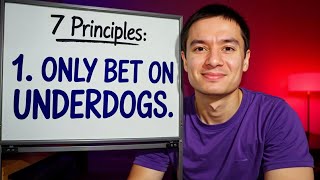

Stop Losing: Inversion Thinking in Betting
42sReveals a counterintuitive strategy from Warren Buffett's partner that flips losing habits into profit, appealing to anyone tired of losing money.
▶ Play Clip"The title promises wealth, but the video delivers a solid, realistic framework for disciplined betting."
This video outlines seven principles for profitable sports betting, emphasizing a systematic, analytical approach over emotional gambling. The speaker shares personal experiences and strategies used by professional bettors to consistently extract value from sportsbooks.
The speaker claims to have developed a system used by sharp bettors to consistently profit, moving from a losing gambler to a disciplined bettor.
Instead of asking how to win, ask how to guarantee losing. Eliminate losing behaviors like parlays, chasing losses, and following fake gurus.
Emotional attachment to teams leads to poor bets. Focus on positive expected value (EV) rather than who you think will win.
Use the Kelly Criterion or a simplified 1-2% per bet to size wagers. Avoid going all-in, as even strong favorites can lose.
Track all bets to identify what works. The speaker offers a free bet tracker to help spot patterns and edges.
Public narratives (e.g., 'must-win game') are already priced into the odds. Betting against the narrative can be profitable.
Focus on positive EV bets. Example: a +300 underdog with true odds of +200 yields a 3% edge, leading to profit over many bets.
Consistent small edges compound over time. Starting with $5,000 and 1% bet sizing with a 3% edge can grow to over $1 million in 10 years.
Professional bettors build models and systems. Start with one edge, test it over 50-100 bets, refine, and scale slowly.
By applying these seven principles—inversion thinking, betting on numbers, bankroll management, ignoring narratives, focusing on EV, long-term compounding, and building systems—anyone can transform from a casual gambler into a profitable bettor.
What is inversion thinking in sports betting?
Instead of asking how to win, ask how to guarantee losing, then eliminate those behaviors.
00:42
What is the Kelly Criterion used for?
It helps size bets based on the edge you have; the bigger the edge, the bigger the bet.
03:31
Why should you ignore public narratives in betting?
Because narratives are already priced into the odds by sportsbooks.
04:36
What is a positive expected value (EV) bet?
A bet where the odds offered are better than the true probability of the outcome.
05:47
How much should you bet per wager according to the speaker?
1 to 2% of your bankroll per bet.
03:55
What is the compound effect of small edges over time?
Starting with $5,000 and 1% bet sizing with a 3% edge can grow to over $1 million in 10 years.
07:13
What is the first step to building a betting system?
Pick one edge you trust, test it over 50-100 bets, and check if it's profitable.
08:24
Inversion Thinking
Introduces a counterintuitive mental model from Charlie Munger applied to betting.
00:42Bet on Numbers, Not Teams
Highlights the common mistake of emotional betting and the importance of EV.
02:19Bankroll Management
Emphasizes that even a winning edge can lead to ruin without proper bet sizing.
03:03Thinking in Expected Value
Explains the mathematical foundation of profitable betting with a concrete example.
05:32Build Systems, Not Picks
Distinguishes between casual gamblers and professionals who use data-driven systems.
07:53[00:00] once I learned to think like them, to flip the script and exploit the same math they use to bleed casuals dry, I started pulling consistent profit. I wasn't chasing six leg heaters like a parlay princess. And I definitely wasn't
[00:16] buying picks from some Tik Tok kid named Lock Daddy69. I built a system, the same one sharp betterers use to steal money from the sports books every single day. Now, this strategy works, but if you do this right, you become dangerous. So
[00:30] dangerous that sports books will limit you and try to ban you. So today, I'm breaking down the seven principles that took me from just another degenerate to someone who stopped donating his rent money to fund the book's private jet
[00:42] fuel. But let's talk about principle one because this one's huge. Most people try to win their way to profit. But the smartest betters start by learning how to lose on purpose. Charlie Mer, Warren Buffett's right-hand man, once said,
[00:55] "All I want to know is where I'm going to die, so I never go there." It's like designing an airplane by asking, "What would make this crash instantly? You'd skip the wings, overload the engines, maybe let a toddler do the wiring."
[01:08] Obviously, you'd never build that plane. But that list is your blueprint for what to never do. And the same idea applies to sports betting. You don't start by asking, "How do I win?" You ask, "How would I guarantee I lose money over the
[01:22] long run?" This principle is known as inversion thinking, and it's what all the sharks do. They eliminate losing behaviors first. They don't do parlays. They don't chase losses or wager half their bankroll. They don't join crappy
[01:35] Discord servers and copy pics from fake gurus with anime profile pictures. And once they cut out all the losing habits, what's left are actions that will seriously, you can't go at this alone. Being around disciplined betters who
[01:51] to the next level. So, I'm building a private community where that's the norm. We don't talk about picks or any of that crap. It's all about following proven systems that work long-term. If that sounds like your kind of room, I'll drop
[02:06] principle 2 changes the game. Here's why. This is where most go completely wrong. They're betting on teams, not numbers, and that's killing their edge.
[02:19] I was at a UFC watch party when Usman fought Leon Edwards. One of my boys was glazing Usman all day, talking like it was his actual boyfriend. No way he loses. He's untouchable. Lock of the year. He dumped $1,000 on Usman atus400.
[02:34] All in on the favorite. And for 24 minutes, he looked like a genius. Usman was dominating. But then in the last few seconds of the fight, head kick. Lights out. My friend didn't talk for an hour. Every bet is either positive EV or
[02:48] they'll win and ignoring the price, you will lose money in the long term. But moving on to principle three, and it might be the most important one yet. You can have a winning edge and still go broke unless you know how to size your
[03:03] bets with surgical precision. I remember this one game Juventus were playing some bottom table Syria A team. They were like minus 105, which looked like insane degenerate. Literally, my entire bankroll. But what I didn't know was
[03:19] that Juventus already won the league. So, they rolled out their bench and half the squad looked hung over. The game ended in a 1-1 draw and I was pissed. This is why bankroll management is required if you want to make a living
[03:31] from sports betting. And a lot of advanced bers use the Kelly criterion to figure out their unit sizing. The Kelly criterion basically helps you size your bets based on how much edge you have. The bigger your edge, the bigger the
[03:43] bet. Now, full Kelly tells you the theoretical max you should bet based on your edge, but it's aggressive and a bit risky. That's why most sharp bers use half or quarter Kelly instead. But quarter Kelly usually lands somewhere in
[03:55] the 1 to 2% range. So, I personally just stick to 1 to 2% per bet rather than busting out the calculator like a nerd every time I see a line I like. But speaking of being a nerd, you actually do need to track your bets. I know
[04:09] working and what's leaking. It's like trying to lose weight without ever stepping on a scale. That's why I built a free bet tracker. It tracks every unit, helps you spot patterns, and shows where your edge is actually coming from.
[04:24] I'll drop a link in the description if you want to grab it. Now, when you get ESPN, it's already priced into the line. This is where sharp betterers stop
[04:36] playing checkers. I still remember this game on the final day of the 2016 Premier League season. Newcastle versus Spurs. Newcastle were already relegated. Newcastle have nothing to play for. They won't show up. Meanwhile, Spurs were
[04:52] trying to lock in second place and people were calling it free money. Like, how could they lose to a team that's already down? But I'm a Newcastle fan. So, when we smashed them 5 to1, even after going down to 10 men, I was losing
[05:05] it. My friend who supports Spurs, he wasn't laughing. But that's the problem with narratives. They sound good, but they don't hold value. Must-win game is not real analysis. It's just noise. And the books are already a step ahead
[05:17] because that story you're betting on is already priced in. So, here's a pro tip. doing. And betting against the narrative is one of those things. Which takes us to principle five, and this is the difference between casual betting and
[05:32] serious profit. Thinking in yes or no outcomes is like using a coin flip to build a business. This step rewires how real betters see risk. So, let me show you how to actually make a profit. Let's say a sports book offers plus 300 odds
[05:47] on a team, but the real odds should be closer to plus 200. With plus 300 odds, that gives you a 25% chance to win. And plus 200 implies a 33% chance. So, if you take that bet at plus 300, you're getting paid more than you should be.
[06:02] That's a positive expected value bet. Now, yeah, you'll lose most of the time. It's an underdog. But let's say you bet $100 on that line 10 times. Team wins three out of 10. You make $900, lose $700, and make a net profit of $200. And
[06:17] this is exactly why DraftKings tries to limit your account because now you're no longer donating money to fund their beachfront vacation home. And if enough building a private community. It's an inner circle full of people who take
[06:32] this seriously, who track, share edges, and treat it like a business. So, if people who actually win. I'll drop the link in the description if you want in. But principle six is where things start to click. If you're judging results by
[06:47] weekends instead of seasons, you're thinking like a gambler, not an investor. It's kind of like going to the gym. You don't show up once, hit a few sets, and walk out with abs. But if you train consistently, eat right, and stay
[06:59] disciplined, that slow progress compounds. And the same principle applies here. You're not looking to hit a six-legg heater or win the lottery. You're stacking 3 to 5% positive EV bets every single day. Yes, it's super
[07:13] boring, but over time, it starts to compound. Let's say you start with a $5,000 bank roll. You stick to 1% bet sizing, take five good bets a day, and only hit bets with a 3% edge. It doesn't feel like much at first, and after a
[07:28] year, you're only up $3,000. But if an investment gave you 60% ROI, you'd be kicks in hard. By year six, you're sitting at $10,000 a month. And by year
[07:41] 10, you've cracked a million. Small, positive, expected value bets stacked over time will make you crazy rich. But if principle 7 doesn't make you rethink everything, nothing will. Most berstors are out here chasing picks, scrolling
[07:53] Twitter, waiting for some guy to say, "Max unit heater incoming." But the sharpest bers, they're not chasing anything. They're building systems. They build models, they find angles, they run data, they automate, and once
[08:09] the edge is real, they scale it. That's how probers operate. It's not emotional. full-on models right away, but here's where you start. Pick one edge you trust. Maybe it's line movement or maybe it's price discrepancies. And let's say
[08:24] you notice that in the Premier League certain teams consistently generate high game. That's your angle. You start betting those games. You track every result and after 50 or 100 bets, you check the results. If it does, cool. Now
[08:41] you've got a system. From there, you refine it, add filters, automate parts, scale slowly. That's how you go from guessing to printing money. Now, building edge is one thing, but knowing how to actually scale it is what
[08:54] separates real bettors from the rest. So, watch this video next to see how I'd turn $100 into $1,000 using nothing but positive EV bets. You'll see the exact structure, how I'd size it, and what I'd avoid completely.
⚡ Saved you 0h 09m reading this? Transcribe any YouTube video for free — no signup needed.