
Flip the Odds: Beat Blackjack!
45sChallenges the common belief that the house always wins, creating intrigue and a desire to learn the secret.
▶ Play Clip"Title accurately reflects the comprehensive guide provided; it's a thorough tutorial on advantage blackjack play."
This video provides a comprehensive guide to advantage blackjack play, focusing on the Hi-Lo card counting system. The creator, Quatro, explains how to turn the odds in the player's favor through proper strategy, counting, and bankroll management.
Blackjack has a house edge, but with proper strategy and card counting, players can gain a mathematical advantage over the long term.
Card counting is legal; it does not involve collusion or external devices. It is a skill-based advantage play method.
Blackjack is played against the dealer using 52-card decks. The goal is to get as close to 21 without busting. Face cards are worth 10, aces are 1 or 11.
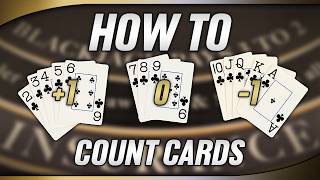
The Hi-Lo count system assigns values to cards: low cards (2-6) are +1, high cards (10-A) are -1, neutral cards (7-9) are 0. The running count tracks the ratio of high to low cards remaining.
Perfect basic strategy reduces the house edge to 0.5%. It is essential to memorize the strategy chart line by line before learning to count.
Running count is updated for each card: +1 for 2-6, 0 for 7-9, -1 for 10-A. Practice counting through a deck in under 35 seconds.
True count = running count / number of decks remaining. Each true count increase adds about 0.5% to player advantage. Deck estimation is crucial.
Deviations are playing decisions that change based on true count. The Illustrious 18 are core deviations. Learning them adds about 30% to a counter's edge.
Bankroll should be at least 100 times max bet. Risk of ruin should be low. Bet spread (e.g., 1-10 or 1-20) is used to capitalize on positive counts.
N0 is the number of rounds needed for expected profit to equal one standard deviation. Lower N0 means less volatility. Aim for N0 under 30,000 rounds.
With dedication, anyone can learn card counting and gain an edge in blackjack. Proper bankroll management and practice are essential for long-term success.
What is the Hi-Lo count system?
A card counting system where low cards (2-6) are +1, high cards (10-A) are -1, and neutral cards (7-9) are 0.
09:29
How do you calculate true count?
Divide the running count by the number of decks remaining to be dealt.
13:14
What is the house edge with perfect basic strategy?
About 0.5% over the player.
06:50
What are the Illustrious 18?
A set of 18 core deviations from basic strategy based on true count.
16:41
What is N0?
The number of rounds needed for expected profit to equal one standard deviation of variance.
30:34
What is the recommended bankroll size relative to max bet?
At least 100 times your max bet.
25:57
What is the effect of deck penetration on EV?
Better penetration (more cards dealt before shuffle) increases EV because high true counts occur more often.
22:29
What is the difference between H17 and S17 games?
H17 means dealer hits on soft 17; S17 means dealer stands on soft 17.
03:23
What is the payout for a blackjack?
Traditionally 3 to 2 odds.
04:34
What is the recommended speed for counting through a deck?
Under 35 seconds.
12:19
Card Counting is Legal
Clarifies a common misconception that card counting is illegal.
00:43Effect of Removal
Explains the mathematical basis for why card counting works.
05:16True Count Conversion
Key technique to standardize advantage across different deck numbers.
13:14Deviations Add 30% Edge
Highlights the importance of learning deviations beyond basic strategy.
16:41Understanding Variance
Emphasizes the psychological and financial challenge of short-term swings.
30:34[00:01] Blackjack, you might win that day. You might even win a couple days in a row. You'll have some losing days, too, but over time it probably won't feel like you lose too much. However, if you zoom out, after a while, the long-term data
[00:15] doesn't lie. The casino has a house edge in Blackjack, and overall, you are a What if I told you there was a way to flip this around, and with proper playing strategy, you can actually turn the odds in your favor? Mathematically,
[00:29] over the long term, you will win at Blackjack. This form of gambling is called advantage play, or card counting specifically. The form of card counting called the Hi-Lo count system. Now, it does take some practice and
[00:43] certain any one of you could become proficient. Don't worry about the stories of people getting beat up in casino backrooms. We don't live in the movies. Card counting is completely legal, as you're not colluding or using
[00:56] any external devices to gain the edge. My name is Quatro, and I make POV videos documenting my card counting career. I also am the founder of AP Toolbox, which is an online software suite dedicated to all things advantage play, with a focus
[01:11] on Blackjack. I'll be highlighting some of the training features offered on AP Toolbox throughout this video, so make sure you guys check it out. This video is an updated version of one I made a long time ago. You OGs will remember.
[01:24] The information will be refined, and some of the training resources are going This video is going to be split up into seven sections. They will be What is Blackjack? Why is it beatable? Basic strategy, running count, deck estimation
[01:39] and calculating true count, deviations, and finally, bankroll management and EV Timestamps for each section will be in the description, so if you want to skip ahead. So, firstly, what is Blackjack? Being
[01:55] the most popular card game in the world, most of you probably already know what Blackjack is, but I'll touch on it quickly just to be sure. Skip ahead to how it's played. Blackjack is a card game where you play
[02:08] against the dealer. It uses 52-card decks. Between one and game offered. Cards are dealt out usually from a shoe, out, they'll be shuffled and the game restarted. Some games use a continuous
[02:24] shuffler, which looks like this. The cards are continuously shuffled, hence the name, and these games are not beatable by card counting. Every hand or round, the player is dealt two visible cards and the dealer dealt
[02:37] The object of the game is to get your hand total as close to 21 as possible without going over. The player will always play out their hand first. If you exceed 21, you bust out and lose the hand. If you settle for less than 21
[02:54] draws more than you, but not more than 21, you lose. Each card's number value is equal to the card number itself. Face cards being jack, queen, and king are worth 10. Aces are worth one or 11 according to
[03:10] the player's choice. A hand that values an ace at 11 is known as a soft total. The dealer must always draw to 17. If the dealer has a total of 17, including an ace valued at 11, known as
[03:23] a soft 17, some games require the dealer to stand, while other games require another draw. These games are categorized as hit 17 or stand 17 games respectively, and this rule is often written right on the table
[03:37] felt. You'll see them abbreviated as H17 or S17. There's a few playing decisions in Blackjack. You can hit, which means you will draw another card. You can your hand and will not take another card.
[03:52] You can split if you are dealt two cards of the same number value, meaning you separate them to make two hands requiring another bet. You can double your hand, meaning you double your bet, but receive only one more card and
[04:05] finish the hand. Doubles can only be done on the first two cards of a hand. Some games offer surrender, where you forfeit half your bet for that hand and retire. The dealer will never double, split, or surrender. A player total of
[04:19] 21 on the first two cards is a blackjack and the player wins immediately unless the dealer also has one, in which case the hand ties. In the case of a tie, also known as a push, the player's bet is simply returned. A blackjack beats
[04:34] any hand that is not a blackjack, including one with a value of 21. Wins are paid out at even money, except for player blackjacks, which are traditionally paid out at three to two odds. This means if you bet $10, you're
[04:48] Some games pay blackjacks at less than three to two, and those games are generally not beatable by card counting. Most casinos offer an insurance side has an ace before they check for blackjack. Insurance bet can be up to
[05:04] half of your original hand bet and pays two to one. So, if the dealer has blackjack, insurance will keep you from losing any money on that hand. Now that you understand the basics of blackjack, let's talk about why it's
[05:16] I'll be describing the Hi-Lo count system in this video. It's a very effective system and it is what the majority of professional players use. Once a card has been dealt, it is removed from play and placed into the
[05:29] discard tray until the next shuffle. We will not see that card again. This has a measurable effect on the game's odds due to a concept called effect of removal. Low-value cards, which are anything from two to six, do
[05:42] not benefit the player. However, high cards like tens and aces do benefit the player. They allow more opportunities for high hand totals, successful doubling, and blackjacks being dealt. A card counter will keep track of high
[05:56] of the shoe and make betting decisions based on the composition of the cards remaining to be dealt. If many high cards have been dealt out already, the count will be negative and the player will not have an advantage. Therefore,
[06:10] the counter would keep their bet low. Opposite to that, if a disproportionate amount of low cards have come out already, the player is now at an advantage. At this time, the card counter would start to raise their bets,
[06:22] going higher as the count increases, gaining them an edge over the house. successful counter can raise their bets at times when the game is in their favor. Of course, they won't win every hand when they raise their bet, as the
[06:36] advantage is small, but over many hands, it will be apparent and you can beat the casino at their own game. Before you can learn to count, you must first know perfect basic strategy. Basic strategy is a set list of moves
[06:50] for each and every possible hand combination in blackjack. You will never have to guess what the next move is. You simply follow the decisions. I'm not going to break it down and explain every single move, but
[07:03] you can see here that this chart shows the proper playing decision for each hand. I know this chart looks daunting if you're a beginner, but trust me, it's easier to grasp than you think. The playing decisions on this chart are the
[07:15] proper way to play blackjack, even for a casual player. Playing perfect basic strategy reduces the house edge to a mere 0.5% over the player and is the first step to being an advantage player.
[07:28] By far, the easiest way to learn basic strategy is to memorize this chart line by line. When I say line by line, what I mean is to break it down into phrases. Memorize one line at a time and once you've committed it to memory, move on
[07:41] to the next. Always repeat every preceding line as you add another one, and eventually you'll be able to recite basic strategy with ease. I'm including the hit 17 basic strategy chart here from AP Toolbox, along with
[07:55] Throughout your day, just continuously recite these lines every 15 to 20 weeks to learn this entire chart. Progress may feel slow, but if you stay committed, I promise it's easier than
[08:09] Basic strategy should be automatic, and you shouldn't need to think much about it when you're playing. You'll need the mental energy for other things when you're counting. This step is crucial to master, so make sure you
[08:21] get it down before you try to progress further. Be aware that there are slight changes in basic strategy depending on if the dealer has to hit a soft 17 or not. I recommend learning both, as the changes are very small and you'll likely
[08:34] end up encountering both games. The difference for a stand 17 game is that soft 19 doesn't double versus six, 11 doesn't double versus ace, and 17 doesn't surrender versus ace. For anyone playing in Europe with no hole card,
[08:50] strategy, so just be aware of the game you're playing and learn the proper chart. This chart and several other basic strategy variations are all available on AP Toolbox. Once you start getting more familiar with basic
[09:03] strategy, you can test your knowledge with the basic strategy drill on AP Toolbox. Once you specify your rules, you can play endless hands with detailed analytics highlighting the areas you need to improve on.
[09:16] This is a surefire way to fast-track your training, and I can't recommend it Once you've mastered basic strategy, you can start learning the count. As I said earlier, I use the Hi-Lo count system. It's one of the easiest to learn and is
[09:29] the most popular method. It's been around for ages, and the community surrounding it is large, which is also a huge benefit. There are some newer count systems that are worth a look, specifically CAC 2 for shoe games, but
[09:42] for this video, I will be focusing on Hi-Lo. In Hi-Lo, a point value is assigned to low cards, neutral cards, and high cards. The running count is a tally in your head that you update for every single card that is dealt out of
[09:55] every single card that is dealt out of the shoe. Low cards are 2, 3, 4, 5, and 6. Anytime one of these cards is dealt, you will add one to the running count in your head. 7, 8, and 9 are neutral cards. These can be ignored when
[10:08] counting as they have a zero value assigned to them. 10s, face cards, and aces are all high cards. Anytime you see one of these ones come out, you will subtract one from the running count in your head. For example, if you were
[10:22] dealt two sixes versus a dealer's five, that's three low cards. If we add one for each of those, the running count would be positive three. Basic strategy says to split, so let's do that. Now, we are dealt two face cards on both our
[10:36] sixes, which are each high cards with a value of minus one. If we subtract one for each of these cards, it would bring the running count down to a positive one. Basic strategy says to stand both hands, so we do that. The dealer flips a
[10:50] seven, which is neutral and would be ignored, and a 10, which is another high card, bringing the count down for a running total of zero. As a counter, you will constantly be repeating this running count in your head and updating
[11:03] it as cards come out. When counting cards, it is best to wait until both players' cards have been dealt before updating the total. Oftentimes, the hand will cancel itself out if it's a high card and a low card, and overall, it's
[11:15] about half the mental effort to wait until the second card has been dealt for all players at the table. I always count clockwise, starting with the number one spot at the table on the far right, and finishing at the dealer. Make sure you
[11:28] follow the same order for counting every single time. Don't count spot three, then spot five, then spot one. Always go clockwise and in the direction of play so that you don't miss or double count a hand. This is one of the more difficult
[11:41] aspects of counting cards. You need to be focused and alert while also not making it obvious what you're doing. A successful counter needs to engage in conversation with people around them and not be hyper-focused on the cards coming
[11:54] out. While you're learning, I highly recommend going to a casino and watching a game of blackjack being played with a full table. Try to keep the count with all the distractions of the casino going on around you. This is a great way to
[12:07] practice discreetly and get a feel for the casino environment. A good way to practice your running count at home is to count through a deck of cards while watching a show or talking with someone. A deck has an equal number of high and
[12:19] low cards, so you should always end up back at zero. Once you can count the full deck down in less than 35 seconds, you're quick enough for 99% of tables. When I was practicing back in my early days, I'd always try to have as many
[12:33] distractions around me as possible while I trained. You never know what you'll run into at the casino and you need to train to be focused on the count even if you have to pay attention to multiple things at once. AP Toolbox has a great
[12:45] counting drill that focuses solely on keeping the running count. The hands are need to do is keep track of that running count. Keep in mind that the higher automatic dealing speeds are faster than almost any casino you'd ever experience,
[13:00] but still it's better to over-prepare than under-prepare. Now I will get into the true count and deck estimation. The running count by itself is not particularly useful. It needs to be converted to the true count.
[13:14] True count is the true measure of player advantage and for every digit of true count increase, player advantage rises by about 0.5%. To calculate the true count, you simply divide the running count by the number
[13:26] of decks remaining to be dealt. You can tell how many decks are remaining to be dealt by looking at the discard tray. Every Blackjack table dealt out of a shoe will have this tray, and once cards have been played, they're placed here
[13:39] until the end of the game. Firstly, you will need to know the total amount of decks in play, and if you're unsure, you can always ask the dealer. Six and eight deck games are the most popular. You'll need to eyeball the discard tray and
[13:53] determine how many decks are there. If you're playing a game with six decks total and four of them have been dealt out with two remaining to go, your remaining deck divisor will be two. If the running count is 12, you would
[14:05] divide 12 by two, and your true count would be six. If you're playing the same six deck game and only two decks have been dealt out, that means there are four remaining. Your divisor would be four. If the running count was 10, 10 /
[14:20] 4 is 2.5, and your true count would be two. Notice how I drop the decimal. If half of a deck has been dealt, your divisor would be 1.5 because there's 1.5
[14:33] decks remaining to come out. If your running count is six, 6 / 1.5 is four, and your true count would be four. When you're just starting out, I recommend truncating your true count calculations. This means we will drop
[14:47] calculations. This means we will drop the decimal. 2.5 becomes two, 3.7 becomes three, etc. This keeps things simple and conservative, ensuring that you're never over betting. When you're starting out learning deck estimation,
[15:00] work in one deck increments. If more than one deck has been dealt, but you're sure it's not at two yet, just keep the number of decks dealt at one. half deck increments and even quarter deck for single and double deck games.
[15:15] your deck estimation as you make all your count base playing decisions off of it. If you're having trouble with your deck estimation, try to remember that a deck of cards is roughly 15 mm tall or 5/8 of an inch. Try to fit these
[15:30] discard tray. The true count conversion allows any Blackjack game dealt out of a shoe to be beatable. A true count of any value offers a very similar player advantage whether it's in a single deck game or an
[15:44] eight deck game or anything in between. However, a good rule of thumb is the less decks in play the better. This step of the learning process can be difficult for some. Deck estimation can be tricky and it will require some practice. It
[15:58] can help to buy your own discard tray and mark it at one deck increments, then just deal to yourself practicing deck estimation as you go and confirming your answers with your marks. As per usual, AP Toolbox has a solution for practicing
[16:12] this. It combines deck estimation and the true count conversion into one drill and is a great way to get familiar with this aspect of card counting. This is starting out and you guys trying to learn will benefit greatly from using
[16:26] it. Just remember that for true count conversion, we are always dividing by the number of decks remaining to be dealt, not the number of decks that have With all that said, we will get into the count-based deviations. Earlier in this
[16:41] video, we talked about basic strategy. It is the proper way to play Blackjack no matter what hand is dealt. However, once you are able to determine the true count, there is some playing decisions that will change. These are called
[16:54] deviations and they are changes to basic strategy that take place when the true count is at certain levels, also known as true count indexes. Some popular ones are splitting 10s, standing 16 versus 10, and taking insurance. Historically,
[17:09] there are 18 core deviations known as the Illustrious 18. However, the creator of the Illustrious 18 released a book not long ago that gets a bit deeper into what each deviation is actually worth taking into account both EV and
[17:23] variants. Inside, you'll find over 300 pages of tables ranking deviation values taking into account decks in play, deck penetration, spread size, wonging out, and more. It truly is the only book
[17:37] high-low deviations, so make sure you guys check it out if that interests you. the main resource to create my deviation charts, which I'm about to show you.
[17:49] Proper deviations account for about 30% of a card counter's edge. Generally speaking, a card counter's edge will be right around 2% overall. card counter can expect to have around a 1.4% edge. Keep in mind that the 2%
[18:05] overall edge I quoted is just an average, and some games will be higher or lower depending on the conditions even with perfect play. For simplicity's sake, we're going to say 2%. For this video and my site, I
[18:18] settled on three tiers of deviation sets that you guys can learn. Beginner, intermediate, and pro. Beginner deviations extract 70% of the EV to be gained from deviations, resulting in a roughly 1.82%
[18:32] total edge for the player. Intermediate deviations extract 82% of the EV to be gained from deviations, resulting in roughly 1.89% total edge for the player. And finally, the pro deviations extract
[18:46] 92% of the EV to be gained from deviations, resulting in a roughly 1.95% edge for the player. The last remaining 0.05% to be squeezed out from learning every possible deviation is a task only some people will deem worth it. You have
[19:02] at the table trying to remember some obscure deviation and how that slows down your play. The EV lost from slowing the game down very quickly overpowers any EV to be gained from knowing these additional deviations. Since I'm
[19:17] throwing the EV term around a bunch, let me explain it quickly. EV stands for expected value, and simply put, it is the average amount of money you expect to win or lose over the long run based on the game conditions and bet sizes. If
[19:31] EV is positive, you have the edge. If it's negative, the casino does. For example, if you have a 2% edge and you're betting a $100 per hand, your you're betting a $100 per hand, your expected return, aka EV, on each hand is
[19:45] $2 over the long run. Even if you learn just the beginner deviation set, your edge over the casino is still solid. The process for learning deviations is the exact same as learning basic strategy. Here, I'm including the hit 17 beginner
[19:59] deviations, as well as the phrases, to give you guys a training resource to get started with. To read and understand these charts, simply look for the cells For example, let's look at these ones. 15 and 16 versus a 10. At true four or
[20:15] higher, the 15 will stand against 10. At any positive running count, a 16 will Anytime you see a deviation that is either zero plus or zero minus, it means positive or negative running count,
[20:30] respectively. If the running count is exactly zero and you get dealt a hand that has one of these zero plus or zero minus indexes, follow the basic strategy for that hand. If you're confused on what the deviation actually is, just
[20:43] look at the color of the cell. These cells are this yellowish-orange color, which, as we can see, means they will stand. Compare this to the normal basic strategy chart where the cell color signifies to hit. This was the
[20:56] hardest part of the learning journey for me and took the longest to do, but again, with consistency and dedication, anyone can do it. Keep in mind, I learned the 30-ish deviations of the pro set right off the bat, which is
[21:09] beginner deviation set. Be aware that the deviations for a stand 17 game and hit 17 game are slightly different. Once again, I'd recommend learning both sets.
[21:21] Of course, every deviation chart that you could possibly want is included in AP toolbox as well as the phrases, ensuring you'll be a master of deviations in no time. Again, if you want to learn more about deviations than
[21:33] you could possibly ever need to know, check out the book I mentioned earlier. information. On AP toolbox, we also have a deviation training drill, which deals out specific hands intended to test your deviation
[21:47] knowledge depending on the set you've selected. It's a great way to get reps shoe to spit out the specific hand and count combos that deviations apply on. Once you've learned your deviations, you now know how to play perfect advantage
[22:02] blackjack. But, before you go sprinting to the tables, there is one more step to being successful in your endeavor, and that is bankroll management. I'm going to explain a bit more about EV here in this section because it goes
[22:15] hand-in-hand with bankroll management. The main conditions that affect EV are the game rules, number of decks in play, how many decks are dealt before a shuffle, speed of the game, and bet spread. The basic game rules that affect
[22:29] EV are as follows. Whether the game is hit 17 or stand 17, if re-split is allowed, if re-split of aces is allowed, if double after split is allowed, if double on any first two cards is allowed, and if surrender is allowed. EV
[22:45] will generally decrease as the number of decks in play increase, simply because highly positive counts will occur less. The number of cards dealt before EV. The dealer will insert a cut card into
[22:59] the shoe, and once this card is reached during gameplay, the cards will be reshuffled. This is called deck penetration. Generally, you want more than 65% deck penetration on a six or eight deck game, and at bare minimum 50%
[23:14] That means you would see 50% of the cards before shuffle on double deck, and at least 65% of the cards before a shuffle on a six or eight deck game. These are the bare minimums, and I wouldn't recommend playing worse,
[23:28] especially for double deck. In the rare occasion that you're playing a single deck game in this day and age, you want to see four rounds being dealt out to see four rounds being dealt out before shuffle. 65% penetration on a six
[23:40] deck game would mean that four of the six decks are dealt before shuffle. cards than that are being dealt before the shuffle, and you'd want to look for a new table. This is because high true counts are much less likely as the deck
[23:54] penetration worsens, and you're spending a lot more time on average playing in negative counts, aka at a disadvantage. Penetration is usually better than that at most places. One deck cut off for six or eight deck is considered great, and
[24:08] it could get even better than that at times. For double deck, if they're cutting off 0.75 of a deck or less, it's great. The game speed, aka the rounds per hour, also plays a large part in the expected value. You want your rounds per
[24:23] hour to be as high as possible because it equals more opportunities to place positive EV bets within that hour, and quite literally speeds up the long run. A quick solo player can do at least 190 rounds per hour in most cases. As soon
[24:37] as there is two other players at the table, rounds per hour drops to roughly 90, meaning you're getting half as many rounds in as you would playing solo. This cuts your EV in half. Playing with other players is fine and
[24:50] is unavoidable at times, but you should always try to play with as few as possible. A full table can be as low as 40 rounds per hour. Keep in mind that it's kind of a catch-22 situation. If you're playing solo, there's no one else
[25:03] for surveillance to look at. This can cause them to focus their attention on you and potentially back you off more quickly. Sometimes with another player or two, the EV you generate in the end actually turns out to be higher simply
[25:16] because you were able to play much longer undetected. Lastly, bet spread. Your bet spread is a pre-calculated list of bets that you'll be betting for each in true count index. As the true count rises, player advantage increases and so
[25:31] do the bets. A proper bet spread is crucial to being a successful card counter. You'll need to take into account your total bankroll and generate a bet spread that does not put you at too high of a risk of losing said
[25:43] bankroll. Generally, you want to play with quite a low risk of ruin depending on bankroll size. Risk of ruin, by definition, is the percent chance of you busting and losing your entire bankroll before you can double it. It is
[25:57] absolutely possible to lose many, many large bets in a row even if the count is in your favor. As I've said before, a card counter's advantage is small, only hundreds of hours to be guaranteed a
[26:11] profits will trend close to your expected value, but that's not always the case. A large bankroll is necessary. Without using any software, a general should be at least 100 times your max bet. To properly calculate EV and risk
[26:28] of ruin based on the game conditions and your bet spread, you'll need some sort of betting software. There's a few options for this. CV CX is a very powerful Windows-based software that can sim any conditions you could possibly
[26:40] want. The only drawback is that the interface is a bit dated and you have to have your computer with you if you want to run a sim. While I highly recommend getting your hands on CV CX regardless of this, I'll take this opportunity to
[26:53] highlight the EV calculator on AP toolbox. It has everything you need to get started and is designed to be as user-friendly as possible. You can calculate the EV for any game conditions on any device you use, save templates,
[27:06] and even simulate long-term variance based on whatever conditions you'd like. In this EV calculator, you'd enter your total bankroll, all the game conditions, and your bet spread. Then the software will spit out some numbers for you.
[27:19] The main ones to look at are the hourly rate and the risk of ruin. If your bankroll is $5,000 and you can easily get your hands on another $5,000 if you were to lose it all, a higher risk of ruin can be okay, say 10 to 20%. Even
[27:33] higher in some cases. But, if you're playing with a high five or six-figure bankroll, you'll want to play with a sub 1% risk of ruin because you cannot take the chance to lose that much money. If the risk of ruin is acceptable to you,
[27:47] you can go ahead with playing that bet spread at a game of those conditions. You can lower your risk of ruin even further by not playing whenever the true count is negative, also known as wonging out, but this is sometimes unavoidable
[28:00] if you're the only person at the table. When you're generating your bet spread, it's common to use between a 1 to 10 or 1 to 20 spread. That means your maximum bet would be 10 times what your minimum is on a 1 to 10 spread, and max bet
[28:14] would be 20 times what your minimum is on a 1 to 20 spread. You can do a larger spread, like 1 to 50, but keep in mind that this will likely result in a quicker back-off. This is one of the reasons I usually don't last long in my
[28:27] videos. If my minimum bet is $25, and max bet is $2,500, that is a 1 to 100 spread, and the surveillance team would have to be blind to not notice such a blatant increase. A 1 to 20 spread on a $25 unit would look
[28:43] The bet spread will increase gradually as the count rises, capping out at a true seven when player advantage is extremely high. Notice how I switch to two hands at true two. I recommend playing two hands at true two and above
[28:57] because it lowers the risk of ruin and variance compared to if you were betting a single hand of the same dollar amount at those counts. Some people choose to reach max bets even sooner, say at a true five. The
[29:10] reason that we don't continue betting higher in counts above a true seven is because they happen so infrequently and the variance can be brutal. Variance is the natural short-term swing in results around your expected value caused by the
[29:23] randomness of the game even when you have a mathematical edge. As a card counter, you might earn say $100 an hour in EV, but variance means your actual results can be far above or below that in the short term. This means that big
[29:38] wins and big losses are inevitable despite playing perfectly. Higher volatility games, bigger bet spreads, and shorter play sessions all increase variance, which is why bankroll size and risk of ruin matter. Over the long run,
[29:52] your edge should be apparent, but variance determines how wild the ride is before the math catches up. A good way to determine how volatile a set of game conditions is is to take a look at the N0 result you get when you calculate
[30:06] AP Toolbox displays this in a number of hours, but N0 is truly a measure of rounds played. In simple terms, the hours to reach N0 is how long you need to play under these conditions for your expected profit to
[30:20] equal one standard deviation of variance. Practically speaking, at N0, you're only 84% likely to be ahead, so it's not the finish line, but it tells you roughly how long the long run is for your game.
[30:34] The true definition is on screen, and I highly recommend doing your own deeper The higher the bankroll, the more volatility most people can stomach, but for anyone new watching this, I'd recommend that you try to find a game
[30:48] with an N0 of less than 30,000 rounds. To see this, simply enter your game conditions and then drop the rounds per hour to one. This will update the N0 result in the top right to display how many rounds it takes to reach it. To
[31:02] limit volatility, as I mentioned, you want to see this number be less than 30,000. You can play higher and you're probably going to have to at times to be able to play at all, but be aware that it's increasingly volatile.
[31:15] on the standard deviation number that the EV calculator gives you as well. This number signifies how big of a swing is standard playing with these conditions and bet sizes over 1 hour. So, if I'm playing a game of these
[31:28] conditions, I can expect to experience a dollar swing of this amount every hour. will vary and this is just an average over the long run. I can't stress this
[31:40] enough that being a successful advantage player is not all about knowing how to play and count. You need to have a plan with your bankroll and play a bet spread that is not too risky. Long losing or break-even streaks are very possible and
[31:54] quickly if you aren't managing your bankroll properly. If you have a perfect game, you will win in the long term, but the short term can be a roller coaster. want to track all your results. There's ways to do this for free, like cooking
[32:10] up some fire Google spreadsheets. However, a more simple option is to take advantage of AP Toolboxes' extensive result tracking system. No matter how many games you're playing, where you're playing them, or who you're playing
[32:23] with, AP Toolbox has a fully modular and customizable results tracking system, ensuring that all your session data is accounted for properly. I'm going to wrap it up there. This is basically all the info anyone needs to get started
[32:36] with card counting and advantage Blackjack play and is quite the upgrade from the first video I made on this. It can be intimidating to get started, but virtually anyone can learn if they dedicate some time and effort to it.
[32:48] I've referenced AP Toolbox several times throughout this video and I highly you're interested in learning this skill. I've worked very hard to bring the best training and playing resources possible to you guys at an affordable
[33:00] price. I hope you found this video informative. Don't be afraid to leave feedback or ask questions in the comments. I'll do my best to answer everything. I'll see you all in the next POV video.
[33:12] I'll see you all in the next POV video. Peace.
⚡ Saved you 0h 33m reading this? Transcribe any YouTube video for free — no signup needed.